
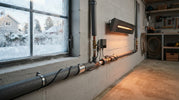
Infrared heating and frost protection: the ultimate buying guide for 2026
, by Warmteshop, 15 min read
, by Warmteshop, 15 min read
Continuously heating a pipe or outbuilding electrically to prevent freezing is the most expensive mistake you can make this winter. With a well-thought-out combination of self-regulating trace heating and infrared heating …
Continuously heating a pipe or outbuilding electrically to prevent freezing is the most expensive mistake you can make this winter. After all, with a well-thought-out combination of self-regulating trace heating and infrared heating frost protection, you are not opting for constant energy waste, but for targeted protection that only switches on when the mercury truly approaches freezing point.
Every homeowner shares the same concern: the fear of a sudden burst water pipe resulting in thousands of euros in water damage, coupled with the frustration of traditional heaters guzzling electricity day and night. No one wants to pay needlessly for heat that dissipates into a drafty garage or crawl space.
In this buying guide for 2026, you will discover exactly how to keep pipes and rooms frost-free cost-effectively using self-regulating anti-freeze cables and infrared technology, entirely without complicated external thermostats.
We walk you step by step through the right cable types, required lengths, and smart sizing, so you can withstand the severest frost periods with peace of mind and minimal energy costs.
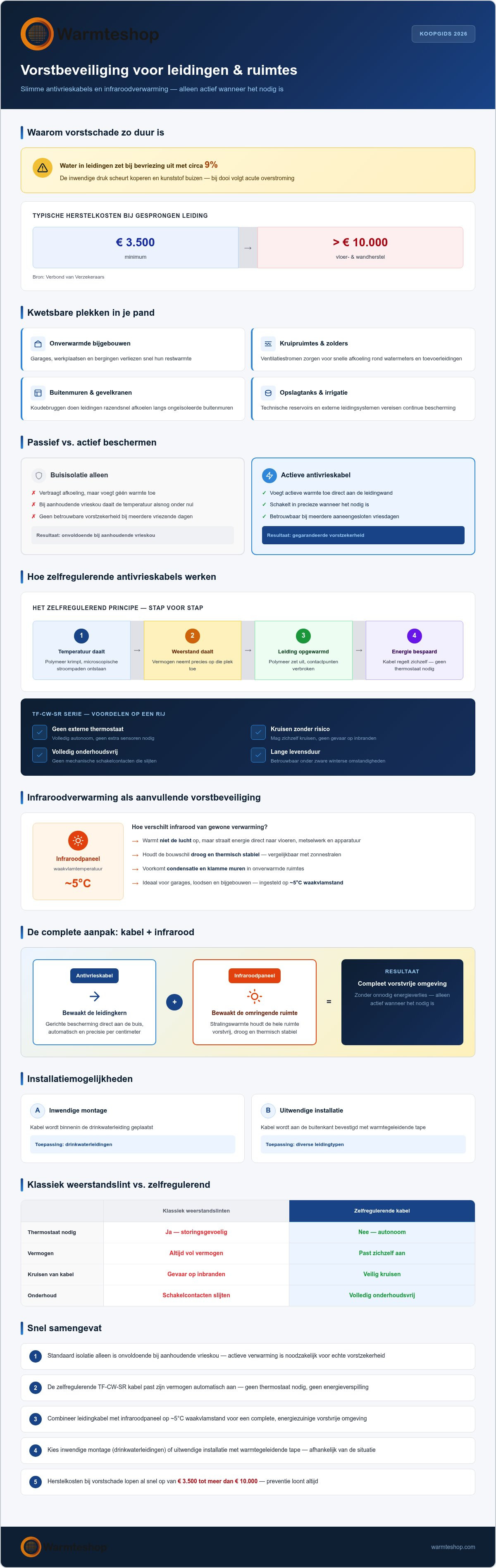
Cold nights pose a creeping risk to unheated parts of a building. Standing water in pipes expands by approximately 9 percent when it freezes. This physical expansion causes enormous internal pressure, leading to copper or plastic pipes bursting. As soon as the thaw sets in, this results in acute flooding with repair costs that, according to the Dutch Association of Insurers, quickly rise from €3,500 to over €10,000 for floor and wall repairs.
Many owners rely blindly on foam or rock wool pipe insulation. Insulation material significantly slows down the cooling process but does not add any active heat itself. During prolonged freezing temperatures lasting several days, the water temperature in a passively insulated pipe eventually drops irrevocably below zero. Reliable frost protection therefore requires active thermal support. The advanced operation of self-regulating heating cables ensures that the pipe wall receives heat immediately as soon as critical limits are reached.
Certain zones are at significantly higher risk during sudden cold waves:
Direct pipe heating with ribbons specifically protects the pipe core. Nevertheless, the surrounding air in an unheated room often remains ice-cold, leading to condensation and damp walls. Here, a well-thought-out setup with infrared heating offers a decisive advantage for larger areas.
Infrared panels do not heat the air, but radiate their energy directly into surrounding solid structures, such as floors, masonry, and technical equipment. Just as sunbeams make a chilly spring day comfortable, this radiant heat keeps the building envelope dry and thermally stable. By setting a compact panel to a pilot temperature of approximately 5°C, you prevent cold drafts in the corners of a warehouse or garage. This combined application of targeted cable protection and infrared heating frost protection results in a completely frost-free environment without unnecessary energy loss.
Traditional heating tapes with a fixed resistance have a major disadvantage: they burn continuously at full power or require interference-prone external sensors. Self-regulating antifreeze cables address this fundamentally differently thanks to a core of conductive polymer with carbon particles. If the temperature drops around a specific part of the cable, the polymer contracts locally. This creates countless microscopic current paths between the two copper conductors, causing the electrical resistance to decrease and the heating power to increase precisely at that spot.
If the pipe warms up again due to sunlight or stagnant indoor water, the material expands and automatically breaks the contact points. The cable effectively acts as an infinite series of autonomous thermostats along its entire length. Consequently, you do not need a separate thermostat for this pipe protection to prevent overheating or energy waste. This dynamic behavior forms the ideal complement to infrared heating frost protection, where the cable monitors the pipe core while radiant panels keep the surrounding space frost-free.
The advanced TF-CW-SR series distinguishes itself through exceptional reliability under severe winter conditions. Because the power output varies per centimeter, this cable can cross itself without the risk of burning; a fault that immediately leads to defects in traditional resistance cables. The system is completely maintenance-free and has a long service life because no mechanical switching contacts wear out. Those looking for smart combinations of pipe and space heating will find valuable insights through independent advice on infrared panels regarding how targeted infrared radiation efficiently protects drafty areas
The robust outer jacket of the TF-CW-SR collection offers a high protection class against chemical substances, rodents, and moisture. Thanks to special certifications, the material has been found to be completely inert and safe for both external mounting and direct insertion into drinking water pipes. This makes the system versatile:
Do you want to optimally prepare your building for freezing temperatures? Discover the full range of the TF-CW-SR collection at Warmteshop for a sustainable, custom-made installation.
Selecting the right protection system begins with a thorough inventory of your piping route. Accurately measure the total length of the vulnerable pipes in advance and check the pipe diameter. While larger industrial pipes sometimes require spiral winding, for standard water pipes, straight installation along the bottom of the pipe suffices. Additionally, verify whether there is a grounded power point nearby. After all, a connection via a 30 mA RCD guarantees safe operation in accordance with NEN standards. By tailoring this accordingly, the cable, together with infrared heating frost protection, forms an impenetrable defense against the winter cold.
The installation method depends heavily on the accessibility of the pipes:
Always take the pipe material into account. Metal pipes such as copper or galvanized steel conduct heat directly around the circumference. Are you working with plastic pipes such as Tyleen, PVC, or Alu-Pex? Then first carefully wrap the pipe in aluminum tape. This intermediate layer ensures homogeneous thermal conduction over the entire pipe circumference, preventing local thermal bridges from forming.
Each project requires a specific length to avoid unnecessary loops or cable shortages. For insulated outdoor taps and short branches to a drinking trough, compact cables of 1 to 4 meters suffice. For longer supply lines in barns, holiday homes, and utility buildings, lengths up to tens of meters are available that function reliably without complex couplings.
Discover all available lengths in the TF-CW-SR range of self-regulating anti-freeze cables to immediately and effectively protect your pipeline network.
Professional installation forms the foundation for reliable frost protection. Before installing the cable, thoroughly clean the pipe, ensuring it is dry and free of grease. Carefully remove any burrs or sharp edges at connections so that the protective sheath remains intact. Then, secure the cable tightly along the length of the pipe using heat-resistant aluminium tape. Never use standard PVC tape or tightly fastened cable ties for this purpose, as these can cut into the pipe over time.
Next, immediately apply a moisture-resistant insulation jacket over the pipe and cable, such as dimensionally stable PE foam or synthetic rubber. Without this insulation layer, the generated heat dissipates directly into the cold air. Finally, plug the connector into a grounded outlet to activate the power supply.
When negotiating bends, allow for a generous bending radius and never kink the cable forcefully. For thicker fittings such as ball valves or water meters, wrap slightly more cable length around the metal housing, as these components dissipate heat to the surroundings more quickly. If you opt for internal mounting, always use a special T-piece with a pressure-resistant drinking water connection and tighten the conical seal hand-tight to prevent leaks.
Although the self-regulating cable functions independently, you can connect the system to a wireless thermostat. This is particularly practical when you connect pipe protection in parallel with an infrared heating frost protection panel in the same room.
Thanks to the absence of moving parts, the technology is virtually maintenance-free after installation. Perform a quick inspection in early autumn:
Do you want to be sure that your installation fully complies with safety requirements? Ask Warmteshop for advice on a tailor-made security plan for your premises.
Well-thought-out winter protection requires more than isolated interventions after the fact. As part of the Infrared Heating Group, Warmteshop combines specialist knowledge of pipe protection with high-quality infrared technology. This allows you to transform vulnerable, chilly zones into stable, energy-efficient spaces. Whether it concerns a private holiday home or a complex commercial building, a targeted approach prevents unpleasant surprises as soon as the freezing cold strikes.
Personal advice makes all the difference here. In our nationwide showrooms, you can experience for yourself how comfortable radiant heat feels and examine the technical structure of the range up close. Our advisors calculate exactly what capacity your situation requires, ensuring you never purchase oversized systems. This expertise guarantees that your investment in infrared heating frost protection seamlessly integrates with the building's pipework and thermal envelope.
Frost prevention extends beyond just the crawl space or outdoor tap. In large industrial halls or workshops, our powerful industrial air heaters the workspace operational and frost-free. Indoors, you want to keep damp cold out of sanitary facilities. With a stylish towel radiator , you maintain a pleasant indoor climate and dry towels, while effectively preventing the freezing of drain and supply pipes. For in-depth insights into bathroom comfort, read our comprehensive guide on electric bathroom heating.
Waiting until the mercury drops below zero increases the risk of acute stock shortages and unnecessary damage. With a wide selection of 13 specific versions within the TF-CW-SR collection, you will find a suitable plug-and-play solution for every pipe length. Support is available both online and via our expert showroom teams to ensure a smooth commissioning.
Protect your pipes preventively against frost and frost damage today. Discover all options and easily order the anti-freeze cables at Warmteshop.
Protecting pipes against winter frost no longer requires guesswork or sky-high electricity bills. By choosing a well-thought-out setup with infrared heating frost protection and advanced trace heating, you protect your property in a targeted and sustainable way. With 13 different lengths, the TF-CW-SR collection offers the perfect fit for every project, from a compact outdoor tap to an extensive piping system.
Thanks to its self-regulating capability, the cable heats purely in the areas where the pipe temperature drops. This significantly reduces energy costs and completely eliminates overheating. Furthermore, the strict drinking water certification guarantees that your tap water remains pure and safe, whether installed internally or externally. This allows you to enjoy the same reliable, even protection as the sun effortlessly warms up a cold winter day.
Don't let freezing temperatures catch you off guard with burst pipes and costly water damage. View all TF-CW-SR self-regulating anti-freeze cables at Warmteshop and switch to worry-free pipe safety today.
A self-regulating cable consumes an average of between 10 and 16 watts per linear meter in freezing temperatures. Because the conductive polymer core continuously adjusts the power to the local pipe temperature, power consumption drops automatically as soon as the pipe warms up. At mild temperatures, the cable switches back almost completely. As a result, you never pay for unnecessary heat, making this technology significantly more energy-efficient than outdated heating tapes with a fixed wattage.
Yes, self-regulating trace heating can technically be cut to size without affecting the heat output per meter. However, shortening requires professional finishing using a certified end and connection set to prevent moisture ingress. For maximum ease of installation, Warmteshop supplies the TF-CW-SR collection as standard in 13 ready-to-use lengths with molded plugs. This allows you to install immediately, safely, and worry-free without having to cut or solder yourself.
Yes, self-regulating antifreeze cables are ideally suited for plastic pipes such as Tyleen, PVC, or Alu-Pex. Because the system thermally limits itself, the pipe wall can never melt or overheat. However, it is necessary to wrap plastic pipes with heat-conducting aluminium tape beforehand. This metal layer ensures even heat distribution across the entire circumference of the pipe, reliably keeping the stagnant water inside liquid.
No, you do not need a separate thermostat for the wiring itself. The built-in polymer technology reacts entirely independently to the cold and automatically controls the power. However, if you opt for a combination with infrared heating frost protection to keep the entire garage or storage room above zero, then a wireless thermostat is practical. With this, the infrared panels switch on precisely when the general room temperature drops below 5°C.
Yes, the TF-CW-SR series is fully approved for internal installation in drinking water systems. The high-quality outer jacket is chemically neutral and does not affect water quality or taste. Using a special pressure-resistant gland, you feed the cable into the pipe watertight. This method is ideal when pipes have already been cast in concrete or are located behind finished false walls that are inaccessible from the outside.
In the event of a power outage, the heating switches off temporarily, but a solid layer of pipe insulation significantly slows down the cooling of the water. As a result, short interruptions rarely cause problems. As soon as the power returns, the self-regulating system immediately starts at full power to quickly bring the piping system back to a safe temperature. For unmanned premises, you can add a smart Wi-Fi module that sends an instant notification to your phone. Should a prolonged outage during extreme freezing temperatures unexpectedly lead to a pipe burst, prompt assistance from a professional is required; read more about how a 24/7 emergency plumber like SOS Plombiers handles acute leaks and piping problems.
A high-quality self-regulating cable has an expected lifespan of 15 to 20 years. Since there are no mechanical contact points or bimetallic switches in the cable, physical wear is minimal. Furthermore, the sturdy protective sheath is resistant to moisture, pressure, and acids. In combination with infrared heating frost protection, this provides robust, maintenance-free protection that performs reliably for decades during severe frost.
Certainly, the high protection class and robust construction make these cables extremely suitable for agricultural applications, stables, and riding arenas. They ensure that supply lines to automatic drinking troughs and irrigation systems remain open, which is essential for the health of the livestock. By mounting the cable securely under insulation or routing it through a protective conduit, the system remains completely safe from curious animals and rodents.


