

Heating the production hall in 2026: The complete guide to efficient hall heating
, by Warmteshop, 17 min read
, by Warmteshop, 17 min read
Why would you continue paying to heat the top three meters of your roof structure when your team on the factory floor needs direct heat? Many industrial entrepreneurs find that their current sys…
Why continue paying to heat the top three meters of your roof structure when your team on the factory floor needs direct heat? Many industrial entrepreneurs find that their current systems fall short, and the search for a truly efficient production hall heating solution often leads to outdated techniques that primarily move dust around and unnecessarily drive up energy bills. It is a fact that conventional hot air blowers lose up to 40 percent of their generated energy to unused air masses at the top of the hall. This not only creates an uncomfortable working environment but also hinders your ambitions to operate profitably and future-proof.
You likely also feel the pressure to make your business operations more sustainable, as the strict climate targets for 2026 fast approach. In this comprehensive guide, you will discover how switching to targeted infrared technology allows you to make the transition from heating air to heating people and objects, similar to the natural radiant heat of the sun. We show you how this smart upgrade lowers your operational costs and creates a healthy, draft-free working environment for your staff. Learn how to transform your production hall today into a sustainable and comfortable flagship ready for the demands of tomorrow.
In 2026, many entrepreneurs face a major challenge regarding the heating of production halls. Traditional gas-fired air heaters have been the standard for decades, but their shortcomings are becoming increasingly apparent as energy requirements become stricter. The biggest problem is simply physics. Warm air has a lower density than cold air, causing it to rise directly to the roof. In an average 10-meter-high production hall, precious heat is often located in areas where no one is working. This results in enormous energy waste, where 90% of the unused volume is heated while the work floor remains cold.
When a hall reaches a height of 10 meters, a phenomenon known as thermal layering or stratification occurs. In traditional systems, the temperature difference between the floor and the ceiling can reach as much as 2 degrees Celsius per meter of height. This means that it can be 30 degrees at the ceiling, while the workers below are freezing at 10 degrees. The physics of infrared teaches us that radiant heat heats objects directly without using the intervening air. This is essential for efficient heating of production halls, because traditional air heaters unintentionally use the roof panel as a radiator for the outside air instead of serving the work floor.
Air movement by convection often causes complaints about drafts, which, according to occupational health and safety studies, leads to an average increase in absenteeism of 15% during the winter months. Moreover, a constant airflow moves dust and particulate matter throughout the entire space. For the precision industry, where machines are sensitive to contamination, this is a critical disadvantage. The ideal working climate follows the principle of "warm feet, cool head." Traditional systems do exactly the opposite. In addition to comfort, there are the hidden costs. Central gas-fired systems require annual inspections and maintenance of burners and filters, which unnecessarily drives up operating costs.
Companies looking to reduce their ecological footprint are taking a critical look at these outdated technologies. The transition to a green production environment requires systems that heat not only the air, but also people and materials. It is a smart upgrade that directly impacts productivity. The days of unnecessarily heating the roof are behind us. For those seeking specific solutions, modern industrial air heaters based on radiant technology offer a solution that is kind to both the wallet and the planet.
Infrared radiation works fundamentally differently from the traditional air heating that many production halls relied on for decades. Whereas old systems first have to heat tens of thousands of cubic meters of air before an employee experiences comfort, infrared focuses directly on the mass. The radiation travels at the speed of light and is only converted into heat once it strikes an object, floor, or person. For efficient heating of production halls in 2026, this principle is the key to a lower energy bill.
You can best compare this process to the sun on a clear winter day. Even though the outside temperature is around freezing, the direct radiation feels pleasantly warm on your skin. However, as soon as you step into the shade, you feel the actual cold of the air. Infrared panels and heaters apply this natural mechanism in industry. The floor and the machinery present absorb the radiation and act as a thermal battery. These objects then slowly radiate the heat back into the surroundings, resulting in a stable climate without drafts. When installing such systems, it is essential to comply with the applicable safety regulations for industrial infrared heating to guarantee an optimal and safe working environment.
The choice between different wavelengths determines the success of your heating strategy. Bright radiators (short wave) are ideally suited for areas with significant drafts or ceilings higher than 6 meters. This radiation is more powerful and less sensitive to air movement. For constant base heat in well-insulated areas, dark radiators (long wave) are often the better choice. These do not emit visible light and ensure an even heat distribution that is ideal for prolonged shifts. Selecting the correct wavelength can improve the efficiency of a heating production hall by as much as 15% compared to an incorrectly sized system.
One of the biggest advantages of infrared technology is speed. Traditional hot air heaters often need to be switched on hours before the start of the workday. A modern infrared system reaches 100% of its thermal output within 5 to 10 minutes. This completely eliminates unnecessary preheating times. In practice, we see that companies reduce their operational energy costs by 20% to 50% as a result. Thanks to smart sensors, heating only takes place where and when needed, which fits perfectly within the 2026 sustainability goals. Would you like to know which configuration is most efficient for your specific space? Then take a look at our infrared heating for tailored advice.
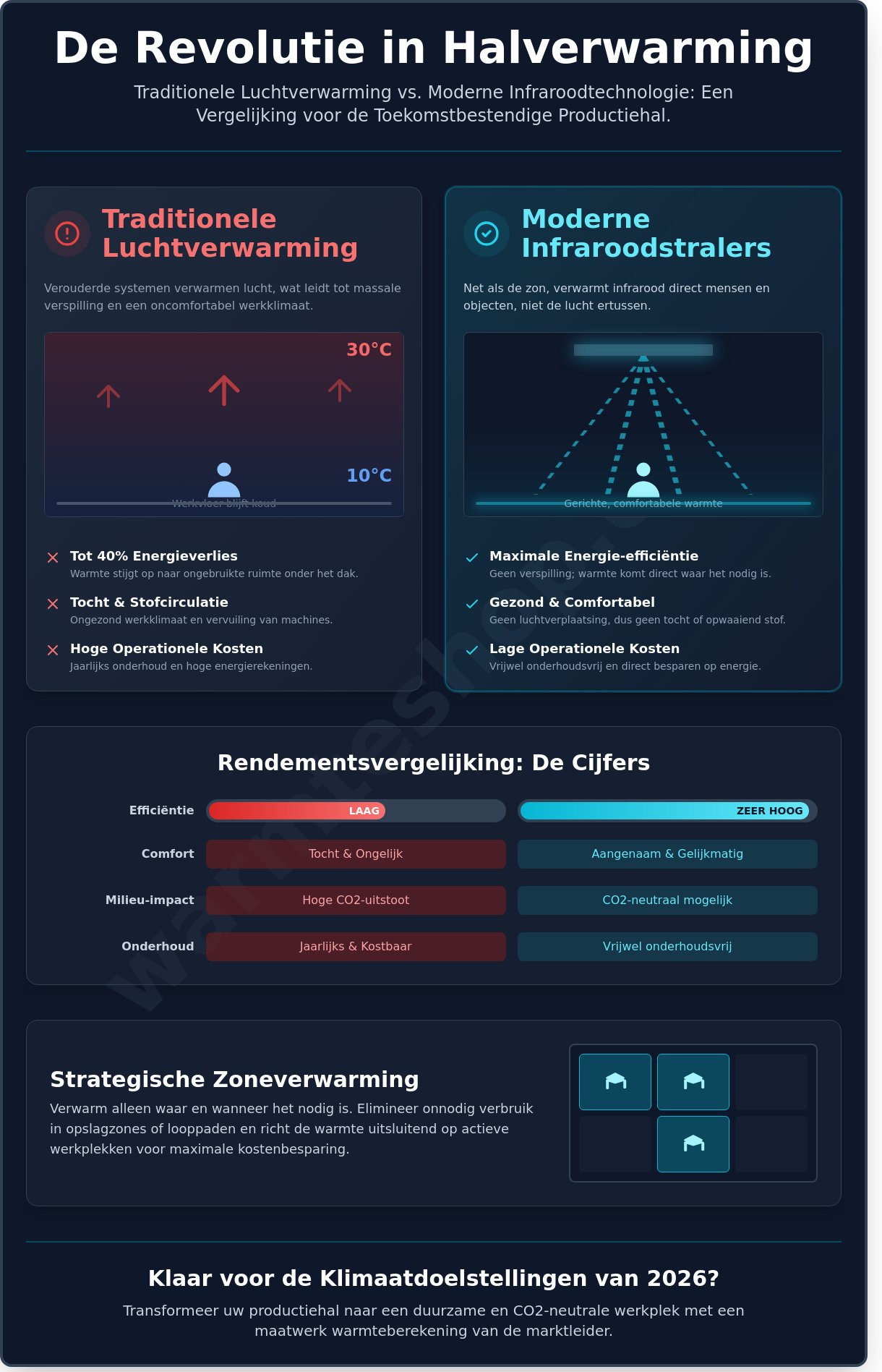
Efficient heating of production halls does not start with the hardware, but with a well-thought-out plan that reflects the reality of the workplace. In 2026, haphazardly heating an entire hall will be financially irresponsible and ecologically outdated. By heating specifically where your employees are actually active, you reduce energy costs without compromising on comfort.
Zone heating works on the principle of the sun; it heats objects and people directly, not the air in between. This means you create a pleasant working environment in the packing department, while the air three meters away in the warehouse remains cool. Sensors and timers play a crucial role in this. They prevent the heating from running at full power during breaks or on weekends. Optimize your consumption with our advanced thermostats for precise control per individual zone.
Ceiling mounting offers the most efficient utilization of your floor space. It keeps walkways and storage space clear for logistical movements. Mounting to existing trusses or cable trays ensures minimal disruption to your ongoing production process. Furthermore, infrared panels have a major technical advantage: they contain no moving parts, filters, or pumps. As a result, the systems are virtually maintenance-free. This saves you up to 15% annually on operational costs compared to traditional gas-fired air heaters, which require periodic inspections and intensive cleaning.
Do you want a heating plan that seamlessly aligns with your logistics flow? Discover our industrial solutions and let our experts advise you.
Since 2008, the Infrarood Verwarming Groep has served as the driving force behind the sustainability of large commercial spaces in the Benelux. As a market leader, we have not only followed the transition from traditional gas heaters to electric radiant heat but have actively shaped it. Our expertise is rooted in years of data collection and practical experience in a wide variety of industrial environments. For entrepreneurs striving for the highest standards in production hall heating, we offer systems that meet the strictest European efficiency standards.
There is no standard solution in the industry. Every production hall has unique variables, such as ceiling heights of up to 15 meters, the presence of overhead doors, and specific insulation values. Therefore, our engineers always perform a custom heat calculation. In doing so, we look not only at the volume of the hall but specifically at the work zones where the heat demand is greatest. This results in a detailed layout plan that eliminates unnecessary energy consumption in unused corners of the hall.
We build trust through transparency. In our 30 physical showrooms spread across the Benelux, business decision-makers can experience the unique radiant heat for themselves. It is the most direct way to understand how our technology mimics the sun by heating objects and people instead of the air. After the consultation phase, our own installation team takes over. They handle the full implementation nationwide, always prioritizing the continuity of your production process.
Our approach is designed to eliminate every risk for the customer. This starts with an initial on-site scan and continues through to full aftercare following installation. We supply not just hardware, but a guarantee of performance. Companies switching to our systems often realize a reduction in energy consumption of 30% to as much as 50% compared to conventional air heaters. Curious about the possibilities for your specific location? Discover our full range of infrared heating for commercial use and see how we transform the workplace.
Choosing Warmteshop means choosing a partner that leads the technological race. We offer direct access to the latest generation of industrial heaters specifically developed for the harsh conditions of a production environment. Our role goes beyond sales; we are a guide in the energy transition. Together, we are working towards a CO2-free production environment that is ready for the legislation of 2026 and beyond. Our systems integrate seamlessly with solar panel installations, making the step towards an energy-neutral heating production hall a feasible reality for every ambitious entrepreneur.
The transition to a sustainable working environment in 2026 requires smart choices that go beyond traditional methods. Infrared heaters offer the solution by heating the space using the natural power of the sun. This limits energy loss to an absolute minimum. With strategic zone heating, you create an optimal working climate without unnecessary costs. Warmteshop has been the market leader in the Benelux since 2008 and supports entrepreneurs with these complex energy issues. Our expertise is readily available in more than 30 physical showrooms where you can experience the technology personally. For high-quality heating of production halls, we exclusively employ certified installers for industrial projects. This guarantees a system that not only performs well today but also meets the stricter environmental standards of tomorrow. Trust our years of experience for a healthy and efficient heat source.
Request a free heat calculation for your production hall now and discover immediately how to lower your energy costs. Together, we are building a workplace that is ready for the future.
With infrared heating, you save 30% to 50% on your energy costs compared to traditional air heating. This saving is achieved because radiant heat directly warms objects and people without using the air as a transport medium. In a large space, this prevents warm air from rising unnecessarily to the ceiling and being lost there. This targeted approach makes the heating production hall extremely efficient and reduces your CO2 emissions right from the first day.
Infrared heaters are safe for industrial environments provided you strictly maintain the minimum safety distance of 50 to 100 centimeters from combustible objects. For zones with a specific fire hazard, we recommend heaters with a lower surface temperature or official ATEX certification. Our experts calculate the exact positioning so that the installation complies with the strictest safety standards of 2024. You enjoy healthy warmth that feels just as natural as the safe rays of the sun.
You can perfectly combine infrared heating with an existing air heating system to create a hybrid solution. In this setup, the air heating provides a base temperature while the infrared heaters provide targeted supplementary heating to specific work zones. This increases comfort for your staff in drafty locations without causing energy costs for the entire hall to skyrocket. It offers a flexible way to upgrade your current system to the sustainable standards of the near future.
Industrial infrared heaters can be effectively mounted at heights ranging from 3 to as much as 18 meters above the floor. The maximum suspension height depends on the wattage; a powerful 4000-watt unit effortlessly reaches the work floor from a considerable height. By using special reflectors, we focus the heat so that no energy is lost at the ridge of the building. A precise installation plan guarantees that the heat distribution on the work floor remains constant.
The average payback period for an industrial infrared installation is 2 to 5 years. This rapid return on investment is achieved through the combination of low installation costs and a structural reduction in energy consumption of at least 30 percent. Because the system has no moving parts, you eliminate the annual maintenance costs that are necessary with traditional systems. The investment immediately increases the value of your business premises and improves productivity through a healthy working environment.
Infrared heaters have no negative impact whatsoever on the operation of your machines or sensitive electronics. The radiation operates using long waves that do not cause electromagnetic interference to computer-controlled systems on the factory floor. The dry heat actually helps prevent condensation on metal components, which benefits the lifespan of your equipment. It is a reliable solution for heating production halls that does not disrupt technical processes in any way.
Generally, no specific building permit is required for the installation of electric hall heating. However, you must check whether your current grid connection offers sufficient capacity, as switching often requires an upgrade to 3x80A or more. We recommend always notifying your insurer of the installation to confirm that everything complies with current NEN standards. Our advisors provide all the technical specifications necessary for the smooth handling of your internal safety protocols.


