

Heating for renovation in 2026: The complete guide to a gas-free future
, by Warmteshop, 18 min read
, by Warmteshop, 18 min read
What if the road to a gas-free home in 2026 doesn't start with breaking up your floors or an investment of at least 12,000 euros in a traditional heat pump? Many homeowners dread the dust cloud and d…
What if the road to a gas-free home in 2026 doesn't start with breaking up your floors or an investment of at least €12,000 in a traditional heat pump? Many homeowners dread the dust cloud and the technical complexity involved in a major renovation. You want an energy-efficient home with a favorable EPC label. The right choice of heating for a renovation determines not only your future energy bill but also your daily living comfort.
In this comprehensive guide, you will discover how to heat your home efficiently and stylishly without disrupting pipes or radiators. We show you how modern infrared technology mimics the natural warmth of the sun for a healthy indoor climate. You will learn exactly which steps are required for a quick installation that reduces your maintenance costs by an average of 30 percent. We dive into the world of smart thermostats and aesthetic solutions that blend seamlessly into your renovated interior.
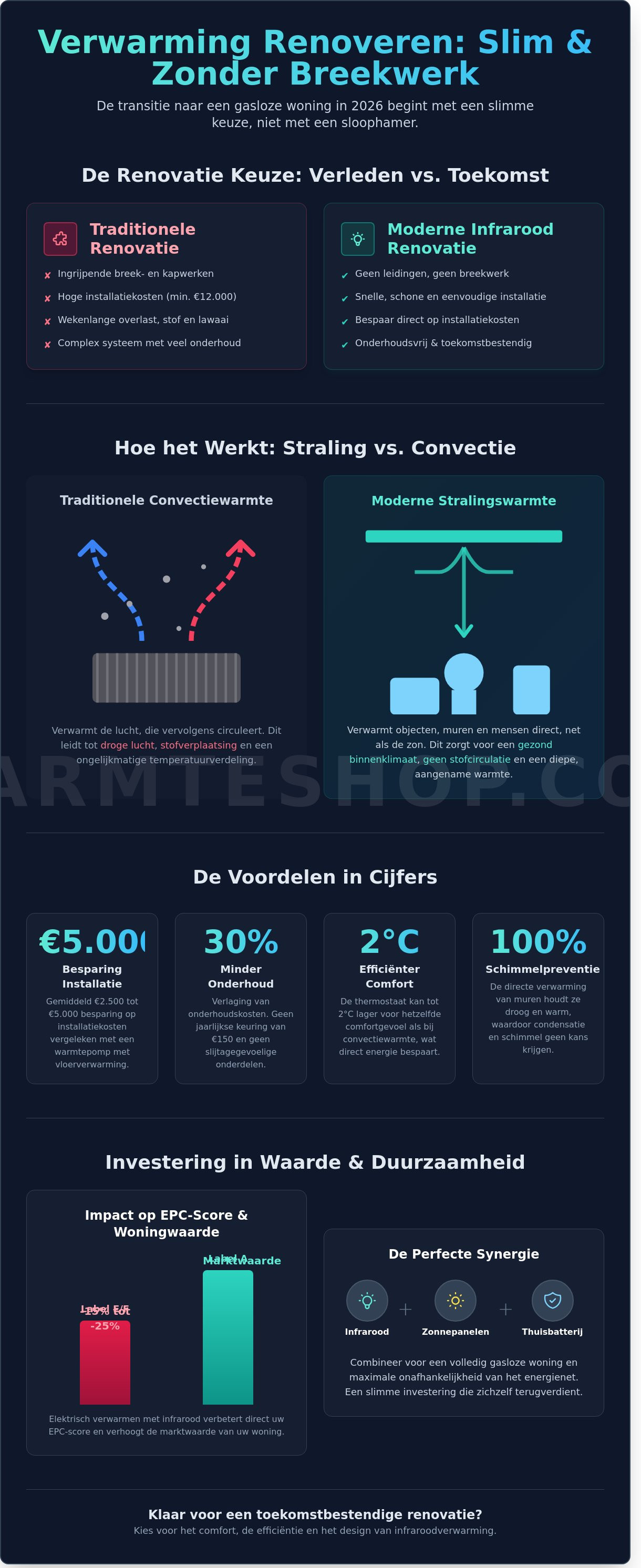
A thorough renovation in 2026 is about more than just aesthetics. The energy performance of your home currently directly determines its market value. Homes with an EPC label E or F sell for an average of 15 to 25 percent less in the current market than comparable homes with an A label. Simply keeping your old gas boiler is therefore a costly mistake. The right heating system for renovation forms the core of a future-proof and value-retaining home.
Such a project is often part of a larger plan. For a complete overview of the entire process, you can explore moving here: purchasing a new home, selling your current home, arranging a mortgage, and the move.
Traditional radiators operate on the basis of air circulation. In a modern, well-insulated home, this often results in an unpleasant indoor climate with dry air and dust circulation. When looking at the various types of heating systems, it is striking that the transition to radiant heat is becoming the new standard. Instead of heating the air, radiation directly heats the objects and people in the room. This feels like the natural warmth of the sun on a crisp spring day. It is healthier, more efficient, and prepares you for the definitive end of the fossil fuel era.
Insulation and heating are inextricably linked. An improved building envelope often reduces a room's heat demand by more than 60 percent. As a result, old, oversized systems constantly cycle on and off. This leads to an unnecessary loss of efficiency of at least 30 percent. A powerful synergy is created when you combine high-efficiency glass with infrared heating. The panels do not have to work as hard, while the radiation no longer escapes through cold window surfaces.
The renovation obligation that started in 2023 forces buyers to bring their homes to at least label D within five years. However, by 2026, the ambitions for new owners are even higher. Installing electric heating coupled with solar panels is a smart move to immediately improve your EPC score. The government makes various grants available for this switch to sustainable heating for renovations . Through instruments such as the Mijn VerbouwPremie, you can recover substantial amounts, provided the installation meets current efficiency standards.
Infrared technology is a revolution for anyone seeking efficient heating for renovation. Instead of heating the air, as with traditional radiators, infrared works with direct radiant heat. You can compare this to the healthy feeling of the sun on your skin during a clear winter day; the air remains cool, but you feel a deep, pleasant warmth. Because you do not need to lay pipes or break open floors during installation, you save an average of 2,500 to 5,000 euros in installation costs compared to a heat pump running on underfloor heating.
With this technology, you simply switch from a bulky central system to a smart, decentralized network. Each panel functions independently and is connected directly to the power grid. This makes the transition to a gas-free future in 2026 feasible without your home turning into a construction site for weeks. It is a future-oriented solution that perfectly aligns with modern requirements for living comfort and aesthetics.
The technology focuses on heating the thermal mass in a room: the walls, the floor, and the furniture. These objects store heat and gradually release it back into the environment. This allows you to set the thermostat up to 2 degrees Celsius lower while experiencing exactly the same comfort as with 21 degrees of convection heating. A crucial advantage in older homes is the prevention of moisture. Because the walls are heated directly, they remain dry and condensation has no chance to form. As a result, the risk of mold formation drops by nearly 100%. For those who want to make the move towards sustainability financially smart, it is advisable to look into the Investment Subsidy for Sustainable Energy and Energy Saving (ISDE) for additional insulation measures that further increase the efficiency of your panels.
Traditional systems require annual inspections costing approximately 150 euros and feature wear-prone parts such as pumps and burners. Infrared panels are completely maintenance-free; there are no moving parts that can malfunction. The response speed is another strong point of this heating solution for renovation. While a classic radiator often takes 20 to 30 minutes to bring a room up to temperature, you feel the radiation from a panel within just 5 to 8 minutes of switching it on. Moreover, you reclaim valuable space. An infrared panel is often only 2 centimeters thick and can be easily mounted to the ceiling, meaning you no longer have to take large radiators into account when placing your furniture.
Curious about the power required by your specific rooms? Then take a look at our extensive collection of infrared heating for a solution tailored to your renovation project.
When choosing a new heating system for a renovation, many homeowners immediately look at the heat pump. However, the initial investment for a hybrid or full heat pump often ranges between €8,000 and €15,000. Infrared panels offer a financially attractive alternative here; for an average home, the investment typically amounts to between €5,000 and €9,000. Because no demolition work is required for pipes or radiators, you save immediately on installation costs.
Although the initial costs for a heat pump are higher, it is an extremely efficient technology that is considered for many renovations. Specialized companies offer solutions in this area; for example, one can visit vesinimas.lt.
The lifespan of infrared technology is a decisive factor for overall efficiency. While a gas boiler is due for replacement after 15 years, high-quality panels last up to 30 years without any loss of power. There are no moving parts, which means that annual maintenance costs averaging €150 to €200 are completely eliminated. This makes the total cost of ownership over the entire lifespan very competitive.
In 2026, the combination of solar panels and a home battery will be essential for a low energy bill. Infrared converts electricity into heat almost 100%. By storing electricity generated during the day in a battery, you heat your home in the evening with your own green energy. Zone heating reinforces this effect; you only heat the rooms where you are actually staying. This results in a 25% saving on total energy consumption compared to central systems that keep the entire house unnecessarily warm.
Determining the correct wattage prevents panels from having to run at full power constantly. For standard renovation heating , we use a rule of thumb of 75 Watts per square meter for a well-insulated room with a ceiling height of 2.5 meters. In older homes with less insulation or large glass surfaces, this can rise to 100 Watts per square meter. A detailed heat loss calculation by a specialist is essential to prevent undercapacity and to get the highest efficiency from your installation.
Maximum efficiency is only achieved with intelligent control. By using advanced thermostats , you create smart schedules that automatically lower the temperature as soon as you leave the room. Presence sensors detect activity and switch the panels on instantly, similar to the direct heat of the sun breaking through the clouds. Integration with smart home systems provides real-time insight into your consumption, allowing you to immediately adjust your heating behavior to current energy rates.
A well-thought-out heating system for renovation requires a strategic approach that goes beyond simply replacing a boiler. Infrared technology offers the unique opportunity to integrate heat directly into the structure of your home. This step-by-step plan helps you make the right choices for a future-proof result.
In the bathroom, infrared transforms the space into a wellness sanctuary. An infrared mirror is the smartest choice here; the radiation heats the glass, preventing condensation. You have an instantly clear view after showering. For extra luxury, choose a towel radiator that not only heats the room but also keeps your towels dry and soft. Safety comes first, so always choose panels with an IP44 rating for installation in zone 2 of your bathroom.
Heating no longer needs to be hidden behind a casing. Photo panels with high-resolution prints turn your heating into a personal work of art. In the kitchen, chalkboard panels are popular for jotting down recipes or shopping lists. For those who love a minimalist look, ceiling heating is the solution; the panels blend invisibly into the plasterwork. The radiant heat feels like the natural warmth of the sun, ensuring a healthy indoor climate without air or dust circulation. Custom solutions ensure that every panel matches the color scheme of your new interior exactly.
Would you like to know exactly what capacity your renovation project requires? Request a no-obligation consultation with Warmteshop immediately for a customized calculation.
Choosing the right heating for your renovation determines your living comfort and energy bill for the next thirty years. Since 2008, Warmteshop has served as the driving force behind the energy transition in the Benelux. As an essential part of the Infrared Heating Group, we possess over 15 years of specific expertise in radiant technology. We do not supply standard solutions, but rather systems of high-quality European production specifically designed for sustainability and aesthetics. Our panels come with extensive warranties that underscore the reliability of your investment.
Our approach is based on providing a worry-free experience. This starts with a detailed heat loss calculation per room, ensuring you never overconsume but always enjoy an optimal temperature. From initial technical advice to professional installation by our own certified technicians, we manage the entire process. This prevents surprises during your renovation and guarantees a system that seamlessly integrates with your current or new electrical infrastructure.
Infrared radiation is a sensory experience that you must experience for yourself to understand its added value. In our 30 showrooms spread across Belgium and the Netherlands, you can experience the unique "solar heat" firsthand. It is the only way to feel how radiant heat directly warms objects and bodies without unnecessarily moving the air. During a visit, you will gain immediate insight into the latest infrared heating collections. Our advisors will make free on-the-spot calculations based on your building plans or photos of the current situation. You will immediately see which designs, from mirror panels to chalkboard finishes, best match your interior design preferences.
Warmteshop looks beyond today's installation. Our vision focuses on a completely CO2-neutral living environment where your heating system for renovation works perfectly with solar panels and smart thermostats. We help you navigate the maze of regulations and assist with applying for available grants or subsidies in your region. This makes the switch to gas-free living financially attractive and technically simple. A healthy indoor climate without dust circulation is no longer a luxury, but the standard for every modern home.
Are you ready to get your home ready for 2026? Visit a showroom near you today or request a no-obligation quote for advice tailored to your project.
The transition to a sustainable home by 2026 is not an obligation, but an opportunity to take your living comfort to a higher level. By choosing infrared technology, you avoid costly demolition work and immediately enjoy healthy radiant heat that feels like the natural warmth of the sun. Since 2008, Warmteshop has been the specialist in this innovative heating for renovations, seamlessly combining aesthetics and energy efficiency. With more than 30 physical stores in the Benelux, our experts are always ready to guide you through every step of your project.
An efficient heating plan begins with a precise analysis of your living situation. During a no-obligation consultation, we perform a free heat loss calculation for you, ensuring your new system is perfectly tailored to the specific insulation value of your property. This guarantees optimal efficiency and a lower energy bill from day one. Invest in a solution that is good for both the planet and your daily well-being. We look forward to realizing your ideal indoor climate together with you.
Discover our infrared solutions for your renovation
Yes, infrared heating is perfectly suitable as primary heating, provided your home meets the 2023 insulation standards. For efficient operation, a maximum U-value of 0.24 W/m²K is recommended for the exterior walls. This technology does not heat the air, but directly the objects and people in the room. This creates a natural indoor climate comparable to the healthy radiation of the sun. In this way, you achieve future-proof heating for renovation that directly contributes to your daily comfort.
For an average renovated living room, you should expect a power output of 25 to 35 Watts per cubic meter. In a 40-square-meter room with a standard height of 2.5 meters, you therefore need approximately 3,000 Watts of total power. In practice, this often translates to four 750-Watt panels for even heat distribution. Our experts in the physical showrooms calculate the exact requirements based on your specific building plans and insulation values.
You can easily mount infrared panels to the wall or ceiling yourself thanks to the convenient plug-and-play system with a standard plug. For a sleek finish without visible cables, or when installing more than three panels on a single circuit, a certified electrician is necessary. A professional guarantees that your home's electrical load remains balanced. This prevents overloading your fuse box and ensures safe, aesthetic integration into your renovated interior.
The average payback period for infrared panels is between 5 and 10 years, depending on your current energy contract and the level of insulation. Because the initial purchase price is up to 40 percent lower than that of a heat pump, you immediately save significantly on your investment costs. In combination with solar panels, you reduce monthly energy costs to nearly zero euros. This makes it a financially smart choice for any modern renovation heating system striving for a carbon-neutral future.
When switching to fully electric living, upgrading the connection to 3x25 Amperes is usually necessary. A standard single-phase connection often offers insufficient capacity for the simultaneous use of infrared panels, an induction hob, and an electric water heater. The one-time costs for this upgrade from your grid operator amount to approximately 250 to 400 euros. With this, your technical installation is fully ready for a comfortable life without fossil fuels.
In Flanders, there are currently no direct grants for the purchase of infrared panels themselves, but you do benefit from indirect financial support. Through the Mijn VerbouwPremie, you receive up to 50 percent back on the necessary insulation works that make your new heating system more efficient. In addition, the installation of solar panels significantly reduces your total energy bill. Our advisors are happy to help you navigate the complex grant landscape of 2024 for maximum return.
The impact on your EPC score is positive when you combine infrared panels with renewable energy sources such as solar panels. Since the adjustment of the calculation method in 2022, electric heating is assessed more favorably, provided the thermal envelope of the home is properly constructed. A reduction of 10 to 15 points in the E-level is achievable due to the high response speed and precise thermostat control per room. This significantly increases the market value of your property in the event of a sale.
It is perfectly possible to combine infrared panels with your existing radiators as a hybrid solution. You set the central heating to a low base temperature of 15 degrees and use the panels for targeted heat in frequently used rooms. This reduces your total gas consumption in the bathroom or home office by up to 30 percent. It offers a flexible and step-by-step transition to a completely gas-free home without having to replace your entire system immediately.


