

Financing for Sustainable Heating: Your Guide for 2026
, by Warmteshop, 13 min read
, by Warmteshop, 13 min read
What if the transition to sustainable heating costs you less than your current energy bill? 73% of Dutch homeowners believe that financing for sustainable heating is unaffordable, while in 2026 there will be more subsidies…
What if the transition to sustainable heating costs you less than your current energy bill? 73% of Dutch homeowners believe that financing for sustainable heating is unaffordable, even though more subsidies and financing options will be available in 2026 than ever before.
You are not alone in worrying about the initial investment in a heat pump, infrared heating, or other sustainable heating system. The complexity of subsidy applications and uncertainty regarding long-term benefits deter many homeowners from taking the plunge. This uncertainty is understandable, as a wrong financing choice can impact your budget for years to come.
In this comprehensive guide, you will discover exactly which financing options are available for sustainable heating in 2026, how to maximize the benefits of subsidies, and which approach best suits your situation. We lead you step by step through the process, so you can confidently make an informed choice that enhances your living comfort and saves your wallet.
Sustainable heating forms the basis of an energy-efficient home. It encompasses heating systems that operate in an environmentally friendly manner, utilize energy efficiently, and are future-proof. These technologies, such as heat pumps, biomass boilers, and infrared heating, significantly reduce dependence on fossil fuels.
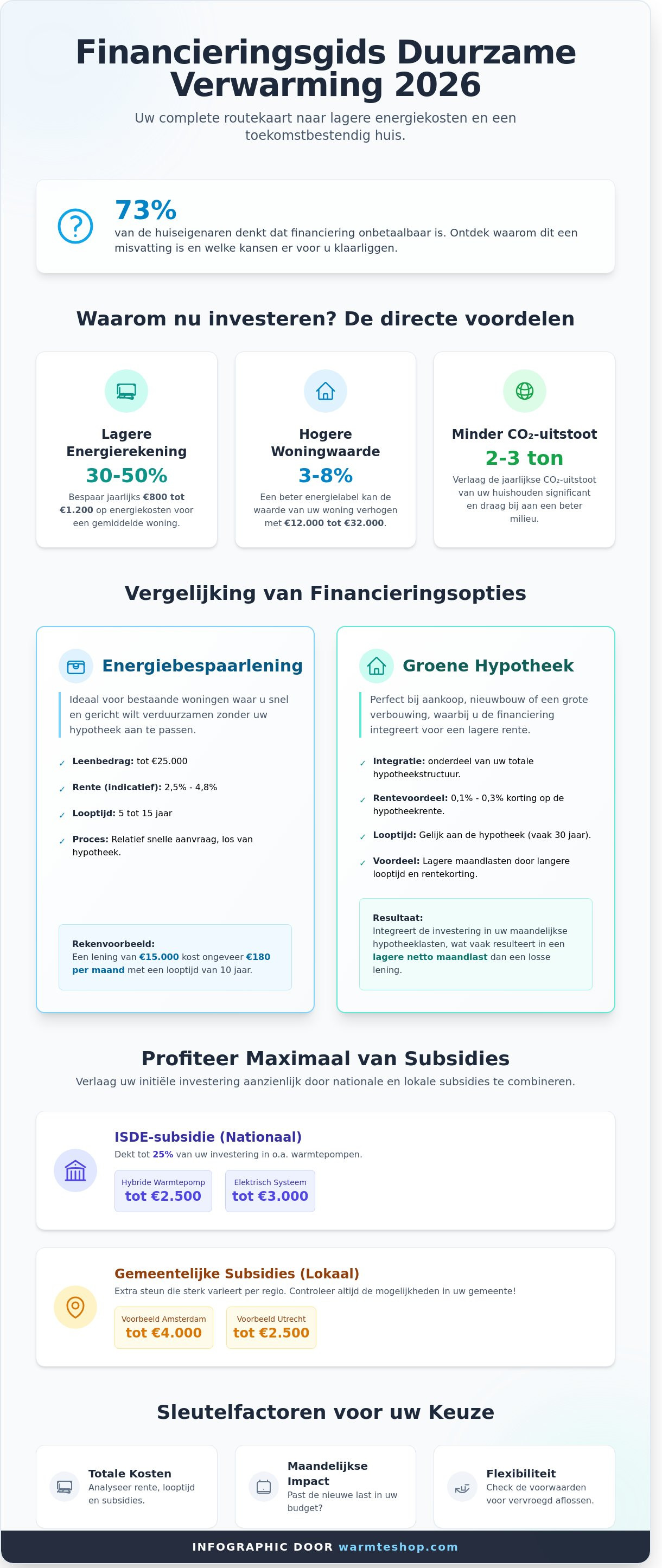
The financial benefits are measurable and immediate. Households with sustainable heating save an average of 30-50% on their energy bills compared to traditional central heating boilers. A modern heat pump can save €800-1,200 annually for an average home of 150 square meters.
Subsidies make the switch even more attractive. The ISDE subsidy offers up to €2,500 for hybrid heat pumps and €3,000 for fully electric systems. This financial support reduces the payback period to 5-7 years.
Future-proofing plays a crucial role. With the planned phase-out of the gas network by 2030 in many neighborhoods, owners are now investing in systems that will last for decades. Financing for sustainable heating is becoming increasingly accessible through green loans with lower interest rates.
Sustainable heating systems reduce energy costs through higher efficiencies. A modern heat pump extracts 4-5 kW of heat from every kW of electricity. This means 75-80% less primary energy consumption than gas heating.
The CO2 reduction is substantial. An average household reduces emissions by 2-3 tonnes of CO2 per year by switching to sustainable heating. Over the lifespan of the system, this means 40-60 tonnes less emissions.
Long-term benefits accumulate. Energy prices are rising structurally, while sustainable systems guarantee stable costs. Owners protect themselves against future price fluctuations of fossil fuels.
Homes with energy label A or B sell 3-8% above market price. Buyers value lower housing costs and future-proofing. An energy-efficient home priced at €400,000 can fetch €12,000-32,000 more upon sale.
Energy labels are increasingly determining market value. From 2030, rental properties may only be rented out with a minimum label C. This forces landlords to invest in sustainable heating.
Consider infrared heating as a sustainable option. These systems provide direct radiant heat, comparable to sunlight, and require minimal maintenance with maximum efficiency.
When making your heating system more sustainable, you can choose from various financing options, each with specific advantages and disadvantages. A good understanding of these possibilities helps you make the best choice for your situation and budget.
The energy saving loan is often the most accessible option for homeowners. This loan offers interest rate benefits between 2.5% and 4.8% (as of January 2024) and covers investments up to €25,000. The repayment period varies from 5 to 15 years, depending on the amount and your financial position.
In addition, the green mortgage offers interesting possibilities, especially for purchases or renovations. This option integrates financing for sustainable heating into your mortgage structure, often at lower interest rates than separate loans. The National Mortgage Guide 2024 shows interest rate benefits of 0.1% to 0.3% for energy-efficient homes.
The energy-saving loan works best for existing homes that you want to make more sustainable quickly. Banks such as ABN AMRO and Rabobank offer these loans without modifying the mortgage. The green mortgage, on the other hand, is perfect for major renovations or new construction, where you combine multiple sustainable investments.
For an average home of 150m², this means in concrete terms: an energy-saving loan of €15,000 costs approximately €180 per month over 10 years. A green mortgage incorporates the same amount with potentially lower monthly payments due to the longer term.
The ISDE subsidy (Investment Subsidy Sustainable Energy) covers up to 25% of your investment costs for heat pumps and other sustainable systems. In 2024, the subsidy for an air-to-water heat pump amounts to €1,200 to €2,100, depending on the capacity.
Municipal subsidies vary significantly by region. Amsterdam, for example, offers up to €4,000 extra for going completely gas-free, while Utrecht focuses on €2,500 for heat pumps. These local schemes often combine well with national subsidies.
When comparing options, consider three key factors: the total costs over the entire period, the monthly impact on your budget, and the flexibility regarding early repayment. Your income, home type, and sustainability plans determine which financing for sustainable heating is the best fit.
Do you want to start with efficient heating immediately? Discover our energy-efficient infrared solutions that combine perfectly with your financing plans.
A successful application for sustainable heating financing begins with careful preparation. Gathering the right documents and information prevents delays and significantly increases your chances of approval. Most applications are processed within 4 to 6 weeks, provided all required documents are complete.
For every financing application, you need specific documents. Start by gathering your most recent energy bill, a copy of your energy label, and quotes from certified installers. Your energy label plays a crucial role in subsidy applications, as many schemes require your home to achieve at least label B after the investment.
Calculate your current energy consumption and expected savings in advance. An average household saves between 30% and 50% on energy costs after switching to sustainable heating. These figures strengthen your application and demonstrate that you are well-informed about the investment.
Essential documents include:
Applying for an Energy Saving Loan is done through your bank or financing company. These loans typically offer an interest rate between 2.5% and 4.5%, depending on your creditworthiness. Start your application online and upload all documents digitally for faster processing.
A specific timetable applies to ISDE grants. Applications are processed in order of receipt, and the budget is often exhausted before the end of the year. Therefore, submit your application before October 1st to avoid disappointment.
Avoid common pitfalls by never starting the installation before your subsidy has been approved. This automatically leads to rejection. Also ensure that your installer is certified according to the applicable quality requirements.
A smart thermostat optimizes your new heating system and can qualify for additional subsidies. View our energy-saving thermostats and increase your chances of full financing for sustainable heating.
Choosing financing for sustainable heating presents challenges. Homeowners frequently make costly mistakes that delay their energy transition or make it more expensive than necessary. These missteps are often the result of haste, insufficient preparation, or underestimating the complexity of the financing landscape.
The most common mistake is insufficient research into available options. Many people automatically choose their main bank without considering alternative forms of financing. Green loans from specialized lenders often offer better terms than traditional personal loans. The National Heat Fund reported in 2024 that 67% of applicants did not compare different financing options.
Grant applications are frequently submitted incompletely. Missing documentation, incorrect calculations, or missed deadlines cost households an average of €2,800 in lost subsidies per project. The ISDE scheme alone saw a rejection rate of 23% in 2024 due to administrative errors.
Thorough research prevents costly mistakes. Reliable sources of information include the websites of the RVO, the Warmtefonds, and recognized energy advisors. Professional advice from an independent energy advisor costs between €300 and €500, but often saves thousands of euros on suboptimal choices. This investment in expertise always pays off.
Common application errors include:
A complete checklist prevents these problems. Check all required documents in advance, request multiple quotes, and submit applications at least six weeks before the planned start.
Repayment options are often estimated too optimistically. Base calculations on realistic energy prices and take maintenance and potential repairs into account. Ignoring the fine print in contracts leads to unpleasant surprises. Pay particular attention to early repayment penalties, variable interest rates, and mandatory insurance.
When choosing a new heating system, it is essential to thoroughly review all aspects. Consider our underfloor heating as an energy-efficient option that aligns perfectly with modern financing options for sustainable heating.
The decision to switch to sustainable heating is just around the corner. Now it comes down to the proper planning and execution of your project. A well-thought-out approach ensures that you benefit optimally from both the technology and the available financing options.
Start with a thorough evaluation of your current energy consumption and heating needs. Analyze your annual gas bill for the past three years and note peak moments in your energy usage. This data forms the basis for determining the optimal system capacity and helps select the most suitable financing for sustainable heating.
Three key factors determine which financing option suits you best. First, your available equity: how much can you invest immediately without compromising your financial stability? Second, your cash flow preferences: do you want lower monthly payments or to pay off the loan faster? Third, your tax situation: can you take full advantage of the ISDE subsidy and VAT benefits?
Always compare the total costs over the entire term, including interest and any penalty interest for early repayment. An energy loan with a 2.8% interest rate can turn out to be more advantageous than a mortgage increase of 4.2%, despite the shorter term.
Plan your installation project outside the heating season, preferably between April and September. This avoids problems with overloaded suppliers and gives you time to resolve any teething issues before winter begins.
Ensure you have a maintenance contract that includes annual inspections. Modern heat pumps achieve their optimal efficiency only with proper maintenance. A well-maintained system retains 95% of its original efficiency after ten years, whereas neglected systems can lose 20% of their performance after just five years.
Consider additional comfort solutions for your outdoor spaces. Visit our patio heater collection for extra comfort during transitional periods when your main heating is not yet active.
Start comparing quotes from at least three recognized installers today. Ask for reference projects and check their certifications for the type of system you are considering. The investment in professional advice and quality installation determines the success of your switch to sustainable heating for the next fifteen to twenty years.
The energy transition offers concrete opportunities to improve your living comfort while saving on energy costs. With the right preparation, you can benefit from subsidies of up to €19,000 for heat pumps and tax advantages that significantly shorten the payback period. Comparing different financing options ensures that you choose the most cost-effective route for your specific situation.
A well-thought-out step-by-step plan prevents costly mistakes and accelerates the approval process of your application. Many homeowners underestimate the importance of energy labels and technical specifications, causing them to miss out on financing for sustainable heating or accept suboptimal terms.
Infrared heating offers a smart interim solution with lower investment costs and immediate energy savings. Discover our infrared heating options and receive expert advice in one of our 30 showrooms. Our durable, long-lasting products make the switch to green energy easier than you think.
Sustainable heating lowers your energy bill by an average of 30-50% per year and increases the value of your home by 5-10%. Modern systems such as infrared heating offer healthier radiant heat comparable to natural sunlight, without air pollution or dust. In addition, you contribute to CO2 reduction and benefit from stable energy costs, independent of gas price fluctuations.
You can apply for an Energy Saving Loan through the Nationaal Warmtefonds or at recognized banks such as ABN AMRO and Rabobank. The application process takes an average of 2-4 weeks and requires an energy label for your home plus quotes from recognized installers. The interest rate ranges between 0.5% and 3.5%, depending on your income and the planned energy-saving measures.
The most important subsidy is the ISDE (Investment Subsidy Sustainable Energy), which offers up to €2,500 for hybrid heat pumps and up to €5,000 for fully electric systems. Municipal subsidies vary by region, with amounts ranging from €500 to €3,000. For financing sustainable heating, you can also make use of the Energy Saving Loan, with favorable interest rates starting from 0.5%.
The ISDE subsidy process takes an average of 6-8 weeks from submission to payment. You must apply for the subsidy before starting the installation; otherwise, your entitlement to the subsidy will lapse. After approval, you have 6 months to complete the project and submit the necessary documents for final payment.
Financing for sustainable heating in holiday homes is only available to a limited extent through commercial loans from banks. The ISDE subsidy and Energy Saving Loan apply only to primary residences in the Netherlands. For holiday homes, you can turn to regular renovation loans with interest rates between 4% and 7%, depending on your financial situation and the value of the property.
Infrared heating has lower installation costs than heat pumps because no pipework is required, but higher operating costs due to electricity prices. An average system for 100m² costs €0.18 per kWh versus €0.06 per kWh for a heat pump. The advantage lies in the direct radiant heat, which warms rooms faster and offers healthier comfort than traditional convection systems.
Companies can make use of the MIA/Vamil scheme, which offers a 36% investment deduction on sustainable heating installations. BNG Bank's Green Projects facility provides loans starting from €250,000 with interest rates between 1.5% and 3%. In addition, the EIA (Energy Investment Deduction) offers a tax benefit of up to 45.5% on investments in recognized energy-efficient equipment, including modern infrared heating systems.


