

Electric supplementary heating for the living room: the complete guide to comfort in 2026
, by Warmteshop, 19 min read
, by Warmteshop, 19 min read
Why would you heat the entire living room to the rafters if you are actually only looking for comfort on the sofa? In 2026, many households are still struggling with high gas bills averaging over 1.28 euros per cubic meter…
Why heat the entire living room to the rafters if you are actually only looking for comfort on the sofa? In 2026, many households will still be struggling with high gas bills averaging over €1.28 per cubic meter, while that one corner by the window remains freezing cold despite the central heating. You probably recognize this: the thermostat is turned up high, but the air feels dry and your feet remain cold. The right electric supplementary heating for the living room offers a smart solution here without having to immediately invest in a full heat pump, which has become a conscious and free choice since the abolition of the obligation.
It is time to say goodbye to bulky heaters that spoil your interior. In this guide, you will discover how to create an oasis of comfort with innovative solutions such as infrared panels while simultaneously lowering your monthly costs through smart zone heating. We dive into the technology behind radiant heat that feels like the natural warmth of the sun. You will learn how modern systems efficiently heat not only the air but also the people and objects in the room, ensuring that every cold corner in the house is a thing of the past.
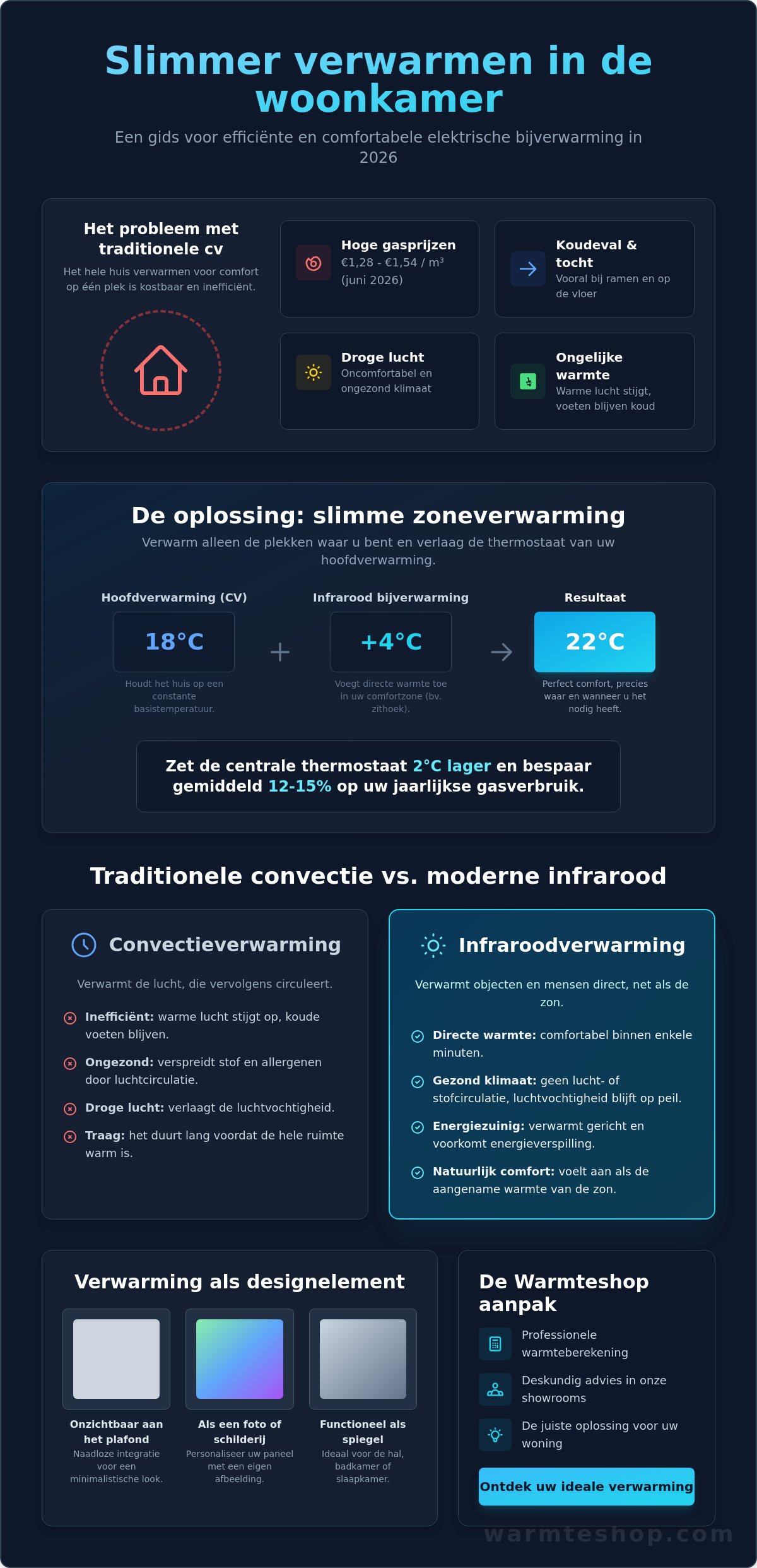
Energy prices in June 2026 paint a clear picture: gas will cost between €1.28 and €1.54 per cubic meter. This forces us to take a critical look at how we heat our homes. A traditional central heating system often heats the entire house, whereas we spend most evenings only in the sitting area. That is a waste of energy and money. By choosing targeted infrared heating as electric supplementary heating for the living room, you create immediate comfort exactly where it is needed at that moment. Instead of waiting for slow radiators to heat up all the air in the room, you experience instant luxury with radiant heat.
There are various types of electric heating, but for the living room, choosing radiant heat is often the most logical option. The concept of zone heating is essential here. You do not heat the entire cubic meters of the room, but instead focus specifically on the areas where you actually spend time. This is comparable to the sun on a cold winter day; even when the air temperature is low, the direct radiation feels wonderfully warm on your skin. For owners of solar panels, this switch is particularly interesting. In 2026, with an electricity price between €0.23 and €0.30 per kWh, it is smart to use your own generated electricity directly for your living comfort.
In a hybrid setup, the central heating lays the foundation by maintaining the home at a constant base temperature of, for example, 18 degrees. The electric supplementary living room heating supplements this to the desired comfort temperature in the seating area. This also prevents the phenomenon of cold drafts. With large windows, the air cools down quickly and sinks to the floor, creating an unpleasant draft along the legs. A strategically placed infrared panel immediately counteracts this effect by heating the objects and people in that zone, without the need to turn up the central heating thermostat.
The biggest savings lie in the thermostat setting of your main heating system. When you lower the central thermostat by just 2 degrees, you save an average of 12 to 15 percent on your annual gas consumption. With current gas prices, this quickly adds up to hundreds of euros per year. Smart thermostats help you maintain this balance. You program the auxiliary heating to switch on only when you are actually in the room. This way, you enjoy comfortable warmth without paying to heat unused corners or the air near the ceiling.
To make the right choice for electric supplementary heating in the living room, it is essential to understand the difference between heating air and heating objects. Many standard solutions, such as the well-known convector, work on the basis of air circulation. The heater draws in cold air, heats it up, and blows it back into the room. This process often results in an uneven heat distribution, where the warmest air collects against the ceiling, while your feet remain cold on the floor. This is less than ideal for those suffering from allergies, as the constant airflow also spreads dust and pollen throughout the room.
Infrared panels offer a fundamentally different alternative here by utilizing radiant heat. Instead of using the air as a means of transport, these panels directly heat the walls, furniture, and people in the room. This creates a feeling comparable to the warm rays of the sun on a terrace. Because the air remains still, humidity levels are maintained and no dust swirls around. This contributes to a healthier indoor climate and a higher level of comfort, even if the air temperature is a few degrees lower than you are used to with traditional central heating.
When it comes to efficiency, infrared panels score highly due to their very short warm-up time. Within a few minutes of switching them on, you will already feel the first radiation landing on your skin. However, it is important to determine the exact placement of the panel beforehand to ensure optimal coverage of the seating area. When choosing the right power output, you must take into account the distance to the sofa and the overall insulation value of the home. For a detailed overview of the possibilities, you can take a look at our collection of infrared heating, where design and technology go hand in hand.
For those seeking not only warmth but also extra coziness, an electric decorative fireplace is an excellent option. Modern models use advanced LED technology to create a realistic flame effect, often combined with a powerful heating element that operates independently of the light display. A decorative fireplace serves perfectly as a visual focal point in the living room. It provides that desired boost of warmth during cold winter evenings while simultaneously enhancing the atmosphere in the room. The heat is usually directed into the room through the front, meaning you notice the effect immediately as soon as you switch on the fireplace. Would you like to experience for yourself how these systems transform your interior? Feel free to visit one of our showrooms to compare the different technologies in person.
A common mistake when purchasing electric supplementary heating for the living room is simply adopting standard wattages without considering the specific situation. While competitors often apply a general rule of 100 watts per square meter, smart zone heating requires a more precise approach. With supplementary heating, you do not need to compensate for the entire volume of the room; you only supplement the lack of comfort in the zone where you are spending time. In an average insulated home with an active central heating system, 40 to 60 watts per square meter of the specific seating area is often sufficient to experience that desired extra warmth.
However, it can be wise to choose a panel with slightly more power than strictly necessary. This overcapacity does not result in higher electricity consumption, but it does ensure that the desired temperature is reached faster. After all, as soon as the zone reaches the desired temperature, the thermostat switches the panel off again. This significantly increases the immediate sense of comfort. Also take ceiling height into account when making your choice. In homes with ceilings higher than 2.70 meters, warm air rises faster with traditional heaters, meaning infrared radiation from the ceiling offers an even greater advantage because the heat is directed straight downwards.
Start by measuring the seating area itself, for example, an area of 3 by 4 meters. Next, take a critical look at the surroundings. Is the sofa against an uninsulated exterior wall, or is there a large window nearby? In such cases, you must adjust the calculation upwards by approximately 10 to 15 percent to compensate for cold drafts. The management of this capacity depends entirely on precise control. By using modern thermostats , you ensure that the panel is never switched on unnecessarily and consumes exactly the right amount of energy to maintain the set comfort level.
The effectiveness of your electric living room supplementary heating is determined half by where you mount the panel. Ceiling mounting is often preferred because the radiation can then reach the entire seating area unimpeded without being blocked by furniture. If you choose wall mounting, ensure that the beam angle is not interrupted by a coffee table or an armchair. A crucial safety and efficiency rule is that an infrared panel must never be hung behind a curtain or a cupboard. The radiation must be able to travel freely into the room to heat objects. Ensure at least 20 centimeters of free space around the panel for healthy air circulation and safe system operation.
Heating in the living room no longer needs to be a disruptive element that you would prefer to hide behind a sofa or curtain. With modern electric supplementary living room heating, you choose solutions that blend seamlessly into your interior or make a powerful visual statement. While old radiators were often bulky and unsightly, current infrared systems offer an aesthetic freedom that was previously unthinkable. You can now treat a heating source as a full-fledged part of your decor, where functionality and design reinforce each other.
One of the most innovative ways to make heat invisible is by opting for ceiling mounting. A white, matte panel on a white ceiling is barely noticeable and keeps the walls free for art or cabinets. This creates a sense of calm and spaciousness in the living room. For those who prefer a creative touch, there are panels that function as a chalkboard. In a modern eat-in kitchen or seating area, this is the ideal spot for weekly menus or children's drawings, while the panel simultaneously radiates a healthy, deep warmth that fills the room without displacing the air.
The ultimate form of personalization can be found in the infrared photo panel. You can have your own vacation photos, a beautiful landscape, or an abstract artwork printed in high resolution on the surface of the heater. The finish ranges from a sleek, frameless design for a minimalist look to luxurious frames that suit a classic interior. Additionally, you can opt for an infrared mirror in the living room. This visually enlarges the space, never fogs up, and provides that delightful radiant heat when you are relaxing in the seating area.
The material of the panel largely determines its appearance and heat transfer. Glass panels have a luxurious, glossy look that perfectly suits modern interiors, while metal panels often have a more subtle, matte finish. Ceramic surfaces offer a robust appearance and retain heat slightly longer. Nowadays, it is even possible to match the color of your panels exactly to the wall paint from brands such as Farrow & Ball or Histor. This allows the technology to blend seamlessly with the architecture of your home. You are therefore not just choosing a temperature, but a complete atmospheric experience that suits your personal living comfort.
Are you curious to see what these design solutions look like in reality? Discover the possibilities for your interior in our extensive collection of infrared panels and be inspired by the combination of technology and style.
Choosing the right electric supplementary heating for the living room is a long-term decision that requires an expert eye. While many providers stop at simply selling a product, Warmteshop's service goes a step further. We base our advice not on estimates, but on accurate heat calculations specifically tailored to your living situation. In doing so, we consider the insulation value, the size of the seating area, and your personal comfort preferences. This prevents you from investing in a system with insufficient capacity or, conversely, consuming unnecessarily high amounts of energy due to overcapacity.
With more than 30 physical stores spread across the Benelux, we offer a local anchor point in an increasingly digital world. This physical presence is our guarantee of reliability and after-sales service. Should anything arise after installation, our experts are ready to assist you. Furthermore, our professional installation service ensures that the transition to infrared technology is completely worry-free. The technicians at the Infrarood Verwarming Groep know the technical requirements of every panel and ensure a safe, aesthetic finish without visible cables or unsafe connections.
Expertise is the foundation of every high-quality installation. For those who want to know more about professional development and accredited vocational training: visit Axiom College for more information about their diverse offerings.
Infrared radiation is a sensory experience that is difficult to read from a computer screen. In our showrooms, we invite you to feel the warmth on your skin—which we invariably compare to the healthy rays of the sun. It is a fundamentally different sensation from the dry air of a convector. During a visit, you can compare the various materials and finishes in real life. You will see how a glass surface reflects, how matte a ceiling panel truly is, and how sharp the print on a photo panel appears. This personal conversation with an expert helps you find the right balance between technology and interior design.
Our vision for the energy transition is positive and solution-oriented. We view the switch to electric heating not as a burden, but as a smart upgrade to your living comfort. The systems we offer are designed to last for decades, making them an extremely sustainable investment in a carbon-neutral future. By choosing quality and proven technology, you become less dependent on the volatile gas market. Are you ready to transform your living room into an oasis of healthy warmth? Discover our current range and the latest innovations directly in our webshop or visit us for tailored advice.
, choosing electric supplementary heating for the living room will no longer be a necessity, but a conscious step towards greater comfort and lower energy costs. In this guide, you have discovered how smart zone heating using infrared not only reduces your gas consumption but also creates a healthier indoor climate without bothersome air movement. Whether you opt for an invisible ceiling panel or a decorative photo panel, from now on, technology serves your interior, not the other way around.
Warmteshop has been the specialist in energy-efficient infrared technology since 2008. With more than 30 showrooms in the Benelux, we offer you the assurance of expert, tailored advice and the opportunity to experience natural radiant heat for yourself. Our own certified technicians provide a professional installation service, so you can enjoy a comfortable seating area worry-free.
Discover the ideal electric supplementary heating for your living room at Warmteshop and transform your home into an oasis of sustainable living comfort today.
Infrared panels are currently the most energy-efficient form of electric supplementary heating for the living room. Unlike traditional heaters, they do not heat the air, but rather the objects and people present in the room directly. As a result, no valuable energy is lost to rising warm air near the ceiling. Because you feel the heat immediately, the system does not need to be on for as long, which, combined with current electricity prices between 0.23 and 0.30 euros per kWh, results in significant savings.
For a specific zone of 30 m² that you want to use as supplementary heating, you need an average of between 1,200 and 1,800 watts of power. This calculation assumes a requirement of 40 to 60 watts per square meter for a comfortable supplement to central heating. It is often smarter to distribute this power over two panels for better distribution of radiant heat. This way, you prevent cold zones and enjoy uniform comfort throughout.
Many infrared panels are designed for simple self-mounting on the wall with a standard plug connection. However, if you opt for ceiling mounting or a sleek finish without visible cables, we recommend our professional installation service. Our own technicians ensure safe integration into your power grid and optimal placement for the best efficiency. This guarantees that the system performs at its maximum and meets all technical safety standards for years of worry-free use in the living room.
With smart use, supplementary heating is often more economical than turning up the central heating. With current gas prices that can rise to 1.54 euros per cubic meter, you save significantly by leaving the main thermostat at 18 degrees and only using electric supplementary heating for the seating area. You then only use electricity for the place where you are actually spending time, instead of wasting precious gas on heating the air in unused corners of the room.
Infrared panels are extremely safe for households with children and pets. The panels contain no moving parts, and there is no risk of burns from a brief, accidental touch of the surface. This is because the heat conduction of the materials used differs from that of a metal radiator. For maximum peace of mind and to prevent prying hands, we often recommend mounting the panels on the ceiling, where they remain safely out of reach while optimally heating the room.
A modern electric infrared panel has a very short warm-up time of approximately 5 to 10 minutes for a full sense of comfort. Unlike radiators, which first have to heat liters of water and then the air, you feel the radiant heat land on your skin almost immediately. It is comparable to the natural warmth of the sun emerging from behind a cloud; the air temperature does not change instantly, but you immediately experience a pleasant and deep warmth that transforms your seating area.
It is technically possible, but we always recommend using a separate wireless thermostat for your electric supplementary heating in the living room. This is because the central thermostat measures the average temperature throughout the entire home, whereas you want to regulate the supplementary heating based on the comfort level in a specific zone. With your own smart home Wi-Fi module, you maintain full control over your consumption and ensure that the panel only switches on when necessary for your comfort.
A convector heats the air, causing constant air circulation, dry eyes, and swirling dust in the house. Infrared heating, on the other hand, works with radiant waves that directly heat objects and people without moving the air. This is a much healthier way of heating because humidity levels remain stable and no allergens are swirling around. Moreover, infrared is more efficient because the walls and furniture retain heat longer than the volatile air in your living room.


