

Choosing separate mirror heating: find the right size and model
, by Warmteshop, 16 min read
, by Warmteshop, 16 min read
Why constantly have to wipe clean a foggy mirror when you can keep it clear with a targeted upgrade? With separate mirror heating, you make an existing mirror more pleasant to use, without immediately creating a compl…
Why constantly wipe away a foggy mirror when you can keep it clear with a targeted upgrade? With separate mirror heating, you make an existing mirror more pleasant to use without immediately choosing a completely new model. After showering, the heating element helps keep the mirror warmer, so condensation is less likely to obstruct your view.
Choosing the right model is not always straightforward. Do you want to heat the entire mirror surface, or primarily the part you look into? And does a foil or heating element suit the shape and dimensions of your mirror? The required size, the heated surface area, and the specified wattage all play a role. Installation and connection also require attention, especially in a bathroom.
In this article, you will learn how to match separate mirror heating to your mirror and the desired clear viewing area. We explain what to compare between a heating element and mirror heating foil, and what to look for regarding power and installation. This allows you to compare Ecaros and Termofol models with realistic expectations and determine more specifically which solution suits your bathroom.
You step in front of the mirror after showering, but mostly see a haze. Waiting a moment or wiping the glass clean helps temporarily, but interrupts your routine. With separate mirror heating, you can modify an existing mirror: a heating element is mounted behind the mirror glass and heats the surface when switched on.
By heating the back of the mirror, you reduce the temperature difference at which condensation forms. This can help keep the viewing area clearer without having to replace the mirror. How well this works depends in part on the conditions in the bathroom.
Warm shower or bath air contains moisture. When that warm, humid air hits the colder mirror surface, the air near the glass cools down. The moisture settles as small droplets: condensation. You see the same phenomenon on a cold window on a humid day.
A fogged-up mirror does not mean the glass is defective. The amount of moisture in the room and the ventilation affect how quickly the condensation disappears. Heating behind the mirror can help, but it does not remove humid air and therefore does not replace ventilation. If the bathroom remains damp for a long time, also consider air circulation and ventilation options.
The element is located out of sight on the back of the mirror. When switched on, it heats that side and the glass. Because the mirror surface is less cold, water vapor and condensation have less chance to settle on it. This way, you preserve the appearance of your existing mirror, and using it after showering can become more pleasant.
The heated area does not automatically have to be the same size as the mirror. Therefore, consider where you look: do you mainly want to keep the center clear, or do you use a larger section? Choose a size that fits the mirror and the desired viewing area. View suitable versions of the mirror heating foil for existing mirrors.
Separate mirror heating can also be referred to as mirror heating foil. Before choosing, check how the version needs to be mounted and connected. Heating reduces condensation, but does not guarantee that the glass remains completely condensation-free under all circumstances.
Would you like to know more about a related optical application? The explanation of the technology behind mirror heating describes how a specific type of mirror reflects infrared light and transmits visible light. That is a different technical principle than a heating element behind an existing bathroom mirror, but it helps to distinguish between different meanings of mirror technology.
Start with the mirror you already have. Its size and shape determine which versions are suitable. Next, decide which part you want to keep clear. The heated surface is not automatically the same size as the mirror surface. If the element is smaller, the edges may still fog up after showering.
First, note the width and height of your mirror. Next, determine which central area you use during your routine. With a wide mirror or when multiple people use the mirror, a larger, bright viewing area may be more practical. Keep in mind that a heated center does not mean that the outer edges will also get warm.
Measure the available space at the rear and compare it with the specified dimensions of a model. This prevents you from relying solely on the total mirror size and choosing an element that does not fit the viewing area you want to heat.
A heating element shaped to match your mirror is often easier to position accurately. Rectangular, square, and round versions are available. For round mirrors, the collection includes Termofol AF-10, AF-11, and AF-12, among others. These versions come in various diameters. Check the current product specifications to see which size and wattage suit your mirror.
| Product form | Execution | Specified dimensions | Wattage |
|---|---|---|---|
| Around | Termofol AF-10 | Check product page | Check product page |
| Around | Termofol AF-11 | Check product page | Check product page |
| Around | Termofol AF-12 | Check product page | Check product page |
| Rectangular or square | Compare available versions | Check product page | Check product page |
The table helps you compare shapes, but the current product page is the definitive source for dimensions and wattage. These specifications may vary by variant. View different versions of mirror heating foil for existing mirrors.
During the preparation phase, also check the installation instructions for the chosen model. The U.S. Consumer Safety Service offers a general electrical safety checklist per room. Use this at most as supplementary background information, not as a substitute for product-specific instructions or local advice. This way, you align your size selection with the mirror and keep the next steps in mind.
The terminology can be confusing. A separate heater for an existing mirror may also be referred to as mirror heating foil. Therefore, do not look solely at the product name, but especially at the application and specifications. It concerns a solution for behind your current mirror. The shape, dimensions, and mounting location must match your situation.
If you want to keep your mirror and improve ease of use afterwards, a separate solution may be worth considering. You do not automatically have to replace an entire mirror. Careful measuring is important, especially for a mirror with an unusual shape or size for which you do not immediately recognize a suitable variant.
Inspect the back of the mirror before making a choice. Measure the clearance, note any fixings, and determine where the cable can exit. An element may appear suitable in terms of size but be difficult to install if the available space or cable exit does not match the mounting instructions.
First, compare the shape and dimensions of the design with the mirror and the desired clear viewing area. An element smaller than the mirror does not automatically heat the entire glass. Therefore, determine where you usually look and which surface suits that. For a wide mirror, also consider use by multiple people.
Next, check the specified wattage. This is a useful product specification, but it does not, in itself, indicate how much mirror surface remains clear. Assess the overall picture: dimensions, shape, wattage, mounting method, and the location where the element can be installed behind the glass. Consult the current product specifications and follow the accompanying mounting and connection information.
If you are unsure about the electrical connection, discuss it with a qualified installer. Techniek Nederland is a trade association for installers. The product-specific instructions remain the guiding principle for the chosen version.
Do you have the dimensions and mounting location in mind? Compare the mirror heating film for existing mirrors based on shape and specified specifications. This way, you can determine which upgrade suits your mirror.
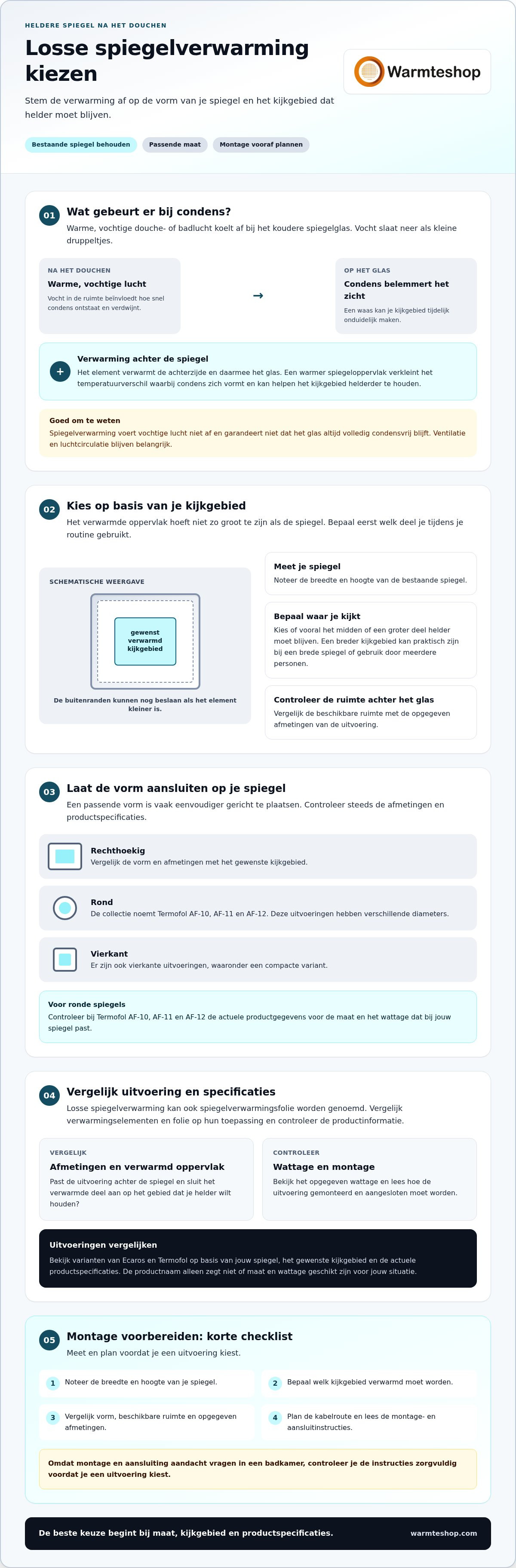
Good preparation helps prevent you from choosing a version that doesn't fit or encountering surprises during installation. First, measure the mirror and the available space at the back. Next, determine where the cable needs to run and check the product's mounting and connection instructions before you begin.
Review these points before making a choice:
An element may be the correct size on paper but be unsuitable if the cable routing clashes with a mounting point. Take this into account when making your choice, not only after you have applied the foil.
Always follow the instructions for the specific version when installing. The back side to which you are mounting must be clean, dry, and free of grease. This prevents dirt or moisture from getting between the surface and the element. Position the heater carefully and avoid creases or tension, insofar as the product instructions prescribe this.
Do not assume that every element fits every mirror or surface. The construction, clearance, and cable outlet vary depending on the situation. Also, check whether the mirror can hang after installation without putting pressure on the element. If you have any doubts about the connection, the mirror's construction, or the bathroom requirements, seek expert advice and have the electrical connection assessed by a qualified installer. Follow the applicable regulations and manufacturer's instructions. General installation advice does not replace product-specific instructions.
By measuring first and only then installing, you make a more informed choice for separate mirror heating. View the mirror heating for existing mirrors and compare the models with your dimensions, mounting location, and desired viewing area.
The collection includes versions of Ecaros and Termofol in various shapes and sizes. Use this variety as a comparison aid, not as a guarantee that a specific version will automatically fit your mirror. First, measure the mirror and determine which viewing area you want to keep clear. Then, compare the product dimensions and the stated wattage with the available space at the back.
For a compact square mirror, the 27.5 × 27.5 cm Ecaros Anti-Fog Mirror Film is a concrete size to compare with. If your mirror has a different surface, the 27.5 × 52.5 cm and 52.5 × 52.5 cm Ecaros versions are examples of larger sizes. The dimensions alone do not determine which part of the mirror remains clear. Also take into account the position of the element and your viewing area.
The Termofol AF-10, AF-11, and AF-12 are round versions with different diameters. Compare the exact size of each model with your mirror. For the rectangular or square variants AF-1, AF-3, and AF-6, it is also advisable to consult the current product specifications. This prevents you from assuming a size or shape based solely on a model name.
| Execution | Shape or size example | What are you comparing? |
|---|---|---|
| Ecaros Anti-Fog Mirror Film | Square, 27.5 × 27.5 cm | Does the size suit the desired viewing area? |
| Ecaros Mirror Film | 27.5 × 52.5 cm or 52.5 × 52.5 cm | Which size fits the free space behind your mirror? |
| Termofol AF-10, AF-11 and AF-12 | Round, various diameters | Check the current diameter and wattage for each version. |
| Termofol AF-1, AF-3 and AF-6 | Check shape and size per version | Compare the product specifications with your mirror and mounting location. |
A suitable choice starts with your existing mirror. Take into account the shape, the desired heated viewing area, the dimensions, the wattage, and the available mounting location. Wattage is useful information, but it does not indicate on its own how much glass is heated. Therefore, before making a choice, check the current product name, dimensions, wattage, and mounting instructions on the product page.
Could you use some help comparing? Warmteshop offers expert advice and has showrooms in the Netherlands and Belgium. View the mirror heating for existing mirrors and compare the current models with your dimensions and preferences.
A more pleasant view after showering starts with a model that matches your existing mirror. Let the shape and dimensions of the glass guide your decision and determine which viewing area you want to keep clear. Then compare the product specifications and installation instructions so that you don't rely solely on the product name or wattage.
Warmteshop offers thirteen listed versions of Ecaros and Termofol. You can compare different sizes and shapes and search specifically for standalone mirror heating that suits your situation. If you can't decide, you can ask for expert advice or visit one of the showrooms in the Netherlands and Belgium.
So, you don't have to replace your existing mirror immediately to improve comfort in the bathroom. List your measurements and preferences and compare the options. Compare separate heated mirrors and choose your model. With a well-considered choice, you make your daily routine just that little bit more comfortable.
Yes, separate mirror heating can limit condensation on the heated part of the mirror. The element heats the mirror from the back, making the glass less cold and water vapor less likely to condense. The result depends partly on humidity, ventilation, and the size of the heated surface. Therefore, the mirror is not guaranteed to be completely condensation-free under all circumstances. Heating does not replace ventilation.
First, measure the mirror and determine which viewing area you want to keep clear. Then, compare the dimensions and shape of the element with the free space behind the glass. The heating element does not need to be the same size as the mirror, but areas outside the heated plane may remain damp. Use the specified wattage as an additional product specification, not as the sole measure of coverage.
This is possible for versions intended for mounting behind an existing mirror, provided the mirror construction and available space are suitable. Check in advance whether the element fits, where the cable exits, and whether the mirror can hang flush afterwards. Follow the mounting instructions for the specific version. If you are unsure about the surface or mounting, first check the product information or seek expert advice.
The terms may refer to a similar solution: a heating element or foil that is installed behind an existing mirror. Product names vary by version, so do not rely solely on the word 'element' or 'foil'. Compare the shape, dimensions, wattage, and mounting method on the product page. This way, you can see which variant matches your mirror and the desired clear viewing area.
That depends on the chosen version, the installation location, and a correct electrical connection. Check whether the product instructions permit use in your situation and follow the applicable regulations for electrical installations in bathrooms. Do not assume that every element is suitable for every location in the bathroom. If in doubt regarding the connection or placement, seek advice from a qualified electrician.
The consumption depends on the wattage of the chosen model and how long you switch it on. You can roughly calculate the energy consumption in kilowatt-hours by multiplying the power in watts by the number of hours of use and dividing the result by one thousand. Check the power on the current product page or the label. Without wattage and operating time, a reliable consumption estimate is not possible.
No, that is not automatically required. Whether the mirror heating switches on together with the lighting depends on the chosen connection and the way the installation is configured. Some installations link the heating to the lighting so that it switches on during use, but this is not standard in every situation. Check the product instructions and, if in doubt, have the connection assessed by an electrician.


