
Buying mirror heating in 2026: the complete buying guide for a condensation-free bathroom
, by Warmteshop, 16 min read
, by Warmteshop, 16 min read
To have immediate clear vision after a hot shower, you really don't need to heat your entire mirror from edge to edge. Targeted mirror heating is, after all, purely about focused visual comfort at eye level, and not about…
To have an immediate clear view after a hot shower, you really don't need to heat your entire mirror from edge to edge. Targeted mirror heating is purely about focused visual comfort at eye level, and not about heating the entire glass surface. We all know the familiar morning frustration: a mirror that fogs up completely within seconds and that you try to rub dry with a towel, resulting in ugly streaks and condensation returning immediately.
Fortunately, condensation is easy to prevent as soon as the glass surface is a fraction warmer than the surrounding humidity. In this guide, you will discover how to permanently eliminate condensation with the right mirror heating, which film exactly matches your mirror in terms of dimensions and power, and how to install it reliably. From smart switching via your bathroom lighting to safe installation behind existing mirror glass: we clearly explain all practical steps for a streak-free start to your day.
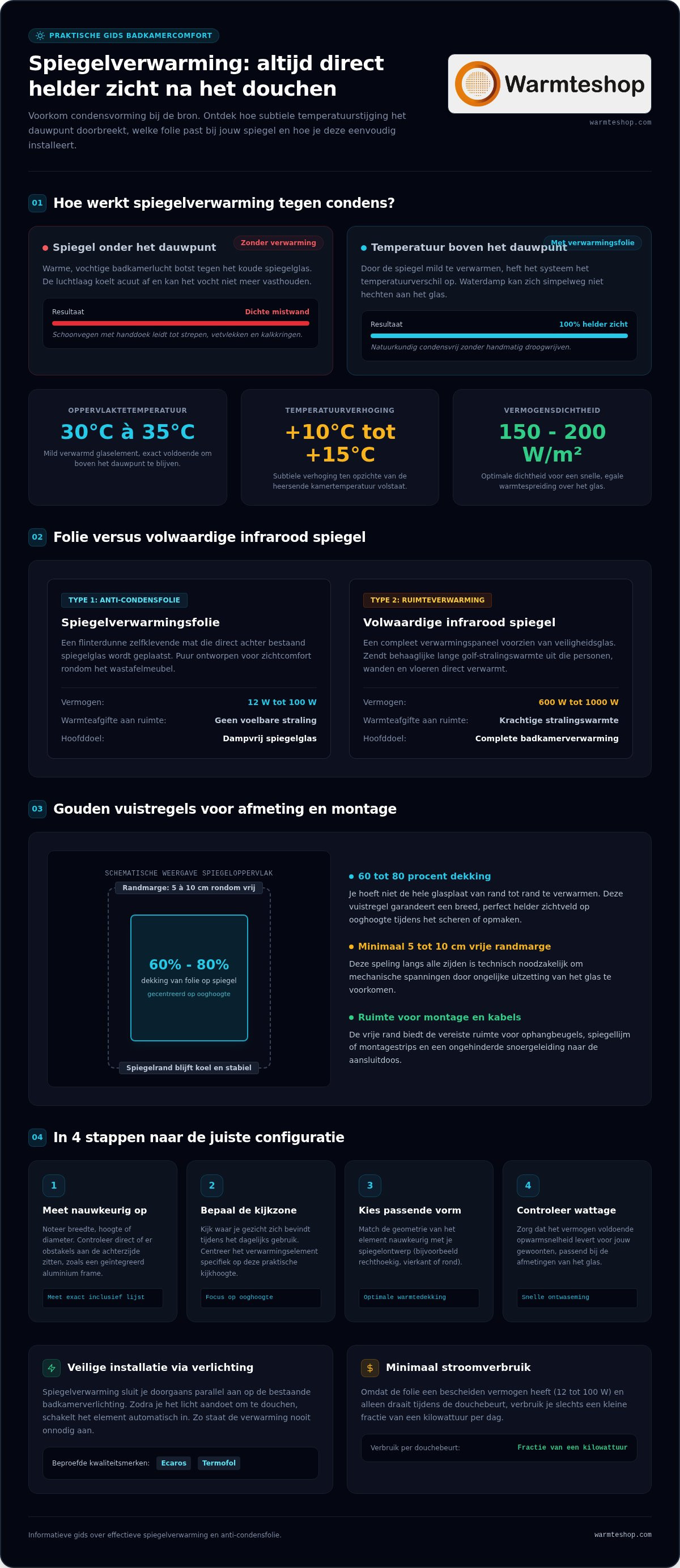
What is mirror heating? Mirror heating is an ultra-thin, electric heating element that is placed directly behind the mirror glass. By gently heating the glass surface to approximately 30°C to 35°C, the temperature remains above the dew point, preventing water vapor from the bathroom from condensing and keeping the mirror completely condensation-free.
Everyone recognizes the scene after a hot shower: the bathroom fills with steam and the mirror turns into an impenetrable wall of mist. This phenomenon occurs as soon as warm, saturated air comes into contact with a cold surface. The mirror glass conducts the cold from the tiled wall behind it, causing the layer of air directly against the glass to cool down suddenly. This cooling means the air can hold less moisture. The result? The excess water vapor immediately condenses into thousands of microscopic water droplets: condensation.
Mirror heating solves this problem at the source. Instead of treating symptoms, the system eliminates the temperature difference. A subtle increase of 10°C to 15°C above room temperature is sufficient to make condensation physically impossible.
The dew point marks the exact temperature at which humidity turns into liquid water. As long as the mirror surface is colder than the surrounding air, moisture continues to adhere. If you then reach for a towel to wipe the mirror clean, limescale rings, grease stains, and fine scratches appear in the glass almost immediately. By heating the glass surface evenly with a power density of 150 to 200 W/m², the glass remains continuously warmer than the humid bathroom air. The water molecules cannot adhere, ensuring your view always remains sharp and streak-free.
There is often confusion between an anti-condensation film and an infrared mirror panel, while both products serve a fundamentally different purpose:
Are you looking for pure comfort at the washbasin and do you want to make an existing wall mirror condensation-free? Then a compact heating foil offers exactly the targeted functionality you need.
Selecting the right heating element requires a well-considered approach. After all, you do not need to cover the entire glass pane to enjoy optimal viewing comfort. Therefore, use the golden rule of thumb that the film covers approximately 60 to 80 percent of the total glass surface. This ensures a perfectly condensation-free field of view at eye level, while leaving sufficient space all around for a safe finish.
When choosing mirror heating, always allow for a free edge margin of at least 5 to 10 centimeters along all sides. This clearance is technically necessary: it prevents stress in the glass caused by uneven expansion and provides the necessary space for mounting materials, suspension brackets, and cable routing to the junction box.
With this practical 4-step plan, you can quickly determine the right configuration:
Always turn the mirror over first before placing an order. Carefully check how much flat glass space is available between any mounting brackets or suspension strips. For a standard vanity unit, one centrally placed film directly in front of your field of vision is sufficient. However, do you have a wide vanity unit with a double faucet? Then it is often smarter and more economical to mount two compact films directly behind both washbasins, exactly where visibility is needed.
The shape of your mirror dictates the final choice. For standard rectangular or square mirrors, countless ready-made film sizes are available. Do you have a modern round mirror? Then specifically choose a round heating element to prevent corners from protruding or heating unevenly. With a power density of around 150 to 200 W/m², the mirror reaches an even temperature of approximately 30°C to 35°C within just 2 to 3 minutes. Curious which size seamlessly matches your bathroom interior? Browse the wide range of anti-fog mirror film models to find the perfect match immediately.
Quality and safety are paramount for electric heating elements in damp rooms. Within Warmteshop's range, foils from Ecaros and Termofol have held a leading position for many years. Both manufacturers use high-quality carbon resistance elements, encapsulated between double-insulated foil layers of impact-resistant polyester. As a result, the foils are splash-proof (IP44 to IP54 certified) and deliver extremely constant heat transfer without hotspots. Anyone looking for reliable mirror heating is guaranteed to find a suitable solution with these two brands.
Ecaros self-adhesive mats excel in simplicity and well-thought-out dimensions. For compact vanity units, the 27.5 x 27.5 cm (12.5 W) model suffices. If you have an average-sized vanity unit, the 27.5 x 52.5 cm (26 W) and 52.5 x 52.5 cm (50 W) variants offer excellent coverage. For wide mirrors above double washbasins, the 52.5 x 102.5 cm (100 W) size provides powerful, even heating.
Termofol perfectly complements the spectrum with special solutions for organic and round mirror shapes. With round elements such as the TF-AF series (with diameters from 300 to 600 mm), you effortlessly provide trendy circular mirrors with a condensation-free zone. In addition, the brand supplies rectangular mats such as the TF-AF-2 (400 x 600 mm, 44 W) and generous sizes such as the TF-AF-6 (700 x 900 mm, 108 W) for large mirrors.
The overview below helps you directly match the right model to your mirror dimensions. All displayed models operate directly on 230 volts and have a warm-up time of only 2 to 3 minutes:
| Make and type | Dimensions (cm) | Power (W) | Ideal mirror size (indication) |
|---|---|---|---|
| Ecaros XS | 27.5 x 27.5 | 12.5 W | approx. 40 x 40 cm to 50 x 50 cm |
| Ecaros M | 27.5 x 52.5 | 26 W | approx. 40 x 70 cm to 50 x 80 cm |
| Termofol Round | Ø 40 to 50 | 30 - 45 W | Round mirrors Ø 60 to 80 cm |
| Ecaros L | 52.5 x 52.5 | 50 W | approx. 60 x 60 cm to 80 x 80 cm |
| Termofol XL | 40 x 60 / 54 x 80 | 44 - 65 W | approx. 60 x 80 cm to 70 x 100 cm |
| Ecaros / Termofol XXL | 52.5 x 102.5 / 70 x 90 | 100 - 108 W | Mirrors from 80 x 120 cm |
Do you want to view and compare all available sizes immediately? Discover all versions in the complete range of anti-fog mirror film.
Correct installation of mirror heating not only guarantees flawless operation but also ensures electrical safety in the wet room. According to installation standard NEN 1010, the area around the washbasin falls within zone 2. This means that all electrical devices must meet at least protection class IPX4 (splash-proof), a requirement that quality foils meet as standard. Furthermore, the standard stipulates that the downstream 230V circuit must always be protected by a residual current device (RCD) with a maximum rating of 30 mA.
Safe installation begins with the preparation of the mirror surface and stress-free processing of the element.
Place the mirror face down on a soft blanket to prevent scratches. Thoroughly degrease the back with pure alcohol or a grease-free glass cleaner and allow the glass to dry completely. Peel off a small piece of the protective paper and align the film within the previously determined margins. Then, gently rub the heating element from the center outwards with a soft cloth. This prevents creases and trapped air bubbles that could hinder heat transfer. Ensure that the power cable points towards the recess in the wall without sharp kinks.
There are various practical possibilities for the electrical control:
Never install a heated mirror tightly against the wall with sealant. A clearance of at least 5 to 10 millimeters is crucial for dissipating residual heat and prevents the terminal blocks from jamming against the tiling. Use special mechanical mirror clamps, magnetic mounting kits, or sturdy spacers for this purpose. For broader advice on safe electrical installations and zoning in damp areas, view our comprehensive background guide on electric bathroom heating solutions.
Ready to provide your bathroom with reliable visual comfort? Order the right heating foil directly and experience the convenience of a permanently clear mirror tomorrow.
Many people fear that adding an electric heating element will lead to a significant increase in the energy bill. With mirror heating, however, the exact opposite is true. Because an anti-fog mat only heats the glass surface and does not need to heat the entire room, power consumption remains remarkably low. Compare that to the classic habit of throwing the bathroom window wide open after showering: in the winter months, precious heated room air escapes in just a few minutes, forcing the main heating system to work hard to top up.
The actual energy consumption can easily be expressed in kilowatt-hours. An average bathroom foil has a power rating of approximately 50 watts. When this element is active during a 20-minute shower, the system consumes only about 0.017 kWh. Even in a family of four where everyone showers daily, the total daily consumption remains limited to less than 0.07 kWh. On an annual basis, this requires barely 25 kilowatt-hours of electricity. Such minimal consumption is effortlessly offset by a solar panel installation, meaning your daily visual comfort effectively operates in an energy-neutral manner.
In addition to immediate comfort, a heated mirror also offers significant benefits for the preservation of your bathroom:
As a leading specialist in infrared and electric heating systems, Warmteshop has been guiding homeowners in making their homes more sustainable since 2008. Do you want to experience how pleasant radiant heat feels, or are you looking for expert advice on the ideal dimensions for your mirrors? In our more than 30 showrooms spread across the Benelux, our advisors are ready to provide personalized, tailor-made advice. Take control of your bathroom comfort and choose your ideal model directly from our collection of mirror heating.
With targeted mirror heating, you transform your daily morning routine in an instant. By simply applying proven films from top brands such as Ecaros or Termofol to 60 to 80 percent of the glass surface, you permanently break the dew point. Streak-free, without waiting time, and with minimal power consumption of just a fraction of a kilowatt-hour per shower, your view remains crystal clear at all times, while your mirror glass remains optimally protected against excess moisture.
As a leading specialist in electric and infrared heating systems, Warmteshop has guaranteed tested quality and reliable service since 2008. Would you like to experience the technology yourself, or are you looking for specific advice on the ideal size for your particular situation? Feel free to visit one of our more than 30 showrooms spread across the Benelux. Put an end to foggy mirrors today: view the complete range of mirror heating and order directly online for a comfortable and carefree start to every day.
Within 2 to 3 minutes of switching it on, the mirror surface is already sufficiently heated to completely prevent or eliminate condensation. High-quality films quickly reach a mild temperature of approximately 30°C to 35°C. If you switch on the element at the same time as your bathroom light as soon as you step into the shower, the glass remains crystal clear throughout your entire shower. So you never have to wait for the steam to dissipate on its own.
No, the film certainly does not need to be as large as your entire mirror. The intention is actually to cover 60 to 80 percent of the glass surface and leave at least 5 to 10 centimeters of clearance all around. This guarantees a condensation-free viewing area at eye level and prevents thermal stress in the glass. Additionally, this free edge space provides room for mounting hooks and a safe passage for the connection cable.
Yes, self-adhesive heating foil is perfectly suitable for mounting behind an existing flat mirror. You simply remove the mirror from the wall, thoroughly degrease the back, and stick the element directly onto the glass. However, ensure that there is at least 5 to 10 millimeters of mounting space remaining between the mirror and the wall. This can easily be done using spacers or mounting brackets, so that the connection sits tension-free behind the glass.
With daily use, mirror heating consumes on average only 0.02 to 0.07 kWh of electricity. A standard 50-watt heating element active during a 20-minute shower requires barely 0.017 kilowatt-hours. Even if multiple family members shower daily, the annual kilowatt-hours remain extremely low. As a result, the low power demand aligns seamlessly with a sustainable household equipped with solar panels, without any significant impact on your energy bill.
Yes, connecting mirror heating in parallel to bathroom lighting is the most popular and safest installation method. The heating foil then switches on automatically as soon as you turn on the light and switches off again when you leave the room. According to NEN 1010 standards, the circuit must be protected by a 30 mA RCD and the element must be at least IPX4 splash-proof. High-quality mats fully comply with these requirements for worry-free use in Zone 2.
Certainly, special round heating elements are specifically designed for round and rounded mirrors. Brands such as Termofol supply circular mats in various diameters, ensuring the heat distributes harmoniously without protruding corners. Even with oval or asymmetrical organic shapes, you can easily select a suitable round or compact rectangular foil that fits centered behind the primary field of vision. This way, you maintain the sleek design while simultaneously enjoying streak-free vision.
An anti-condensation film is a wafer-thin mat with a low power output of 12 to 100 watts, intended purely to keep the glass fog-free. An infrared mirror panel, on the other hand, is a full-fledged heater featuring tempered safety glass and a power output of 600 to 1000 watts. This panel heats the entire bathroom space with soothing radiant heat, thereby replacing conventional radiators. Which option you choose therefore depends on your needs: visual comfort or complete room heating.


