

Buying infrared floor heating: the complete guide to a smart choice
, by Warmteshop, 18 min read
, by Warmteshop, 18 min read
Imagine: a warm floor under your feet, no radiators taking up precious wall space, and an energy bill that won't shock you. Sounds like a dream? For more and more homeowners, infrared flooring is a…
Imagine: a warm floor under your feet, no radiators taking up precious wall space, and an energy bill that won't shock you. Sounds like a dream? For more and more homeowners, infrared floor heating has become exactly that—and not just as luxury supplementary heating, but as a full-fledged primary heating system during a renovation.
Your doubts are understandable. Will such a system actually work on your laminate or PVC floor? Is the consumption really as low as the manufacturers claim? And what if the installation turns out to be more of a hassle than expected? Almost everyone seriously considering a switch asks these questions.
In this guide, you get honest, concrete answers. You will discover which types of underfloor heating are suitable for which subfloor, how to use zones and thermostats smartly to save money, and what to look out for when purchasing. This way, you make a choice that suits your home, your floor, and your budget, without any surprises afterwards.
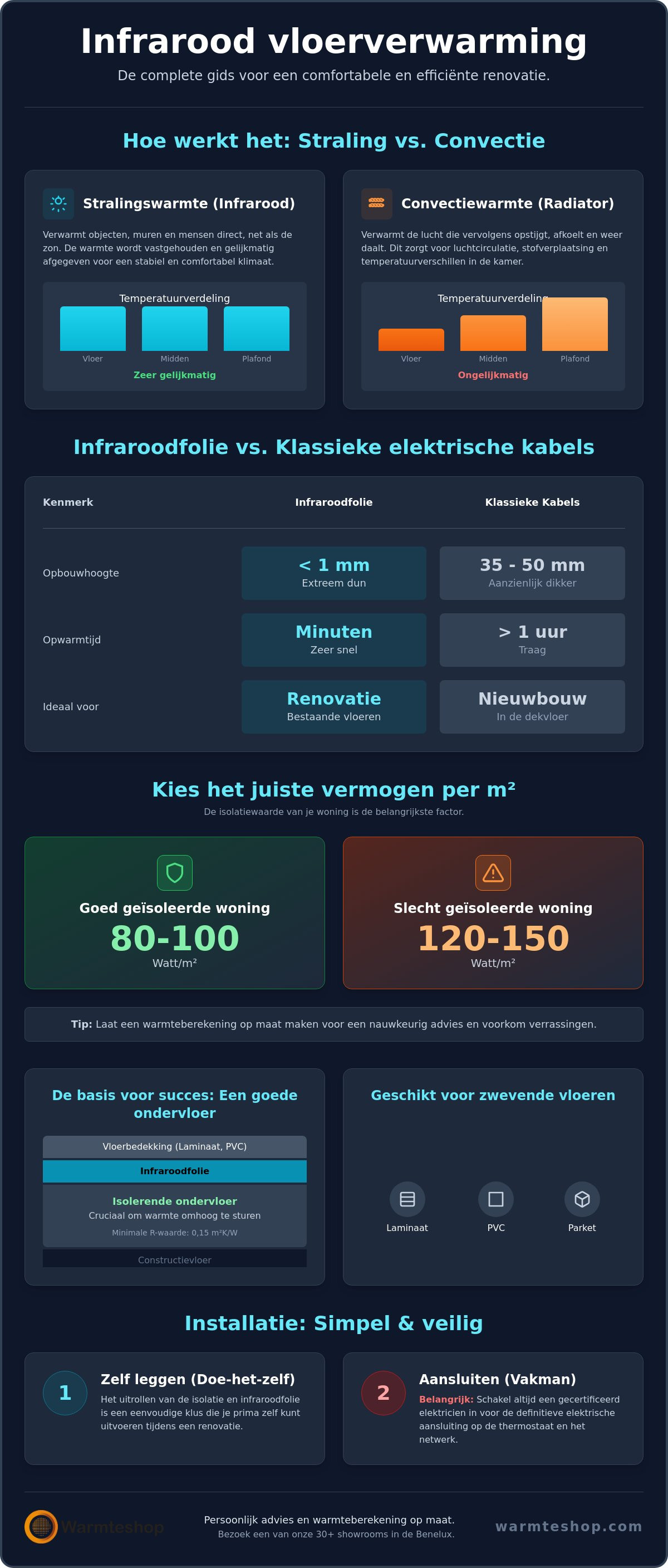
The sun warms your skin, not the surrounding air. That is precisely the principle behind infrared underfloor heating: long-wave infrared radiation that transfers energy directly to solid objects, furniture, walls, and people, without having to heat the air first. The result is warmth you feel as soon as the system switches on, stable and evenly distributed throughout the entire room.
Traditional radiators work via convection: they heat air, which then rises, cools, and sinks in a constant circulation. That sounds efficient, but in practice, it means temperature differences of sometimes as much as four degrees between floor and ceiling. With a heated floor as a radiant source, the temperature distribution is much more even, from your ankles to your shoulders.
Because objects in the room retain heat and release it gradually, infrared floor heating creates a heat buffer that remains active for some time even after being switched off. In practice, this thermal flywheel effect means you can set the thermostat two degrees lower without feeling any cooler. Your body responds to radiant temperature, not solely to air temperature. That two-degree difference translates directly into lower energy consumption.
An additional benefit that is rarely discussed: because the air hardly moves, household dust also circulates much less. For people with a dust mite allergy or asthma, this makes a noticeable difference in daily air quality. Moreover, humidity remains more stable because convection heating dries out the air, whereas radiant heat does not have that effect.
Traditional electric underfloor heating works with heating cables embedded in a finishing layer. That system has a build-up height of at least 35 to 50 millimeters and a warm-up time that can run up to an hour or more. Infrared foil is only a fraction of a millimeter thin, lies directly beneath the floor covering, and reaches the desired temperature within a few minutes. The polymers used in these foils are comparable to the engineering plastics supplied by specialists such as Plastiques Elastomères for industrial applications. For renovation projects where floor height is a critical factor, this makes a huge practical difference.
The applications in 2026 are broad: from a bathroom floor to a complete living room renovation, from an attic room to an extension. View the full range in Warmteshop's underfloor heating collection to see which systems suit your specific floor type and situation. Whether you have laminate, PVC, or another finish: there is almost always a suitable solution.
Not every floor covering reacts the same way to heat from below. The choice of your flooring material directly determines the wattage you need, how quickly the room heats up, and how long the heat is retained. Ignoring this risks an underperforming installation or, in the worst case, damage to an expensive floor.
As a rule of thumb, a capacity of 80 to 100 watts per square meter applies to well-insulated homes. For poorly insulated rooms, a concrete floor without insulation underneath, or a north-facing room, the requirement quickly rises to 120 to 150 watts per square meter. This calculation is not something to be done by feel: a customized heat calculation prevents you from installing too little capacity and then having to use supplementary heating later.
An insulating underlay is not an optional extra. Without an insulation layer, a significant portion of the heat radiates downwards, towards the concrete structural floor. That is energy you pay for but do not feel. An underlay with a thermal resistance of at least 0.15 m²K/W ensures that the heat is directed upwards, exactly where you want it. At the same time, ensure that the total thermal resistance of the underlay and floor covering combined does not become too high: above 0.15 m²K/W for the finished floor itself, heat transfer becomes noticeably less efficient.
Thermal bridges occur where the foil is interrupted by threshold profiles, pipe ducts, or irregularities in the substrate. Always roll the foil along the walls with an overlap of at least five centimeters and carefully seal connections with aluminum tape suitable for high temperatures.
Floating floors—floors that are not glued down but move freely on the subfloor—require thin heating foil. The thickness of the foil is a technical necessity here, not just a practical advantage. PVC floors generally withstand a maximum floor temperature of 27 degrees Celsius; if you exceed that limit, the top layer may deform or detach. For parquet and solid oak, that limit is even lower, around 25 degrees, because wood expands and contracts and dries out at sustained high temperatures. Always check your floor manufacturer's specifications before installing a system. Furthermore, a level and dry subfloor is essential: even small irregularities of more than two millimeters per meter can locally damage the foil due to the mechanical stress of movement and furniture.
Tiles and natural stone are thermally heavier than laminate or PVC. They require more power to reach temperature, but then retain that heat much longer, which makes the energy balance favorable over a longer period. For glued floors, infrared foil is not always the right choice: heating mats embedded in the tile adhesive offer a more robust and durable alternative. For those who want to get all components right the first time, Warmteshop offers complete underfloor heating kits compiled based on your floor type and room surface area, so you can get started without searching or measuring errors.
The switch to infrared floor heating often raises questions about the monthly costs. In 2026, we look beyond just the purchase price; it is about the total cost of ownership over the entire lifespan of the system. While a traditional central heating system requires regular maintenance, inspections, and parts replacement, infrared foil excels in being completely maintenance-free. There are no pumps to seize up, no pipes to leak, and no boilers due for replacement after fifteen years. This long-term saving makes the initial investment a smart move for many homeowners.
Insulation remains the most important factor for your return on investment. In a home with energy label A or B, the floor and structure act as a thermal battery that retains heat for a long time. In a moderately insulated home, the system has to switch on more frequently to compensate for heat loss through walls or windows, which is immediately visible on your energy bill. Good preparation with heat calculations prevents unpleasant surprises in this regard.
A realistic estimate of consumption depends heavily on your lifestyle and the insulation quality of your home. With average insulation, a system often consumes significantly less than people initially fear, simply because the thermostat can be set lower due to radiant heat. Smart thermostats play a crucial role here; they can reduce consumption by as much as 20% through smart algorithms that learn when the room needs to be warm. The payback period of such an installation is closely linked to current energy prices in the Netherlands, with self-generation via solar panels tipping the balance more quickly.
Modern Wi-Fi modules and app control make managing your energy consumption easier than ever. You can see what is happening in real time and adjust schedules based on your actual presence. A wireless thermostat is essential for accurate measurement, as you can place it in the ideal spot in the room without having to worry about wiring. For optimal comfort in specific areas, you can combine this system with an infrared mirror in the bathroom. This way, you enjoy a warm floor and a fog-free mirror, while only heating the bathroom when you are actually using it.
At Warmteshop, we understand that choosing infrared floor heating goes beyond simply selecting a product. Since 2008, we have specialized in energy-efficient radiant heat, providing our customers not only with high-quality systems but, above all, with expert advice. With more than 30 physical showrooms in the Benelux, we offer you the opportunity to experience the heat for yourself before making a decision. Our experts are happy to perform an accurate heat calculation for you, ensuring you get the right capacity for your specific living situation. This personal approach is what sets us apart as a reliable guide in the world of the energy transition.
Our selection is based on years of experience and strict quality standards. All components are extensively tested and our service is certified via Trustprofile, giving you the assurance of a safe and sustainable purchase. Our complete kits are the most popular option for DIYers. These packages contain everything you need: from the foil and insulation to the thermostat and connection materials. You can find these in our selection of complete underfloor heating kits, where every component is tailored for maximum efficiency. This prevents you from making mistakes during installation or combining parts that do not work together optimally.
For those looking to make an existing home more sustainable without breaking up the entire floor, our ultra-thin foil is the ideal solution. With a thickness of less than a millimeter, this system almost always fits under your new laminate or PVC without the need to shorten doors or raise thresholds. The installation process is surprisingly simple and requires no hacking or breaking into the subfloor. We stand fully behind the sustainability of our products, which is reflected in the extensive warranty conditions we offer on our foil systems. It is an investment in comfort that lasts for decades without ever requiring a technician for maintenance.
Not every situation calls for a complete renovation of the entire room. Sometimes you just want to tackle that one cold spot by the sofa or under your desk in the home office. For this, we offer specific solutions that you can install directly under an existing rug. It is the most efficient way to create local comfort without heating the entire room, which you will immediately notice positively in your monthly energy consumption. You transform a cold seating area in an instant into a cozy spot that feels like the natural warmth of the sun. Curious about the possibilities for your home? Discover the full range in our infrared floor heating collection and choose a smart upgrade to your living comfort that suits your lifestyle.
By 2026, the integration of heating with your own energy generation will have become the standard. The installation of infrared floor heating is a crucial step towards a self-sufficient home in this regard. Unlike water-based systems, which involve heavy pumps, distribution stations, and the risk of leaks, infrared technology is technically a 'solid state' system. This means there are no moving parts that can wear out. The result is a heating solution that is completely maintenance-free: you will never again have to bleed radiators, replace filters, or schedule expensive annual boiler maintenance.
The installation always begins with a clean, level subfloor. First, you lay the specific insulation boards that reflect heat upwards. Next, you roll out the infrared foil according to the installation plan included with your order. It is a process much like putting together a puzzle; relaxing and well-organized. However, for the final electrical connection and linking to the meter box, you must always engage a certified electrician. This is not only essential for safety but also a strict requirement for maintaining your warranty and the validity of your buildings insurance.
Rolling out the foil on the subfloor is a perfectly manageable task for most DIYers. The simplicity of the system ensures that you save significantly on labor costs. A crucial moment during this process is the placement of the floor sensor for the thermostat. This must be positioned precisely between two heating strips, inside a protective tube, to guarantee accurate measurement and prevent overheating of your PVC or laminate. For larger projects or complex renovations involving the entire home, Warmteshop offers a professional installation service. Our experts will then take the entire process off your hands, from the initial heat calculation to the final handover.
The most important rule when installing infrared foil: never overlap the strips. Overlapping causes hotspots that can irreparably damage the foil and your floor. Always maintain the prescribed spacing. Additionally, measuring the resistance with a multimeter is a step you must not skip. Do this immediately after laying the foil and again just before the finishing floor is laid over it. This ensures that no damage has occurred during the work. Do you want to enjoy the same healthy radiant heat outdoors after your indoor renovation? Then check out our guide on buying a patio heater for optimal comfort in your garden or on your balcony. By investing wisely now in the right technology and careful installation, you will enjoy warmth for decades that feels just as natural and soothing as the sun.
The step towards infrared floor heating is an investment in a sustainable and comfortable future for your home. By doing so, you choose not only the beneficial radiant heat comparable to the natural warmth of the sun, but also a system that is completely maintenance-free and lasts for decades. By making smart use of zone heating and accurate heat calculations, you transform your home into an energy-efficient haven of tranquility without the need for extensive demolition or construction work.
Whether you are planning a complete renovation or seeking specific local comfort for your workspace, today's technology offers a suitable solution for every space. Visit one of our 30+ showrooms for a personal demonstration or request a free heat calculation for your specific project directly. Our experts are ready to guide you through every step of this smart and comfortable upgrade. View all infrared floor heating options in the Warmteshop webshop and discover how easily you can take your living comfort to the next level. You are just one step away from an always-warm floor and a lower energy bill.
Yes, infrared floor heating is perfectly suitable as primary heating, provided your home's insulation is of sufficient quality to retain heat. The system heats the objects and the room's structure directly, creating a very stable and comfortable indoor climate. By using smart thermostats and zone heating, you can accurately regulate the temperature in each room, ensuring high efficiency without the need for wall radiators.
The foil is extremely thin, often less than 0.5 millimeters thick, offering unique benefits for modern homes. This makes it the ideal solution for renovation projects where every millimeter of floor build-up height counts. You lay the foil directly on the insulating subfloor and beneath the finished floor, eliminating the need to shorten doors or raise thresholds. Despite this minimal thickness, the system delivers powerful and even radiant heat throughout the entire room.
Absolutely, this system can be installed without any problems under a wooden floor, parquet, or laminate for optimal living comfort. However, it is essential to limit the floor temperature, usually to a maximum of 27 degrees, to prevent the natural wood from warping or drying out due to the heat. By using a thermostat with an external floor sensor, you monitor this limit fully automatically and enjoy a warm floor without damaging your valuable wooden flooring.
For a well-insulated living room or bedroom, a capacity of 80 to 100 watts per square meter is usually sufficient. In rooms with a higher heat demand or less insulation, such as a bathroom or an attic room with a lot of glass, we often recommend a capacity of 120 to 150 watts per square meter. An accurate heat calculation by a Warmteshop expert will help you determine exactly the right wattage for your specific situation.
A heat pump heats water flowing through pipes to warm the air, whereas infrared foil emits radiant heat directly to objects and people. Infrared is significantly cheaper to purchase and completely maintenance-free, as no pumps or fluids are involved. While a heat pump is often a slow system, infrared floor heating reacts lightning-fast, allowing you to heat much more precisely at the times you are actually using the room.
No, that is one of the biggest advantages of this system for renovations compared to traditional water-based systems. You do not need to mill grooves or break open the existing screed for installation. The foil is simply rolled out over an insulating underlayment that is placed on top of the existing floor. You then lay your new laminate, PVC, or parquet directly over this, saving you a huge amount of time, dust nuisance, and costs for demolition work.
Absolutely, the system is completely safe for your entire family and your pets thanks to the low surface temperature and double insulation. There are no hot surfaces that children can burn themselves on, and there is no risk of leakage or carbon monoxide poisoning. Furthermore, the radiant heat causes less dust circulation than traditional radiators, creating a healthier indoor climate for people with allergies. The electrical installation complies with all strict safety requirements for use in living spaces.
A high-quality system from Warmteshop has an expected lifespan of more than 30 years, making it a highly sustainable investment. Because the foil contains no moving parts such as pumps or valves, no mechanical wear occurs during use. The carbon materials used are resistant to aging and maintain their full efficiency throughout the entire service life. This makes it one of the most reliable heating solutions currently available for the modern energy transition.


