

Avoiding unexpected electric heating costs: A complete guide for 2026
, by Warmteshop, 18 min read
, by Warmteshop, 18 min read
The cheapest electric heater at the local hardware store is often the most expensive financial decision you can make for your home in 2026. While the energy transition is in full swing, many households are unknowingly running too…
The cheapest electric heater at the local hardware store is often the most expensive financial decision you can make for your home in 2026. While the energy transition is in full swing, many households are unknowingly running into significant unexpected electric heating costs by opting for outdated, inefficient systems. You probably want nothing more than a comfortably warm home without the daily stress of fluctuating energy prices or a necessary, costly upgrade to your grid connection. It is perfectly logical that you seek certainty before investing in a new way of heating.
In this comprehensive guide, you will discover how to avoid the hidden financial pitfalls of traditional electric heaters and keep your monthly costs predictably low with modern infrared technology. We explain why radiant heat, which directly warms objects and people like the natural warmth of the sun, works up to 30% more efficiently than heating air. You will gain insight into smart thermostat controls and technical innovations that make your switch to green energy a smart, cost-effective upgrade for a healthy and sustainable indoor climate.
Switching to a fully electric home is a smart move for the future, but without the right knowledge, unexpected electric heating costs. These costs are rarely caused by the technology itself, but rather by a mismatch between the chosen system and the specific needs of the space. A common pitfall is the psychological focus on the purchase price. A cheap electric heater costing 40 euros seems attractive, but these devices are often energy guzzlers that unnecessarily drive up the energy bill during the winter months. It is the classic mistake where a low investment leads to high operating costs.
Furthermore, the thermostat setting does not always reflect actual consumption. In a home with a moderate level of insulation, an electrical system has to work harder to retain heat. According to data from 2024, homes with single glazing or poorly insulated walls lose up to 25 percent of their generated heat through transmission losses. Understanding fundamental electric heating principles is therefore necessary; it teaches us that efficiency depends not only on the device but also on how the room retains energy.
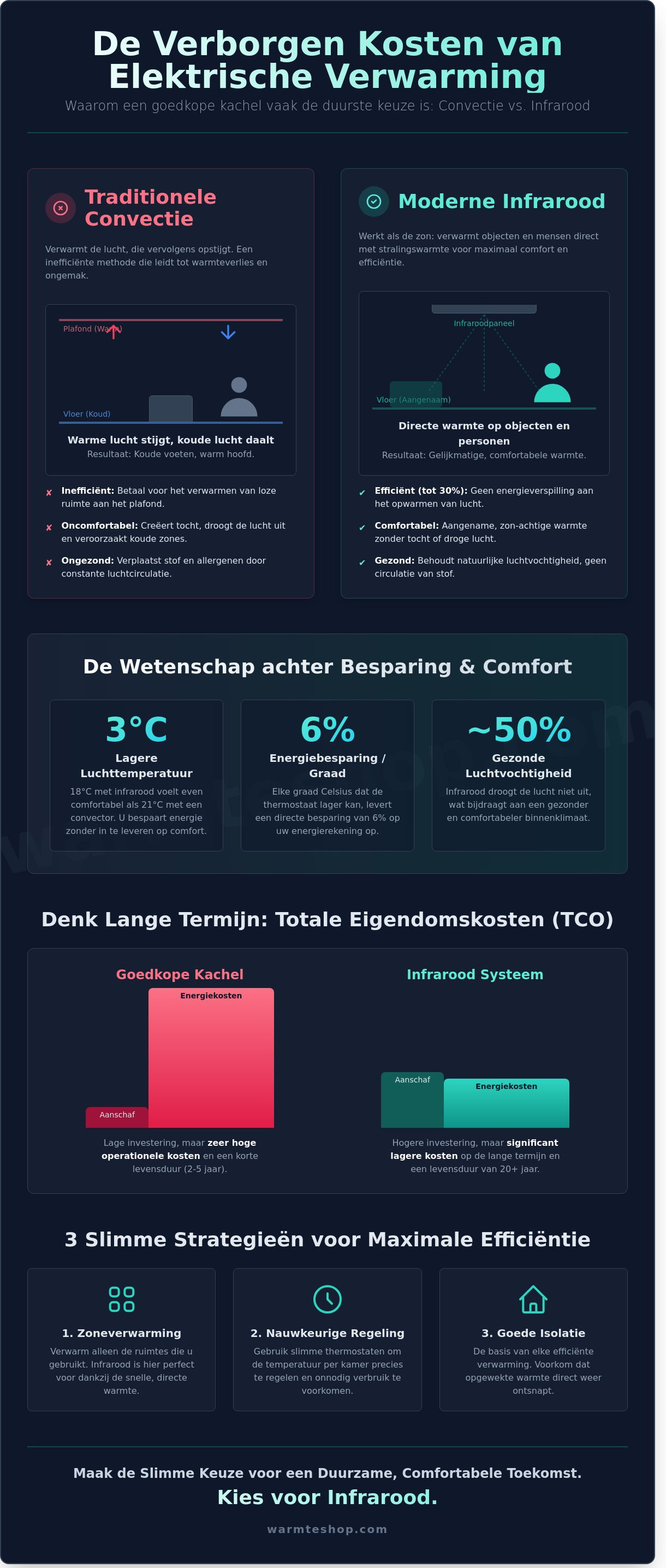
Many users opt for a traditional convector because it heats the air quickly. However, a major disadvantage lies here: warm air rises directly to the ceiling. In rooms with high ceilings or poor sealing, this heat escapes before you can benefit from it. This results in the phenomenon of cold feet while the head feels warm. Because the thermostat is often mounted at eye level, the system continues to draw power to heat the lower layer of air, making consumption much higher than the specifications on the box suggest. Infrared heating, on the other hand, works like the natural heat of the sun; it heats objects and people directly, which is much more efficient in large or drafty rooms.
Modern technology brings convenience, but also hidden consumers. Digital displays, Wi-Fi modules for app control, and constant standby modes consume a small amount of power 24 hours a day. While this may seem minimal per device, for a complete home installation, it adds up to a noticeable amount on an annual basis. Another critical point is the placement of sensors. When a sensor is mounted too close to a cold wall or in a drafty corner, it registers a lower temperature than the actual room temperature. The system then continues to heat unnecessarily, leading to overheating and the unnecessary waste of precious green energy. Precise control and smart placement are the keys to a healthy and affordable indoor climate.
When choosing a system, the way heat is transferred determines your monthly expenses. Traditional electric heaters work on the basis of convection. This process heats the air, which then rises to the ceiling. It is an inefficient method, because you are effectively paying to heat empty space where you are not present. To unexpected electric heating costs , switching to radiant heat is a wise decision.
Infrared technology works on the principle of direct transfer, similar to the natural rays of the sun on a cold winter day. You feel the heat directly on your skin, even when the air temperature is lower. Scientific research shows that lowering the air temperature by just 1 degree Celsius results in a 6 percent saving on your energy consumption. Because infrared directly heats the mass in a room, you experience the same comfort at an air temperature of 18 degrees Celsius as you would at 21 degrees Celsius with an air-based system.
An often overlooked factor in energy efficiency is humidity. Convection systems move dust and dry out the air due to the constant airflow past heated elements. Dry air feels colder on the skin, causing you to unconsciously turn up the thermostat more quickly. Infrared maintains the natural humidity level of approximately 50 percent. This results in a healthier indoor climate and prevents you from consuming unnecessary wattage to compensate for a lack of thermal comfort.
Infrared panels do not heat the air, but the objects in the room. Walls, floors, and furniture absorb the energy and act as a thermal battery. This mass releases the heat slowly and evenly back into the environment. When you open a door or window, all the expensive warm air immediately escapes outside by convection. With radiant heat, the energy remains stored in the structure of the home, allowing the room to return to the desired temperature much faster. For rooms with ceilings higher than 2.6 meters, infrared heating the only logical choice, because the heat is not lost at the top of the ridge.
Traditional radiators and electric convectors are notorious dust traps. An accumulated layer of dust on the heating elements can reduce a heater's efficiency by as much as 25 percent. Energy is consumed, but the heat simply does not reach the room. This is a classic example of how unexpected costs for electric heating can accumulate unnoticed due to neglected maintenance. Additionally, sofas or heavy curtains often block the necessary airflow in convectors. Infrared systems are completely maintenance-free and experience no loss of efficiency due to dust accumulation. This guarantees constant and predictable consumption throughout the entire lifespan of the panel. Would you like to know exactly what power output your specific home requires? Visit one of our showrooms for tailored advice.
Those who look solely at the purchase price often encounter unexpected costs for electric heating due to the limited lifespan of cheap equipment. A simple convector from a hardware store lasts an average of 3 to 5 years before the elements lose their efficiency or fail. High-quality infrared panels, on the other hand, are designed for a lifespan of more than 20 years. This durability translates directly into a lower TCO; you make a one-time investment in a system that mimics the healthy warmth of the sun for decades without loss of efficiency.
The myth that electric systems are expensive to maintain is easy to debunk. Unlike gas-fired boilers, electric systems have no moving parts, pumps, or burners that need to be inspected annually. This immediately saves you the costs of a maintenance contract, which in 2026 will average between 80 and 120 euros per year. A well-considered TCO analysis prevents unexpected costs for electric heating in the long run by also taking safety into account. Inferior wiring or overloaded circuits increase the risk of fire and can lead to higher insurance premiums or even the refusal of damage claims.
Switching to electric heating requires a critical look at your meter cupboard. When the total heating power exceeds 3.7 kW, a separate circuit is necessary. For a complete home transition, an upgrade to a 3-phase connection (3x25A) is often required. The grid operator charges a one-off fee for the physical modification, but pay particular attention to the standing charges. A smart approach is to use advanced thermostats that prevent peak loads by switching panels alternately. This prevents you from having to upgrade to an even more expensive 3x35A connection, which would significantly increase the annual standing charges.
Floor space has a tangible economic value, especially in modern homes where every square meter counts. Freestanding heaters take up valuable space and obstruct circulation. By opting for wall or ceiling mounting, you make optimal use of the space and enhance the aesthetic value of your interior. Multifunctional solutions offer an additional financial benefit in this regard. Consider an infrared mirror in the bathroom; it replaces the traditional radiator, never fogs up, and serves immediately as a full-fledged mirror. Moreover, a professionally installed, virtually invisible heating system contributes to the value retention of your home in the event of a future sale.
To completely eliminate unexpected electric heating costs in 2026, a proactive approach is essential. It starts with an accurate heat loss calculation for each specific room. When a heating system lacks capacity, it paradoxically consumes more energy because the unit operates continuously at full power without reaching the desired temperature. A deviation of just 10% in the calculation can already significantly increase operating costs.
The transition to smart technologies offers the solution here. By investing in quality components with a long warranty period of 10 years or more, you avoid premature replacement costs. Combine this with the following steps for optimal results:
The era of the central thermostat controlling the entire house as a single unit is definitely behind us. With zone heating, every room gets its own intelligent regime. By heating only the rooms where you actually spend time, you save up to 30% on your annual energy bill. Imagine a home office that stays at 21 degrees during the day, while the living room is only heated to a comfortable temperature from 5:00 PM onwards. This precision prevents you from paying for heat that no one uses.
Do you want immediate control over your consumption per room? Discover our selection of smart thermostats for efficient zone division.
In 2026, the dynamics of the energy market will have changed. Low injection tariffs make it less profitable to feed excess solar energy back into the grid. The focus is now on self-consumption. By connecting infrared heating to a home battery, you use the solar energy generated during the day during the cold evening hours. Infrared radiation acts as the perfect partner in this regard; it heats not the air, but the mass of the home. This stored heat feels like the natural warmth of the sun and lingers in the room longer than traditional convection heat. This makes a gas-free home not only a sustainable choice but also a financially smart upgrade that minimizes the unexpected costs of electric heating.
Preventing unexpected electric heating costs starts with making a fundamental choice for the right technology. While traditional convection systems often lead to disappointing energy bills due to heat loss through the air, infrared heating offers a stable and controllable solution. By directly heating objects and people rather than the air mass, the heat remains exactly where you need it. This results in efficient energy consumption that can be accurately monitored via smart thermostats.
The switch to infrared is more than a financial decision; it is an investment in a healthier and aesthetically pleasing indoor climate. You enjoy warmth comparable to the natural radiation of the sun, without the bothersome air and dust circulation of classic radiators. Since 2008, the Infrared Heating Group has proven that this technology is the standard for the modern home. Our years of expertise guarantee that the calculations we make today truly reflect the reality of tomorrow. You get the assurance of a system that lasts for decades without costly maintenance or complex installations.
With access to more than 30 showrooms spread across the Netherlands and Belgium, we offer the personal advice essential for a successful transition. An accurate heat calculation is the only way to unexpected electric heating costs . Our certified installers ensure professional installation, so you will never face any surprises afterwards. We focus on sustainable quality and utilize Dutch and Belgian craftsmanship to deliver a product that is both functional and aesthetically superior.
Would you like to experience the difference in heating comfort for yourself? A visit to one of our showrooms is the best way to feel the pleasant radiant heat and view the various designs. Every living situation is unique, which is why we offer you the opportunity to request a completely no-obligation quote and heat calculation for your specific spaces. This way, you know exactly what capacity you need and what the expected consumption figures will be. Take control of your energy consumption today.
Discover our complete collection of infrared panels and take the step towards a predictable and comfortable future.
The transition to a sustainable interior requires a clear view of the future and the right technological choices. By focusing on the Total Cost of Ownership (TCO) rather than just the purchase price, you prevent your energy efficiency from falling behind the ambitions for 2026. Infrared panels offer a crucial advantage in this regard by heating objects directly, similar to the natural radiation of the sun. This method eliminates the unexpected costs of electric heating often associated with traditional convection systems that only move air and therefore consume unnecessarily large amounts of energy.
As the market leader in the Benelux since 2008, Warmteshop has guided this transition for thousands of households. Our specialization in energy-efficient infrared technology ensures a healthy indoor climate without surprises on the bill. With more than 30 physical stores spread across the region, an expert advisor is always nearby for tailored local advice. It is time to enhance your living comfort with a system that is as reliable as it is modern.
Calculate your savings with a free consultation at Warmteshop
You deserve a home that is ready for the future, where warmth once again feels like a natural and carefree part of your daily life.
In 2026, electric heating will often be more cost-effective than gas due to the structural increase in the CO2 tax on fossil fuels. While gas users face rising transport costs, you benefit from a return of nearly 100 percent with infrared panels. When you combine these systems with your own solar panels, your operating costs are reduced to a minimum. This helps you manage the unexpected costs of electric heating that often occur with traditional systems due to variable maintenance.
The biggest mistake is choosing panels with insufficient power, forcing the system to operate at 100 percent load constantly. This leads to unnecessarily high energy consumption and significantly shortens the lifespan of the electronics. Additionally, consumers often purchase cheap imported products lacking the necessary TÜV certificate for safety and efficiency. Furthermore, without precise thermostat control for each individual room, you miss out on savings averaging 22 percent on your annual energy bill.
For a modern, well-insulated home built in 2020 or later, you need an average of 20 to 25 watts per square meter. In older homes with less insulation, this requirement rises to 45 to 60 watts per square meter to ensure a comfortable indoor climate. Precisely calculating this required power is essential to avoid unexpected electric heating costs. An under-calculated system will never heat the room efficiently, which unnecessarily drives up your electricity consumption.
For the installation of a few infrared panels, modification is usually not necessary, provided the total load remains below 3680 watts per circuit. However, if you decide to heat your entire home electrically, an upgrade to a 3-phase connection is often necessary for safe power distribution. This prevents fuses from blowing when using your induction hob and heating simultaneously. Always engage a certified installer to validate the current capacity of your 230V connection for use.
The average payback period for a high-quality infrared panel is between 5 and 10 years, depending on your insulation values and current electricity prices. Because infrared heating has no moving parts, you save approximately 140 euros annually on maintenance costs that you would incur with a central heating boiler. The long lifespan of at least 25 years ensures that the initial investment more than twice over pays for itself. This sun-like warmth thus offers a stable financial benefit for the long term.
In 2026, there is no direct national ISDE subsidy available for standalone infrared panels, but you can make use of the Energy Saving Loan with an interest rate starting from 0 percent. Furthermore, various municipalities offer local incentive schemes for homes being made completely natural gas-free. If you combine the panels with a heat pump boiler for your domestic hot water, you often qualify for substantial national subsidies. Consult the current conditions on the RVO website for your specific situation.
An electric heater can affect your energy label because the current calculation method taxes electricity more heavily than gas when determining primary energy demand. You can easily compensate for this effect by connecting your heating system to at least 6 to 8 additional solar panels on your roof. In practice, infrared panels perform much better than electric convectors because the air temperature can remain 2 degrees lower for the same level of comfort. This lowers your actual energy consumption, despite the theoretical calculation in the EPC report.
You can easily mount infrared panels to the wall or ceiling yourself using the included templates and brackets to save on installation costs. However, it is advisable to have the positioning determined in advance by a Warmteshop expert for optimal radiation range. Incorrect placement causes cold zones in the room, meaning you have to leave the panel on longer. By performing the physical installation yourself and following the advice plan, you will find the ideal balance between savings and comfort.


