
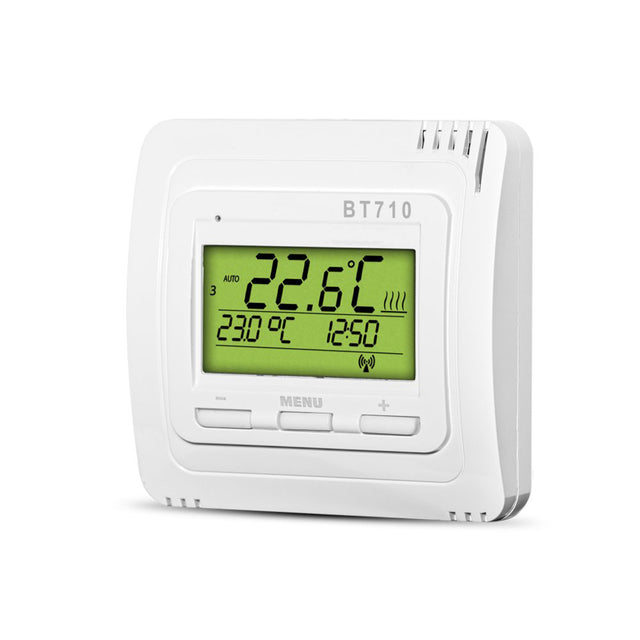
Wireless Elektrobock thermostats for flexible temperature control
Wireless Elektrobock thermostats control electric heating without a control cable between the thermostat and the switching receiver. This allows you to measure the temperature at a representative location in the room, while the receiver is placed near the heating appliance. This is practical for renovations, zone control, and spaces where new wiring is difficult or undesirable.
In this collection, you can compare wireless thermostats, receivers, and sets for various heating situations. Please pay close attention to the model number and the contents of the packaging. A standalone transmitter cannot switch a heater on and off independently; a compatible Elektrobock receiver is required for this.

How does a wireless Elektrobock thermostat work?
The thermostat acts as a transmitter and measures the room temperature. As soon as the measured temperature drops below the set value, it sends a radio signal. The connected receiver then switches on the heating system. When the target temperature is reached, the thermostat commands it to switch off again.
The connection between transmitter and receiver works via radio frequency. This is different from Wi-Fi. Therefore, a standard wireless thermostat does not automatically have an app, internet connection, or remote control. If you want control via a smartphone, explicitly check whether the chosen model supports Wi-Fi or a compatible gateway.
Which parts do wireless Elektrobock thermostats need?
Thermostat or transmitter
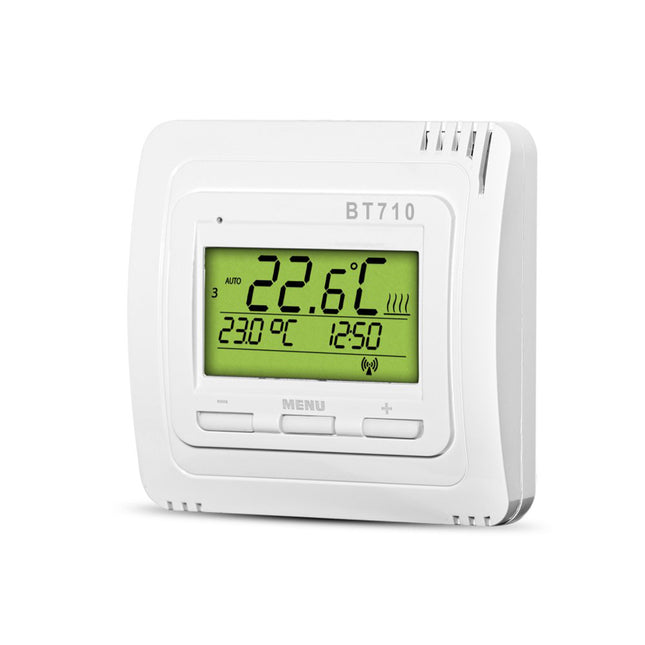
The transmitter measures the temperature and contains the controls. Depending on the model, you can choose a fixed temperature, a manual mode, or a weekly program. Place the transmitter at living height, out of direct sunlight, and not near a window, door, or heat source. Otherwise, it may not measure the average room temperature.
Wireless receiver
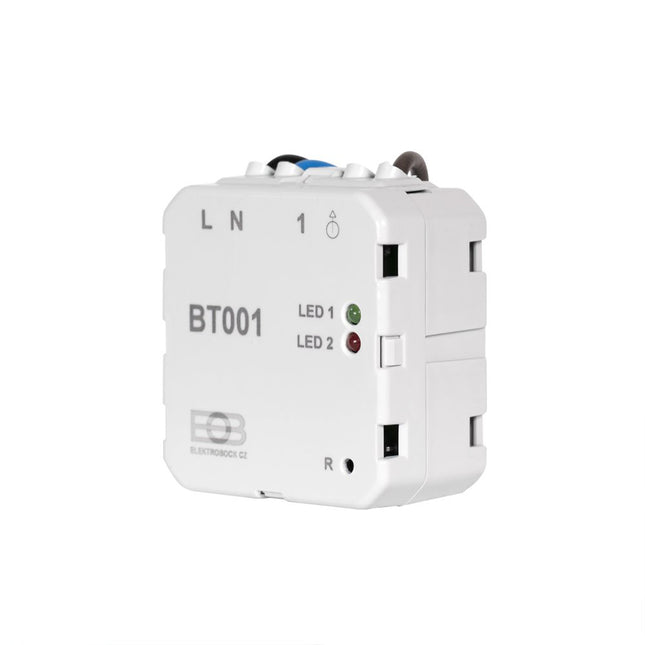
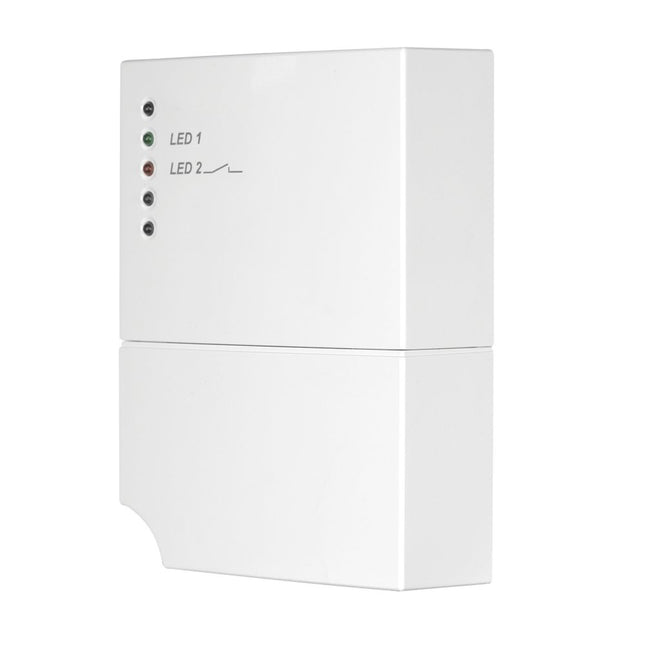
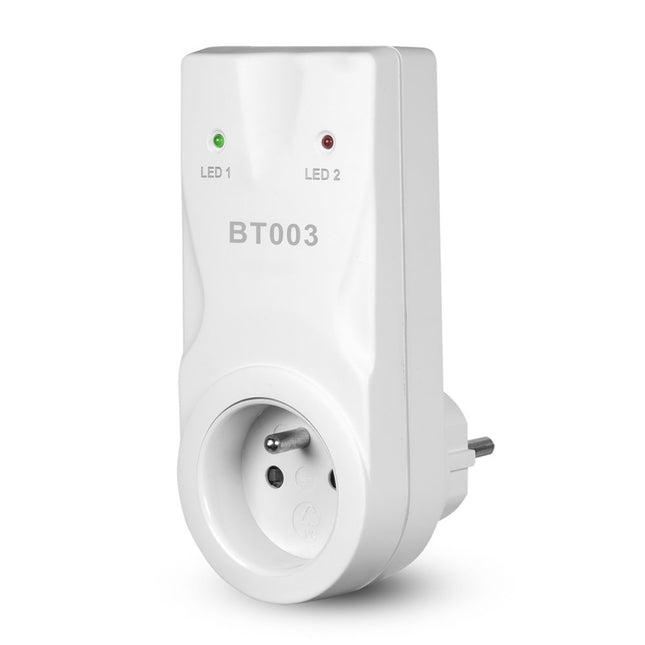
The receiver receives the radio signal and switches the connected heater. There are, among others, plug-in receivers, wall receivers, and built-in receivers. Which version fits depends on the appliance, the connection, and the desired mounting. Furthermore, always check the maximum switching capacity and the type of contact.
Complete thermostat set
A set typically contains a transmitter and a compatible receiver. This reduces the risk of an incorrect combination. Nevertheless, it remains important to read the product specifications. Some expansion products are intended for an existing installation and are therefore supplied without a thermostat.
Elektrobock BT and BPT: pay attention to the model name
With some Elektrobock products, you will encounter both a BT and an older BPT designation. The manufacturer states, for example, that BT710 was previously called BPT710. Therefore, always use the full model number when comparing thermostats and receivers. A similar name does not automatically mean that every component is interchangeable.
Also check whether you are viewing a thermostat, receiver, or complete set. For the BT/BPT710, the manufacturer lists compatible receivers such as the BT/BPT001, BT/BPT002, and BT/BPT003. However, the current range and product version may differ. Therefore, consult the specifications and manual of the specific item before purchasing.
Receivers for wireless Elektrobock thermostats
| Execution | Suitable when | Key check |
|---|---|---|
| Plug-in receiver | The electric heater is connected via a plug and remains within the permitted power. | Maximum current, maximum power, grounded socket and unobstructed placement. |
| Built-in receiver | You want a neat, fixed solution by or behind the heater. | Installation space, contact type and installation by a qualified professional. |
| Wall-mounted or boiler receiver | A heating source is controlled via a control contact. | On/off or potential-free contact and compatibility with the heat source. |
When dealing with multiple heating devices, never count only the number of appliances. Calculate the total connected power and compare this with the receiver's permissible load. A relay rated for a specific current must not be subjected to a higher load. If the total power is too high, a separate relay or contactor may be required. In that case, have the electrical setup assessed by an installer.
Suitable for electric heating and infrared panels
Wireless Elektrobock control can be used for electric radiators, convectors, and infrared panels that can be switched on and off externally. However, not every heating device is suitable for this. Some devices do not automatically return to the set heating mode after a power interruption. Others have their own electronic thermostat that may conflict with the external control.
Therefore, check three points: does the device resume automatically after power restoration, does the power remain within the receiver limit, and is the internal control correctly configured? With a built-in thermostat, the external room thermostat can only regulate properly when both settings work together logically.
Range of wireless Elektrobock thermostats
The stated range is a guideline under certain conditions. Concrete floors, reinforced walls, metal, technical cabinets, and other wireless equipment can weaken the signal. As a result, the range in a home or business premises may be shorter than in an open environment.
Therefore, do not place the transmitter and receiver unnecessarily close to large metal objects. Pair and test the system at the intended locations first before permanently mounting a fixed receiver. Furthermore, it is advisable to re-check whether the communication remains reliable after renovation or relocation.
Programming for comfort and targeted energy use
A programmable thermostat allows the temperature to align with your daily rhythm. This enables you to lower the heating when the room is empty and let it warm up in time for use. This can limit unnecessary heating hours. However, the final savings depend on insulation, outside temperature, settings, usage time, and the heating system.
The BT/BPT710 is described by the manufacturer as a programmable transmitter with multiple temperature changes per day. Additionally, this model can control multiple compatible receivers. Check per version how many time blocks, receivers, and control modes are actually supported. This will prevent you from expecting features that are only available on another model.
For a bedroom, a simple night-time reduction may suffice. In a home office, a weekly schedule is often more convenient. For multiple separately controlled rooms, you typically need a separate temperature sensor and compatible receiver for each zone.
How to choose the right wireless thermostat
- Determine the heat source. Is it an electric radiator, infrared panel, convector, or another system?
- Check the control method. Does the installation require a switched mains voltage, a potential-free contact, or another protocol?
- Calculate the load. Add up the power of all devices switched by a single receiver.
- Choose the receiver. Compare plug-in, flush-mount, or wall-mounted versions based on mounting and switching capacity.
- Check the pairing. Verify that the transmitter and receiver are compatible according to the manufacturer.
- Assess the range. Take into account walls, floors, metal, and the distance between both parts.
- Select the controls. Determine whether manual control, a weekly program, or Wi-Fi is desired.
Safely install wireless Elektrobock thermostats
A suitable plug-in receiver can often be connected without fixed wiring. Always follow the manual and use a suitable, grounded outlet. Do not use an overloaded power strip or coiled extension cord for powerful electric heating.
A flush-mounted or permanently connected receiver operates on mains voltage. Have such connections made or checked by a qualified electrician in accordance with the applicable regulations in Belgium or the Netherlands. Switch off the power before working on the installation. Furthermore, do not place a thermostat or receiver in a damp room unless the specific product and the installation zone permit it.
Frequently asked questions about wireless Elektrobock thermostats
Is a separate thermostat sufficient?
No, a wireless transmitter does not switch the heating directly. You need a compatible receiver. Choose a complete set if you do not yet own a suitable switching element.
Does a wireless thermostat work via Wi-Fi?
Not necessarily. Many wireless models communicate directly with their receiver via radio frequency. Only a Wi-Fi model or a system with a suitable gateway offers internet or app control.
Can one thermostat control multiple heaters?
Some models can connect multiple receivers. All connected devices then typically follow the same measured temperature and heat demand. Check the maximum number of receivers and the manual for the selected model.
Can I book multiple rooms separately?
Yes, but for independent zones, a separate thermostat or temperature sensor and a suitable receiver are usually required for each room. A single central transmitter cannot measure different room temperatures simultaneously.
Why is the room not reaching the set temperature?
Possible causes include insufficient heating power, heat loss, incorrect sensor placement, an interrupted radio connection, or an incorrect setting of the heater. First check the status of the transmitter and receiver, and then consult the manual.
Compare wireless Elektrobock thermostats
Don't just compare the price of the thermostat. Also consider the required receiver, switching capacity, control method, programming functions, and the range in your building. Finally, check whether the item is a standalone transmitter, an expansion unit, or a complete set. This way, you can choose a control system from our wireless Elektrobock thermostats that suits your heating system both technically and practically.