


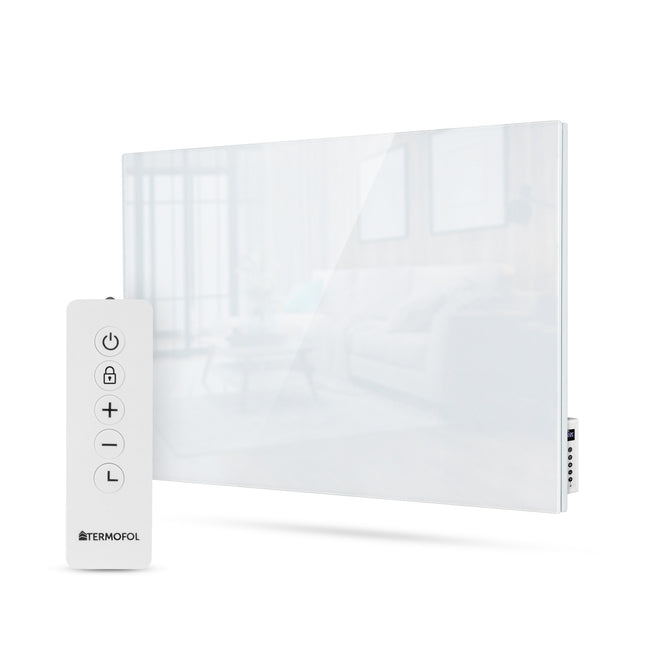
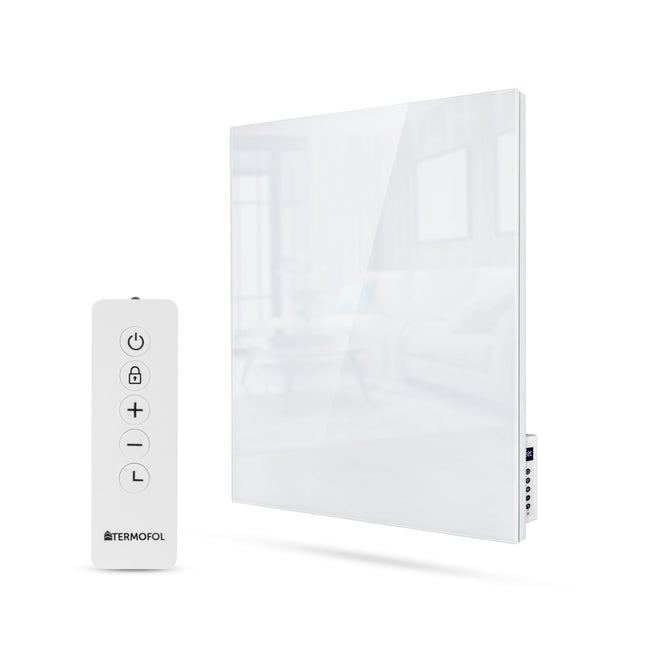
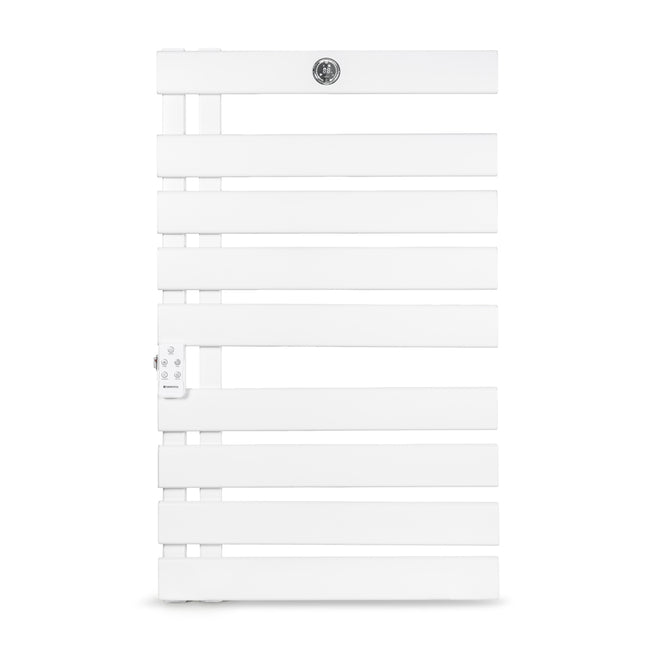

White infrared panels for wall and ceiling
White infrared panels combine electric radiant heat with a calm, light finish. As a result, they often blend unobtrusively against a white wall or ceiling in a living room, bedroom, office, or other interior space. However, the models differ in material, shade of white, power output, dimensions, mounting, and control. Therefore, compare more than just the color.
Would you like to know how the technology works first? Then view the main page about infrared panels. On this collection page, we help you choose specifically between white metal, glass, and framed panels.

How does a white infrared panel work?
An infrared panel converts electricity into heat. The heated surface radiates energy towards people, floors, walls, and objects within its range. These surfaces absorb heat and then release it. This feels different from convection heating, which primarily heats the air.
The white finish does not change the basic principle. Therefore, a white panel with the same electrical output is not automatically more energy-efficient than a black panel. Comfort is primarily determined by the surface temperature, radiation distribution, mounting location, control system, and the room's heat demand.
Advantages of white infrared panels
- Neutral look: white combines easily with light walls and ceilings.
- Space-saving: wall or ceiling mounting keeps the floor free.
- Silent operation: a panel without a fan makes little noise during normal use.
- Targeted control: with a thermostat, you heat per room or zone.
- Many versions: choice of metal, safety glass, a frame, or a frameless design.
- Main or supplementary heating: possible when capacity and distribution suit the application.
White, black or mirror glass?
White is suitable when the heating needs to remain visually calm. For contrast, you can black infrared panels . In a bathroom, hallway, or dressing room, a mirror panel combine heating and a mirrored surface.
Choose the finish only after the required power and a suitable mounting location are known. After all, a beautiful panel that is too light or hangs behind furniture will not provide the desired comfort.
Metal, glass, or aluminium frame?
| Execution | Features | What to look out for? |
|---|---|---|
| White metal panel | Often designed to be light and simple | Edge finishing, surface temperature and permitted installation |
| White glass panel | Sleek, smooth surface with a more pronounced design | Weight, wall load capacity, safety glass and gloss level |
| Panel with white frame | Clear framing and often various sizes | Color difference between frame and front, mounting bracket and total dimensions |
| Frameless white panel | Minimalist appearance | Actual edge, thickness and distance to wall or ceiling |
Not every white panel is made of the same material. Therefore, check the product information instead of assuming that all models are steel or glass. Material influences weight, appearance, cleaning, and installation, among other things, but the correct output remains decisive for the heat demand.
Which shade of white suits your interior?
White comes in multiple shades. RAL 9016 is often referred to as traffic white, while RAL 9010 generally appears warmer. Additionally, matte, satin, and gloss make a visible difference. Lighting and the color of the wall can further enhance the contrast.
Therefore, check the specified RAL code and finish. Photos on a screen are indicative only, as brightness and white balance vary by device. If you want the panel and ceiling to match as closely as possible, compare with a color sample if possible or view the product in daylight.
White infrared panels with thermostat
A room thermostat switches off the panel as soon as the set temperature is reached. Therefore, view infrared panels with a thermostat and check whether the sensor is located in the panel, on a separate control unit, or on an external receiver.
A sensor close to the hot panel may measure a different temperature than a sensor in a neutral location. Therefore, the sensor's position is important for accurate room control. Additionally, check whether the thermostat can safely switch the total connected power when multiple panels are operating in a single zone.
Calculate the power of white infrared panels
The required wattage depends on the surface area as well as heat loss. Consider insulation, glazing, exterior walls, ventilation, ceiling height, and the desired temperature. For primary heating, a heat loss calculation is the most reliable basis.
As a first indication, these bandwidths are often used:
- Well-insulated room: approximately 50–70 watts per m².
- Average insulated room: approximately 70–100 watts per m².
- Moderately insulated room: 100 watts per m² or more.
These values are not a guarantee. A high-ceilinged room or conservatory with a lot of glass can require significantly more power. Conversely, a well-insulated bedroom with little exterior surface area may result in a lower output. Therefore, do not round the calculation down without verification.
Main heating or local supplementary heating
As primary heating, the panels together must be able to compensate for the entire heat loss. Furthermore, the radiation must be distributed usably throughout the room. One powerful panel is not always more comfortable than two smaller panels in favorable positions.
For supplementary heating, you can specifically heat a desk, seating area, or dining table. The required power can then be lower, as the entire room does not need to meet the same heat demand. However, do take the line of sight into account: a cupboard or partition wall blocks part of the radiation.
White infrared panels in the living room
In a living room, seating position, windows, and furniture arrangement play a major role. Do not place a wall panel behind a sofa or curtain. When mounting on the ceiling, maintain the prescribed distance from people and the floor.
If you want to minimize the visibility of the panel, a white ceiling model might be suitable. However, do check whether the specific product is approved for ceiling mounting. Not every wall panel can simply be mounted horizontally to the ceiling.
comparing 700 to 1500 watts
For a small room or a specific zone, a 700-watt be suitable. For a higher heat demand, models up to 1500 watts available. However, the highest wattage is not automatically the best choice.
A 1,500-watt panel consumes a maximum of 1.5 kWh during one hour of continuous full power. In practice, the thermostat switches the panel on and off. Actual consumption therefore depends on heat loss, the set temperature, and the duration of use.
Wall mounting, ceiling mounting or freestanding
On the wall
Wall mounting directs the radiation horizontally into the room. Choose an open spot opposite or angled towards the living area. Keep the distances specified in the manual clear and check if the wall can support the weight.
On the ceiling
Ceiling mounting keeps walls and floor clear. Moreover, the panel can reach multiple surfaces from a central position. Use only the prescribed ceiling bracket and check the minimum mounting height.
Detached
Some panels can be used freestanding with suitable feet or a stand. This offers flexibility, but only if the manufacturer permits that setup. Keep the device stable and out of walkways.
Bathroom and damp rooms
A white finish does not automatically make a panel suitable for the bathroom. Check the IP rating, permitted installation zone, and mounting instructions for the specific model. Have a permanent electrical connection in a damp room carried out in accordance with the regulations applicable in Belgium or the Netherlands.
IP44 or another classification describes a certain level of protection, but does not independently determine where a device may be installed. The bathroom zone, distance to water points, and local installation requirements also remain relevant.
Maintenance and color retention
Switch off the panel and allow it to cool completely before cleaning. Use a soft, dry or slightly damp cloth according to the manual. Avoid abrasives and harsh cleaners, especially on glass, lacquer, and printed surfaces.
Smoke, cooking grease, dust, and direct sunlight can affect the white appearance over time. Therefore, do not place the panel in conditions for which it was not designed and keep the surface clean. Paint a panel only when expressly permitted by the manufacturer; paint can affect heat output and the warranty.
Choose and install safely
- Check the total power and the available circuit.
- Use only mounting parts intended for the panel.
- Never cover the heated surface.
- Keep a safe distance from furniture, curtains, and flammable materials.
- Check if a thermostat or receiver can switch the load.
- If in doubt, have a permanent connection installed by a qualified electrician.
Frequently asked questions about white infrared panels
Do white panels turn yellow?
The quality of the paint or glass, temperature, smoke, grease, UV light, and maintenance all play a role. Check the material and warranty information for the selected model and clean it according to the manual.
Are white panels more energy-efficient than black ones?
Not only by color. For the same electrical power, consumption depends primarily on duty cycle and control. Additionally, compare surface temperature, radiation distribution, and mounting.
Can any white panel be mounted on the ceiling?
No. Only when the manufacturer permits ceiling mounting and the correct bracket and spacing are used. Check this for each product.
Can I paint over an infrared panel?
Only when the specific panel is designed for it. Any paint layer can affect heat output, odor, safety, and warranty.
How many panels do I need?
That depends on the total heat loss and the layout. One panel may be sufficient for a small open zone. In a long or L-shaped room, multiple panels often distribute the radiation better.
Compare white infrared panels at Warmteshop
First, compare power, dimensions, material, white shade, and approved installation. Then, determine which thermostat and connection suit your space. Would you like to view a model or receive advice on the calculation? Then check the showroom locations. Additionally, you can find reviews and company information via the public Trustlocal profile.
Compare further: black panels · glass panels · mirror panels · selection guide for the best infrared panel.