


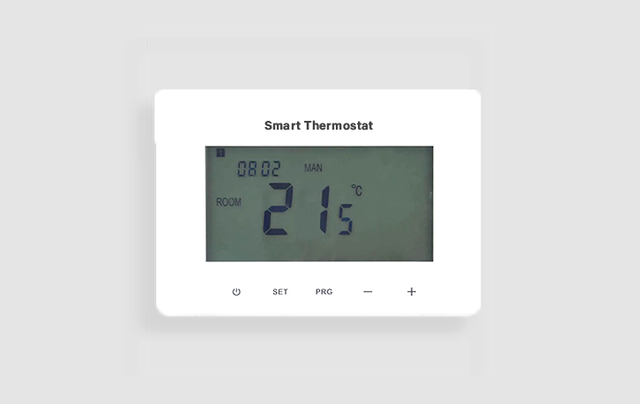
Infrared panel with thermostat: targeted heat control
An infrared panel with a thermostat combines direct radiant heat with automatic temperature control. The thermostat measures the room temperature and switches the panel on when heat is needed. This allows you to determine not only how warm the room gets, but also when the panel heats. At Warmteshop, you will find models from Termofol, Alkari, and Welltherm, among others, with various power outputs, materials, and control options. Furthermore, you can visit our 32 stores in the Netherlands and Belgium.

How does infrared heating with a thermostat work?
An infrared panel primarily heats people, walls, floors, and furniture within its radiation range. These surfaces then release heat into the room. Meanwhile, a thermostat regulates the room temperature. As soon as the measured temperature drops below the set value, the control system requests heat. When the target temperature is reached, the panel stops.
The thermostat usually does not continuously change the panel's output. It primarily determines when the panel switches on or off. Therefore, a correct power calculation, proper placement, and appropriate insulation remain important. A panel that is too small may struggle to reach the desired temperature, while a system that is too large switches on or off more often than necessary.
Built-in thermostat or separate room thermostat?
The term “built-in thermostat” can describe various systems. With some panels, the controls or receiver are located within the panel. With other models, a supplied remote control measures the room temperature and controls the panel wirelessly. Therefore, always check where the temperature sensor is located and which parts are included.
- Panel controls: compact and simple, but the sensor could be positioned closer to the heat source.
- Wireless room thermostat: measures at a more suitable location and can often manage multiple settings.
- Wi-Fi or app control: enables remote control and schedules, depending on the model.
- Separate control system: is often more practical when multiple panels need to work together as a single heating zone.
If you want to control multiple panels centrally, also consider a separate thermostat with suitable receivers. For specific automations, a compatible Shelly home automation module be an option. Always have the connection and maximum load checked.
Benefits of an infrared panel with thermostat
- The thermostat automatically maintains the set room temperature.
- You heat each room individually instead of the entire building at once.
- A daily or weekly program can limit unnecessary heating hours.
- Depending on the model, you operate the system locally, with a remote control, or via an app.
- The thin panel takes up little floor space and operates without a fan.
- You can choose from wall, ceiling, glass, metal, hybrid, and LED versions.
However, a thermostat does not automatically guarantee fixed energy savings. Actual consumption depends on the total power, operating hours, insulation, desired temperature, and room usage. A well-configured schedule helps primarily because the heating remains active unnecessarily for shorter periods.
When do you choose this combination?
An infrared panel with a thermostat is well-suited for a separate room where you want easily adjustable electric heating. Think, for example, of a home office, bedroom, kitchen, bathroom, practice room, or holiday home. Moreover, the system can be used as targeted supplementary heating when the central installation does not cover the same heat demand everywhere.
For primary heating, a heat loss calculation is important. Factors such as surface area, ceiling height, insulation, glazing, and outside temperature are taken into account. In a poorly insulated or very high room, a single panel may be insufficient. Therefore, have the total required power determined before choosing solely based on size or price.
Which version suits your interior?
Metal panels with thermostat
Metal panels are an accessible and discreet choice. They are available in various sizes and power outputs. Depending on the model, control is integrated or performed via a supplied thermostat. Compare our metal infrared panels based on power output, mounting method, and control technology.
Glass panels with smart control
A glass panel combines heating with a high-quality appearance. Some models offer Wi-Fi, a remote control, or programmable functions. Additionally, certain versions are suitable for damp rooms. Always check the IP rating and permitted mounting zone for this. View the glass infrared panels.
Hybrid panels
Hybrid infrared panels combine radiant heat with convection heat. As a result, they heat both surfaces and part of the room air. Some versions offer smart programs, open window detection, or app control. However, the exact functions vary by product.
LED panels with thermostat
A ceiling model with integrated lighting saves space and combines two functions. With LED infrared panels, heat and lighting can often be controlled separately. Pay attention to light color, dimmability, power, mounting height, and the included thermostat.
Determining the correct capacity
For an infrared panel with a thermostat, the wattage must match the heat loss of the room. A simple guideline per square meter can give a first impression, but it is not a complete calculation. For example, a corner room with a lot of glass requires more power than a well-insulated intermediate room of the same size. Ceiling height and desired indoor temperature also influence the result.
Therefore, measure the length, width, and height of the room. Next, note the year of construction, insulation level, type of glazing, and the number of exterior walls. Finally, determine whether the panel serves as primary or supplementary heating. With this data, an advisor can estimate the required power more accurately.
Installation of panel and thermostat
For a comfortable result, an infrared panel with a thermostat must be able to reach the usage zone effectively. Therefore, do not place a wall panel behind a cabinet, curtain, or large sofa. A ceiling panel must also be able to radiate freely and be mounted according to the installation manual. Always maintain the prescribed distance from materials and objects.
A separate temperature sensor should be placed in a representative location, out of direct sunlight, drafts, and the direct radiation beam of the panel. Otherwise, the measured temperature may deviate from the actual room temperature. Furthermore, a portable remote control with a sensor must not be left lying right next to an open window or other heat source.
Bathroom: pay attention to IP class and installation zone
Not every infrared panel with a thermostat is suitable for the bathroom. Check the IP rating of the panel as well as any controls or connections. The correct degree of protection depends on the installation zone and the distance to the shower, bath, and washbasin. Furthermore, a rating such as IP44 does not mean that the product can be installed anywhere in the bathroom.
Have a permanent electrical connection in a damp room carried out by a qualified installer. Additionally, follow the product manual and applicable electrical regulations. This will prevent unsafe or incorrect installation.
Wi-Fi, app control and smart features
An infrared panel with a thermostat and Wi-Fi primarily offers extra convenience. You can adjust the temperature before you get home, change a weekly schedule, or set a holiday temperature. Furthermore, some models support voice assistants, open window detection, timer functions, or consumption information.
Before purchasing, check which app is used, which Wi-Fi frequency is required, and whether all desired features are available without a subscription. Local control remains possible on many systems in the event of an internet outage, but this varies by model. Therefore, read the product specifications and manual instead of relying solely on the term “smart” or “Wi-Fi”.
Calculate consumption and costs
You calculate the maximum consumption of an infrared panel with a thermostat using a simple formula: power in kilowatts multiplied by the number of hours the panel actually heats. An 800-watt panel consumes a maximum of 0.8 kWh per full hour of heating. The thermostat can shorten the effective switch-on time once the set temperature is reached.
The final costs therefore depend on the electricity tariff and the actual duty cycle. In addition, heat loss and temperature settings play a major role. Therefore, do not compare panels solely on wattage: a correctly chosen system and a realistic program are at least as important.
Buy infrared panel with thermostat at Warmteshop
First, compare the required power and the desired mounting location. Then, consider the thermostat shape, sensor position, operation, and any Wi-Fi functions. Finally, check the IP rating, dimensions, connection, and included components. This way, you choose a system that suits the space both technically and practically.
Warmteshop has specialized in infrared heating since 2006. If you would like to compare the heating experience or different materials, please visit one of our 32 stores in the Netherlands and Belgium. Additionally, for multi-panel installations, you will find various separate thermostats and control solutions.
Frequently asked questions about infrared panels with thermostat
Is the thermostat always actually built into the panel?
No. With some models, the control and sensor are integrated. With other products, a wireless room thermostat or remote control is included. Therefore, please check the product description and the contents of the packaging.
Can one thermostat control multiple panels?
That depends on the system, the receivers, and the maximum switching load. Do not automatically use multiple panels on a single thermostat. Have the total load and connection checked first, and if necessary, choose a suitable separate thermostat with receivers.
Does a Wi-Fi panel also work without internet?
Local control remains available on many models, but remote control requires internet. Saving schedules also varies by product. Therefore, consult the manual for the specific panel.
Can the panel serve as primary heating?
Yes, provided the total power matches the heat loss of the room and the panels are properly installed. A professional power calculation is particularly important for larger or less well-insulated rooms.
Where does the thermostat measure the temperature?
That depends on the model. The sensor can be located in the panel, in a remote control, or in a separate wall thermostat. A sensor located away from the heat source generally provides a more representative room temperature.
Is a thermostat the same as a power regulator?
No. A thermostat switches based on the measured room temperature. A power controller or dimmer affects the heat output in a different way. Use only control equipment that is explicitly compatible with the panel.