
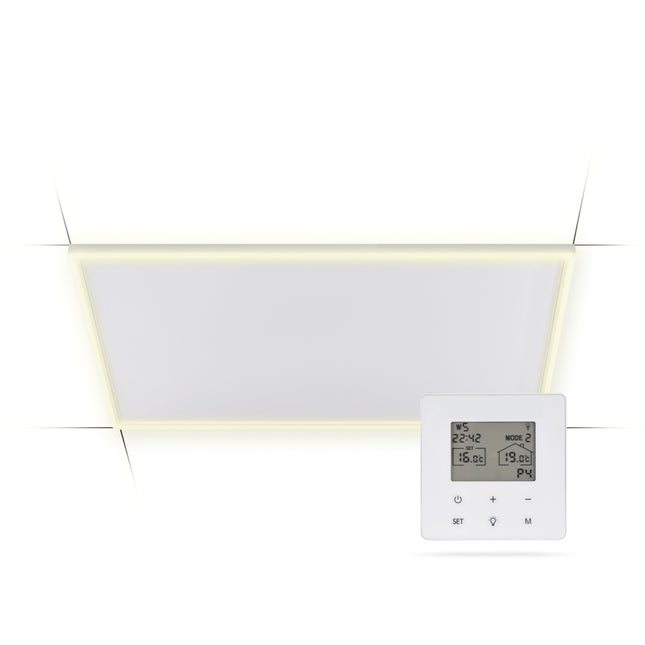
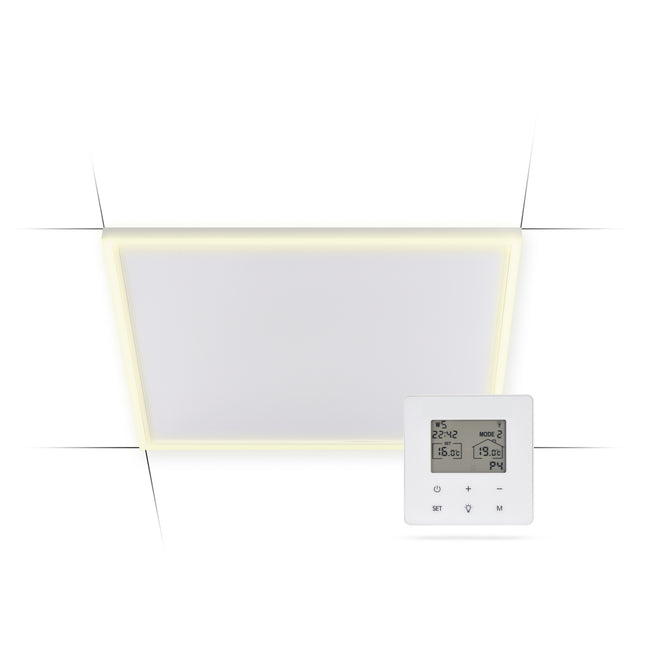
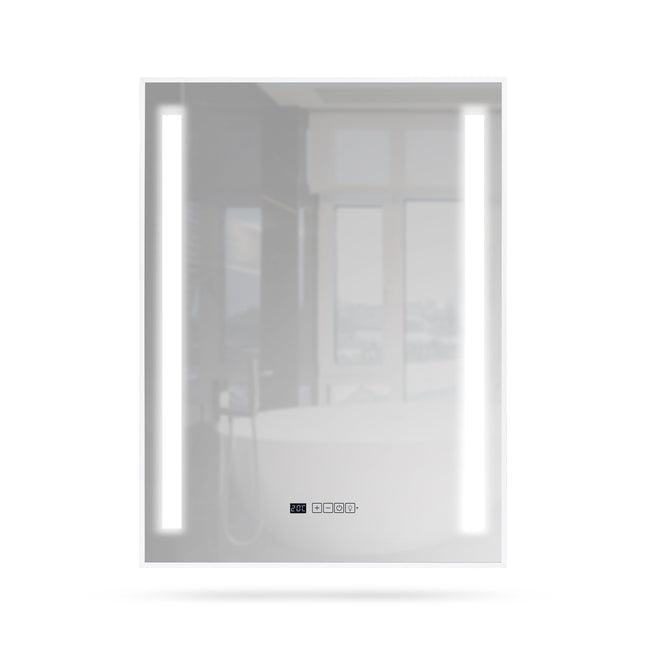

Infrared toilet heating with lighting: heat and LED in one
Infrared toilet heating with lighting combines targeted heat with practical ceiling lighting. As a result, you do not need to install a separate radiator and ceiling lamp. The floor and walls remain unobstructed, while a compact toilet space quickly feels more comfortable. This solution is suitable for homes, offices, shops, and medical practices.

However, the right panel does not depend solely on the dimensions. Insulation, ventilation, exterior walls, ceiling height, and service life also play a role. Furthermore, LED panels differ in light output, color temperature, control, and IP rating. Below, you can read how to compare these properties.
Why combine heat and lighting?
A toilet is often small and used only briefly. A traditional radiator takes up a relatively large amount of wall space there. A freestanding electric heater, on the other hand, requires floor space and can stand in the walkway. Therefore, a ceiling panel with integrated light is a neat solution.
Heating and lighting do not need to operate simultaneously. With suitable models, you control both functions separately. For example, you use the light during every visit, while a thermostat regulates the heat according to temperature and a schedule. This prevents the panel from continuing to heat unnecessarily.
A combination panel can also replace the existing ceiling lamp. However, this is not possible at every light point without modification. The available wiring, permanent power supply, and desired switching determine how the installation is carried out.
How does infrared heating work in a toilet?
An infrared panel converts electricity into radiant heat. This radiation heats people and surfaces within its range. Subsequently, the floor, walls, and sanitary fixtures return a portion of the heat to the room. As a result, the air heats up indirectly.
This differs from convection heating, which primarily circulates air. An infrared panel without a fan generally operates silently. Moreover, the system itself generates little air movement. This is pleasant in a small, enclosed space.
The heat is not immediately uniform everywhere. Distance, power, mounting position, and obstacles determine what you feel. Therefore, place the panel above the usage zone and follow the recommended mounting height of the chosen model.
Key Benefits
- Two functions in one: heating and LED lighting in a single ceiling solution.
- Clear walls: there is still room for a mirror, washbasin, cabinet, or accessories.
- No loss of floor space: handy in a narrow or compact toilet.
- Silent operation: models without a fan do not have a continuous airflow.
- Separate controls: with suitable models, you control light and heat independently.
- Zone control: a separate thermostat controls only the toilet area.
- Sleek finish: a thin white panel often blends seamlessly into the ceiling.
Be sure to check the product specifications. Not every panel has the same controls, light color, dimming function, or moisture resistance.
Ceiling mounting or wall mounting?
An infrared panel on the ceiling keeps the small space completely clear. Moreover, the radiation from above reaches the floor and the person under the panel. However, check whether the ceiling structure can support the weight.
When ceiling mounting is not possible, a wall-mounted infrared panel be an alternative. In that case, direct the panel towards the usage zone. Furthermore, keep it free of towels, toilet rolls, doors, and furniture.
Do you want infrared heat, but no integrated lamp? Then take a look at the collection of infrared heating for the toilet. A separate panel offers more freedom in the choice of fixture and lighting design.
How much power does a toilet need?
For infrared toilet heating with lighting, there is no fixed minimum value for every toilet room. First, determine the heat loss. Floor area and ceiling height are taken into account here. In addition, insulation, exterior walls, windows, ventilation, and the desired temperature are important.
A small indoor toilet generally requires less power than a room against a cold exterior wall. Moreover, mechanical ventilation removes heated air. Therefore, a heat loss calculation can yield a different result than a simple wattage-per-square-meter rule.
Insufficient power results in long running times and potentially inadequate comfort. Nor is a lot of extra power automatically better. The thermostat can switch off a powerful panel sooner, but the electrical load and purchase cost remain higher.
Also consider the usage strategy. For a residential toilet, a low base temperature with temporary comfort enhancements can be pleasant. In a busy office, the room may require a more constant schedule. Therefore, tailor the capacity to both the building and its usage.
LED lighting: look beyond just warm or cool white
The quality of the light determines how pleasant and practical the toilet area feels. Therefore, compare the light output in lumens. Also look at color temperature, color rendering, dimmability, and spread. The wattage of the LED alone says little about the actual brightness.
Warm white light generally creates a softer atmosphere. Neutral white is often practical near a mirror. Adjustable models allow you to switch between color temperatures. However, not every system remembers the last selected setting after a power interruption.
Additionally, check whether the light is diffused directly, indirectly, or via a rim frame. Direct light illuminates the space precisely. Indirect light may appear softer but may require extra lumens. A small toilet particularly benefits from even distribution without harsh shadows.
Do you want to dim? Then check which control unit belongs to the panel. A standard wall dimmer is not automatically compatible with the built-in LED driver. Therefore, use only a suitable remote control, app, switch, or dimming module.
Control heating and lighting separately
With a good infrared toilet heater with lighting, you can use the functions independently. The light switches on, for example, via a wall switch or sensor. Meanwhile, the heating responds to a thermostat and program.
Separate operation sometimes requires extra wires or a permanent power supply. A wireless receiver may have different requirements than a wired thermostat. Therefore, discuss the desired operation before installation. Running new wiring afterwards is often more difficult.
Also pay attention to what happens when the main switch interrupts the entire power supply. Some smart functions will then temporarily lose connection. Other models retain settings or restore automatically. The manual indicates what behavior you can expect.
Thermostat, timer, Wi-Fi and presence sensor
A room thermostat measures the temperature and switches the heating element on according to the set value. A program adds fixed operating times. This allows the toilet to reach the desired temperature before busy periods and then switch back down.
Wi-Fi control offers operation via an app. Please check network requirements, account usage, and the availability of manual control. After all, the heating must remain usable even when the internet or the app is temporarily unavailable.
A presence sensor is particularly useful for lighting. For heating, switching it on only during a brief toilet visit is often too late. A thermostatic schedule usually provides more predictable comfort. In a commercial restroom, a combination of a basic schedule and sensor logic can be beneficial.
Do not place the temperature sensor directly under the panel or next to a ventilation grille. Otherwise, the measurement may deviate from the rest of the room. Preferably choose a representative location without drafts or direct radiant heat.
Ceiling mounting
- Check whether the model is explicitly approved for ceiling mounting.
- Determine the ceiling material and the load-bearing capacity of the structure.
- Locate cables and pipes before drilling.
- Use the prescribed bracket and all attachment points.
- Respect the clearances specified in the product manual.
- Plan the wiring for lighting and heating before installation.
- Test thermostat, lighting control, and any sensor after installation.
Concrete, wood, and plasterboard require different fasteners. Sometimes you need to anchor into the underlying supporting structure. Have the installation assessed if you have any doubts about the ceiling or the weight.
An existing light fixture may be usable, but does not automatically provide the correct switching. A panel with a thermostat may require a permanent power supply. Therefore, have fixed wiring installed or checked by someone with knowledge of electrical installations.
Energy consumption and operating costs
You calculate the maximum hourly consumption based on the heating capacity. Divide the wattage by 1,000. A 400-watt panel consumes a maximum of 0.4 kWh during one hour of continuous operation. Additionally, the LED lighting has its own, usually lower, power consumption.
The actual running time depends on insulation, ventilation, the set temperature, and usage. A thermostat switches off the heating when the target temperature is reached. As a result, the average consumption is often below the maximum hourly consumption.
Compare systems with the same heat requirement. A low wattage is not automatically more economical if the panel has insufficient power and runs for a long time. For broader context, also read how the consumption of infrared heating is assessed.
Toilet or bathroom: note the difference
A toilet room is usually drier and used for a shorter period than a bathroom. Nevertheless, a hand basin, cleaning water, or a nearby shower can affect the required protection. Therefore, always check the IP rating and installation zone.
For a larger or wetter room, it is better to compare infrared heating solutions for the bathroom. There, moisture resistance, higher comfort temperatures, and electric zones are often more important.
An IP code describes protection against contact, dust, and moisture. The correct class depends on the location. Therefore, a general statement such as “suitable for sanitary use” does not replace a product specification or installation instruction.
Safety in a small space
With infrared toilet heating with lighting, the panel surface can become hot. Ceiling mounting limits accidental contact but does not make the system risk-free. Maintain the prescribed distance from fixtures, cables, and other materials.
Never cover the panel. Do not hang clothing or decorations on it. Switch off the system in case of damage, discoloration, a loose bracket, or an unusual odor. Clean only when the panel is cool and de-energized.
Do not use just any smart plug or dimmer. First check the maximum switching load and compatibility. General European information on energy and electrical solutions can be found via the European Commission's energy portal.
Buying Checklist
- Required heat output based on insulation and ventilation.
- Light output, color temperature, dimmability and color rendering.
- Separate control of heating and lighting.
- Thermostat, timer, Wi-Fi, and optional presence sensor.
- Dimensions, weight, and load-bearing capacity of the ceiling.
- IP rating and permitted installation position.
- Required wiring, receiver, and circuit.
- Manual operation when app or network is unavailable.
- Warranty conditions, manual and installation service.
With these points, you compare more than just price and wattage. This way, you choose a system that is technically compatible with the toilet and easy to operate.
Why Warmteshop?
Warmteshop helps you evaluate heating, lighting, and controls as a single system. Our advisors therefore consider the space, insulation, ceiling, ventilation, and daily use. In our showrooms, you can compare various panels and lighting solutions.
Independent reviews via Trustprofile provide additional insight into service and customer experiences. When requesting advice, please bring the dimensions, ceiling height, and photos of the existing light fixture.
Additionally, view the full range of infrared panels from Warmteshop. This allows you to compare a combination panel with separate wall and ceiling solutions.
Frequently Asked Questions
Can the panel replace the existing ceiling lamp?
This is possible provided the light output, mounting, and electrical connection are suitable. Check whether heating and lighting require separate power supply or controls. An installer can assess the existing light point.
How many watts do I need for a toilet?
That depends on dimensions, insulation, exterior walls, ventilation, and the desired temperature. Therefore, use a heat loss calculation instead of a single fixed minimum value for every toilet room.
Should the heating switch on at the same time as the lights?
No, with suitable models, you can control both functions separately. A thermostat then controls the heat, while a switch or sensor operates the lighting.
Is Wi-Fi necessary?
No. A programmable thermostat without Wi-Fi may be sufficient. Wi-Fi is mainly useful when you want to adjust schedules and settings remotely.
Is infrared toilet heating with lighting suitable for a guest toilet?
Yes, provided the power, light output, and installation are suitable for the room. A schedule or low base temperature prevents the heating from running at maximum capacity continuously.
Can I install the system myself?
Mechanical mounting is possible if the manual permits and the ceiling is suitable. However, have fixed wiring, extra switch wires, or questionable plumbing installations assessed by a professional.