

Infrared heating 20m²: choosing power and panels
Infrared heating for 20m² can be a comfortable solution for a bedroom, home office, dining room, or compact living room. However, the correct power output does not depend solely on the floor area. Insulation, ceiling height, glazing, exterior walls, ventilation, and whether it is used as primary or supplementary heating all combine to determine how much heat is required.
For local supplementary heating, a panel from the 700-watt infrared panel already provide immediate comfort within the radiation zone. If you want to maintain the entire room at temperature, a higher total output or a combination of panels is often required. Below, you can read how to make a responsible choice.

How does infrared heating work in a 20 m² room?
An infrared panel converts electricity into heat and emits a large portion of it as long-wave heat radiation. People, floors, walls, and furniture within its range absorb this radiation and subsequently release heat into the surroundings. As a result, the effect feels different from that of a convector, which primarily heats the air.
Heat is most evident where the panel can radiate freely. A cupboard, partition wall, or large piece of furniture can block the line of sight. Therefore, wattage and surface area are not the only factors that matter. The mounting location, panel shape, and distribution throughout the room also determine comfort.
How many watts of infrared heating for 20m2?
Use watts per square meter solely as a first indication. For a room of 20 m² with a typical ceiling height, you can use the ranges below to determine the order of magnitude. A heat loss calculation remains more accurate.
| Situation | Indicative heat demand | Indicative total for 20 m² |
|---|---|---|
| Well insulated, small exterior surface area | approximately 50–70 W/m² | approximately 1,000–1,400 watts |
| Average insulation | approximately 70–100 W/m² | approximately 1,400–2,000 watts |
| Moderately insulated, lots of glass or heat loss | 100 W/m² or more | 2,000 watts or more |
These figures do not constitute a product guarantee. A terraced house with insulated facades, for example, requires less than a detached conservatory with a lot of glass. A three-meter ceiling also increases the room volume compared to the standard height. Therefore, for primary heating, have the heat loss per room calculated.
Infrared heating 20m2 as primary or supplementary heating
Infrared as primary heating
As primary heating, the entire system must be able to compensate for the calculated heat loss on a cold day. Furthermore, the radiant heat must be distributed usably throughout the room. In that case, a single 700 or 900-watt panel is not automatically sufficient for 20 m², even though the heat close to the panel feels pleasant quickly.
Infrared as supplementary heating
For a fixed workstation, seating area, or dining table, lower power can provide targeted comfort. In a workspace, you can combine this with infrared panel desk. You then heat primarily the zone in use rather than the entire air volume. This can be practical when the base heating already keeps the room at a lower temperature.
Wall or ceiling for infrared heating 20m2?
A wall-mounted model primarily projects horizontally into the room. Choose a spot without a sofa, cupboard, or curtain directly in front of it. Aim the panel at the zone where you spend time, but adhere to the mounting distance and clearance specified in the manual.
A ceiling panel keeps walls clear and can distribute radiation evenly across a walking, sitting, or working zone. Ceiling height and minimum distance to people are important in this regard. Always check whether the chosen panel is approved for ceiling mounting and use the prescribed brackets.
One or more panels for infrared heating 20m2?
A single panel requires fewer connection points and is often easier to control. Two smaller panels, on the other hand, can distribute radiant heat better across an elongated room or two usage zones. The total required power does not automatically change due to the number of panels; it is primarily the distribution and controllability that change.
- Choose one panel for a compact, open room with a convenient central mounting location.
- Choose multiple panels for an L-shaped room, multiple seating areas, or obstacles in the line of sight.
- Work with zones when parts of the space are used at different times.
- Check the connection when multiple panels are switched via a single thermostat or receiver.
Applications per room
Living room and dining room
In a 20 m² living room, windows, exterior walls, and the position of the seating area play a major role. Position the panel so that the main living zone falls within the radiation range. For a dining area, a separate zone can be useful when the rest of the room does not require a consistently constant temperature.
Bedroom
An infrared panel operates without a fan and is therefore quiet. Program the thermostat around usage hours and do not choose an unnecessarily high temperature. Keep bedding, curtains, and furniture outside the prescribed clearance area.
Bathroom
For a bathroom, use only a panel suitable for the specific damp room and installation zone. To do so, see infrared heating for the bathroom. The IP rating, installation zone, and electrical connection must comply with the regulations applicable in Belgium or the Netherlands.
Design that suits the space
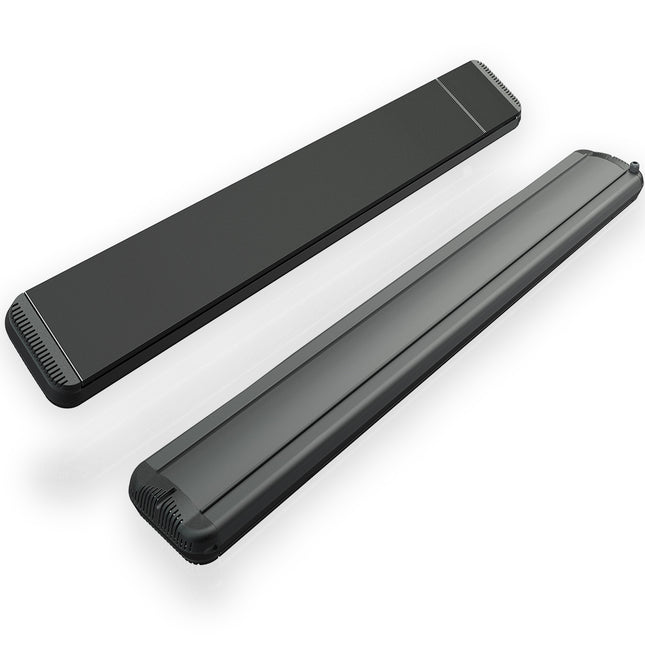
White infrared panels often blend in seamlessly against a light wall or ceiling. Black panels, on the other hand, provide a distinct graphic accent. For a modern finish, you can compare glass infrared panels
In a hallway, bedroom, or bathroom, a mirror panel combine two functions. Please note, however: the material and finish do not independently determine how much heat the room requires. Therefore, always compare the power output, mounting method, and product specifications first.
Which panel combination fits 20 m²?
A 700-watt panel may be suitable for targeted supplementary heating or a very low heat demand. A 1000-watt infrared panel delivers more heat, but for primary heating of 20 m², it is still only suitable if the calculated heat demand falls within that capacity.
If the calculation results in 1,600 watts, for example, you can consider one suitable high-power panel or two panels with a combined output of approximately 1,600 watts. Choose the combination based on available mounting locations, beam angle, electrical connection, and desired zone control. Never round down significantly without verification.
Controlling 20m² infrared heating with a thermostat
A room thermostat prevents the panels from continuing to heat after the set temperature has been reached. Therefore, compare infrared panels with a thermostat and check where the temperature sensor is located. A sensor close to the warm panel may measure differently than a sensor in a representative spot in the room.
With Wi-Fi and app control, you can manage schedules and temperature remotely, depending on the model. This does not automatically save energy. The savings come from heating empty rooms for shorter periods or to a lower temperature.
Calculate infrared heating consumption for 20m2
You calculate the maximum consumption using: power in kilowatts × number of hours at full power = kWh. Two panels with a combined 1,600 watts use a maximum of 1.6 kWh during one hour of continuous heating. Multiply this by your current electricity rate to estimate the costs for that hour.
In practice, a thermostat switches the heating on and off. The actual operating time depends on heat loss, outside temperature, and settings. Therefore, no one can state a guaranteed energy saving based solely on 20 m². Measure consumption over several representative days and always compare the same comfort temperature.
Safe installation
Check if the wall or ceiling can support the weight and use the supplied or prescribed mounting hardware. Keep away from furniture and flammable materials. Never cover a panel. Do not connect multiple panels to a single power strip, receiver, or circuit without checking.
For a permanent connection, bathroom installation, or high total power, it is preferable to engage a qualified installer. Additionally, check whether an external thermostat or receiver can safely switch the entire connected power.
Frequently asked questions about infrared heating for 20m²
Is 700 watts enough for 20 m²?
This can be used as local supplementary heating or in cases of exceptionally low heat loss. For full primary heating, 700 watts is usually only appropriate if a heat loss calculation confirms this.
Is 1000 watts enough for a room of 20 m²?
With very good insulation, 1,000 watts can be close to the calculated heat demand. With average or moderate insulation, more total power is generally required. Therefore, look beyond the floor area.
Should infrared heating be mounted on the wall or the ceiling?
Both can be suitable provided the panel is approved for this. Choose the position with an unobstructed line of sight to the living area and follow the manufacturer's minimum mounting distances.
Can infrared be the only heating?
Yes, provided the system is calculated for the full heat loss and the panels are well distributed. For a poorly insulated room, insulating first or choosing a different heating solution might be wiser.
Does an infrared panel provide instant heat?
You will experience radiant heat as soon as the panel reaches temperature. Heating up all surfaces and the entire room takes longer. The exact heating time varies by panel and room.
Advice for infrared heating 20m2
Start with the intended use and a realistic heat loss calculation. Then choose the total capacity, the distribution over one or more panels, the mounting position, and the control system. Also view the independent company profile via Trustlocal and, if desired, visit a Warmteshop showroom for personal advice.
Would you like to compare all models first? Then view the full range of infrared panels. This way, you choose infrared heating for 20m² based on comfort, technology, and actual heat demand.