



Choosing bathroom heating: comfortable, safe, and suitable for your space
Bathroom heating must provide comfort quickly and be suitable for a humid environment. That is why you should not only look at the design or wattage. The dimensions, insulation, ventilation, placement, and electrical safety zones determine which solution fits. At Warmteshop, you will find infrared panels, heated mirrors, electric towel radiators, underfloor heating, and complete sets. This allows you to make a targeted choice for primary heating, supplementary heating, or warm towels.

Which bathroom heater suits your needs?
Start with the purpose of the heater. Do you want to keep the entire bathroom at a comfortable temperature, only extra heat while showering, or primarily dry towels? A single appliance can combine multiple functions, but not every towel model provides enough power for the entire room.
Next, note the length, width, and height of the bathroom. Also examine the exterior walls, windows, insulation, and existing ventilation. This will allow you to better estimate the heat loss. After all, a compact, well-insulated bathroom requires a different approach than a spacious bathroom with a large window.
Compare infrared, radiator, or underfloor heating
Infrared panel for targeted radiant heat
An infrared panel heats surfaces and people via radiation. As a result, the heat feels more direct within the radiation zone. The panel can be mounted on the wall or, if the model allows, on the ceiling. View our infrared panels for the bathroom.
A panel with integrated lighting combines two functions at a single connection point. This is particularly useful in a small space or for ceiling mounting. However, be sure to check the light output, color temperature, dimmability, and permitted mounting zone separately. Compare our LED infrared panels.
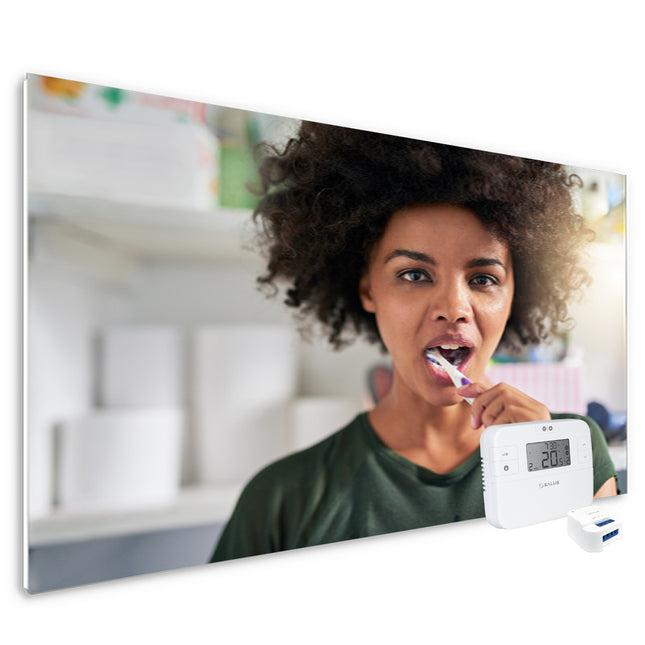
Heated mirror above the washbasin
An infrared mirror heater makes efficient use of the wall above the washbasin. Due to the heated surface, the mirror fogs up less quickly. However, good ventilation remains necessary to remove moisture from the entire bathroom. Therefore, do not choose the size and power based solely on the mirror width.
Electric towel radiator
An electric towel radiator heats or dries towels and can also emit heat into the room. Check whether the stated power output is intended exclusively for towels or also for room heating. After all, a low-power towel warmer is not automatically sufficient as the sole heat source.
Underfloor heating under tiles
Electric underfloor heating provides even heat from the floor and keeps the walls free. This makes the system well-suited for renovations involving new tiles. A mat directly beneath the finish generally reacts faster than a cable embedded in a thick screed. Plan the system only on the exposed floor surface and not under fixed sanitary fixtures or enclosed cabinets.
Bathroom heating as primary or supplementary heating
For supplementary heating, the focus is primarily on comfort during short periods of use. A targeted infrared panel, towel radiator, or floor mat can be a good addition in this regard. However, as primary heating, the entire system must be able to cover the calculated heat loss of the bathroom.
Therefore, pay attention to the available wall and floor space. A large part of the bathroom is occupied by the shower, bath, and furniture. As a result, a panel with sufficient total capacity can sometimes be more practical than underfloor heating alone. In other situations, a combination actually yields the best result.
How do you calculate the required power?
A fixed watt-per-m² or watt-per-m³ rule is merely an initial estimate. Heat loss also depends on exterior walls, glazing, ventilation, desired temperature, and insulation level. Moreover, the desired bathroom temperature is often higher than in a bedroom.
Therefore, have a heat loss calculation performed for primary heating. Provide the internal dimensions, window dimensions, year of construction, insulation, and adjacent rooms. Also indicate whether the unit heats the bathroom continuously or only around usage times. This prevents an undersized system that runs for extended periods.
Example of a consumption calculation
You calculate the maximum power consumption using: power in kilowatts × duty cycle × electricity price per kWh. A 1 kW appliance that heats at full power for one hour uses a maximum of 1 kWh. In practice, a thermostat switches off the element when the set temperature is reached.
The actual costs therefore depend on heat loss, settings, and duration of use. Program the bathroom heating around your morning and evening routine. This way, the room does not need to remain at a comfortable temperature all day.
Electrical zones and IP rating in the bathroom
A bathroom has safety zones around the bath and shower. The permitted equipment, IP rating, and connection method differ per zone and may depend on the applicable national installation regulations. Therefore, never use only a general internet table to determine the placement.
Check the product manual and have the chosen position assessed by a qualified electrician. The IP code describes the protection of the housing against contact, solid particles, and water. However, a higher value does not automatically make a device suitable for every zone.
- Choose only a product that the manufacturer approves for bathroom use and the planned mounting position.
- Have the power supply, RCD, and required equipotential bonding checked in accordance with local regulations.
- Maintain the minimum distances to the bath, shower, taps, ceiling, and other surfaces.
- Install switches, plugs, and thermostats only where installation regulations permit.
Moisture, condensation and ventilation
Heating can keep surfaces warmer and thereby aids drying after showering. However, bathroom heating does not replace ventilation. Moisture must be able to leave the room via a properly functioning mechanical exhaust, ventilation grilles, or a suitable ventilation system.
Mold can have various causes, including thermal bridges, leaks, and insufficient ventilation. Therefore, address the source first. Simply adding extra heating does not guarantee that existing mold will disappear. Clean affected materials safely and seek expert advice for structural problems.
Thermostat, timer and smart control
A thermostat prevents the bathroom from overheating unnecessarily. With a weekly program, you schedule moments of comfort, while a timer is suitable for short use. Wi-Fi control can be convenient for varying routines, but always check whether the controller is compatible with the appliance and its total power output.
An integrated control system saves extra wall space. Therefore, compare our panels with a built-in thermostat. Please note that the thermostat must be able to measure the air temperature without being directly affected by the panel or sunlight.
Sunshower and heat while showering
A Sunshower provides targeted infrared heat in or near the shower. Depending on the chosen model, additional lighting functions may be available. Therefore, always check the product specifications, operating instructions, and possible contraindications for the exact model.
Have the installation carried out in accordance with the manual and the electrical bathroom regulations. Furthermore, do not make general medical expectations of infrared or UV functions. The product is intended for comfort and must be used for the indicated operating time.
Complete set or individual parts?
A complete set helps to match the panel, thermostat, and mounting materials. View our complete bathroom heating sets. Do check that each component is suitable for the planned bathroom zone and surface. Also view our panels with built-in thermostat.
With a modular configuration, you have more freedom in design and operation. On the other hand, you must check the electrical load, compatibility, and mounting requirements yourself. Therefore, seek advice in advance when combining different brands or control systems.
Where do you place the bathroom heating?
Wall mounting
Direct a wall panel at the zone where you dry yourself or get dressed. Do not hang it behind a door, cupboard, or towel rack that blocks the radiation. Additionally, check whether the wall can support the weight and whether the cable runs safely to the connection point.
Ceiling mounting
Ceiling mounting distributes the radiation over a larger free surface and saves wall space. However, the model must be explicitly suitable for this. Adhere to the prescribed mounting height and distance to the shower, lighting, and ceiling materials.
Mirror or towel radiator
A heated mirror fits logically above the washbasin. A towel radiator works best when you can easily reach the towels without completely blocking the airflow or heat output. Also, take the doorway and walking route into account.
Have bathroom heating installed safely
- First determine the required power and the desired heating zone.
- Next, choose a device that is approved for bathroom use and the mounting position.
- Have the electrical zone, power supply, and protection checked by a qualified professional.
- Use the supplied stirrups and respect all clearances.
- Next, test the thermostat, timer, and shut-off before daily use.
- Regularly check cables, mounting, and ventilation for damage or blockage.
Would you like help with assembly and connection? Check out our professional installation service.
Common mistakes with bathroom heating
- Calculate only on floor area and forget about insulation or ventilation.
- Choosing a towel warmer as the complete room heater without checking the power.
- Confusing the IP code with automatic authorization for each bathroom zone.
- Place an infrared panel behind furniture, doors, or thick towels.
- Turn off ventilation because the heating makes the room feel drier.
- Mounting a thermostat too close to the heat source, causing it to switch off too early.
Buy bathroom heating at Warmteshop
A good choice starts with the function, heat requirement, and a safe installation location. Therefore, compare infrared panels, mirrors, towel radiators, and underfloor heating based on power output, controls, and suitability for the bathroom. You can engage our installation service .
Frequently asked questions about bathroom heating
Which bathroom heater heats up quickly?
A directional infrared panel and many electric radiators provide palpable heat relatively quickly. However, the full heating time of the room depends on power, insulation, mass of walls and floor, and ventilation.
Can a towel radiator heat the entire bathroom?
This is possible if the output covers the calculated heat loss. A model that primarily heats towels sometimes has insufficient capacity. Therefore, check the room heating specifications.
Is an infrared panel suitable for a humid bathroom?
Only if the manufacturer, IP rating, and installation instructions match the planned zone. Have the exact position and electrical connection assessed by a qualified installer.
Does heating help prevent condensation?
Warmer surfaces can limit condensation, but ventilation remains necessary. In the event of persistent dampness, you should also investigate leaks, thermal bridges, and inadequate drainage.
Can I install bathroom heating myself?
Always follow the manual. Because electrical safety regulations in bathrooms are strict, it is best to have the zone selection and fixed connection carried out or checked by a qualified electrician.
How much does electric bathroom heating cost per hour?
Multiply the power in kW by the operating time and your electricity price per kWh. A thermostat reduces the actual operating time as soon as the set temperature is reached.
What is a Sunshower?
A Sunshower provides targeted infrared heat while showering. Features vary by model. Therefore, follow the product specifications, operating time, and safety instructions.