

Off gas in 2026: Your complete guide to gas-free living and heating
, by Warmteshop, 18 min read
, by Warmteshop, 18 min read
The impending obligation to heat more sustainably feels like a financial time bomb to many homeowners. Yet, in reality, the year 2026 marks your greatest opportunity for a structurally lower energy bill. You mo…
The impending obligation to heat more sustainably feels like a financial time bomb to many homeowners. Yet, in reality, the year 2026 marks your greatest opportunity for a structurally lower energy bill. You are likely worried about the announced tax shifts from electricity to gas. Does an expensive heat pump really fit in your home? It is understandable that unclear subsidies and the fear of a major renovation are causing you to hesitate at this moment.
In this guide, you will discover exactly how to approach the switch to gas-free living by 2026 smartly and cost-effectively. We show you how infrared heating brings the healthy, natural warmth of the sun into your living room. This provides you with financial security through immediately lower monthly costs. We present a concrete action plan that allows you to switch to a future-proof system without any disruptive work, a system that heats not only your home but also your well-being. In this article, we dive deep into the figures and practical possibilities for your specific living situation.
The Dutch government has set a clear course for making our homes more sustainable. The aim to natural gas by 2026 sets a milestone forces homeowners to make strategic choices. This transition goes beyond just the environment; it represents a fundamental shift in how we manage our monthly expenses. The Energy Transition in the Netherlands ensures that the familiar central heating boiler is slowly but surely making way for innovative electric systems that are not only more efficient but also offer greater comfort.
Waiting until 2026 could be a costly mistake. Fossil fuel prices are on an upward trend, while the technology for gas-free living is already mature and available. By taking steps towards an all-electric home now, you immediately reduce your CO2 emissions and protect yourself against the vagaries of the gas market.
The government is implementing a fiscal incentive to accelerate the switch to electricity. The energy tax on gas is rising annually by an average of 5 to 10 cents per m³, while the tax on electricity is actually being reduced. In 2026, this price difference will be even more prominent on your energy bill. Moreover, the phasing out of the net metering scheme will take shape starting in 2027, which means that directly using your own solar power for heating will become essential for your return on investment.
There has been much debate regarding the mandatory hybrid heat pump. Although the current government has relaxed the strict obligation regarding the replacement of a central heating boiler, the national CO2 targets for the built environment remain fully in effect. In many situations, such as apartments or homes where an outdoor unit cannot be installed, alternative solutions are necessary. A completely gas-free home is often achievable sooner than you think.
These national objectives require careful planning at the municipal and regional levels. To visualize and analyze the impact of the energy transition on the built environment, urban planners and governments use advanced software. A platform such as 3D Cityplanner, for example, helps to calculate and present scenarios for sustainable area development.
At Warmteshop, we view the transition as an opportunity to redefine living comfort. Instead of complex installations that make the air dry and dusty, our infrared heating systems offer healthy, natural warmth that directly heats the objects and people in the room. This principle, comparable to solar radiation, is not only energy-efficient but also aesthetically pleasing and integrates beautifully into any interior. We are happy to guide you through the regulations to a solution that suits your specific living situation and budget.
The transition to be completely gas-free by 2026 requires a critical look at your current heating method. While the government presented the hybrid heat pump as the standard for years, recent changes to the heat pump mandate show that this compulsion is off the table. This opens the door to efficient alternatives such as infrared heating. The investment costs of a (hybrid) heat pump average between €5,000 and €15,000, whereas you can often equip a home with high-quality infrared panels for a fraction of that amount.
The installation impact differs significantly per system. A heat pump often requires new, thicker piping and an outdoor unit, which involves extensive demolition work. Infrared panels are easily mounted on the wall or ceiling; a power outlet suffices. Infrared also scores highly in terms of hassle-free operation in the long term. A heat pump contains moving parts and refrigerants that require annual maintenance of approximately €150 to €250. Infrared panels have a lifespan of over 20 years without ever needing a technician.
The experience of comfort makes the biggest difference in daily practice. A heat pump operates on the basis of convection, whereby the air is heated and circulates. This can lead to dust displacement and dry air. Infrared distributes radiant heat, comparable to the direct effect of the sun on your skin. This technology does not heat the air, but the mass in the room, such as walls and furniture, resulting in constant and healthy warmth without a feeling of drafts.
The technology behind infrared heating is based on direct transfer. Instead of heating the entire air volume of a room, which is very inefficient with high ceilings, the radiation focuses on objects. A panel reaches its operating temperature within 5 to 10 minutes of being switched on. This makes the system ideal for a dynamic household where you do not want to keep every room at 21 degrees all day long. Moreover, with a thickness of only 2 centimeters and various design options, you save valuable space in your interior.
When you opt for a smaller heat pump, infrared panels can serve as the perfect partner to handle peak loads on cold winter days. By using zone heating, you heat only the areas where you are actually present, such as the home office or the seating area. This reduces your home's total electricity consumption by an average of 20% to 30% compared to a system that is running everywhere simultaneously. The synergy with solar panels is crucial here; you convert your own generated green electricity directly into comfortable warmth. Would you like to know which configuration best suits your home to achieve gas-free living by 2026 ? Then request a no-obligation calculation for your specific situation.
Many homeowners fear that fully electric heating is a huge drain on their monthly budget. This fear often stems from the era of poorly insulated homes and inefficient radiant heaters. However, in the context of the 'Gas-Free 2026' initiative, a very different picture is emerging. Due to stricter insulation requirements for homes, the generated heat remains within the walls for much longer. Infrared panels do not heat the air, but the mass of the room. This prevents unnecessary energy loss and ensures a constant climate.
A persistent myth is that electricity bills are becoming unaffordable. The fact is that the gas tax in 2026 will be significantly higher than in previous years. The government is encouraging the switch to electricity by gradually increasing the tax on gas. As a result, the payback period for an infrared system drops to an average of 7 to 10 years. For an average living room of 30 m² in a modern, well-insulated home, you need approximately 2,100 Watts of power. This amounts to three 700-Watt panels that are only switched on when you are actually using the room.
In 2026, financial incentives remain crucial. The ISDE subsidy often covers part of the costs for insulation and heat pumps, but local municipal subsidies for infrared solutions are also becoming increasingly available. This significantly lowers the threshold for the initial investment.
The greatest savings with infrared heating lie in the precision of the system. The use of advanced thermostats is essential to prevent waste. With modern Wi-Fi modules and apps, you maintain control over consumption in each individual room. You do not heat the bedroom while you are standing in the kitchen. Zone heating saves an average of 30% on energy costs compared to central heating that heats the entire house at once.
Looking at the long term, the value of your home increases immediately upon improving the energy label to A or higher. Infrared technology has very low depreciation; there are no moving parts that can wear out or require annual maintenance, unlike a central heating boiler or heat pump. A complete all-electric infrared system for an average home costs between €5,000 and €8,500. This is a fraction of the €12,000 to €22,000 you pay for a full heat pump installation, including modifications to the floor or radiators.
The switch to going gas-free by 2026 is therefore not a financial burden, but a strategic choice for more comfort and a lower energy bill in the long term.
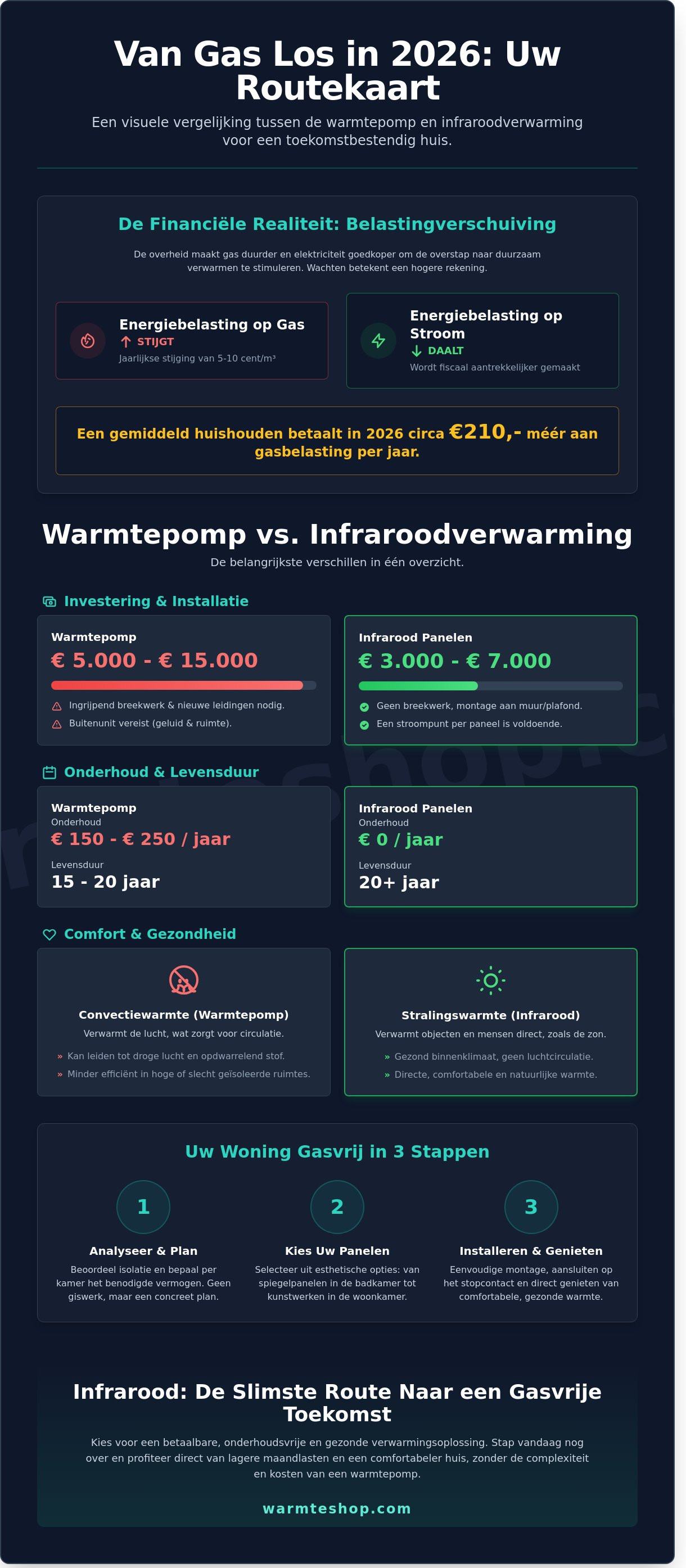
The process of being completely off gas by 2026 does not have to mean an overwhelming renovation. By tackling your home room by room, you maintain control over your budget and progress. The foundation of this step-by-step plan is always excellent insulation and careful draught sealing. Without a good thermal envelope, precious radiant heat escapes too quickly. Once the insulation is in order, you transform your home step by step into a modern, gas-free comfort paradise.
The bathroom is the ideal space to start the transition. Here, direct heat is essential for a comfortable start to the day. An infrared mirror offers a dual function here: it warms your body with the healthy power of the sun and simultaneously prevents the mirror from fogging up after a hot shower. For drying textiles and extra comfort, a towel radiator indispensable. These systems operate independently of a central boiler, allowing you to enjoy a dry towel even during the summer months without heating the entire house. Safety is paramount here; ensure that all electrical elements meet the IP44 standard for Zone 2 so that they are resistant to splashing water.
In larger living spaces, everything revolves around even heat distribution. Ceiling mounting of infrared panels is a smart choice here. The panels radiate heat downwards, where the floor and furniture absorb the energy and slowly release it back into the room. This creates a pleasant climate without air movement or dust circulation. If you prefer warm feet without extensive renovation, infrared underfloor heating a solution. This system can often be installed directly under laminate or PVC flooring, saving an average of 2 to 3 days of demolition work compared to traditional water-based systems. For those who value aesthetics, infrared photo panels are the perfect solution; they combine high-quality heating technology with personal art on the wall.
Bedrooms and workspaces are often used for only a small part of the day. It is therefore illogical to heat these spaces constantly. Infrared panels are extremely efficient in these rooms because they reach their full operating temperature within 5 to 10 minutes. You only switch on the heat when you are actually using the room. This results in significant savings on the energy bill and contributes directly to the goal of gas-free by 2026. A smart thermostat per room ensures that energy is never consumed unnecessarily.
Are you ready to take the first step towards a future-proof and comfortable home?
View our innovative infrared solutionsInfrared heating offers a concrete and direct answer to the challenges of phasing out natural gas by 2026.While traditional systems heat the air, infrared directly heats the objects and people in a room. This creates a healthy indoor climate because there is hardly any dust circulation; an essential benefit for the 25 percent of the population sensitive to allergies or respiratory issues. Humidity remains stable around the ideal 40 to 60 percent, effectively preventing mold growth and keeping your home's structure dry and warm.
The switch to gas-free living does not have to mean weeks of renovation. Infrared panels are often installed within a single working day without the need for extensive hacking or breaking work. This makes it one of the most accessible methods to meet the new gas-free standards of 2026. Moreover, Warmteshop's systems are fully recyclable. Coupled with green electricity or your own solar panels, you operate 100 percent CO2-free. Furthermore, with the rise of smart grids after 2026, these panels are ready for intelligent control, allowing you to respond smartly to dynamic energy tariffs and avoid peak loads on the power grid.
With more than 30 showrooms in the Benelux, Warmteshop is the trusted guide during this transition. Our experts use precise software for a customized heat calculation that determines exactly the capacity required for your specific living situation. This prevents overcapacity and unnecessary energy consumption. With us, you receive not only a high-quality product but also a long-term quality guarantee and the assurance of a local partner who personally advises you on your living comfort.
The unique 'sun effect' of infrared is a sensory experience you have to feel for yourself. Our advisors are ready to shape your transition plan with a no-obligation heat calculation based on your floor plan and insulation values. Visit one of our showrooms and discover how aesthetics and sustainability come together in your interior. Do not wait for the government deadline, but choose the certainty of a future-proof system today.
The switch to a sustainable household is no longer a distant prospect. Within 24 months— 2026—going off natural gas the new reality for thousands of Dutch households. By choosing infrared heating now, you are investing in a system that heats walls and objects directly, just like the natural rays of the sun. This prevents unnecessary heat loss and significantly improves air quality in every room.
Warmteshop has been the market leader in the Benelux for innovative heating solutions since 2008. With a network of more than 30 physical stores, we always offer an expert point of contact near you. Our certified installation service guarantees that your new system performs optimally from day one. You are not alone in this transition; we guide you step by step towards an energy-efficient and comfortable home.
Calculate your savings and view our infrared solutions
Start making your living comfort more sustainable today and enjoy healthy, green heat.
In 2026, infrared heating will often be more economical than gas, provided you use the panels smartly for zone heating. While gas prices rise due to increasing taxes, infrared allows you to save an average of 20% to 30% on your total energy consumption. This is because you do not heat the air, but the objects in the room. This feels like the natural warmth of the sun and prevents unnecessary energy loss through walls or windows.
No, you can perfectly well tackle the transition to a home that is completely gas-free by 2026 in various phases. Many of our customers start with the bathroom or the home office to experience immediate comfort without a major renovation. This modular approach spreads the investment costs over several years. You simply replace the old radiators with designer panels room by room, working step by step towards a fossil-free future.
A standard 3x25 Amp electrical connection is more than sufficient for most homes to power infrared panels. An average panel consumes between 400 and 800 Watts, which is comparable to a coffee maker. Only if you are going to heat a very large home entirely electrically might an upgrade to 3x35 Amp be necessary. Our experts in the showroom would be happy to calculate this exactly for you based on your specific situation.
Infrared panels can heat even a less well-insulated house because the radiant heat directly warms people and objects. Unlike convection heat, the heat does not escape directly through cracks or a drafty roof. However, for homes built before 1980, we recommend fitting at least HR++ glass to the windows. This prevents the panels from having to work 15% harder to compensate for the cold air falling from the glass.
The main difference is that an infrared panel emits 90% radiant heat, whereas a convector produces 90% warm air. Warm air rises directly to the ceiling, which is inefficient and causes dust circulation. Infrared radiation penetrates directly into the walls and floor; this is comparable to the healthy warmth of the sun on a winter day. As a result, the temperature in the room remains much more stable and you immediately experience greater living comfort.
In 2026, various local incentive schemes and provincial loans with a 0% interest rate will be available for infrared solutions. Although the national ISDE subsidy often focuses on heat pumps, municipalities such as Amsterdam or Utrecht frequently offer their own budgets for small-scale sustainability projects. Also, do not forget the energy saving loan from the National Heat Fund. With this, you can finance the transition to being off natural gas by 2026 on very favorable terms without using your own savings.
For an average living room, you need approximately 60 to 100 Watts of power per square meter. In a well-insulated new-build home, 60 Watts per m² is often sufficient to create a comfortable climate. For a bathroom, we calculate with 100 Watts per m², because you desire a high peak temperature there sooner. A room of 20 m² therefore requires a total power of approximately 1400 Watts, distributed over two strategically placed panels.
You can easily install infrared panels yourself using the included brackets and two screws; it is often a matter of 15 minutes' work. However, for a sleek finish without visible cables, we recommend hiring a certified installer. They integrate the thermostat control directly into your existing electrical network. This guarantees a safe system that complies with NEN 1010 standards, ensuring you enjoy sustainable heat worry-free for years to come.


