

No dry air in the house caused by heating: The ultimate guide to a healthy indoor climate
, by Warmteshop, 18 min read
, by Warmteshop, 18 min read
Did you know that the humidity in an average home often drops to below 30 percent during the heating season, which is drier than the air in the Sahara? You probably recognize it immediately: as soon as the thermostat is turned up…
Did you know that the humidity in an average home often drops to below 30 percent during the heating season, which is drier than the air in the Sahara? You probably recognize it immediately: as soon as the thermostat is turned up, you suffer from a dry throat, stinging eyes, or those annoying static shocks. Even your wooden furniture suffers and develops small cracks over time due to the dry atmosphere. Fortunately, a comfortably warm home without health complaints is perfectly possible. In this guide, you will discover how to prevent dry air in your home heating by switching to smart, future-proof technology.
We show you how to create a healthy indoor climate using radiant heat, comparable to the natural warmth of the sun, while simultaneously reducing your energy costs by an average of 20 percent. We dive into the world of innovative infrared technology and explain why heating objects instead of air is the key to a dust-free and vital living environment. This way, you enjoy a home that is not only pleasantly warm but also supports your health.
The classic heating system in most homes operates on the basis of convection. A radiator or convector heats the surrounding air, which then rises to the ceiling. As this air cools, it descends back to the floor to be reheated. This process creates a constant airflow that disperses not only heat but also dust and pollen throughout the room. This circulation is the main cause of an uncomfortable indoor climate during the winter months. It is a technical process in which the air is constantly in motion, resulting in uneven heat distribution and a drying effect on the environment.
The problem revolves around the difference between absolute and relative humidity. Cold outside air at a temperature of 0 degrees Celsius contains a maximum of 4.8 grams of water vapor per cubic meter. As soon as this air enters your home and is heated to 21 degrees Celsius by a traditional radiator, the air's physical capacity to hold moisture rises to 18.4 grams. Because no extra moisture is added in an enclosed space, the relative humidity immediately drops to approximately 26 percent. This is significantly lower than the healthy lower limit of 40 percent. Many people instinctively open a window to ventilate, but this actually lets in more dry, cold air which, once heated, only exacerbates the problem. Therefore, for a healthy indoor climate, a heating system designed to prevent dry air essential.
In this process, radiators effectively function as dust machines in your living room. The upward airflow carries along microscopic particles that settle on the warm fins and subsequently circulate through the room. This explains the typical "heating smell" and the dry throat you often experience as soon as winter sets in.
Low humidity has a direct effect on your daily well-being. Your mucous membranes dry out, weakening the natural barrier against pathogens. Medical research shows that viruses, such as the influenza virus, survive longer and spread more easily in air with a humidity level below 40 percent. For the more than 1.2 million Dutch people with a lung disease such as asthma or an allergy, dust circulation caused by convection heat is a heavy burden. Common symptoms of this dry climate are:
By choosing a modern solution such as infrared heating, you prevent this unhealthy air circulation and maintain the natural moisture balance in your living environment. It is a transition from heating air to heating the mass, which makes a fundamental difference to your health.
The core of a healthy indoor climate lies in the way we distribute heat. Traditional systems rely on circulating warm air, which inevitably leads to a drop in relative humidity. Infrared technology completely overturns this principle. Instead of heating volatile air masses, this method focuses on the solid mass in a room. This results in no dry air in the home heating system, because the molecular structure of the air remains unaffected.
When infrared rays strike an object, such as a wooden floor or a brick wall, the energy is immediately converted into heat. These objects then act as a thermal battery. While warm air escapes within minutes when a door is opened, walls and furniture retain heat for hours. This creates a stable environment in which the natural moisture balance is not disturbed by constant air movement.
Convection heat creates a constant airflow that drives dust and allergens through the room. This irritates the airways and dries out the mucous membranes. Radiant heat works differently. It warms you directly, similar to the sun's rays on a cold winter day. You feel the warmth on your skin, while the air remains cool and fresh. Because no active air movement takes place, the humidity in an average living room hovers around the ideal 40 to 60 percent. This is a direct benefit for people with asthma or sensitive eyes.
Modern infrared heating converts electrical energy into long-wave infrared radiation (IR-C) with an efficiency of nearly 100 percent. This specific wavelength is identical to the safe heat emitted by our own bodies. By 2026, experts expect this technology to become the standard for healthy homes, partly due to precise control via smart thermostats.
A digital thermostat not only measures the air temperature but also takes the radiant heat balance in the room into account. As a result, the system does not have to work as hard to create a comfortable feeling. A lower air temperature while maintaining the same level of comfort automatically means that the air can hold more moisture. For those wishing to take a step towards a healthier living environment, our advisors in the showrooms often offer a suitable thermostat solution to perfectly monitor this balance.
The choice of a heating system largely determines the quality of the indoor climate. Traditional radiators work on the basis of air convection, where cold air is drawn past a warm element and flows back into the room as warm, dry air. This process extracts moisture from the environment and creates unhealthy humidity. Underfloor heating performs better in this respect, but the slow response time makes it difficult to maintain a constant balance. Infrared panels work fundamentally differently; they heat objects and bodies directly, similar to the sun's rays, allowing you to enjoy heating that prevents dry air in your home.
In addition to air quality, hygiene plays a role in the comparison. Radiators have complex shapes and fins where dust accumulates, causing an unpleasant 'scorching smell' when heating up. Infrared panels are flat, closed units that you can make dust-free with a simple movement. This saves time and prevents bacteria and allergens from settling in your heating source.
Infrared technology minimizes air circulation in your home. With convection heating, a constant airflow is created that carries fine dust, pollen, and dust mites upwards into the breathing zone. With infrared panels, the air remains still, resulting in a reduction in dust circulation of approximately 25 percent. This is an immediate relief for people with asthma or allergies. In humid rooms, infrared mirrors their added value. They not only prevent condensation after showering but also actively keep the walls dry. Because the radiation penetrates the walls, mold formation stands no chance, protecting the structural health of your bathroom.
The sense of comfort provided by infrared heating is unique because the air temperature can remain lower without sacrificing coziness. In a room heated with infrared, 19 degrees Celsius feels the same as 21 degrees Celsius under a traditional radiator. Every degree the thermostat is set lower results in an energy saving of approximately 6 percent. The panels reach their full power within 5 to 10 minutes, meaning you do not have to preheat the air mass for hours. For optimal results, the use of an intelligent thermostat essential. It regulates the temperature accurately to within 0.5 degrees, keeping humidity stable and allowing you to benefit from the most efficient form of dry air heating in your home.
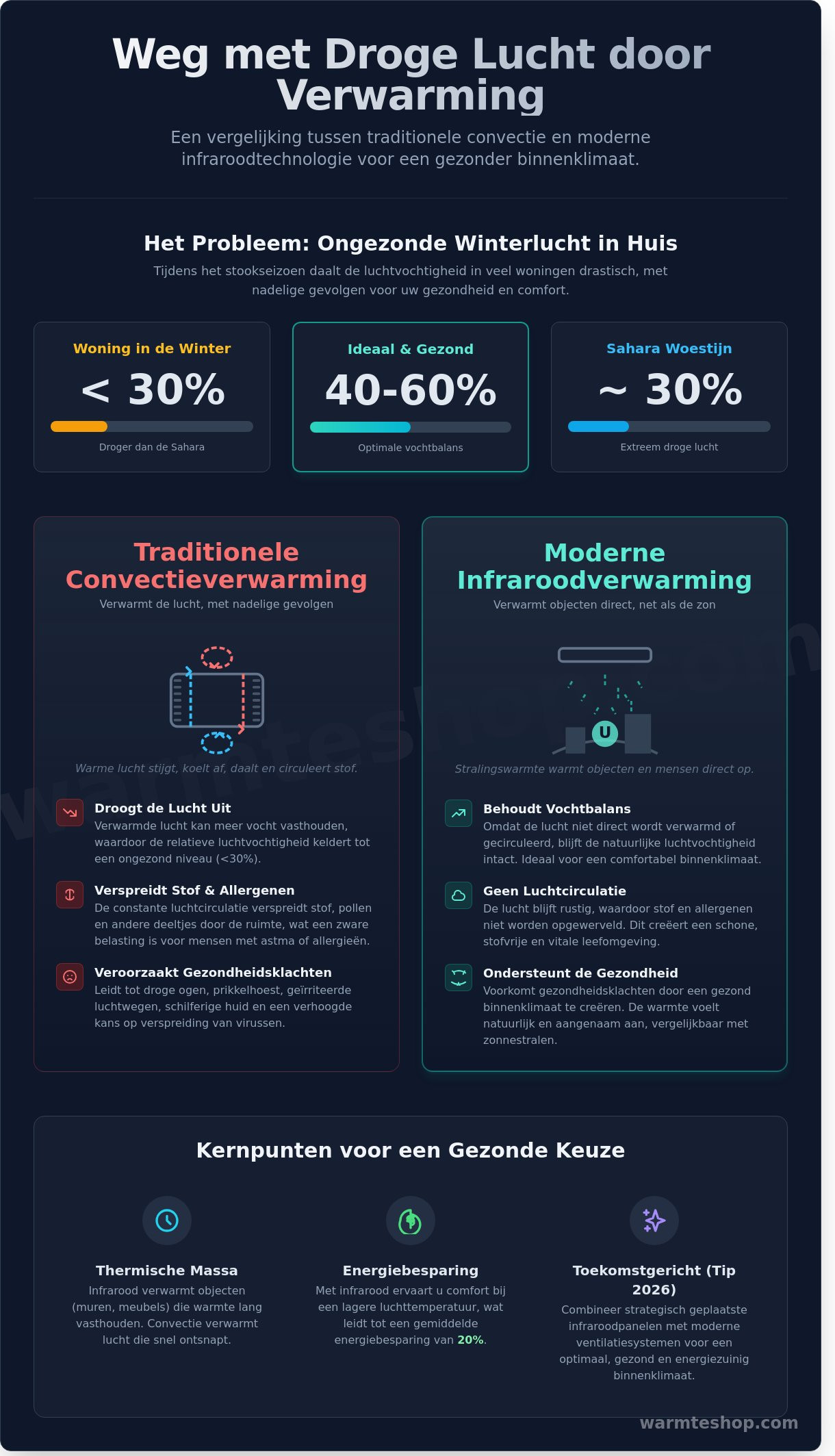
A healthy home in 2026 revolves around the perfect balance between innovative technology and natural elements. Switching to infrared heating is a major step towards preventing dry air in the home, but the overall climate only truly benefits from an integrated approach. Combine your panels with a smart ventilation system with heat recovery (HRV). While the HRV provides fresh, filtered outside air, the infrared system heats the mass in the room without affecting the humidity. This prevents the well-known dry eyes and irritated airways that often occur with traditional convection.
Natural materials play a crucial role in this. Use materials such as clay plaster, wood, or lime hemp in your interior. These materials act as a natural buffer for moisture. They absorb excess moisture and release it again when the air becomes drier. In combination with infrared radiant heat, which is comparable to the healthy rays of the sun, you create a stable environment. It is essential to monitor this process; hang a digital hygrometer in a central location. Healthy humidity levels will still be between 40% and 60% in 2026. As soon as you see the value drop below 40%, you can make targeted adjustments with plants or a humidifier.
The effectiveness of radiant heat depends heavily on the position of the source. Ceiling mounting is the smartest choice in most living spaces. From the ceiling, the rays reach the floor and furniture unimpeded, ensuring even heat distribution. This increases efficiency by an average of 15% compared to wall mounting. Moreover, this eliminates cold corners. In these corners, moisture often condenses on cold walls, promoting mold growth. In the bedroom, we recommend placing the panel not directly above the headboard, but above the foot end. A constant temperature of 18 degrees Celsius is ideal here for a deep, undisturbed night's sleep without a stuffy nose.
In the bathroom, comfort is of essential importance, especially during cold mornings. You prevent unpleasant cold feet by using underfloor heating as the primary heating source. This system keeps the floor at a constant, comfortable temperature, while infrared panels on the wall or ceiling quickly warm up the room when needed. For an extra luxurious experience and a healthy air balance, a towel radiator indispensable. Unlike traditional radiators that spread dust and dry air, this system dries your towels with direct radiation. This keeps air quality high and your towels fresh. A healthy indoor climate is no accident, but the result of a well-thought-out plan in which every component contributes to your well-being.
In addition to the physical climate, the atmosphere in your home also contributes to your well-being. A delicious aroma of spicy dishes can work wonders here. If you want to enrich your kitchen with unique flavors, you can learn more about Spice Rebels.
In addition to heating, there are other innovative solutions that contribute to health and well-being at home. For those interested in the latest developments in natural pain relief and wellness, it may be worthwhile to discover Numans.no.
Expertise is the decisive factor when switching to a healthier indoor climate. Warmteshop has been advising households in the Benelux on the transition to smart heating for over 15 years. Our focus is on creating an environment without dry air in home heating, utilizing the latest infrared technology. These systems do not heat the air, but the objects and people in the room, just as the sun does on a clear winter day. This prevents the circulation of dust and pollen, which is essential for people with allergies or sensitive airways.
We distinguish ourselves through a scientific approach to living comfort. Every home is unique and requires a specific approach. That is why our advisors perform precise heat calculations that take into account insulation values, window surfaces, and the desired room temperature per room. This results in an installation that offers 100% efficiency without unnecessary energy consumption. With more than 30 physical locations in Belgium and the Netherlands, we offer the opportunity to experience this unique radiant heat for yourself before making a decision. You will notice the difference immediately in the gentle airflow and even heat distribution in our showrooms.
No two interior styles are the same, which is why we offer a wide range of aesthetic options. You will find everything with us from unobtrusive white ceiling panels that blend seamlessly with the plasterwork to stylish infrared heating in the form of photo panels or mirrors. In our stores, you can extensively test these systems and compare the various finishes. Our own professional installation service takes care of everything. They ensure that the panels are mounted safely and efficiently, so you can immediately enjoy optimal results without worrying about the technical connections.
The transition to a gas-free home is an important step that we would be happy to take together with you. Our infrared panels are manufactured from high-quality materials and have an expected lifespan of at least 25 years. That is significantly longer than the average 12 to 15 years of a traditional central heating boiler. This makes it a smart investment in both your health and the value of your home. Thanks to precise control via smart thermostats , you save up to 30% on your annual energy costs compared to electric convection. Make an appointment today for a no-obligation consultation and discover how simple the path to a healthier home is.
Achieving optimal living comfort begins with choosing the right technology. While traditional systems often cause unhealthy air circulation and dry mucous membranes, infrared technology offers a sustainable and medically responsible alternative. By switching to radiant heat, you maintain natural humidity and a dust-free environment. This results in home heating that feels like the beneficial radiation of the sun on your skin, without dry air.
Since 2008, Warmteshop has been the leading specialist in energy-efficient heating solutions. With more than 30 showrooms in the Benelux, our advisors are ready to guide you towards a healthier home. Our systems do not heat the air, but the mass of the home, ensuring an efficient and constant heating experience without energy loss. By choosing this option, you opt for a smart upgrade to your home that immediately improves both your comfort and your health.
Discover our healthy infrared solutions in the webshop
Make the switch to a future-proof home and enjoy the purest warmth available every day.
You prevent dry air by choosing radiant heat instead of the traditional convection heat from radiators. While radiators heat and circulate the air, often bringing humidity below the critical threshold of 30%, infrared panels heat objects and walls directly. This maintains the natural moisture balance in the room. The result is a healthy atmosphere with no dry air in your home, which is gentle on your respiratory system.
Yes, infrared heating offers significant health benefits because it reduces air circulation by approximately 80%. With standard central heating, dust, pollen, and dust mites constantly swirl through the room due to the rising warm airflow. Infrared panels work just like the natural heat of the sun and heat your body directly. This prevents irritated mucous membranes and dry eyes, which means great relief for the 25% of the population with allergies.
The ideal humidity for a healthy indoor climate is between 40% and 60%. When the value drops below 40% in winter due to intensive heating, symptoms such as a dry throat, cracked lips, or static electricity can occur. With infrared panels, this percentage remains more stable because the air itself is not heated unnecessarily. You can easily check this with a 15-euro hygrometer to accurately monitor your living comfort.
Underfloor heating causes less dust circulation than radiators, but it still contributes to drying out the air due to the slow heating of the entire air mass. Although it is an improvement over classic systems, it remains a form of indirect heating. Infrared panels on the ceiling or wall offer a superior alternative. They keep humidity levels on average 10% higher than traditional water-based floor systems due to targeted radiation.
You can use infrared panels perfectly as your primary heating system without ever needing a humidifier. Because this innovative technology does not dry out the molecules in the air, the indoor climate remains naturally balanced. In a well-insulated home of 120 square meters, you thus maintain a pleasant atmosphere in every room. This saves you not only on energy costs but also on the purchase of additional air quality equipment.
Headaches are often caused by a combination of low humidity and a lack of fresh oxygen due to poor circulation. Traditional radiators create a warm blanket of stagnant air at the ceiling, while the floor remains cold. This temperature difference of sometimes as much as 5 degrees between head and feet causes physical stress. Infrared heat distributes the temperature more evenly across the full height of the room, minimizing the risk of tension headaches.
Water trays on radiators have only a marginal effect and often increase relative humidity by less than 5%. Moreover, these trays become a breeding ground for bacteria and mold if you do not clean them thoroughly every 24 hours. It is an outdated form of treating symptoms that does not solve the root of the problem. Switching to modern infrared technology guarantees dry air in your home and heating in a hygienic and maintenance-free manner.
You save an average of between 10% and 40% on your total energy costs by switching to smart infrared panels. This is because the perceived temperature with radiant heat is approximately 2 degrees higher than the actual air temperature. As a result, the thermostat can be set a notch lower without compromising on comfort. The fast warm-up time of just 5 to 10 minutes ensures that you never waste energy unnecessarily in rooms where no one is present.


