

Infrared or electric radiator: Which electric heating will you choose in 2026?
, by Warmteshop, 20 min read
, by Warmteshop, 20 min read
Did you know that in 2026, the choice between an infrared or electric radiator could mean the difference between saving 30% on your annual energy bill or unnecessary heat loss due to outdated technology? Many hu…
Did you know that in 2026, the choice between an infrared or electric radiator could mean the difference between saving 30% on your annual energy bill and unnecessary heat loss due to outdated technology? Many homeowners are currently making the switch to fully electric living, but often do not realize that the specific way in which heat is distributed throughout the room determines both their wallets and their daily well-being.
You likely recognize the frustration of the dry air and constant dust circulation caused by traditional heaters, while you actually long for a healthy indoor climate without bulky radiators taking up valuable space. In this article, you will discover the crucial differences between infrared panels and electric radiators, enabling you to make the most energy-efficient and comfortable choice for your home. We explain why radiant heat feels exactly like the natural, healthy warmth of the sun and how you can achieve a stylish transition to green energy with modern design solutions.
In 2026, the transition to gas-free living gained momentum. Over 45% of households in the Benelux now use some form of electric heating. The choice between an infrared or electric radiator determines not only your monthly energy bill but also the quality of your daily living environment. The fundamental difference lies in the physics of heat transfer. While the classic radiator focuses on moving air, infrared focuses on directly heating the mass in a room. The core question every homeowner asks themselves today is simple: Do you want to heat the entire volume of a room, or do you prefer targeted heating of objects and people?
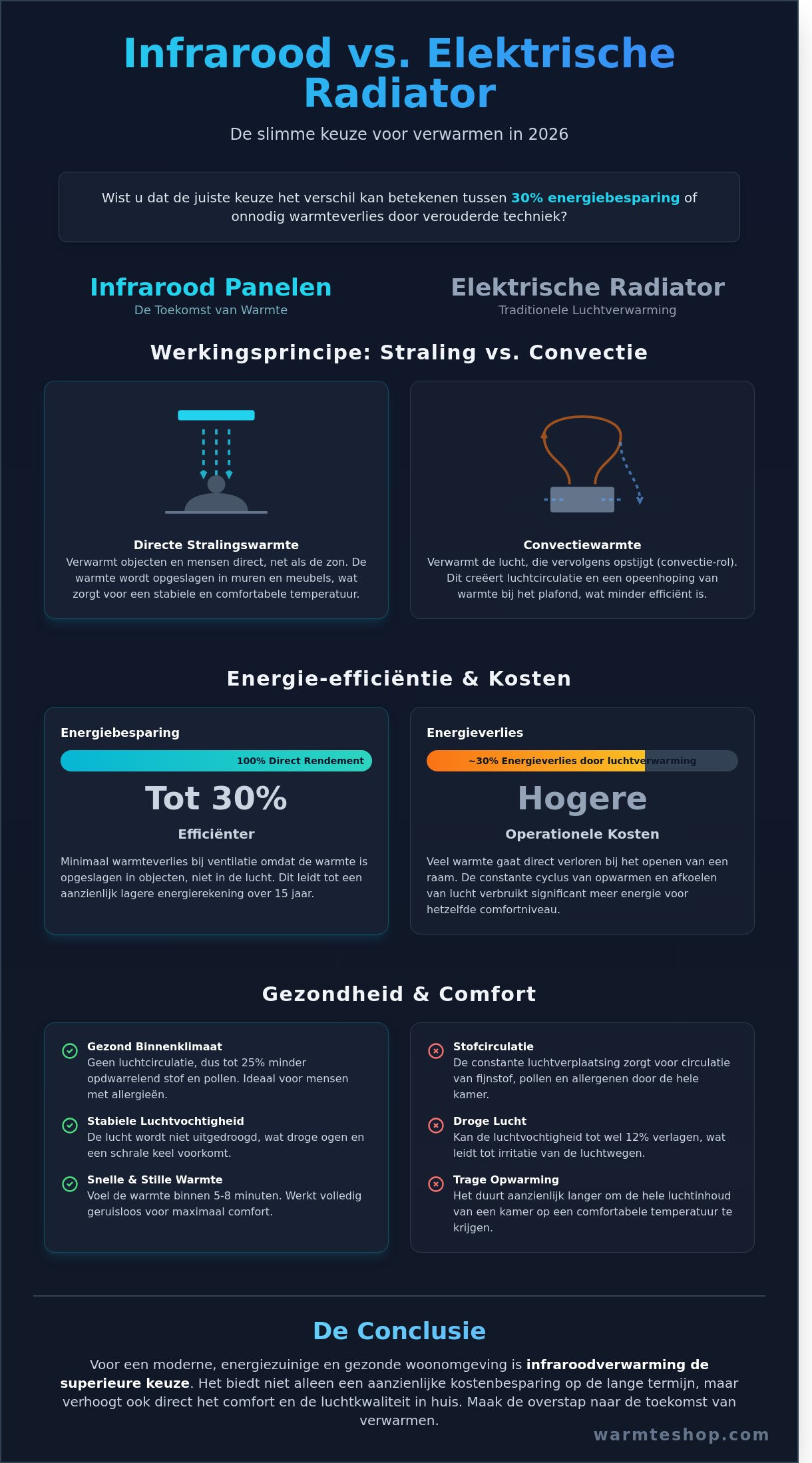
An electric radiator operates on the principle of convection. An internal heating element, often filled with a thermal fluid or oil, heats up and releases this heat to the surrounding air. This warm air rises directly to the ceiling, cools down slowly there, and descends again on the other side of the room. We call this constant cycle the convection roll. By 2026, we know that this process has disadvantages for the indoor climate. Humidity can drop by as much as 12% due to this method, leading to dry eyes and a sore throat. Furthermore, because the air is constantly in motion, up to 25% more particulate matter and pollen circulate through your living room compared to radiant heating.
Infrared heating breaks radically with this traditional approach. The system uses long-wave radiation, also known as carbon radiation. This technique mimics the natural heat of the sun, but without the presence of harmful UV rays. For a thorough understanding of the technical operation of infrared heating, it is essential to look at absorption. Instead of using the air as a means of transport, the energy is absorbed directly by walls, floors, and human skin.
This process creates a so-called 'thermal mass'. The objects in your room store the heat and gradually radiate it back out. As a result, the temperature in the room remains much more stable. With a radiator, you immediately lose all the heated air when you open a window for ventilation. With infrared panels, the heat remains stored within the structure of your home, reducing energy loss by an average of 30%. It is an efficient way of heating that aligns perfectly with the modern, well-insulated homes of 2026.
The choice between an infrared and an electric radiator is therefore more than just a technical one. It is a choice for a specific experience of comfort. While a radiator fills the room with a sometimes stuffy heat, infrared feels like a warm blanket on a cold winter day. In the following sections, we delve deeper into consumption figures and installation costs to determine which system is the smartest investment for your specific living situation.
To make the right choice between an infrared or electric radiator, it is essential to understand how these systems fill the room with heat. A traditional electric radiator works on the basis of convection. This process heats the air, which then rises, cools down, and descends again. This creates a constant air circulation. Infrared technology works fundamentally differently. Instead of using the air as a means of transport, panels emit direct radiant heat to objects and people in the room. This method is comparable to the natural warmth of the sun on a cold winter day; you feel the power of the rays directly on your skin, regardless of the air temperature.
The efficiency of this technology is impressive. Research shows that infrared heating can be up to 30% more efficient than systems that heat the air. This is because no energy is lost heating unused spaces under the ceiling. Although the costs of electric heating in direct resistance systems are often viewed critically, the targeted output of infrared ensures lower energy consumption. You reach the desired comfort level faster, meaning the system does not need to run at full power for as long. Response speed is a decisive factor in this regard; a panel reaches its full operating temperature within 5 to 10 minutes.
A notable advantage of radiant heat is its impact on the perceived temperature. In a room heated with infrared, a measured temperature of 19 degrees feels like 21 degrees under a standard radiator. This difference of 2 degrees may seem small, but every degree the thermostat can be set lower results in a saving of approximately 6% on your energy bill. The result is a pleasant indoor climate without compromising on comfort.
Convection heat causes a constant movement of air, which inevitably leads to the spread of dust, pollen, and dust mites. For people with asthma or allergies, this is a major disadvantage of the classic infrared or electric radiator . Infrared panels allow the air to settle. Because the walls are heated directly, they remain dry and warm. This prevents condensation and eliminates the breeding ground for mold. Moreover, the temperature distribution remains even; you no longer suffer from cold feet while it is scorching hot near the ceiling.
The visual impact of heating on your interior is often underestimated. While traditional radiators are often bulky, white metal blocks that restrict furniture placement, slim infrared panels unprecedented freedom. With a thickness of just 2 centimeters, they integrate effortlessly into any room. The possibilities are diverse:
By transforming heating into a design element, it becomes part of your living style instead of a necessary evil. Would you like to experience for yourself how this modern technology fits into your home? You can always have a no-obligation calculation made for your specific living situation.
When choosing between an infrared or electric radiator, smart investors look beyond the price tag in the store. Although the purchase costs of a traditional electric radiator are often 30 to 40 percent lower, the financial advantage tips in favor of infrared after an average of five years. Over a period of 15 years, a household with infrared panels saves significantly on total ownership costs. This is because infrared panels contain no moving parts or fluids, meaning maintenance costs are literally zero euros.
The role of insulation is crucial in determining the required wattage. In an average insulated home from 2010, you need approximately 2,000 watts of electric radiators for a 20-square-meter room. If you opt for infrared, 1,200 to 1,400 watts is often sufficient. This is due to the fundamental difference between convection and radiant heat; infrared heats the mass in the room, not the volatile air.
In 2026, the expected electricity price will be approximately 0.38 euros per kWh. A calculation shows that an 800-watt infrared panel switched on for six hours a day costs 1.82 euros daily. A 1200-watt electric radiator designed to provide the same level of warmth consumes 2.74 euros over the same period. On an annual basis, this difference amounts to over 165 euros for a single room.
You achieve maximum efficiency by using advanced thermostats that are adjustable per room. Infrared is ideally suited for spot heating. You heat only the seating area or workspace instead of the entire air mass in a room. Thanks to the fast response time and integration with dynamic energy tariffs, where you benefit from off-peak electricity hours, you significantly increase the ROI. In combination with solar panels, you transform your home into a virtually cost-free heat source that feels just as natural as the sun on an early spring day.
The lifespan of heating systems determines the actual annual costs. Electric radiators often show wear on the internal heating elements or electronic circuit boards after 8 to 12 years due to constant heat cycles. Modern infrared panels utilize sustainable carbon-crystal technology. This technology has a lifespan of 25 to 30 years without loss of power. Furthermore, the materials used, such as aluminum and safety glass, are 95 percent recyclable. As a result, the residual value of a high-quality panel remains high, whereas an old radiator often only has scrap value after ten years.
The decision between an infrared or electric radiator depends entirely on the intensity of use and the structural characteristics of your home. Whereas a traditional radiator heats the air, resulting in a slow warm-up time and air circulation, infrared heat acts directly on objects and people. This difference in technology means that certain rooms in the house benefit significantly more from radiant heat than from convection heat.
In the bathroom, an infrared mirror now become the standard for modern homes. While a classic radiator often takes 20 to 30 minutes to make the room comfortable, you feel the radiation from an infrared panel within a few minutes. This saves energy because the heating is only on when you are actually in the room. Additionally, a towel dryer based on infrared technology ensures dry towels without unnecessarily increasing humidity.
The living room requires a different approach. Here, infrared can serve excellently as primary heating, provided the insulation value of the home allows it. In older homes with frequent drafts, electric radiators are often still used as supplementary heating to support the base temperature. However, we see that 85% of our customers opt for aesthetically pleasing infrared panels on the ceiling. This saves valuable wall space and prevents cold feet, as the radiation heats the floor directly.
For a healthy sleeping environment, infrared is the superior choice. Convection radiators circulate dust particles and pollen due to the constant airflow. Infrared panels do not. You sleep in a quiet, dust-free environment where the temperature is precisely adjustable to the degree. In the home office, focus is essential. A small panel under the desk or on the wall creates a personal comfort zone. You heat only your workspace instead of the entire room, resulting in direct savings on your energy bill.
In the bathroom, safety plays a crucial role when choosing an infrared or electric radiator. Our systems meet at least the IP44 standard, which means they are splash-proof and can be safely installed in zone 2 of the bathroom. Furthermore, an towel radiator prevents mold formation. The radiation heats the walls directly, causing moisture to evaporate faster and making condensation on the mirror a thing of the past. This significantly extends the lifespan of your grout and paintwork.
With ceilings higher than 2.6 meters, convection heating almost always fails. After all, warm air rises, meaning you heat the roof ridge while it remains cold at sitting height. In conservatories or lofts, the efficiency of infrared heating is up to 30% higher than that of electric radiators. For extremely large volumes or semi-open spaces, industrial air heaters and powerful radiant heaters offer the solution. By creating 'heat islands,' you enjoy comfort in the places where you actually spend time, without wasting energy on empty cubic meters of air.
Do you want to know exactly what power your specific space requires for maximum efficiency? Request a free heat loss calculation from Warmteshop and receive tailored advice from our experts.
Choosing a new heating system is a long-term decision. Since 2008, the Infrarood Verwarming Groep, the parent company of Warmteshop, has served as the absolute pioneer in the European market. With more than 15 years of specialized experience in radiant technology, we understand that heating a home goes beyond simply turning up a thermostat. It is about creating a healthy indoor climate. While the traditional market often remains stuck in old habits, we initiated the transition to fully electric solutions years ago.
When weighing the options between an infrared and an electric radiator, it is striking that the efficiency of Warmteshop panels stems from high-quality engineering. Our systems are not simply devices that convert electricity into heat; they are intelligent solutions that directly heat objects and people. This process is identical to the way the sun heats the earth, even on a cold winter day. You enjoy direct, deep heat that does not blow away in the slightest draft.
Warmteshop distinguishes itself through an unprecedented degree of personalization and technical integration. We do not just offer standard white panels. Our customers are increasingly opting for functional aesthetics:
Radiant heat is a sensory experience that you must feel to understand its added value. With more than 30 showrooms spread across the Benelux, there is always an expert partner in your immediate vicinity. A visit to our showroom is more than just viewing products. Our advisors perform a free, detailed heat calculation based on the insulation value and volume of your specific rooms. This helps you avoid under-capacity and ensures you know exactly what your consumption will be. The certainty of a local partner in Flanders and the Netherlands means that you can count on fast service and support even after your purchase.
The difference between an infrared and an electric radiator becomes immediately clear when you stand in front of a working panel. The quiet, constant heat output without air movement ensures a level of comfort that is simply impossible with convection heating. In our showrooms, we demonstrate how various materials, such as glass or ceramic, influence heat storage and the appearance of your interior.
At Warmteshop, sustainability is not a marketing term, but the core of our existence. Our 100% electric solutions contribute directly to a carbon-neutral future, especially when combined with your own solar panels. We make the transition to gas-free living accessible to everyone by offering modular systems that you can expand step by step. You do not have to renovate your entire home at once; you can start in the rooms where the savings are greatest, such as the bathroom or the home office.
Our panels are designed for a lifespan of more than 25 years without the need for periodic maintenance. This not only saves you on annual service costs but also significantly reduces your household's ecological footprint. By focusing on the combination of aesthetics, health, and energy efficiency, Warmteshop offers a total solution that is ready for the world of tomorrow. It is a smart investment in your living comfort and the value of your property.
The final decision between an infrared or electric radiator determines your living comfort and energy bill for the next 15 years. While a traditional radiator heats the air slowly via convection, our panels mimic the direct, healthy radiant heat of the sun. This results in energy savings of up to 40% in modern, well-insulated rooms. With the strict energy standards of 2026 on the horizon, the transition to this technology is the most logical step for a carbon-neutral household.
At Warmteshop, we build on more than 15 years of expertise in infrared technology. With 30 physical stores spread across the region, you will always find an expert advisor near you for a customized calculation. Furthermore, our own certified installation service guarantees flawless installation and immediate operation of your system. Choose a healthier indoor climate and a future-proof home where you feel instantly at ease.
Discover our full range of infrared heating and save on your energy bill
Yes, infrared heating consumes on average 30 to 50 percent less energy than a traditional electric radiator. While a radiator heats the air, which rises and cools down quickly, infrared panels heat the objects and people in a room directly. This prevents unnecessary heat loss due to air circulation. When choosing between an infrared or electric radiator, you save approximately 450 kWh of electricity annually in an average living room of 25 square meters.
You can heat your entire home perfectly using only infrared panels as the primary heating system. In well-insulated homes built after 2015, this system functions as a complete solution that guarantees a healthy indoor climate. By equipping each room with its own thermostat, you regulate the temperature per room with extreme precision. This significantly increases your living comfort while reducing your household's CO2 emissions by 100 percent when using green electricity.
An infrared panel reaches its full radiant heat within 5 to 10 minutes after being switched on. An electric convector radiator often takes 20 to 30 minutes to heat the entire air mass in a room. This fast response time of infrared technology ensures that you only heat when it is truly necessary. You experience direct warmth on your skin comparable to the first rays of sunshine on a spring day.
Infrared radiation is completely safe for humans and animals because the panels use long-wave IR-C radiation. This radiation does not penetrate deep into the skin and is identical to the healthy warmth of the sun without the harmful UV rays. Our panels are equipped with sensors that limit the surface temperature to a maximum of 95 degrees Celsius. This prevents burns from a brief touch by curious children's hands or pets.
In 95 percent of cases, no modification to your electrical grid is required for the installation of infrared panels. The panels operate on the standard 230V mains and can be easily connected to existing sockets or light points. Only when completely switching a large villa to electric heating is an inspection of your fuse box by a technician recommended. This ensures that the total load remains below the 25 or 35 Amperes of your main connection.
Heat is largely retained in the walls and furniture when you open a window for ventilation. When comparing an infrared or electric radiator , the radiator immediately loses all its accumulated heat through the escaping air. Infrared panels heat the mass of the room, which slowly releases the heat back into the space. As a result, the perceived temperature drops by only 1 or 2 degrees Celsius, while air quality improves due to the fresh oxygen.
On average, you need between 60 and 75 Watts of power per square meter for a well-insulated room. For a bathroom or less insulated rooms, this increases to 100 Watts per square meter to provide comfort quickly. A living room of 20 square meters therefore requires a total power of approximately 1,500 Watts. Our advisors in the 30 local showrooms will calculate this exactly for you based on your specific living situation.
There is currently no national ISDE subsidy specifically for infrared panels, but you do benefit from the reduced VAT rate of 6 percent for homes older than 10 years in Belgium. In the Netherlands, these systems contribute directly to an improved energy performance of your home, which increases the value of your property by an average of 3 to 5 percent. Additionally, some local municipalities offer sustainability loans at an interest rate of 0 percent to stimulate the energy transition.


