

Infrared warehouse heating: the complete guide to industrial efficiency in 2026
, by Warmteshop, 18 min read
, by Warmteshop, 18 min read
Why would you spend thousands of euros a year heating the air near the ceiling of your hall, while your employees on the shop floor are still suffering from the cold? It is a well-known problem in the logistics sector; tra…
An infrared heater in your warehouse.
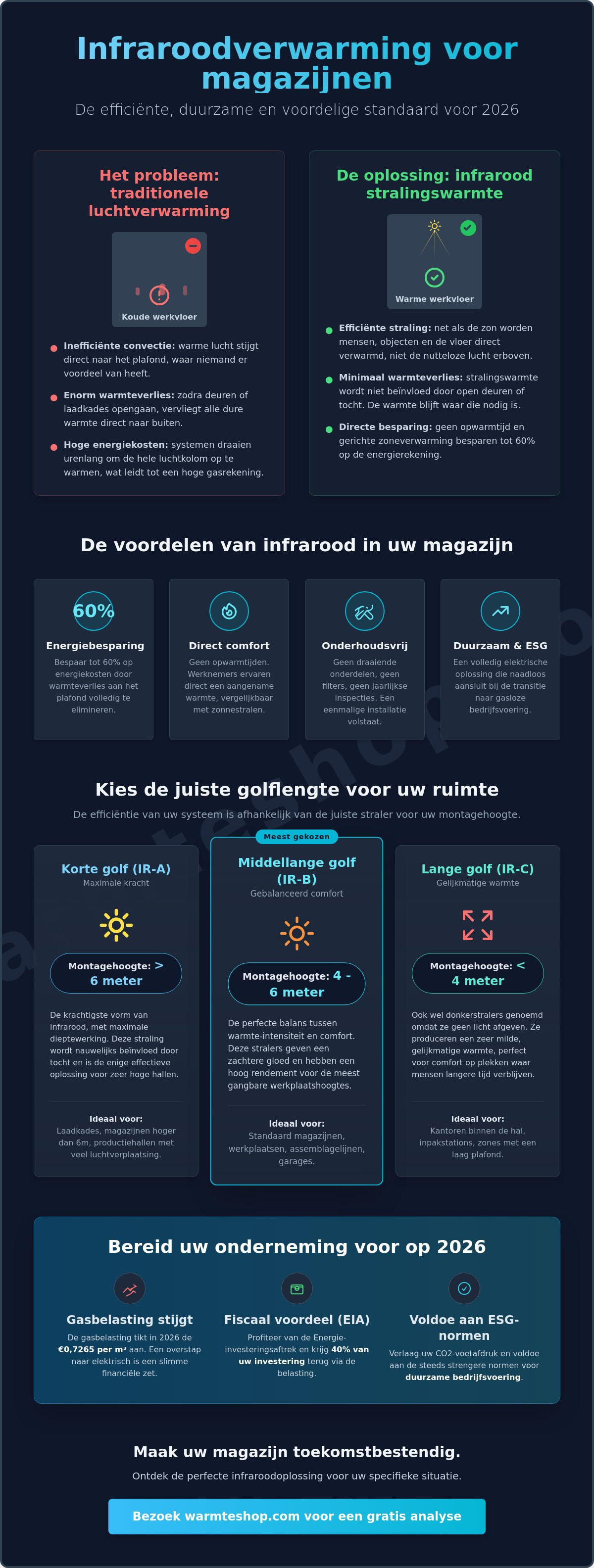
In this guide, you will discover how to make warehouse processes up to 60% more efficient with well-designed infrared heating. By switching from air heating to intelligent radiant heat, similar to the natural warmth of the sun, you heat people and objects directly rather than the air. This results in significantly lower energy bills and immediately noticeable comfort for your staff, without drafts or dust displacement. We delve into the opportunities for 2026, from the 40% deduction via the Energy Investment Allowance (EIA) to realizing a maintenance-free system that seamlessly aligns with your ESG objectives.
Industrial infrared heaters are powerful energy sources that have fundamentally changed the way we heat large halls. Where we used to rely on heating enormous volumes of air, in 2026 we will be looking at efficiency per square meter. An infrared warehouse heating system does not work by moving the air, but by emitting energy via electromagnetic waves. This process is virtually identical to how the sun heats the earth; the rays travel the distance without heating the intervening air and only release their energy once they strike an object or person.
The fundamental problem with traditional systems is convection. Warm air is lighter than cold air, causing the heat from a gas heater to rise directly to the roof. Consequently, in a ten-meter-high warehouse, the comfortable temperature hovers near the rafters, while employees on the floor stand in the cold. The switch to infrared technology eliminates this physical disadvantage. It has become the logical standard in the transition to gas-free commercial buildings in the Netherlands and Belgium, partly due to the rising gas tax, which will reach €0.7265 per m³ in 2026.
The operation of infrared heaters ensures that the floor, shelving, and even the machines in your hall act as a thermal battery. These objects absorb the radiation and gradually release it back into the environment. This creates a stable climate where roof insulation is less critical; after all, we are not heating the air escaping through cracks. Employees experience a high level of perceived warmth, meaning the thermostat can often be set two degrees lower without compromising comfort.
In practice, warehouse infrared heating excels in places where other systems fail. Consider loading docks where overhead doors are constantly open for trucks. Air heating is no match for these locations, but infrared radiation continues to effectively warm the people on the dock. It also offers a solution for monumental warehouses or temporary halls. Because no complex piping for gas or water is required, the installation of industrial infrared heaters often completed within a few days. The system offers the flexibility to provide comfortable warmth to only specific zones, such as packing tables or assembly lines, while the rest of the hall remains cool.
The efficiency of an infrared warehouse heater depends entirely on the choice of the right wavelength. In the industrial sector, we distinguish between three types of radiation, each with its own application based on the mounting height and the specific environmental factors of your hall. Short-wave infrared (IR-A) is the most powerful form. Although some suppliers claim that this is only for outdoor use, in reality, it is the only effective solution for halls higher than 6 meters. This radiation has maximum penetration power and is hardly affected by drafts, which is essential with open loading docks.
Medium wave (IR-B) offers the perfect balance for workplaces with an average height between 4 and 6 meters. These heaters emit less intense light but maintain high efficiency for daily use. For lower warehouse sections or offices within the hall, long wave dark radiators (IR-C) are ideal. These do not emit light and provide very even, comfortable heat that remains pleasant throughout the day. Choosing the right wavelength is crucial for efficient heating in large industrial spaces, where every meter of height counts in achieving the desired intensity on the work floor.
The heart of a high-quality heater consists of anodized aluminum and precision reflectors. The quality of these components determines how effectively the energy is converted into usable heat. An inferior reflector can waste up to 30% of the generated heat because it remains trapped inside the housing instead of being reflected onto the work floor. High-quality reflectors ensure optimal beam focusing, allowing you to comfortably heat a larger area with lower wattage.
Safety is the absolute priority in a busy logistics environment. IP65 certification is necessary for many warehouses; this guarantees that the blasters are completely dustproof and resistant to water jets during cleaning operations. Facility managers must also look for certifications confirming protection against mechanical impact, especially in areas where forklifts or reach trucks are active. Our systems are designed for continuous use and feature built-in overheating protection to ensure your business continuity.
The shape of the reflector determines the dispersion angle and, consequently, the coverage on the floor. Polished surfaces provide a focused, intense heat beam for specific workstations, while matte surfaces distribute heat more gently and broadly over a larger area. By precisely tailoring the reflector technology to your warehouse layout, you prevent unnecessary 'hot spots' and cold zones. Curious which type of heater delivers the best performance for your specific situation? Then take a look at our industrial infrared heaters for an overview of the most efficient solutions for 2026.
, the choice between a traditional gas heater and a modern infrared warehouse heating will often be driven by the hard numbers. With current gas prices ranging between €1,328 and €1,541 per m³, operational pressure on companies with large halls has increased enormously. One of the biggest cost factors in gas heating is the warm-up time. Gas heaters often have to run at full power hours before the shift starts just to get the air somewhat up to temperature. Infrared heaters completely eliminate these lost hours. As soon as the switch is flipped, the heat is immediately felt on the work floor. This not only saves energy but also offers the flexibility to use the heating only during active working hours.
In addition to direct energy consumption, maintenance costs play a crucial role in the total operating costs. In a gas-fired industrial system, you will find filters that become clogged, pumps that can seize up, and burners that require annual inspection. An electric infrared system has no moving parts and requires virtually no maintenance. The high-quality industrial elements are designed for intensive daily use and last for years without loss of efficiency. Furthermore, installation is simpler and cheaper; you do not need expensive gas lines or exhaust pipes through the roof. Only a reliable electrical connection is sufficient to make your hall future-proof.
The payback period for infrared warehouse heating accelerates significantly when combined with solar panels on the warehouse roof. Instead of purchasing expensive energy, you use your own generation for your team's thermal comfort. Furthermore, for Dutch entrepreneurs, there is an additional incentive in 2026 via the Energy Investment Allowance (EIA). With a total budget of €460 million, you can deduct 40% of the investment costs from taxable profit, resulting in an average net benefit of 11%. Various ACEEE industrial heating case studies show that switching to targeted radiant heat in large halls is often the most cost-effective sustainability step a company can take.
A healthy work environment translates directly into lower absenteeism rates. Because infrared does not move air, there is no bothersome draft or flying dust. This is essential for sensitive production processes and employees with allergies. The systems operate completely silently, which benefits focus in the workplace. By heating only the zones where people actually work, you create a pleasant climate without unnecessarily burdening the rest of the hall. Would you like to calculate what this switch means for your specific situation? Our experts are happy to assist you in creating a customized return on investment calculation for infrared heating
An efficient infrared heating warehouse installation does not start with the hardware, but with a precise layout plan. In large industrial halls, it is unnecessary and costly to heat every square meter down to the degree. The art of strategic planning lies in determining the ideal mounting height and the spread angle of the heaters. If you hang a heater too low, an unpleasant 'hotspot' is created directly beneath the unit. If you hang it too high without adjusting the wattage, the intensity dissipates before it reaches the work floor. For optimal coverage, we consider the specific tasks in the hall; a packing station requires a different approach than an aisle where only forklifts pass.
Positioning plays a crucial role in human comfort. Although ceiling mounting is often the most practical choice for coverage, lateral radiation at a 45-degree angle is often more effective for employee well-being. This is because radiation coming from the side strikes a larger vertical surface area of the human body, which increases perceived heat. When calculating the required wattage, we take cubic meters into account, but we weigh the 'draft factor' more heavily at loading docks to ensure that heat is retained even with an open door.
By specifically targeting active zones such as packing stations and assembly lines, you avoid paying for heating empty storage space. An intelligent system uses motion sensors and advanced wireless thermostats to switch on heaters only when someone is actually present. To ensure even coverage and prevent cold zones between racks, we recommend a checkerboard pattern. Position the heaters so that the beams slightly overlap at a height of approximately 1.5 meters above the floor. This creates a continuous curtain of heat in which employees can move freely without experiencing temperature fluctuations.
Switching to powerful infrared heating for a warehouse places specific demands on your electrical infrastructure. When switching high industrial wattages, it is essential that the distribution board is rated accordingly. We frequently use soft starters; these modules absorb the initial peak load when switching on the heaters, ensuring your power grid remains stable and fuses do not blow unnecessarily. In terms of efficiency, ceiling suspension often provides the most homogeneous heat distribution, while wall mounting is ideal for creating targeted heat zones along the exterior walls. Would you like to know exactly how many heaters your space requires? Our advisors will create a detailed layout plan for your industrial infrared heaters.
Implementing an efficient infrared warehouse heating solution requires more than just purchasing hardware; it demands a partner who understands the complexity of industrial environments. Warmteshop positions itself as that reliable guide in the energy transition. We believe that every hall is unique, whether it is a drafty distribution center with constant logistical movements or a finely tuned sorting center. Therefore, our comprehensive approach always starts with expert advice. From the initial professional heat calculation to the final certified installation, we take all the worry off your hands. This ensures you have a system that performs optimally, not only on paper but also in practice.
For large-scale projects, control is essential. Our industrial systems are therefore fully integrable with modern building management systems (BMS). This enables facility managers to centrally control the heating and monitor consumption down to the minute. In challenging spaces where standard solutions fall short, we offer custom solutions that take specific obstacles into account, such as high shelving units or complex airflows. We ensure that the heat goes exactly where your people are active, without wasting valuable energy on unused cubic meters.
A crucial part of our strategy is measuring comfort in the right place. Traditional thermostats often measure air temperature in locations that are not representative of the workplace. Our advanced collection of thermostats for industrial applications operates wirelessly and measures the temperature precisely at working height. By using smart Wi-Fi modules, you maintain control over all individual heaters in your warehouse via a central dashboard. This enables you to accurately align heating schedules with shifts, further maximizing energy savings in 2026.
Infrared radiation is a powerful tool to immediately reduce your CO2 footprint. Because our systems operate entirely electrically, they are the ideal match for CO2-neutral operations. Especially when combined with your own solar energy. A major advantage of our approach is its modular design. You do not have to tackle the entire hall at once. You can start with the most critical zones, such as the packing tables. Later, you can expand the system step by step when your budget or schedule allows. Are you ready to make the switch to a sustainable and healthy working environment? Request a professional heat calculation for your warehouse from Warmteshop and discover the tangible benefits for your business.
The transition to an intelligent infrared warehouse heating solution will be the smartest investment for your industrial real estate in 2026. By switching from heating air to targeted zone heating, you eliminate unnecessary heat loss and create a stable working environment for your team. You have seen how the right technology, from short-wave heaters to advanced reflectors, not only lowers your energy bill but also contributes to your ESG objectives by reducing dependence on fossil fuels.
As a proud partner within the Infrared Heating Group, Warmteshop specializes in complex commercial heating calculations that perfectly align with your logistical processes. With over 30 showrooms spread across the region, our experts are always ready to provide personal and expert advice. Are you ready to transform your warehouse into a comfortable and cost-efficient workplace? Discover our industrial infrared heaters for your business and invest in a sustainable future. We are happy to help you realize a heating system that works just as hard as your company.
No, in practice, infrared warehouse heating is often more cost-effective than a gas-fired system. The savings potential lies in the fact that you do not have hours-long warm-up times and do not heat the air near the ceiling. By heating only the active zones, you use significantly less energy. Add to that the elimination of annual maintenance, and operational costs drop immediately.
Industrial heaters are the best choice once the ceiling height exceeds 3 to 4 meters. Standard infrared panels lack the intensity to effectively reach the work floor at that height. For warehouses with high ceilings, we use short- or medium-wave technology. These rays have a higher energy density, allowing the heat to reach employees on the ground powerfully and precisely.
The number of heaters for a 1,000 m² warehouse is determined by the specific layout of your work zones. We do not calculate the total floor area, but rather the places where heat is truly needed, such as packing stations. Depending on the mounting height and the desired temperature, we create a layout plan. As a result, you often need fewer units than you think, provided they are strategically positioned for optimal coverage.
The radiation from industrial heaters is absolutely safe for your staff. The technology uses the same safe radiant heat as the sun, but without the harmful UV rays. The result is healthy warmth that is absorbed directly by the body. It promotes a pleasant working environment without the disadvantages of dry air or flying dust, which benefits well-being in the workplace.
Certainly, industrial heaters are ideal for loading docks and other semi-open spaces. Short-wave heaters (IR-A) in particular perform excellently here because their heat is not blown away by the wind. Whereas traditional air heating immediately loses all heat as soon as an overhead door opens, infrared continues to constantly heat the people and objects on the dock. This makes it the most efficient solution for drafty logistics environments.
An industrial infrared heater has an average operating life of 5,000 to 10,000 hours for the heating element. Because the system contains no moving parts such as fans or pumps, there is hardly any mechanical wear. With average industrial use, this means you can often count on reliable operation for ten years or longer. Only the elements themselves need to be replaced once after a certain period.
For most large-scale projects, a 400V three-phase power connection is necessary. Industrial heaters often have a high power output to overcome great heights. By connecting them to three-phase power, we can distribute the load evenly across the three phases of your electrical installation. This prevents individual circuits from becoming overloaded and guarantees stable operation of your entire infrared warehouse heating system.
You prevent overheating by investing in devices with a high IP65 rating and a high-quality aluminum housing. These materials dissipate heat optimally and protect the internal electronics from dust accumulation. Additionally, an annual inspection of the reflector is recommended. A clean reflector efficiently reflects heat outwards, keeping the internal temperature of the heater low and maximizing efficiency.


