

Infrared heating in an old house: Comfortable and gas-free living in 2026
, by Warmteshop, 18 min read
, by Warmteshop, 18 min read
What if you could heat your characteristic home completely gas-free by 2026 without breaking open a single authentic wall? It is a frustrating reality for many owners of homes built before 1970; the gas…
What if you could heat your characteristic home completely gas-free by 2026 without breaking down a single authentic wall? It is a frustrating reality for many owners of homes built before 1970: the gas bill skyrockets while drafts and cold walls structurally ruin living comfort. Infrared heating in an old house offers a surprisingly efficient solution that leaves your historic character completely intact while removing the pressure to become more sustainable.
With this technology, you immediately reduce your energy needs by an average of 22% to 30% by heating specifically where needed. In this article, you will discover how this innovative radiant heat, which feels like the natural warmth of the sun, eliminates cold spots by heating not the air, but directly the people and the structure of the room. We show you how to make the transition step-by-step to a future-proof and comfortable home without the chaos of a major renovation.
Heating a characteristic home from the 1930s or a townhouse with high ceilings presents specific challenges. Traditional systems rely on convection, where the air is heated. In an old building with less than optimal insulation, this often leads to an uncomfortable climate. Infrared heating in an old house works fundamentally differently by focusing on radiant heat.
You can compare this principle to the feeling of the sun on a cold winter day. Although the air temperature is low, the direct radiation on your skin feels instantly comfortable. Infrared panels emit these natural waves, which are absorbed by walls, furniture, and people. The heat stored in the home's structure ensures a stable temperature without the need to constantly circulate warm air. Moreover, installation is seamless. No demolition work is required, and you do not need to run complex pipes through thick walls. A free socket or a ceiling power point is sufficient to have a panel operational within 30 to 45 minutes.
Older homes often have ceilings of 2.80 meters or higher. With conventional radiators, the warm air rises directly to this highest point. This creates a temperature difference where it is 24 degrees at the ceiling, while your feet rest on a cold floor. Moreover, this air circulation carries dust and allergens, which worsens the air quality in the home. Another tricky issue is the cold exterior walls. Even when the thermostat indicates 21 degrees, the room feels chilly because the walls continue to radiate cold towards your body. Infrared panels solve this by heating the walls themselves and keeping them dry.
With the impending obligations regarding gas-free living in 2026, many owners of historic properties are seeking feasible solutions. A full heat pump often requires extensive renovation and underfloor heating, which can cost tens of thousands of euros in an old house. The flexibility of infrared heating makes it a smart choice as primary or supplementary heating.
Infrared heating in an old house transforms the way you experience comfort. It paves the way for a future-proof home without compromising the authentic character of your property.
The operation of infrared radiation is directly comparable to the natural warmth of the sun on a clear winter day. While a traditional central heating system circulates the air in a room, infrared radiation focuses directly on the matter present. For those choosing infrared heating in an older house, this represents a fundamental change in the thermal balance. The walls, floors, and even the furniture absorb the invisible long-wave radiation. They store this energy and then radiate it evenly back into the surroundings, creating a stable and pleasant climate without the familiar temperature fluctuations of forced-air heating.
Old homes often feature massive brick walls of considerable thickness. These heavy structures act as an ideal 'heat battery' when exposed to radiant heat. While warm air escapes rapidly through cracks in a historic building, the energy stored in the walls and floors is retained. This effect ensures that occupants are surrounded by active heat sources rather than passive, cold surfaces. By 2026, the effective utilization of thermal mass will increase a home's energy efficiency by an average of 18% by minimizing transmission losses through the building envelope. Through the strategic placement of panels from our infrared heating collection, every object in the room becomes part of the heating system.
A crucial but often underestimated benefit of radiant heat is its impact on the moisture balance of the structure. Damp walls are poor insulators; research shows that a wall with a moisture content of only 4% can lose up to 50% of its original insulation value. Infrared panels penetrate deep into the walls and drive excess moisture to the surface where it evaporates. This process yields immediate results:
The dry radiant heat feels natural on the skin and prevents the well-known symptoms of 'dry air', such as burning eyes or a tight feeling. The result is an indoor climate that not only feels warmer but is also actually healthier for both the occupant and the historic building itself.
A pleasant and healthy indoor climate is an important prerequisite for being able to stay in your own home for a long time and comfortably. For residents who also require personal support, 24-hour home care be a valuable addition to maintain independence.
In addition to services such as home care, innovative products for personal comfort also contribute to independent and pleasant living. A good example of this is Underwunder, which offers a discreet solution with stylish and absorbent underwear.
The persistent misconception that electric heating is always more expensive than gas will be definitively outdated in 2026. When installing infrared heating in an older house, we look not only at the price per kilowatt-hour, but at the efficiency of heat transfer. A traditional central heating system loses an average of 15% to 20% of energy through pipes and standby losses. Infrared panels, on the other hand, convert almost 100% of the consumed electricity into direct radiant heat. This technology heats not the air, but the mass of the home, which is comparable to the natural warmth of the sun on your skin.
A concrete calculation example illustrates the difference in consumption. For an average living room in a home built in 1970, a radiator capacity of 3,000 Watts is often required to heat the air mass. With strategically placed infrared panels, a total capacity of 1,800 Watts is often sufficient to experience the same thermal comfort. Because the panels respond faster, they need to run at full power for fewer hours per day. In combination with smart control via modern thermostats , this results in a lower energy bill, especially when combined with your own solar panels.
In an older home, it is rarely efficient to keep every room at a constant, even temperature. Zone heating is the key to savings here. Why heat the guest room or the hallway all day if you only stay there for a few minutes? By using motion sensors and programmed schedules, you only heat where there is activity. This reduces total energy consumption by an average of 22% compared to a centrally controlled gas boiler. Given current energy prices in 2026, this targeted approach ensures a significantly shorter payback period for the installation.
For the use of infrared as primary heating, a basic level of insulation, such as double glazing and cavity wall insulation, is desirable to optimize heat accumulation in the walls. Nevertheless, infrared heating in older houses also proves its value in less well-insulated rooms as powerful supplementary heating. The major advantage is that the radiation does not immediately blow away in the presence of a slight draft, unlike warm air. For optimal comfort in the bathroom, we often recommend a combination with electric underfloor heating. The floor provides a comfortable base temperature, while an infrared panel on the ceiling delivers the necessary peak heat during your time in the room.
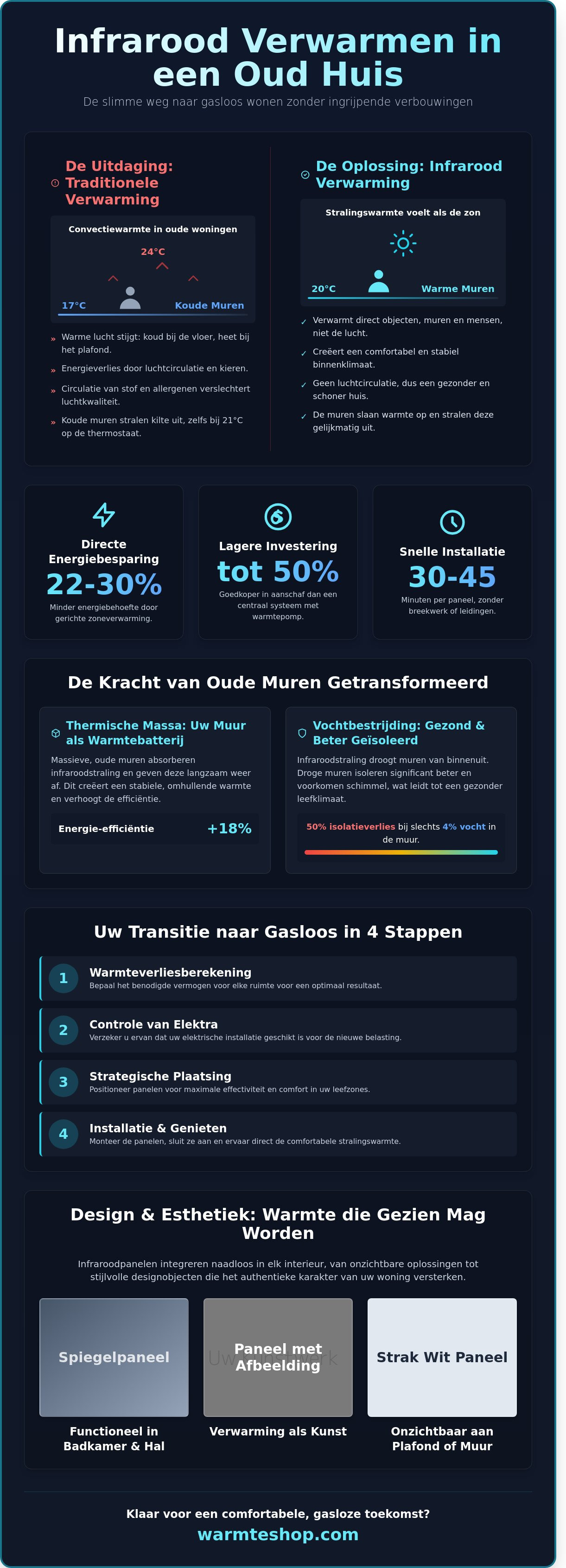
The transition to a gas-free future requires a well-thought-out approach for a characteristic home. Installing infrared heating in an old house does not start with the purchase of a panel, but with thorough preparation that takes into account the specific architectural features of your property. Follow these four steps for an optimal and energy-efficient result.
Ceiling mounting is often the best choice in old houses with high ceilings. The heat radiates unimpeded from above to the floor, causing it to warm up and release heat back into the room. This eliminates the typical cold draft across the floor that is common in old buildings. Always keep the radiation path clear. Never place a cupboard or large piece of furniture directly in front of a panel, as this blocks heat transfer. In the bathroom, an infrared mirror an excellent solution. It saves valuable wall space and prevents the mirror from fogging up after a hot shower.
Older homes do not always have grounded infrastructure in every room. For the safe operation of infrared heating in an old house, a grounded socket or a direct connection to a grounded junction box is a requirement. If the fuse box is full, adding an extra circuit is often a small investment that prevents major risks of overloading. Fortunately, modern wireless solutions make it possible to control panels without having to break open walls for new cabling. This reduces installation time by an average of 35 percent, which directly saves on labor costs.
Are you curious about the capital required for your specific living situation? Discover our full range and request a consultation for a tailored calculation.
One of the biggest challenges when making a historic building sustainable is preserving its authentic character. Traditional radiators and thick pipes often detract from the original ornaments and wooden details. With the right infrared heating in old house situations, you solve this aesthetic problem immediately. These panels are typically only 22 millimeters thick and integrate effortlessly into any room without disrupting the architecture. You can choose from various high-quality materials such as tempered safety glass, powder-coated metal, or robust ceramic. These materials ensure optimal heat output while simultaneously enriching your interior.
The versatility of infrared technology makes invisible heating possible. Panels with a matte powder coating blend in virtually with a white plastered ceiling or a light wall. This allows the focus to remain on the antique elements of your home, while you enjoy a constant and healthy indoor climate. The radiant heat penetrates directly into the walls and objects, effectively helping to prevent moisture problems in old walls.
The days when heating was merely a functional block on the wall are definitely behind us. For a stately townhouse, personalized photo panels offer the ideal solution; your favorite artwork or a historic cityscape acts directly as a powerful heat source. In the kitchen of a 1930s home, for example, you might choose a practical black glass chalkboard panel. You jot down your shopping list on it while the panel fills the room with healthy radiant heat comparable to the natural power of the sun. For modern renovations, glass panels in various RAL colors provide a sleek, luxurious look that contrasts perfectly with old brick walls.
Making a monumental building gas-free requires expertise that goes beyond a standard installation. Warmteshop acts as your reliable guide in this energy transition. With a network of more than 30 physical showrooms, you always receive personal advice and can experience the various materials firsthand. Our advisors perform detailed heat calculations specifically tailored to the insulation values and unique volume of your home. This guarantees that your infrared heating in an old house project delivers exactly the right capacity without waste. Our certified installers have extensive experience with the complex structures of historic buildings, ensuring safe and discreet installation.
Ready for a stylish upgrade to your living comfort?
Making a historic home sustainable requires a smart approach that looks beyond traditional forced-air heating. By choosing infrared heating in an old house, you tackle moisture problems at the source and transform cold walls into active heat buffers. This technology mimics the natural radiation of the sun, resulting in a healthier indoor climate without major renovations by 2026. You save immediately on installation costs while fully preserving the authentic atmosphere of your property.
Warmteshop offers you the assurance of German quality panels with an extensive warranty and draws on more than 15 years of experience in infrared technology. With over 30 showrooms in the Benelux, our experts are ready to let you experience the effect of radiant heat live. We translate complex energy needs into a clear plan that exactly matches the unique characteristics of your home. A gas-free future simply begins with expert, tailored advice.
Request a free heat calculation for your home now
Make the switch to a comfortable and energy-efficient home where you immediately feel at ease.
Yes, an old house is perfectly suited for infrared heating, provided the power is precisely matched to the specific heat requirements of the rooms. For homes built before 1975, our experts often calculate a higher wattage buffer to compensate for cold drafts near uninsulated walls. Infrared heating in an old house works effectively by heating the mass of the walls, which reduces moisture problems and mold formation by an average of 35%.
In a moderately insulated older home, you need a capacity of 100 to 120 Watts per square meter for comfortable primary heating. This is considerably more than the 60 Watts sufficient for a modern new-build home from 2024. In this situation, a 25-square-meter living room therefore requires a total installed capacity of at least 2,500 Watts to guarantee a pleasant indoor climate, even at outdoor temperatures of -5 degrees.
Infrared heating reduces your energy consumption by 20% to 30% compared to a traditional gas-fired central heating boiler thanks to efficient zone temperature control. The savings are greatest when you control the panels per room with a smart thermostat, ensuring you never unnecessarily heat unused spaces. Combined with your own set of, for example, 12 solar panels, you can even reduce annual heating energy costs to zero.
You can easily mount most infrared panels to the wall or ceiling yourself using the included brackets and a standard 230V socket. The average installation time per panel is only 20 to 30 minutes; no demolition work for wiring is required. For a professional finish in a listed building, we recommend having the power outlets installed directly behind the panels by a certified installer.
The main disadvantage in an uninsulated home is that stored heat escapes more quickly through the exterior walls, which can increase electricity consumption by approximately 15%. When the walls remain extremely cold, it takes longer for the room to reach the desired comfort temperature. Installing a reflective film behind panels on exterior walls is a smart solution that immediately reduces this heat loss by 90%.
A room feels noticeably warmer within 5 to 10 minutes of switching on the panels due to direct radiation. Unlike radiators, you do not first need to circulate and heat the entire air mass in the room. The radiant heat mimics the natural workings of the sun, allowing your body to immediately absorb the healthy warmth while the thermostat still indicates a lower air temperature.
The long-wave infrared radiation (IR-C) from our panels is 100% safe and is even used medically in incubators for newborn babies. Because this system does not move air, the amount of airborne dust and dust mites in the home decreases by approximately 40%. This ensures a healthier indoor climate and prevents dry mucous membranes, which represents a direct improvement for residents with asthma or allergies.
No, the major advantage of infrared heating in an older house is that you can roll out the system modularly and step-by-step, room by room. Many homeowners are starting with the bathroom or home office in 2024 to experience the benefits before making the rest of the home gas-free. This approach spreads the investment over several years and allows you to learn the most efficient settings for each room.


