

Infrared heating in a well-insulated house: The smart choice for 2026
, by Warmteshop, 17 min read
, by Warmteshop, 17 min read
Why would you invest up to 15,000 euros in a complex heat pump when a technology costing only a fraction of that price heats your home more comfortably? Many people still think that a heat pump is the only way to…
Why would you invest up to 15,000 euros in a complex heat pump when a technology costing only a fraction of that price heats your home more comfortably? Many people still think that a heat pump is the only way to a gas-free future, but the reality in 2026 looks different. Applying infrared heating in a well-insulated house is no longer a luxury extra for the bathroom; it is the most cost-effective primary heating system for modern homes. While traditional systems circulate the air unnecessarily, infrared brings the natural heat of the sun directly into your living room.
We understand your doubts due to conflicting stories on the internet and concerns about rising electricity bills. It is perfectly logical that you want certainty before making the switch to a fully electric home. In this article, you will discover exactly how to maximize your own solar power with infrared panels and reduce installation costs by 60 percent compared to a heat pump. We dive into the hard numbers of energy consumption, explain the benefits for your health, and show why this choice will take your living comfort to a higher level in 2026.
Infrared heating is a technology that does not use air as a transport medium for heat, but instead directly heats objects and people in a room. In a home with an A-label or BEN status (Nearly Energy Neutral), this system transforms from a luxury extra into a smart primary energy source. While traditional systems circulate warm air that escapes at the slightest draft, infrared heating focuses on the thermal mass of the home. For the residential market, we use exclusively long-wave radiation. This is safe and ensures a constant base temperature without drying out the air. By 2026, the focus in the construction sector will shift entirely to gas-free solutions, where infrared heating plays a central role in well-insulated homes due to low installation costs and high efficiency per square meter.
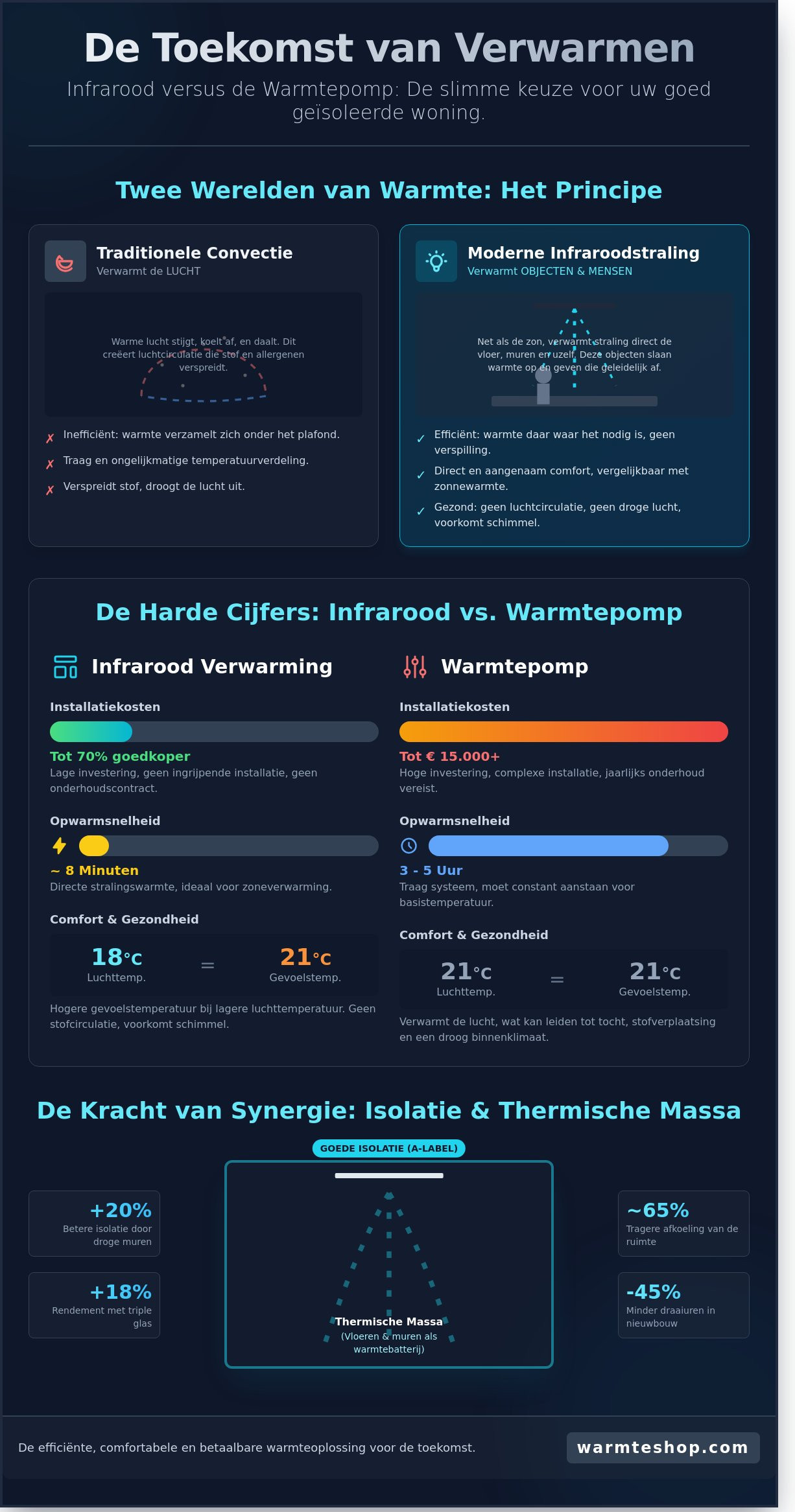
Infrared radiation works by directly setting matter in motion. Walls, floors, and furniture store this energy and act as an active heat source that releases the heat slowly. This process positively influences the perceived temperature. In a room with infrared panels, you often experience the same comfort at 18 degrees Celsius as at 21 degrees in an air-heated room. The effect is identical to the natural warmth of the sun on a clear winter day. You feel the radiation directly on your skin, even if the ambient air is fresh. This results in a healthier indoor climate where dust particles do not constantly swirl through the room.
The insulation level of a home determines how efficient electric heating truly is. A high-quality building envelope with modern HR++ glass and high-grade roof insulation minimizes heat loss through transmission. In a poorly insulated house, the panels would lose the battle against the cold exterior walls, effectively "draining" the panels and increasing the energy bill. However, in a modern house with high airtightness, the stored radiant heat remains trapped within the structure. Figures from energy experts show that the heat demand in passive houses is up to 90% lower than in homes built before 1970. As a result, subtle infrared heating elements are more than sufficient to guarantee a stable and comfortable climate.
Infrared heating in a well-insulated house works fundamentally differently from a traditional convector. While older systems heat the air, infrared radiation activates the thermal mass of the home. Walls, floors, and furniture act as a natural battery that stores heat and gradually releases it back into the room. In homes with a high insulation value, such as new builds with an A+++ label, this stored energy is retained significantly longer. The cooling time of a room is slowed by approximately 65% compared to homes from the 1990s.
Triple glazing significantly enhances this effect. The metal oxide coatings on this glass are designed to retain heat, effectively reflecting long-wave infrared radiation back into the room. This increases the direct radiant efficiency by approximately 18% compared to standard double glazing. In new construction, this results in a system that requires up to 45% fewer operating hours than in a renovation project. British research into infrared as primary heating versus the heat pump demonstrates that this efficiency leads to a very stable and comfortable indoor climate in airtight homes.
Infrared radiation penetrates deep into the structure of the home. Dry walls insulate up to 20% better than walls containing moisture. Due to the constant wall temperature, infrared prevents the formation of thermal bridges and mold, a common problem in airtight modern homes. For optimal comfort in a passive house, we aim for a wall temperature of 20 degrees Celsius. This ensures a comfortable feeling, even if the air temperature is set a degree lower.
The response speed of infrared panels is a major advantage in the dynamic living style of 2026. While water-based underfloor heating often takes three to five hours to adjust the temperature, panels reach their peak power within 8 minutes. This speed enables strict zone heating. You heat the study only during office hours and the living room only in the evening. Connecting smart thermostats to your system is essential to accurately control this heat demand per square meter and eliminate unnecessary consumption.
The choice between a heat pump and infrared heating is about more than just the monthly energy bill. Anyone looking at the Total Cost of Ownership (TCO) over a 20-year period will see that the balance in a modern home often tips in favor of radiant heat. In 2026, a heat pump installation will cost on average between €14,000 and €22,000, including installation and buffer tanks. The purchase price of infrared heating is up to 70% lower. In a well-insulated home, the heat demand is so minimal that the high capital investment of a heat pump is simply not cost-effective within the device's lifespan.
Maintenance plays a crucial role in long-term costs. Whereas a heat pump contains moving parts, refrigerants, and filters that require annual inspections of approximately 180 euros, infrared is completely maintenance-free. The panels have no pumps or compressors that can wear out. As a result, they effortlessly last 25 years or longer without any loss of efficiency, which provides enormous peace of mind for the family budget.
The theoretical COP value of a heat pump is often misleading. In a Nearly Zero Energy Building (NZEB) with very low heat demand, a heat pump often has to 'cycle', which drastically reduces efficiency. In practice in 2026, we see that infrared heating in a well-insulated house consumes only 16 to 21 kWh per square meter per year. Because infrared allows you to regulate the temperature in each room to the degree using advanced thermostats, you avoid wasting energy unnecessarily on unused spaces.
Infrared panels are the perfect consumer for your own generated solar power. Thanks to the direct conversion of electricity into heat, you benefit optimally from your PV installation. An important aspect here is the synergy between insulation and thermal mass. The walls and objects in the room absorb the radiation and release it again with a delay. This process transforms your home into a thermal battery that retains heat long after the panels have been switched off.
This combination makes the switch to a gas-free life not only environmentally friendly but also financially very attractive. It is a smart upgrade that contributes directly to a healthy indoor climate without the complexity of traditional systems. You are not investing in technology that becomes obsolete, but in a sustainable comfort solution for the long term.
Switching to infrared heating in a well-insulated home requires a structured approach. It is not simply a matter of hanging up a panel; proper sizing and positioning determine whether you will save 10% or 30% on your energy bill. In a home that meets the 2026 insulation standards, the house envelope acts as a thermal battery that optimally retains radiant heat. This step-by-step plan assists you with the technical implementation.
An accurate heat loss calculation forms the basis of your comfort. For a modern, well-insulated home, we use a guideline of 20 to 25 Watts per cubic meter (m³). In a 60 m³ living room, this amounts to a total power output of approximately 1,200 to 1,500 Watts. We often recommend a slight overdimensioning of about 15%. This allows the room to reach the desired temperature faster, after which the thermostat switches off the system. This prevents panels from having to operate at full power constantly. A professional thermal study by the experts at Warmteshop is indispensable in this regard to identify thermal bridges or specific heating requirements per room.
The location of your panels determines the efficiency of the radiation. Ceiling mounting is almost always preferred over wall mounting. From the ceiling, the radiation has a clear angle of approximately 170 degrees. As a result, objects and the floor are heated evenly without furniture blocking heat transfer. For specific zones, such as the seating area or a home office, the integration of infrared floor heating be an excellent addition for extra foot comfort.
When building a new home or undertaking a major renovation, it is essential to take the electrical preparation seriously. For an entire home, we recommend distributing the panels across different circuits in the meter cupboard. Conceal cables in suspended ceilings for a sleek, minimalist look. Choose panels that complement the aesthetics of the room: consider a functional towel dryer in the bathroom or an art panel in the hallway. The system is regulated via smart thermostats that operate independently per zone. This ensures a healthy indoor climate where you only heat where and when necessary.
Do you want to know exactly what capacity your specific living situation requires for the highest return? Request a professional heat calculation directly from the experts at Warmteshop and secure a sustainable future.
Heating is no longer a necessary evil that must be tucked away behind a sofa. Modern infrared heating in a well-insulated home functions as a full-fledged interior element that blends seamlessly into the architecture of your home. Because the heat demand in an optimally insulated home will be significantly lower in 2026, the panels can be designed to be slimmer and more discreet than ever before. This offers unprecedented possibilities for both new builds and renovation projects.
The versatility of our products is reflected in various high-quality finishes. You can choose from matte white panels that blend almost invisibly with a sleek plastered ceiling, or striking design pieces made of tempered glass and crystal. For the creative homeowner, we transform panels into functional art. Think of photo panels with a personal high-resolution image or practical chalkboard panels that serve as a central information point for the family in the kitchen.
Infrared technology excels when functionality and design come together. A striking example is the infrared mirror in the bathroom. It not only offers comfortable radiant heat but also guarantees a 100% condensation-free surface immediately after showering. Additionally, our towel radiators provide the perfect combination of a warm room and silky-soft, dry towels. For those seeking extra coziness in the seating area, an electric fireplace is the ideal complement to the main heating system, where aesthetics and comfort go hand in hand.
The transition to a sustainable home often raises questions. That is why the experts at Warmteshop are ready to assist you in more than 30 showrooms spread across the Benelux. We do not believe in standard solutions; every type of home and every resident deserves tailored advice. Whether you have made a 1930s home sustainable or are building a state-of-the-art passive house, we calculate exactly what capacity you need for optimal efficiency.
As part of the Infrared Heating Group, we offer the assurance of years of expertise and innovation. Our guarantee of quality and service means that you are investing in a system that is ready for the future. The combination of healthy radiant heat, comparable to the natural power of the sun, and a flawless design makes infrared heating in a well-insulated home the most logical choice for those who want to combine comfort and style.
The transition to a gas-free home requires solutions that yield immediate returns today. Implementing infrared heating in a well-insulated house transforms your home into an efficient thermal battery that retains generated heat for hours. Since 2008, Warmteshop has served as the market leader in the Benelux, guiding thousands of families towards energy-efficient total solutions that lower their monthly energy bills. With more than 30 physical stores spread across the region, an expert advisor is always ready to thoroughly analyze your specific living situation. Infrared panels offer a completely maintenance-free alternative to complex installations such as heat pumps and, thanks to their sleek design, fit seamlessly into any modern interior. You enjoy constant, natural radiant heat comparable to the benefits of the sun, while simultaneously meeting the strictest sustainability requirements for the near future. Making your living environment more sustainable is a logical step towards a healthier and more comfortable indoor climate.
Discover our collection of infrared heating and request a free quote
Turn your home into a beacon of sustainable warmth and experience the comfort of innovative technology for yourself.
Yes, infrared heating is perfectly capable of comfortably and consistently heating an entire home, provided the insulation values of the walls and windows meet modern standards. In a home with energy label A or B, the system functions as a full-fledged primary heating system that effortlessly brings every room to the desired 21 degrees. The radiation heats the mass of the house, ensuring a stable indoor temperature without cold corners. This makes infrared heating a reliable and future-proof solution in a well-insulated home.
For a modern living room of 40 m², you typically need two to three panels with a combined output of approximately 1400 Watts. In new-build homes, we calculate with a low power requirement of only 35 Watts per square meter due to the high-quality insulation. For example, you can choose two strategically placed 750-Watt panels to optimally distribute the heat across the seating area and dining table. An accurate calculation by an expert prevents you from consuming unnecessarily high amounts of electricity.
Infrared heating is in many cases more economical than gas, especially when you heat rooms specifically using smart thermostats per room. While a traditional central heating boiler often heats the entire piping system and unused rooms, an infrared panel only consumes energy where you are actually present. Figures show that this allows you to save up to 20 percent on your total energy needs compared to convection heating. Combined with a dynamic energy contract, monthly costs in 2024 often fall even further below the price of natural gas.
The most effective location for an infrared panel is on the ceiling, preferably centrally above the area where you spend the most time. From a height of at least 2.5 meters, the radiant heat spreads downwards in a cone shape, ensuring the floor also becomes pleasantly warm. It is essential that no large pieces of furniture are placed directly in front of the panel that could block the radiation. Infrared heating in a well-insulated house performs best when the rays can reach the walls and objects in the room unimpeded.
No, for most installations you do not need three-phase power or major modifications to the meter box. The panels operate on a standard 230-volt connection and draw relatively little power from the grid per unit. An average 16-amp circuit can safely support up to 3,600 watts of power, which is more than sufficient for three to four large panels. However, for a complete switch throughout the entire home, we do recommend having the distribution across the circuits checked by a professional.
The combination of infrared panels and solar panels is the smartest way to heat your home completely carbon-neutral and virtually free of charge. You generate your own green electricity, which the panels convert directly into comfortable radiant heat for your interior. Even with the changes to the net metering scheme, this remains profitable because you increase the self-consumption of your own generated energy to 60 percent or more. It is a sustainable investment that quickly pays for itself due to minimal operating costs.
Infrared radiation is completely safe and even beneficial to your health, comparable to the natural warmth of the sun without the harmful UV rays. The panels use long-wave infrared radiation (IR-C) which stimulates blood circulation and helps muscles relax. Because the system does not move the air, up to 80 percent fewer dust particles and pollen swirl through your home. This creates a noticeably healthier indoor climate, which is ideal for people with allergies or sensitive airways.
A high-quality infrared panel has an average lifespan of 25 to 30 years without the heat output diminishing during that time. Because the system contains no moving parts, pumps, or fluids, mechanical wear is virtually non-existent. Moreover, you are not burdened by annual maintenance costs like with a heat pump or central heating boiler, which saves thousands of euros over the entire service life. It is a robust and maintenance-free technology that ensures a worry-free warm home for decades.


