

Infrared heating for your garden house: the ultimate buying guide for 2026
, by Warmteshop, 18 min read
, by Warmteshop, 18 min read
Why heat the volatile air in a wooden outbuilding if that heat escapes through the smallest crack? Most traditional stoves are fighting a losing battle against drafts and damp, while a smart …
Why heat the volatile air in a wooden outbuilding if that heat escapes through the smallest crack? Most traditional heaters fight a losing battle against drafts and damp, while a smart infrared garden house heater transforms spaces by directly heating the mass of the building and yourself, just like the healthy rays of the sun do.
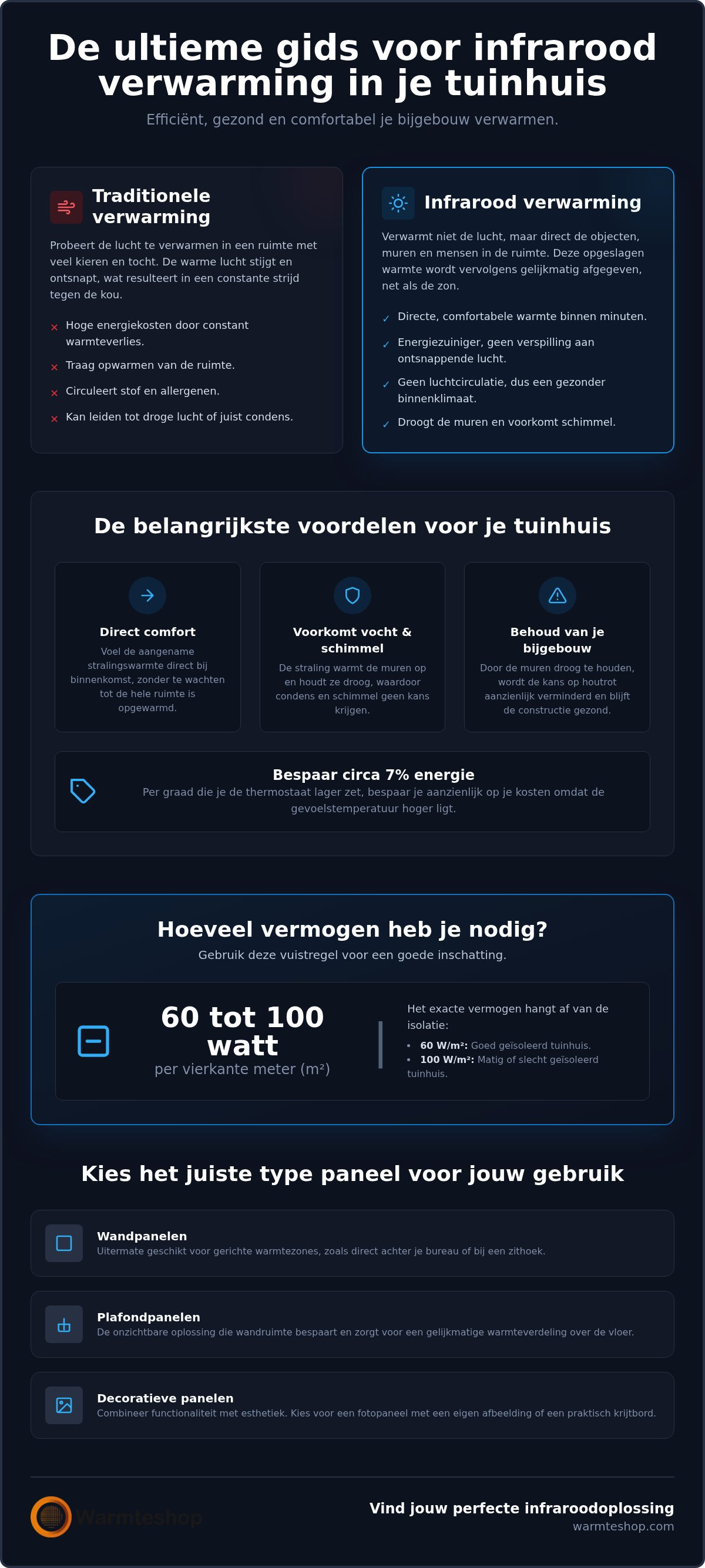
You probably recognize the frustration of a damp garden shed with condensation on the windows and electricity costs skyrocketing as soon as you turn on the supplementary heating. In this ultimate buying guide for 2026, you will discover how, with the right technology, you can transform your outbuilding into a healthy and comfortable workspace or relaxation area all year round. It is a smart upgrade that not only provides instant warmth upon entry but also reduces your energy consumption per degree by approximately 7% compared to traditional systems.
We show you how to permanently prevent mold formation, which capacity suits your type of insulation, and how to maintain full control via a handy app on your smartphone.
A garden house is often the place where you escape the hustle and bustle of everyday life, but as soon as the temperature drops, that oasis quickly turns into a chilly space. Traditional heaters try to warm the air, but in a wooden structure, that is often a losing battle. An infrared heating solution for a garden house tackles this fundamentally differently. Instead of heating the volatile air, an infrared panel emits invisible light waves that directly heat objects, walls, and people. It is a comforting thought that you feel the comfortable radiation within minutes, regardless of how cold the air around you still is.
To fully understand how infrared heating works, it is best to think of a sunny winter day. Although the air temperature may be well below freezing, you feel the warmth of the sun directly on your skin as soon as you step out of the shade. This principle of radiant heat creates an immediate feeling of comfort. For a space you use infrequently, such as a hobby room or a home office in the garden, this speed is essential. You do not need to turn on the heater hours in advance; the warmth is there as soon as you arrive.
Convection heating, the technology behind standard electric heaters, works by circulating air. In a wooden outbuilding with gaps or poor insulation, the warm air rises directly to the ceiling or escapes outside. That is pure energy waste. Infrared panels heat the mass of the room. The wooden walls, the floor, and your furniture store this energy and release it slowly as a natural buffer. Research shows that for every degree you turn the thermostat down, you save approximately 7% on your energy costs, simply because the perceived temperature is much higher with radiant heat than with warm air.
Moisture is the greatest enemy of any wooden outbuilding. Because infrared radiation heats and dries the walls themselves, condensation has no chance to form on the windows and walls. This is a crucial advantage that is often lacking with traditional heating. Dry walls mean that mold finds no breeding ground and the risk of wood rot is significantly reduced. Your valuable garden tools and wooden furniture remain in top condition because the relative humidity stays stable. Moreover, there is no active air movement. This means that no dust or pollen swirls through the small space, ensuring a healthy indoor climate where you can spend hours with peace of mind. Such a dust-free climate is not only pleasant for people but is also essential in professional animal care, such as at the Hof Ter Biezen.
By choosing modern infrared heating from Warmteshop, you invest not only in immediate living comfort but also in the preservation of your outbuilding. It is a sustainable step towards a green future where efficiency and coziness go hand in hand.
Not every outbuilding requires the same approach. For a compact home office, you often choose different systems than for a spacious relaxation area with French doors. Wall panels are ideally suited for targeted zone heating. Place them, for example, directly behind your desk or near the seating area for an immediate sense of comfort. Ceiling panels, on the other hand, are the invisible heroes of the space. They save valuable wall space and ensure even heat distribution across the entire floor, which is ideal if your infrared garden shed heating solution also needs to keep the floor comfortable.
For more open structures, such as a canopy or a semi-open garden house, infrared heaters offer the solution. These devices operate at a higher intensity to minimize the influence of drafts. If you use the space for multiple purposes, movable panels on feet are a flexible option. You simply slide the heat source along to the spot where you are working or relaxing at that moment. It is reassuring to know that official research into infrared heating shows that the user experience in such targeted applications is very positive, provided the installation aligns with the specific needs of the user.
You don't have to compromise on the look of your interior. An infrared photo panel transforms a functional heater into a personal work of art on the wall, allowing you to choose the image yourself. For those with a creative hobby room, an infrared chalkboard offers a smart dual function: you keep your notes or schedule close at hand while enjoying the healthy radiant heat. Mirror panels, on the other hand, are perfect for garden houses that serve as guest accommodation. They visually enlarge the space and, thanks to the heat, always remain condensation-free.
In a well-insulated garden office, infrared can serve excellently as the sole heat source. By using smart thermostats , you regulate the temperature down to the degree, even when you are not present. In guest houses, we often see a hybrid setup where infrared panels heat the living space, while an infrared mirror in the bathroom provides extra luxury. It is all about smart zone heating: you only heat the specific spot where you are at that moment, which prevents unnecessary costs. Curious which model best suits your situation? Then take a look at our extensive range of infrared heating for a tailored solution.
Determining the correct wattage is not guesswork. If you choose an infrared heating solution for a garden shed, you want to be sure that the space remains comfortable even during a severe frost night. Unlike a residential house, where lower wattages per square meter are often used, we apply a rule of thumb of 60 to 100 watts per square meter for garden sheds. This higher margin is necessary because outbuildings often lose more heat due to thinner walls and direct exposure to the elements.
A common mistake is choosing a capacity that is too low to save electricity. In practice, however, this actually has the opposite effect. A panel with excess capacity brings the mass of the room to the desired temperature much faster, after which the thermostat switches off the system. As a result, you ultimately consume less energy than with an undersized panel that has to constantly struggle at full power without ever reaching the desired comfort level. For an independent explanation of how infrared panels work , you can always consult external sources, but practical experience in outbuildings consistently points to a generously sized capacity as the most efficient choice.
The insulation value of your garden house determines where you fall within that 60 to 100 watt range. Do you have a modern, fully insulated office unit with high-efficiency glass? Then 60 watts per square meter is often perfectly sufficient. However, for a standard log cabin with a wall thickness of 28mm and single glazing, you should be thinking closer to 100 watts. Glass surfaces are notorious sources of cold. If your garden house has large windows, we always advise increasing the power slightly to compensate for radiant heat losses. It is the only way to guarantee that delightful, sun-drenched warmth experience in the winter as well.
The position of your panel is at least as important as the wattage. A golden rule: never hang a panel directly opposite a window. Glass does not reflect infrared radiation, causing the heat to literally 'fly' outside. For wall mounting in a small room, a height of approximately 1.50 to 1.70 meters is ideal for optimal distribution. Are you opting for a ceiling infrared panel? Then prevent cold feet by positioning the panel so that the radiation cone fully reaches the floor and your workspace. By combining your system with smart thermostats, you ensure that the heating only runs when it makes technical and economic sense. This way, you enjoy maximum comfort without unnecessary costs.
Now that you know exactly what power you need, it is time to select the ideal equipment. In our extensive collection of infrared garden house heating, you will find solutions specifically tested for their performance in wooden outbuildings. We offer a range of over 32 products available for immediate delivery to transform your space into a comfortable retreat. Furthermore, our expertise is underscored by international recognition, including being a Red Dot Design Award winner, guaranteeing the highest quality and aesthetics.
Standard white metal panels form the backbone of many heating plans. These panels are the unobtrusive all-rounders of our range. They are extremely thin, robust, and heat up lightning-fast as soon as you switch them on. Thanks to their neutral finish, they fit effortlessly into any interior, from a rustic log cabin to a modern studio. Moreover, they are very low-maintenance, which is a major advantage in a garden environment where dust and ambient dirt are sometimes unavoidable.
For those looking to take design a step further, our high-performance glass panels offer a brilliant solution. These panels give your outdoor office a modern and professional look. They combine the renowned energy efficiency of radiant heat with a tempered safety glass surface that retains heat for even longer. The result is a heating system that is not only functional but also truly contributes to the visual appeal of the space.
If your garden house features a canopy or large French doors that are often left open, our robust patio heaters an indispensable addition. These heaters provide the higher intensity needed to compensate for the effects of the outside air. This way, you can enjoy a pleasant temperature even on chilly evenings without the heat immediately blowing away.
A Wi-Fi module is essential for those who want to experience true comfort. It allows you to start warming up your garden house while you are still enjoying your coffee inside. By connecting the panels to wireless thermostats, you achieve precise zone control. You only heat when necessary, keeping your energy bill low. Many of our systems integrate effortlessly with existing smart home systems for maximum efficiency and future-proof management of your energy consumption.
Since 2006, Warmteshop has been a reliable guide in the world of the energy transition. With more than 30 showrooms in the Netherlands and Belgium, we always offer a location nearby where you can experience the heat for yourself and receive personal advice. Our experts perform custom heat calculations that take into account the specific construction and insulation of your garden house. With a stock of over 5,000 panels, we guarantee fast delivery and a professional installation service by our own skilled technicians. Would you like to experience for yourself how this innovative technology improves your living comfort? Then view our complete collection directly at warmteshop.com.
Creating a comfortable outdoor retreat requires more than just hanging a panel. At Warmteshop, we believe in an integrated approach that we call the heating plan. This plan forms the blueprint for your infrared garden house heating project, where we consider not only the heat demand but also the technical feasibility within your specific situation. We guide you from the initial idea to a fully functional system that operates worry-free for years to come.
A crucial part of this plan is the analysis of your current power supply. Many outbuildings are connected to a single circuit that also has to power garden lighting and a small refrigerator. Our experts calculate exactly whether the existing wiring can handle the extra load of the infrared panels. This prevents fuses from blowing the moment you switch on the heating. Furthermore, we advise you on the transition to green energy. By combining your heating system with solar panels on the roof of your garden house, you generate the necessary electricity yourself. This makes your heating virtually free and completely carbon-neutral, a smart and sustainable upgrade for your living comfort.
Before the installer arrives, it is important to ensure the electrical connections are in order. Consider the position of wall sockets or the possibility of concealing cables behind wall finishes. In many cases, we recommend ceiling mounting for infrared panels. This is not only space-saving but also ensures unobstructed radiation that heats the floor optimally. A major advantage of our systems is their low-maintenance operation. Because there are no moving parts or fluids inside the panels, you won't have to worry about your system for years after installation. No annual inspections, no filters to replace; just pure, healthy warmth that feels like the sun on your skin.
The switch to a modern and energy-efficient outbuilding starts with gathering the right information. We would like to invite you to one of our 30+ showrooms in the Benelux to experience the unique effect of radiant heat for yourself. Our advisors are ready to prepare a no-obligation quote and a customized heating plan for your project. Do you already have a clear idea of what you need? Then view the full range directly via our webshop and take the first step towards a garden house where you will enjoy spending time all year round.
The transition to a green and comfortable heating solution has never been easier. By choosing a smart infrared heating installation for your garden house, you opt for a healthy indoor climate free from moisture problems and enjoy direct, natural warmth comparable to the sun. As we have seen, with the correct capacity calculation and a strategic heating plan, you not only lower your energy costs but also extend the lifespan of your valuable wooden structure.
As an infrared expert since 2006, Warmteshop is ready to guide you through every step of this process. Whether you choose aesthetic photo panels or powerful heaters for a semi-open space, our specialists always offer a free, customized heat calculation. Furthermore, you are most welcome to visit one of our 30+ physical showrooms to personally experience the power of radiant heat before making a decision.
View all infrared heating for your garden house in the Warmteshop webshop and discover how easily you can transform your garden retreat into a fully-fledged living space. We look forward to working with you to create the perfect heating solution for the future.
Yes, infrared is actually the most effective solution for poorly insulated spaces because it heats you directly, rather than the air. In an uninsulated garden shed, you feel the radiant heat immediately on your skin, even though the air temperature remains somewhat lower due to drafts or gaps. For optimal results in this case, choose a slightly higher power output so that the objects in the room store the heat more quickly and radiate it back into the surroundings.
For an average garden house of 15 square meters, you should expect a total power output between 900 and 1500 watts. The exact requirement depends heavily on the insulation level of your walls and the glass surface area. In a modern, well-insulated office unit, one 1000-watt panel is often sufficient. In a classic log cabin with thinner walls, it is better to choose two 750-watt panels to ensure even heat distribution.
Compared to traditional electric heaters, the consumption of infrared garden shed heating systems is significantly lower. Because you do not need to heat the entire air mass and the radiation provides immediate comfort, the system does not need to run at full power for as long. By using a smart thermostat and targeted zone heating, you avoid unnecessary energy consumption when you are not present in the outbuilding.
Most infrared panels are easy to install yourself using the included brackets and work directly via a standard power outlet. It is often simply a matter of drilling holes, hanging the panel, and plugging in the power cord. However, for a sleek finish without visible cables or for complex ceiling mounting, we recommend using our professional installation service. This ensures that the safety and efficiency of your system are optimal.
Technically, the ceiling is the most efficient location because the radiation can then reach the floor and furniture unimpeded. In a small room, this also saves valuable wall space for cabinets or decoration. If you do opt for wall mounting, hang the panel at a height of approximately 1.50 to 1.70 meters and ensure it is not positioned directly opposite a window so that heat does not escape through the glass.
Infrared is an excellent remedy against moisture because it directly heats and dries the walls of your garden house. Condensation forms when warm air cools on a cold surface; by keeping the walls themselves warm, you completely prevent this process. This protects your wooden structure against wood rot and harmful mold growth. The result is a dry and healthy indoor climate, which is essential for the preservation of your outbuilding and your belongings.
High-quality infrared panels are completely safe for use in wooden structures. Warmteshop's panels are equipped with built-in safety sensors that immediately prevent overheating. Furthermore, the back of the panel does not get hot enough to pose a fire hazard to wooden walls or ceilings. It is reassuring to know that this technology has been safely applied for decades in both modern homes and rustic wooden outbuildings.
For efficient operation, a specific thermostat for infrared heating is necessary for optimal comfort. Standard thermostats often only measure the air temperature, whereas an infrared thermostat is better tuned to the specific radiation cycles of the panels. We recommend a Wi-Fi-controlled thermostat so that you can accurately regulate the temperature and preheat your garden house via an app on your smartphone before stepping outside.


