

Infrared heating consumption: everything about costs and efficiency in 2026
, by Warmteshop, 19 min read
, by Warmteshop, 19 min read
What if you could turn the thermostat down two degrees without losing even a shred of comfort, while the average electricity price in 2026 hovers around €0.24 per kWh? Many homeowners wonder whether…
What if you could turn the thermostat down two degrees without losing even a shred of comfort, while the average electricity price in 2026 hovers around €0.24 per kWh? Many homeowners doubt whether electric radiant heat is powerful enough as primary heating or worry about the exact wattage required per square meter. It is a logical question in a time when we are moving away from gas en masse and seeking financial security. After all, infrared heating consumption is not a static figure, but a dynamic result of smart zone heating and warming the thermal mass in your home, just as the natural heat of the sun warms the earth.
In this article, you will discover how to heat specifically with infrared panels and lower your energy bill by applying smart calculations. We offer a concrete formula to accurately predict your consumption, so that the fear of unexpected costs disappears. Additionally, you will learn how to set the thermostat for maximum savings and gain clear insight into the actual payback period of this system. This way, you transform your home into a healthy indoor climate not out of obligation, but as a comfortable and future-proof upgrade.
The actual consumption of infrared heating does not depend on how quickly the air in a room heats up, but on how efficiently objects retain heat. With traditional central heating, warm air rises to the ceiling, cools down, and falls back down. We call this process convection. An infrared panel works fundamentally differently by emitting direct radiation towards walls, furniture, and people. As a result, the insulation level of your walls is much more important for efficiency than the total air volume of the room.
This technology closely resembles the natural warmth of the sun. Even on a cold winter day, you feel the warmth of the sun's rays on your face, even if the outside air is freezing cold. Because infrared heats the thermal mass of the room rather than the volatile air, you can often set the thermostat two degrees lower without sacrificing comfort. In fact, 18 degrees of infrared heat feels just as comfortable as 20 degrees from a traditional radiator. This is a crucial factor for your wallet; every degree you lower saves an average of 6 to 7 percent on your energy consumption. For an in-depth explanation of the technical operation of infrared heaters, you can consult scientific sources that describe the different wavelengths.
Once walls and floors have warmed up, they act as a heat battery. They store energy and slowly release it back into the room. This prevents the unpleasant feeling of 'cold walls', meaning the panels do not have to work as hard to maintain the comfort temperature. Installing panels on the ceiling is often the smartest choice in this regard. From the ceiling, the radiation reaches a larger surface area of the floor and walls, maximizing mass storage. This significantly reduces the energy required for so-called maintenance heating.
A common mistake is choosing a panel with too low a wattage to save money initially. In practice, an undersized system actually consumes more power because it must remain on continuously to reach the desired temperature. In 2026, we use approximately 25 to 30 watts per cubic meter for primary heating in an average insulated home. By choosing the correct sizing, you limit the warm-up time. This allows the thermostat to switch off the system more frequently, which is essential for favorable infrared heating consumption in the long term.
To gain complete control over your monthly energy costs, it is essential to understand how to calculate infrared heating consumption yourself. It is not complicated guesswork, but a logical calculation of power, time, and current energy prices. Once you know how many watts you install per room, you can use a simple formula to predict your daily costs down to the cent.
Follow these five steps for a reliable calculation of your consumption:
Suppose you heat a living room with a 1,000-watt panel for 6 hours per day. The calculation then becomes: 1 kW x 6 hours = 6 kWh per day. At the 2026 rate, this will cost you approximately €1.44 per day. The situation is often more favorable in the bathroom. Although you often install a higher wattage per m² there for rapid heating, the panel is often only switched on for 1 hour per day. This makes the consumption of infrared heating in the bathroom surprisingly low, despite the powerful radiation. By using advanced thermostats, you can perfectly regulate these times per room. Scientific research into the efficiency of radiant heating confirms that this type of heating wastes less energy than systems that heat the air, because no heat is lost through air currents or ventilation.
The days of simply plugging a device into a socket are over. Modern Wi-Fi modules and sensors prevent unnecessary consumption when you are not at home. A system with adaptive start learns exactly how long the panel needs to reach the desired mass temperature, ensuring it never stays on too early or too long. Practical figures show that manual on/off switches often lead to 20% higher consumption, simply because we forget to turn off the system or react too late to temperature changes. For optimal results, it is advisable to have a professional heat calculation performed so that your system is perfectly tailored to your living situation.
In 2026, the choice between natural gas and electricity will no longer be solely a matter of environmental considerations, but primarily a strategic financial decision. With an average gas price between €1.28 and €1.54 per m³ and an energy tax on gas that has risen to €0.7267 per m³, the central heating boiler weighs heavily on the monthly budget. Electricity, on the other hand, is stabilizing at around €0.24 per kWh. This makes the use of infrared heating increasingly attractive, especially since this system completely eliminates the hidden costs of a traditional installation.
A central heating boiler entails more costs than just gas consumption. Consider the electric circulation pump that runs continuously and the mandatory periodic inspections and maintenance to guarantee safety. Infrared panels have no moving parts, no fluids, and require no annual maintenance. This means that the total cost of ownership over a ten-year period often turns out to be lower than with gas-fired systems. Switching to infrared heating is therefore an investment in peace of mind and predictability.
With central heating, up to 15% of heat is lost through the pipes on the way from the boiler to the radiator, even if they are insulated. Infrared panels convert electricity into heat with near-100% efficiency, directly in the room where you need it. Scientific studies into the thermal efficiency of infrared show that radiant heat can significantly reduce a home's energy requirements compared to convection systems. This makes it a superior choice for the transition to carbon-neutral living, as every watt consumed contributes directly to your comfort.
The consumption of infrared heating combines perfectly with the generation of your own green electricity. While gas remains an external dependency, solar panels allow you to partially produce your own fuel for the winter yourself. In 2026, we expect a strong rise in the home battery, which stores solar energy generated during the day for use during the cold evening hours. In homes without a gas connection, infrared acts as the ideal partner for zone heating, allowing you to heat only the active living zones with your own energy. For those who want to take sustainability a step further, infrared underfloor heating a constant, low base temperature that perfectly complements this autonomous energy profile.
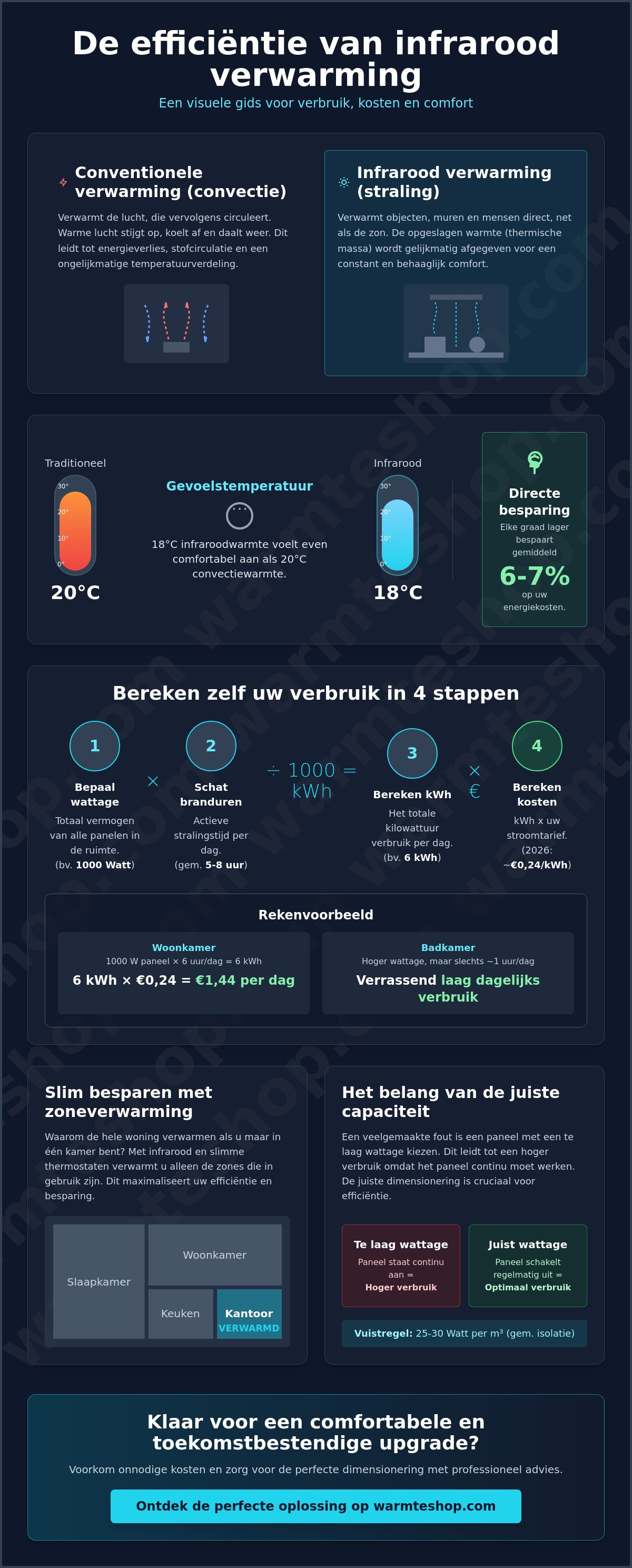
Zone heating is perhaps the most powerful weapon in your fight against high energy bills. While a traditional central heating boiler often has to heat the entire house to make the living room comfortable, infrared panels allow you to determine very specifically where and when you need heat. In practice, it is pointless to heat the bedroom or hallway all day via a central thermostat if you are hardly ever there. By switching to this principle of targeted heating, you can reduce total infrared heating consumption by as much as 30% compared to a system that keeps the entire home at a constant temperature.
In modern, hybrid homes, we increasingly see infrared as the ideal partner for a heat pump. While a heat pump excels at maintaining a constant, low base temperature via underfloor heating, infrared panels handle peak moments in rooms that need to heat up quickly. Consider a home office that you only use for a few hours a day. Instead of turning up the slow-responding underfloor heating there, a panel provides instant comfort without unnecessarily heating the rest of the house. This smart zoning ensures a perfect balance between system efficiency and individual living comfort.
The location where you mount a panel has a direct impact on how you experience the heat and the panel's ultimate energy consumption. A panel directly above the seating area or dining table is many times more effective than mounting it on a cold exterior wall. You feel the radiation directly on your body, providing an instant sense of comfort. However, be mindful of the shadowing effect of furniture. Large cabinets or sofas can block the radiation, preventing the walls behind them from heating up and halting thermal mass storage. In the bathroom, an infrared mirror an excellent choice. It combines two functions in one object, prevents condensation, and offers that delightful warmth exactly where you are getting ready for the day.
To keep infrared heating consumption low, it is wise not to let the night temperature drop by more than 2 to 3 degrees. If the walls and floors cool down too much, the panel has to work much harder the next day to recharge the thermal mass. Ultimately, this costs more energy than maintaining a stable base. Some other smart measures include:
Do you want to know exactly which configuration offers the most benefits for your specific living situation? Then view our full range of infrared heating for a solution that perfectly matches your needs.
The transition to a sustainable home is a process where you need a reliable guide. Determining the right system goes beyond simply choosing a beautiful panel; it is a technical matter where precision makes the difference between a high bill and comfortable savings. A professional heat calculation forms the absolute basis for this. Our experts look not only at the dimensions of the room but also analyze the insulation values and your personal lifestyle. This prevents wattage that is too low, requiring the system to run continuously, or wattage that is too high, resulting in unnecessary investment costs. Correct sizing is the only way to fully control the actual consumption of infrared heating.
Warmteshop has positioned itself as the market leader within the Infrared Heating Group since 2008. With more than 30 showrooms spread across the Benelux, we bring digital information to a tangible environment. Here, you can experience the natural warmth of the sun, translated into our technology, for yourself. Our advisors take the time to review your living situation and provide a down-to-earth, factual basis for every recommendation. You gain access to a wide range of infrared heating that meets the strictest European quality standards, ensuring you have a system that will still perform optimally in 2026.
Every space requires a specific approach. In the bathroom, a stylish towel radiator ensure both warm towels and a pleasant ambient temperature, while for industrial halls we deploy powerful radiant heaters. Our installers ensure safe and often invisible installation, with cables neatly concealed in the ceiling or wall. For those who wish to combine aesthetics with functionality, we offer personalized photo panels. These panels are indistinguishable from works of art, yet contribute imperceptibly to lower infrared heating consumption thanks to their high-quality finish and efficient heat output.
The step towards a lower energy bill starts with a good conversation. We invite you to request a free consumption calculation from one of our experts so that you know exactly where you stand before you invest. Additionally, discover how you can turn your daily routine into a wellness experience by transforming your bathroom with sunshowers. These systems combine the healthy effects of infrared light with the comfort of your daily shower. Make an appointment today at a showroom near you for a live demonstration and let yourself be convinced by the power of radiant heat.
In 2026, switching to electric radiant heating is not only an environmentally conscious choice, but above all a smart investment in your living comfort. You have seen that the actual consumption of infrared heating depends on a strategic approach: from utilizing thermal mass to consistently applying zone heating. By heating only those rooms where you actually spend time, you maintain full control over your energy bill without compromising on comfort in your home.
With over 15 years of experience in infrared technology, Warmteshop is ready to guide you through this energy transition. We offer a free, customized professional heat calculation so you know exactly what wattage your specific living situation requires. Visit one of our 30+ physical showrooms for personal advice and experience the power of our panels for yourself. Calculate your savings and view our infrared panels to take the first step towards a healthier and more energy-efficient indoor climate today. The transition to green energy has never been so comfortable and accessible.
On average, you need 25 to 30 watts per cubic meter for primary heating in a well-insulated home. In less well-insulated rooms, this can rise to 40 watts per cubic meter. It is essential to base the calculation on volume (m³) rather than surface area (m²), as ceiling height and insulation level determine the final heat requirement. An accurate calculation by an expert prevents you from installing insufficient capacity, which actually leads to higher energy consumption.
Looking purely at electricity consumption per unit of heat delivered, a heat pump is more efficient due to its high COP value. However, with infrared heating, you save significantly on installation costs, annual maintenance, and the replacement of complex components. For specific rooms or as targeted supplementary heating, the consumption of infrared heating often more financially advantageous when comparing total costs over a ten-year period. Moreover, the absence of moving parts makes the system completely maintenance-free.
Infrared panels can certainly serve as primary heating in an older home, provided the basic insulation is up to standard. Because infrared heats the walls and floors rather than the air, it prevents the typical drafts and cold air currents of old houses. In such situations, a professional heat calculation is necessary to prevent the panels from having to run continuously at full power to achieve the desired comfort level. Heating the thermal mass ensures a stable and pleasant climate, especially in old buildings.
You save an average of 12 to 14 percent on your energy costs when you set the thermostat two degrees lower. Because radiant heat directly warms your body and the objects in the room, 18 degrees with infrared feels just as comfortable as 20 degrees with a traditional radiator. This direct heat transfer is one of the main reasons why infrared heating consumption is often lower in practice than with systems that only heat the air. It is a smart way to save directly on your bill.
The annual consumption of an infrared panel in the bathroom is relatively low because the system is often active for only 30 to 60 minutes per day. For a 600-watt panel running for an hour daily, the annual consumption amounts to approximately 219 kWh. At the average rate of 2026, which is around €0.24 per kWh, the annual cost for a wonderfully warm bathroom is only a few tens of euros. This makes it a very cost-effective solution for spaces you use only briefly.
It is generally not advisable to switch off the panels completely at night, as the thermal mass in the walls cools down too much. The next day, it costs more energy to reheat the cold walls than to maintain a constant base temperature. Lower the temperature at night by a maximum of 3 degrees for an optimal balance between energy savings and a quick warm-up time in the morning. Smart thermostats can manage this process fully automatically for you based on your lifestyle.
Solar panels significantly reduce the operating costs of infrared heating because you can use your own generated electricity directly for your heating system. Especially in combination with a home battery, you can use solar energy stored during the day for heating during the colder evening hours. This makes you less dependent on fluctuating electricity prices on the grid and substantially shortens the total payback period of your installation. It is the most sustainable path to a carbon-neutral home, where you benefit from free energy from the sun.
Ceiling mounting is in most cases more efficient and results in lower energy consumption than wall mounting. From the ceiling, the radiation reaches a larger surface area of the floor and walls without furniture blocking the heat, allowing the room to warm up more evenly. Wall mounting is often more suitable for local supplementary heating, for example directly behind a desk or seating area, but covers a smaller portion of the total space. Choosing the right position is crucial for the efficiency of your panels and the ultimate sense of comfort.


