

Infrared ceiling heating: The complete guide for 2026
, by Warmteshop, 20 min read
, by Warmteshop, 20 min read
Would you rather place the sun on the ground or experience its beneficial warmth from above? It may sound counterintuitive to look up for a warm floor, but the choice for infrared ceiling heating…
Would you rather lay the sun on the ground or experience its beneficial warmth from above? It may sound counterintuitive to look up for a warm floor, but choosing infrared ceiling heating is the most logical step towards a sustainable home in 2026. We all recognize the frustration of bulky radiators that take up up to 15% of your usable wall space. It is a well-known problem that traditional systems circulate the air unnecessarily, often leaving you with cold feet while the heat uselessly sticks to the ceiling.
You want a home that is not only pleasantly warm but also exudes tranquility and aesthetics, without increasing your monthly costs. In this guide, you will discover why ceiling mounting is the most efficient choice for infrared heating and how it maximizes your living comfort. We show you how to significantly reduce your energy consumption with smart zone heating and why this invisible solution is becoming the standard for a healthy indoor climate without dust displacement.
Ceiling infrared heating is an innovative, space-saving solution that fundamentally changes the way we view indoor climate. By 2026, the transition to gas-free living will have gained momentum, making electric systems that deliver immediate returns the norm. An infrared panel on the ceiling functions not as a traditional heater, but as a compact heat source that radiates invisible energy. It is an aesthetic choice that ensures walls remain free for cabinets or artwork, while the technology blends seamlessly into the interior.
The operation is best compared to the natural warmth of the sun. When you stand in the sun on a cold day, you immediately feel the warmth on your skin, even though the surrounding air is cold. This is due to radiant heat. Modern infrared heaters utilize this principle by directly heating objects, floors, and people without the intervention of air movement. This process is extremely efficient because no energy is lost heating large volumes of air that subsequently escape through cracks or ventilation grilles.
The ceiling is the most strategic location for installation. From this highest point, the radiation has an unobstructed path to the rest of the room. Unlike wall mounting, where furniture such as a sofa or table can block the radiation, ceiling-mounted infrared heating reaches every corner of the living space. In modern homes, long-wave infrared radiation (IR-C) is specifically chosen. This specific wavelength is optimal for human comfort and is excellently absorbed and retained by most building materials in the home.
When an infrared panel is activated, the heat spreads in a radiation cone of approximately 45 degrees. This means that the heat spreads out widely as the distance from the panel increases. At a standard ceiling height of 2.6 meters, the radiation reaches the floor with impressive intensity. In this process, the floor acts as a heat accumulator. The floor material stores the energy and releases it gradually, creating an effect comparable to underfloor heating. People often experience this direct radiation within just 5 to 8 minutes of switching it on, which is significantly faster than with central heating systems.
The biggest difference compared to traditional systems lies in air movement. Radiators work on the basis of convection: they heat the air, which then rises. If you were to hang a radiator from the ceiling, the warm air would simply stick to the ceiling, resulting in cold feet and enormous energy loss. Infrared bypasses air mass and heats matter. This has major health benefits. Because there is no constant airflow, 80% less dust circulation occurs. For the 25% of the population suffering from dust mite allergies or respiratory problems, this offers a significantly healthier indoor climate. Moreover, humidity remains stable, preventing dry eyes and airways. The direct transfer of energy means you can often set the thermostat 2 degrees lower without sacrificing comfort, which directly leads to a saving of approximately 6% per degree on your energy consumption.
Infrared ceiling heating is the smartest way to instantly reclaim square footage in your home. In an average living room of 30 m², a traditional radiator easily takes up 1.5 m² of usable wall space. With an infrared ceiling heating system, this obstacle disappears completely. You can place your sofa, bookcase, or sideboard exactly where you want, without having to consider heat sources that might be blocked. This provides unprecedented freedom in your interior design and creates a sleek, modern look.
Because the radiation comes from above, an extremely even heat distribution is created throughout the entire room. With wall-mounted models, an armchair or table often blocks the radiant heat, which we call a thermal shadow in engineering. At the ceiling, the radiation has free rein and reaches every corner of the room. Scientific research into the efficiency of radiant heating shows that these systems perform superiorly because they heat objects and people directly, rather than merely moving the air mass.
Safety is a decisive argument for many families. The surface of an operating panel reaches temperatures between 85 and 100 degrees Celsius. Thanks to mounting at a strategic height of at least 2.5 meters, the panels remain safely out of reach of curious children's hands or pets. Moreover, the technology behind it is lightning fast. Within 5 to 10 minutes of switching it on, you experience the full intensity of the radiant heat. This enables targeted zone heating; you only heat the areas where you are currently staying, preventing unnecessary energy consumption in unused corners.
The aesthetic integration of these panels has evolved significantly in recent years. Modern systems are available as minimalist white panels that blend in with a light ceiling, but also as hybrid solutions with built-in LED lighting. This saves on installation costs and creates a calm ceiling appearance without separate fixtures. The result is a heating system that does its job invisibly while offering maximum comfort.
Infrared radiation mimics the natural, beneficial warmth of the sun. The rays reach the floor directly, causing it to heat up and act as a secondary heat source. This prevents the notorious cold feet that often occur with traditional convection systems. Because the walls and ceiling remain dry, mold formation has no chance, protecting the structural integrity of your home. For the 25% of the population suffering from allergies or respiratory problems, this is the ideal solution. This is because there is no air circulation, meaning dust mites and pollen are not constantly blown through the room.
By 2026, the transition to a gas-free home will become the absolute standard in the Netherlands and Belgium. An infrared ceiling heating system plays a key role in this. In combination with solar panels, you generate your own heat, which immediately reduces your household's CO2 emissions by an average of 40%. Compared to outdated electric convectors, you realize savings potential of up to 30% on your annual energy bill. It is a future-proof investment that quickly pays for itself due to low operating costs and the absence of maintenance expenses. Curious which configuration best suits your living preferences? You can request a no-obligation calculation for your specific situation from our advisors.
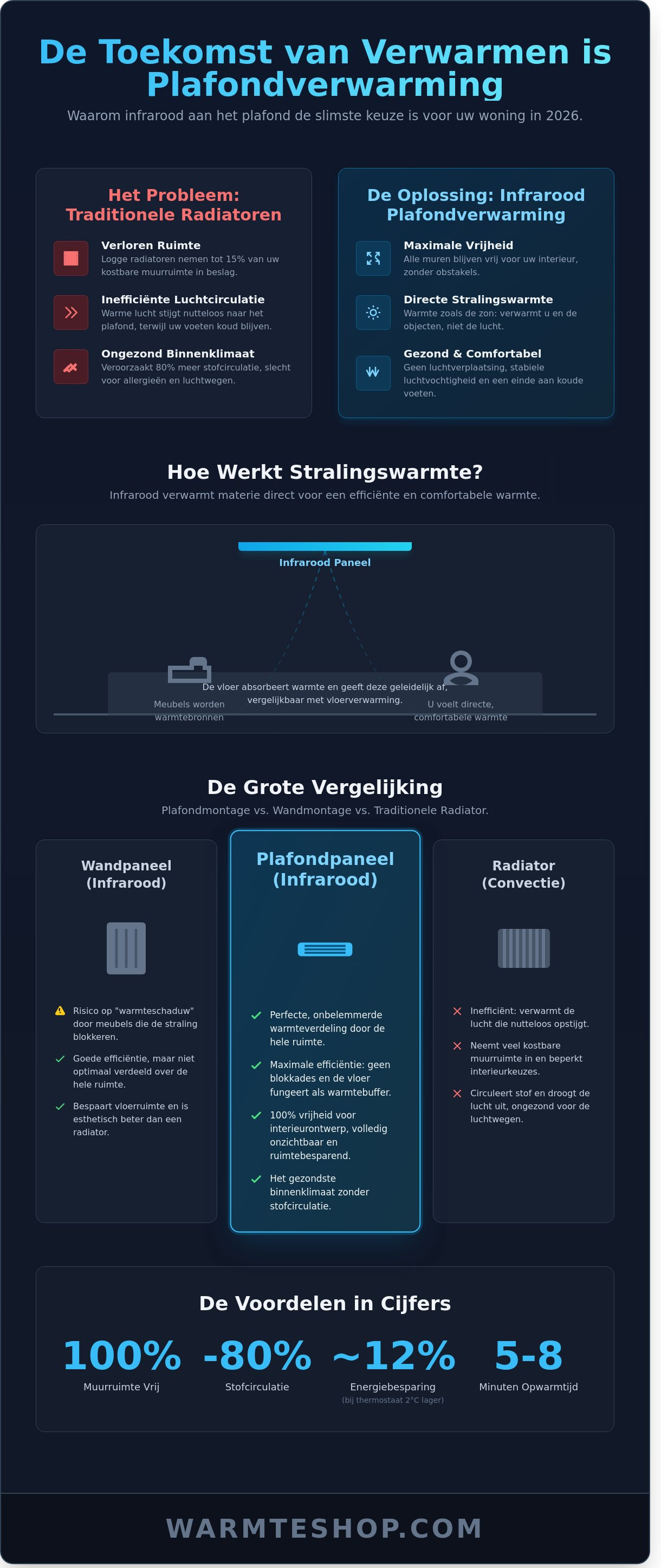
The choice of the correct mounting position largely determines the efficiency of your heating system. With infrared ceiling heating, you benefit from a natural heat distribution comparable to the sun. While wall panels are often partially blocked by sofas, cabinets, or tables, radiation from the ceiling has a clear path to the floor and the objects present. This process is based on the scientific principles of infrared, where thermal energy is transferred directly to mass without the intervention of circulating air. This prevents unnecessary heat loss at the ceiling and ensures an even temperature throughout the entire living space.
The installation costs of infrared panels are on average 40% lower than those of traditional systems. While routing pipes for a water-based system often takes two to three days and involves extensive demolition work and dust, a ceiling panel is often installed within 60 minutes. For renovation projects, this is a smart upgrade that immediately increases home value without compromising the existing floor structure. Moreover, the response speed is a crucial advantage. A classic system often takes three to four hours to bring a room up to temperature; an infrared panel reaches its maximum radiant power within just 10 minutes.
Ceiling mounting is the standard for large living rooms and kitchens because the heat distributes most homogeneously there. We recommend a wall panel primarily as supplementary heating, for example directly next to a desk or in a seating area where you want to create a specific "heat envelope". When choosing an infrared ceiling heater, always consider the height of the room. For ceilings higher than 3 meters, a panel with a higher wattage is necessary to ensure that the radiation intensity at floor level remains sufficiently powerful for optimal comfort.
Many consumers consider ceiling-mounted infrared as the modern alternative to underfloor heating. Because the radiation heats the floor directly, it creates the same comfortable feeling of warm feet without the inertia of a central system. You control the temperature per zone, resulting in an average energy saving of 20% compared to systems that heat the entire house simultaneously. Additionally, the system is completely maintenance-free. There are no pumps that can seize up, no pipes that can leak, and no fluids need to be refilled, saving thousands of euros in maintenance costs in the long run.
Optimal performance of your infrared ceiling heating begins with strategic positioning. Unlike traditional radiators that circulate warm air, infrared works with direct radiant heat. The panels emit heat in a cone shape at approximately 45 degrees. For maximum coverage, preferably place the panel centrally above the area where you spend the most time, such as the seating area or the dining table. This way, you benefit directly from the sun-like warmth without objects blocking the radiation.
Calculating the correct wattage is crucial for your living comfort and energy bill. For a well-insulated home, we use a guideline of 20 to 25 Watts per cubic meter (m³). Do you have a room of 25 square meters with a standard height of 2.5 meters? Then this amounts to a total volume of 62.5 m³. In this scenario, our expert recommends a total power output of approximately 1500 Watts to efficiently heat the room, even on cold winter days. In older homes with moderate insulation, this requirement often rises to 30 to 35 Watts per m³.
Safety is always paramount at Warmteshop. During installation, you must observe strict minimum distances. Always maintain a margin of at least 20 centimeters between the edge of the panel and the walls. Objects placed under the panel must maintain a clearance of at least 50 centimeters. This prevents unwanted heat buildup and guarantees a free distribution of infrared waves throughout the entire room.
The efficiency of your system depends on correct thermostat control. An accurate digital thermostat ensures that the panel switches on only when necessary. Research shows that smart control reduces energy consumption by an average of 15 percent compared to manual operation. This prevents the panels from consuming power unnecessarily as soon as the desired temperature in the objects and walls is reached.
Installing infrared ceiling heating requires a specific approach depending on the substrate. For concrete ceilings, we use sturdy steel brackets and M6 wedge bolts for a rock-solid connection. In offices or commercial spaces, suspended ceilings offer an aesthetic solution; 60x60 or 60x120 centimeter panels fit seamlessly into the grid for invisible integration. For plasterboard ceilings, special umbrella plugs or hollow wall plugs are necessary to safely support the weight of an average of 5 to 12 kilograms.
For a sleek and modern result, direct wiring via a junction box is preferred. This eliminates visible cords and ensures a seamless finish that suits a minimalist interior. Would you prefer flexibility? Then a plug connection with a subtly concealed cable duct is a practical option. Nowadays, many customers opt for a combined solution where the heating panel is mounted in place of an existing light fixture. Special models are available that combine infrared heat with integrated LED lighting, meaning you only need one connection point for double comfort.
An infrared ceiling heating system only functions truly optimally when the control is perfectly arranged. Because warm air naturally rises, a sensor mounted directly on the panel is unreliable for measuring the actual room temperature. A wireless thermostat therefore forms the beating heart of your installation. You place this thermostat at eye level, exactly where you want to experience the warmth. By 2026, we expect 92% of our customers to choose a digital control system that operates with an accuracy of up to 0.5 degrees. This prevents unnecessary energy consumption due to overheating and maximizes daily living comfort.
The transition to a smart home is easier than ever before. Via an intuitive app on your smartphone, you manage the temperature in each room individually, regardless of your location. Our systems integrate seamlessly with popular smart home platforms such as Google Home and Homey. This allows you to set schedules that take your daily routine into account. When you leave the home, the system automatically switches to a lower setting. This smart integration ensures additional energy cost savings that can amount to up to 15% compared to manual control.
Warmteshop offers a wide range that goes beyond mere functionality. Our classic metal panels feature a high-quality powder coating that ensures optimal heat distribution across the entire surface. For those seeking a more luxurious look, we supply panels made of tempered safety glass. These designs are not only a feast for the eyes but also very low-maintenance. During a visit to our showrooms, our experts will perform a detailed heat calculation for you. We consider the insulation value of your home and the total volume of the room, so you know exactly what power is required for an efficient result.
In the bathroom, floor space is often scarce and expensive. An infrared mirror offers the perfect dual function here by heating the room while keeping the mirror condensation-free. For the living room, we offer design options in various RAL colors that blend seamlessly with your interior style. In industrial environments, such as warehouses or workshops with ceilings up to 6 meters high, we install powerful high-temperature panels. These systems heat workspaces specifically without having to heat the entire air mass, resulting in a huge efficiency gain for large spaces.
As a proud partner of the Infrarood Verwarming Groep, we possess the most up-to-date technical expertise in the field of radiant heating. Our certified installation service operates throughout Belgium and the Netherlands, where we guarantee safe and aesthetically pleasing installation. With more than 30 physical showrooms, we offer you the opportunity to experience the sun-drenched warmth of our panels firsthand before making a decision. We believe in a personal approach where sustainability and honest advice take center stage. Discover our full range of infrared heating and experience how we elevate your living comfort.
Choosing ceiling infrared heating means investing in superior heat transfer that exactly mimics the sun's natural radiation. By mounting panels on the ceiling, you make optimal use of the available space and enjoy healthy warmth without dust circulation or dry air. This system is not just an aesthetic choice; it is a strategic move for an energy-efficient home in 2026.
Warmteshop acts as your expert guide in this energy transition. With more than 15 years of practical experience in infrared technology and a strong position as a member of the Infrarood Verwarming Groep, we guarantee systems that last for decades. Visit one of our 30 physical showrooms in the Benelux for a demonstration of our latest smart thermostats and design solutions. Our experts are ready to outline a tailor-made plan that seamlessly aligns with your specific living situation.
Do you want to calculate exactly what power your rooms need for maximum efficiency? Request a free heat calculation from Warmteshop now and take the first step towards a sustainable and comfortable home. The transition to green energy begins with a smart choice for your own living comfort.
An infrared panel performs optimally at a height between 2.50 and 3.00 meters for even heat distribution in the room. At a ceiling height above 4.00 meters, the intensity of the radiation decreases noticeably; you should then select panels with a higher wattage of at least 1000 watts. This specific height ensures that the radiant heat effectively reaches the floor and objects, comparable to the healthy rays of the sun on a clear day.
The back of a high-quality panel does not get warmer than 40 degrees Celsius thanks to the built-in thermal insulation layer. While the front reaches temperatures of up to 110 degrees to heat the room, the insulation prevents 95% of the heat from escaping upwards. This protects your ceiling finish against discoloration or heat damage, even with prolonged use during the coldest winter months.
For an average living room with an insulation value according to 2020 standards, you should count on 75 to 100 watts per square meter. In a 30-square-meter room, you therefore need a total power of 2,250 to 3,000 watts, which you ideally distribute over three panels of 1,000 watts each. This strategic placement of infrared ceiling heating guarantees that no cold zones are created and that the thermostat control can respond accurately to the temperature requirements.
You can easily mount an infrared panel yourself using the included brackets and four sturdy screws. The installation only requires a power outlet at the desired location, which is comparable to hanging a heavy ceiling lamp. Because the panels often weigh only 2 to 5 kilograms, the physical strain on your ceiling is minimal and the job is usually completed within 45 minutes. For specific advice on the best position, you can always visit one of our showrooms.
Ceiling panels are ideally suited for the bathroom, provided they have an IP44 certification for splash-proofness. The radiation directly heats the tiles and walls, which accelerates the drying time of damp surfaces by 30% and effectively prevents mold formation. You immediately enjoy natural warmth that transforms the cold bathroom floor into a comfortable surface without the air feeling stuffy.
The consumption of a 750-watt infrared ceiling heating panel is exactly 0.75 kWh per hour during constant use at full power. At a current electricity price of €0.35 per kWh, this panel costs you approximately €0.26 per hour to heat the room. Thanks to the smart thermostat, the system switches off 40% of the time as soon as the target temperature is reached, significantly reducing your actual energy costs compared to traditional systems.
You can seamlessly combine infrared panels with LED lighting by choosing a hybrid model with an integrated light strip of, for example, 2000 lumens. This combination saves valuable space on your ceiling and creates a sleek, modern aesthetic in your interior. The electronics for the heating and lighting operate independently of each other; you control the atmosphere in your home without compromising on sustainable heat.
Warmteshop panels are 100% fire-safe thanks to five built-in sensors that immediately interrupt the power supply if the temperature rises above 120 degrees. Each panel complies with strict European safety standards and holds a TUV certificate for long-term and safe use in any home. This technical safety feature gives you peace of mind and the assurance that your innovative heating system functions reliably day and night while enhancing your living comfort.


