

Industrial infrared heaters: The complete guide to efficient hall heating in 2026
, by Warmteshop, 20 min read
, by Warmteshop, 20 min read
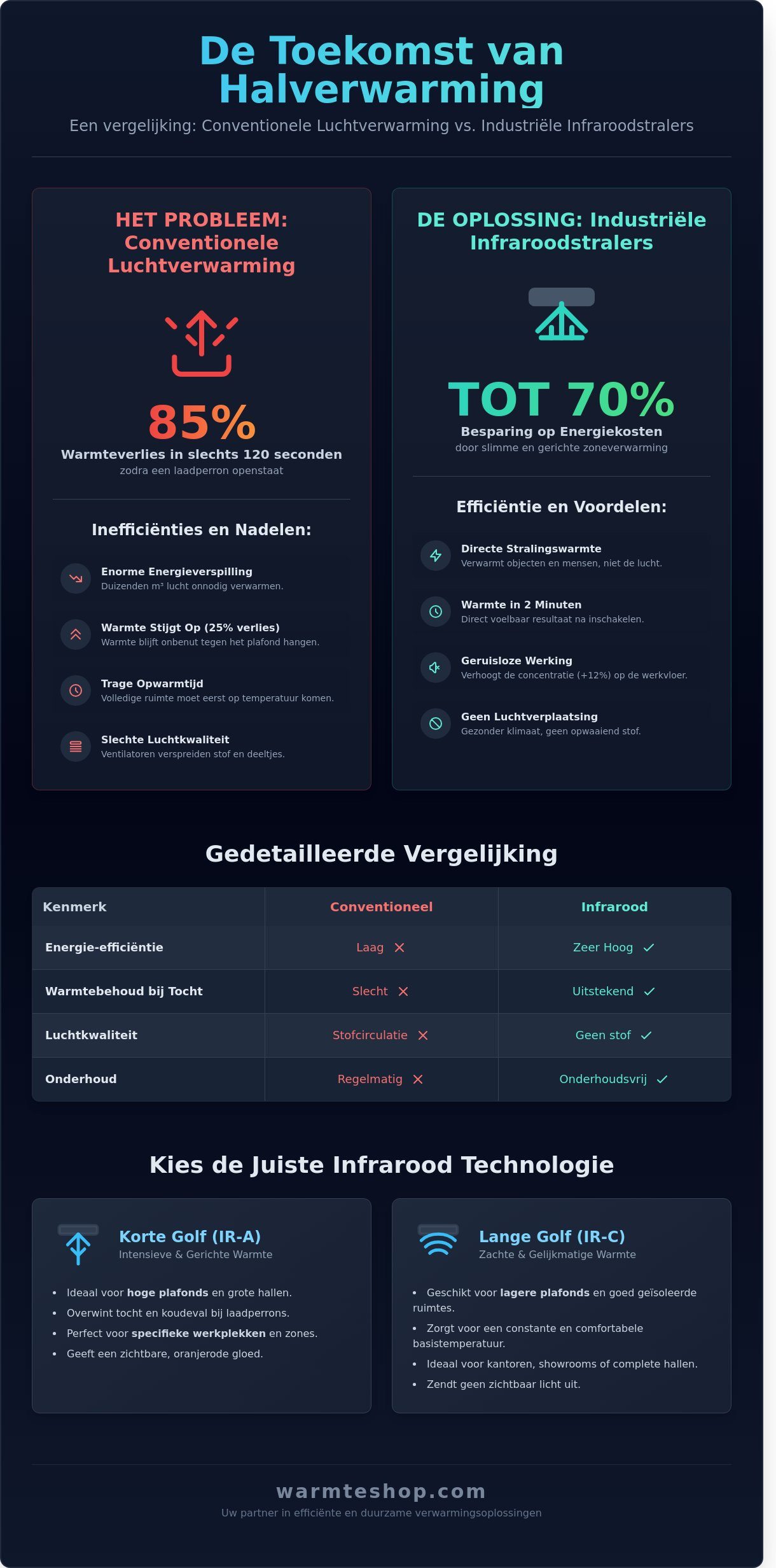
Did you know that conventional air heating in warehouses often loses up to 85% of its heat as soon as a loading dock is open for just 120 seconds? It is a frustrating reality that unnecessarily drives up your energy bill e…
Did you know that conventional air heating in warehouses often loses up to 85% of its heat as soon as a loading dock is open for just 120 seconds? It is a frustrating reality that unnecessarily drives up your energy bill and literally causes your profit margins to evaporate. You probably recognize the problem where the burners are running at full power, while your employees on the shop floor are still shivering and bothered by swirling dust. Heating thousands of cubic meters of air is an outdated method that no longer aligns with the sustainable ambitions of the modern entrepreneur.
In this guide, you will discover how industrial infrared heaters definitively break through this inefficiency by harnessing the power of targeted radiant heat. We show you how to heat large commercial spaces up to 70% more cost-effectively by activating only the zones where work is actually being done. This innovative technology offers the direct, healthy heat of the sun and forms the backbone of carbon-neutral operations by 2026. We discuss the technical implementation of zone heating, the exact savings on your operating costs, and the path to a maintenance-free heating plan for your entire hall.
The way we heat large commercial spaces has fundamentally changed in recent years. Whereas in 2020 we often still relied on noisy gas heaters that had to move enormous volumes of air, industrial infrared heaters have become the absolute norm. These systems do not work by heating the air mass, but by emitting direct electromagnetic waves that only release heat once they strike an object, floor, or person. This principle is exactly the same as the natural warmth of the sun that you feel on your skin, even on a cold winter day.
To fully understand the technology behind it, it helps to know what infrared heaters are and how they convert electrical energy into targeted heat radiation. In the current market, the transition from gas-fired systems to electric radiant heat has fully accelerated. Since the stricter sustainability standards of January 2025, new commercial buildings must reduce their CO2 emissions by at least 45% compared to the old standards. Electric infrared technology makes this possible, especially when a company generates its own electricity via solar panels on the roof of the warehouse or factory hall.
It is a forward-looking choice that not only saves the environment but also drastically reduces energy bills. Companies switching to industrial infrared heaters often report a decrease in energy consumption of 30% to as much as 50%. This is because the heat is available immediately where it is needed, without the need to heat thousands of cubic meters of air before employees experience comfort.
In an average factory hall with a height of 8 meters, nearly 25% of the heat is directly lost due to thermal stratification with traditional air heating. After all, warm air rises and remains trapped against the ceiling unused. Infrared radiation completely prevents this heat accumulation. The rays pass straight through the air, heating the work floor and the machines. These objects store the heat and slowly release it back into the environment. The result is a stable climate, even in drafty spaces or overhead doors that open and close more than 10 times a day. The heat simply does not blow out.
The switch to infrared offers benefits that go beyond just the numbers on an invoice. For many workshops and cleanrooms, air quality is of crucial importance. Because no fans are involved, there is no dust displacement. This ensures a healthier indoor climate and less contamination of sensitive equipment.
This innovative approach makes the energy transition tangible and profitable for entrepreneurs. It is not an obligation, but a smart upgrade to a more comfortable and efficient working environment that is ready for the demands of tomorrow.
Selecting the right infrared technology begins with understanding the physics behind the radiation. Infrared heat works exactly like the sun warming the earth; the air is bypassed, and objects or people absorb the energy directly. With industrial infrared heaters, we make an essential distinction between short wave (IR-A) and long wave (IR-C). This difference determines not only the visual aspect, such as the familiar red glow, but also how the heat is perceived in a specific work environment. Where one technology delivers brute force to overcome drafts, the other focuses on a constant, mild temperature for long-lasting comfort.
Short-wave heaters are the powerhouses of the range. Units such as the Helios HP3 are specifically designed for locations where the challenges are significant. Think of assembly halls with ceiling heights exceeding 4 meters or spaces suffering from heat loss of more than 20% due to open doors. These heaters reach their maximum power within exactly 1 second of being switched on. The intense radiation penetrates deep into the skin and clothing, allowing employees to experience immediate comfort, even in a drafty environment. Because short wave is hardly affected by air movement, efficiency is maintained in semi-open canopies or poorly insulated warehouses.
For spaces where people remain in a fixed spot throughout the entire workday, long-wave panels, also known as dark radiators, offer the best solution. This technology emits no visible light and operates at a lower surface temperature. This results in a soft, even heat that is ideal for ceilings between 2.5 and 3.5 meters high. In modern industrial office spaces or packing stations where insulation levels are up to standard, these panels ensure a stable indoor climate. The aesthetic integration is a major plus; the sleek panels are barely noticeable in an industrial design and contribute to healthy humidity levels because no dust circulation occurs.
The choice of a specific system has a direct impact on your energy bill and workplace productivity. Independent research into energy conservation shows that the targeted use of infrared significantly improves the thermal experience without having to heat the entire cubic volume of a hall. This makes switching to industrial infrared heaters a financially smart move for companies looking to reduce their carbon footprint.
Use the following rules of thumb in your decision-making:
Implementing an optimal heating plan requires a tailored approach that takes into account the specific layout of your floor space. You can easily have a personal calculation made to discover which configuration yields the highest return for your specific business situation. By combining the right wavelength with intelligent thermostats, you transform a chilly workshop into a sustainable and pleasant working environment.
Investing in a heating system for a large industrial hall is about more than just a comfortable temperature. It is a strategic financial decision. Traditional hot air systems suffer from a fundamental problem: warm air rises. In an eight-meter-high hall, the expensive heat clings to the ceiling, while the employees on the factory floor stand in the cold. Industrial infrared heaters solve this problem by bypassing the air and heating the mass directly. This principle, based on the natural workings of the sun, ensures unprecedented efficiency.
Operational costs will shift drastically in the coming years. While gas was the standard for decades, the CO2 tax and fluctuating gas prices are creating a tipping point towards 2026. Electric infrared systems have an energy conversion efficiency of nearly 100 percent. During the transition to a gas-free building, it is crucial to compare the Safety Guidelines for gas-fired infrared heaters with the low-maintenance electric variants. Electric systems do not require annual inspections for burners or flues, which reduces fixed costs by an average of 15 percent.
The greatest savings potential lies in the concept of zone heating. In an average 5,000-square-meter distribution center, intensive work is often only carried out in a few areas. Why heat the entire 40,000 cubic meters of air if only the packing station is staffed? With infrared, you create a "heat island." A 20-square-meter packing station is heated specifically, while the surrounding storage zones remain at a lower base temperature. This reduces energy consumption in unused zones by as much as 70 percent. It is simple. You turn on the heat only where and when it is needed.
A realistic calculation of the payback period (ROI) for an average industrial hall demonstrates the power of this technique:
Infrared heating is the ideal partner for companies with a large roof area covered in solar panels. Since the tightening of energy label requirements for office buildings and adjacent halls in 2023, sustainability has become essential. By using self-generated electricity directly for heating, you maximize self-consumption. This makes your company less dependent on the overloaded power grid and fluctuating purchasing rates. Moreover, the value of your real estate increases immediately due to an improved energy label, often from label D to A or higher. It is an upgrade that pays for itself twice over: in comfort and in hard euros on the balance sheet.
A successful installation of a heating system in commercial premises begins with a watertight foundation: the professional heat loss calculation. In an industrial environment where ceilings are often 6 meters or higher, haphazard heating is a costly mistake that leads to unnecessary energy consumption. Our experts analyze the insulation value of the facades, the frequency of open overhead doors, and the specific zones where employees are active. An accurate calculation prevents you from consuming 20% too much energy due to overcapacity, or conversely, losing comfort due to insufficient output.
The effectiveness of industrial infrared heaters is directly related to the mounting height and the beam angle. For optimal efficiency, we typically install these systems at a height between 3.5 and 5 meters. By mounting the heaters at an angle of exactly 45 degrees, we create an overlapping heat field comparable to the natural radiation of the sun. This targeted approach ensures that the heat reaches exactly where it is needed, without wasting valuable energy heating the air under the roof.
The electrical infrastructure in industrial systems requires specific attention. Three-phase power (400V) is often necessary to safely supply high power outputs and to optimally distribute the load across the fuses. In dusty warehouses or damp production areas, we adhere to strict safety standards. We select only luminaires with an IP65 or IP67 rating. These values guarantee that the equipment is completely dustproof and resistant to water jets, which significantly extends the lifespan of the installation in harsh conditions.
A well-thought-out approach guarantees that every kilowatt-hour is optimally utilized for your comfort and business operations. We follow three crucial steps during the process:
Maximum efficiency is truly achieved through intelligent control. The use of advanced motion sensors ensures that the heating switches off immediately as soon as a zone is unattended. In practical situations, this results in a direct saving of 30% on monthly energy costs. For larger complexes, we seamlessly integrate the systems with building management systems (BMS) via modern thermostats. This connection enables central monitoring and precise time schedules. Furthermore, wireless control offers the necessary flexibility; when the layout of your warehouse or workshop changes, the intelligent control system moves along effortlessly without the need for extensive demolition work.
Are you ready to transform your industrial hall with a sustainable and cost-efficient system? Request a no-obligation consultation and discover how our experts can optimally design your specific space.
The transition to a gas-free industry requires more than just a product. It requires a partner who understands the complexity of large volumes. Warmteshop distinguishes itself through in-depth technical expertise that goes beyond the sale of a single unit. With 30 physical showrooms in the Benelux, we offer a tangible anchor point in a digitalizing market. Visitors experience the power of our systems here through live demonstrations. You immediately feel the difference between conventional convection and the targeted radiant heat delivered by our industrial infrared heaters .
Our full-service approach begins with a detailed heat loss calculation. We leave nothing to chance. Our consultants analyze the insulation values, the height of the building, and the specific work zones. This results in a heating plan that precisely indicates where and how efficiency is achieved. In addition to radiant panels, we offer powerful industrial air heaters for situations where a constant base temperature is required throughout the entire space. The combination of these technologies ensures optimal efficiency. Our professional installation teams then guarantee seamless integration into your existing infrastructure.
Every sector places unique demands on climate control. In the logistics sector, warehouses often struggle with open gates and enormous drafts. Here, industrial infrared heaters their value by directly heating objects and people without the heated air immediately escaping outside. For loading docks and covered outdoor areas, we apply our robust patio heater technology. These systems are weather-resistant and provide instant heat to personnel working outdoors. In the agricultural sector, we see that healthy radiant heat helps reduce dust circulation. This significantly improves the well-being of both animals and employees. A healthy workplace leads directly to lower absenteeism and higher productivity.
Investing in infrared technology means choosing sustainable quality and innovation. We promise a system ready for the energy requirements of 2030 and beyond. Our systems work like the sun. They heat the core of the room instead of just the layer of air under the ceiling. This prevents energy waste in high-rise buildings. Companies that switch often realize savings of 30% to 45% on their operational heating costs. Requesting a no-obligation quote and a customized heating plan is the first step towards a carbon-neutral future. Our experts are ready to guide your project from A to Z with sound advice and proven technology.
Discover our complete collection of infrared heating or visit one of our showrooms for a personal consultation.
the transition to industrial infrared heaters is the smartest path to a CO2-neutral and cost-efficient working environment. By choosing targeted radiant heat, which feels like the natural warmth of the sun, you reduce energy costs by an average of 30 to 40 percent compared to traditional air heating. Since 2008, Warmteshop has been the market leader in the Benelux helping entrepreneurs with this essential sustainability upgrade. With a network of more than 30 physical showrooms, you always receive personal advice based on technical precision and years of experience. Furthermore, our certified installation service guarantees that your system performs at its maximum potential from day one. In most cases, an investment in this innovative technology pays for itself completely within just 3 years due to enormous savings on consumption and maintenance. It is time to say goodbye to unnecessary heat loss and choose a healthy indoor climate that benefits both your bill and your employees.
Request a free heat calculation for your industrial hall now
We look forward to working with you to create the ideal heating solution that is ready for the challenges of tomorrow.
Yes, industrial infrared heaters are ideally suited for halls with ceilings up to 15 meters high. Because these systems heat the objects and people directly, rather than the air, no valuable heat is lost due to rising air to the roof. This prevents a temperature difference of 2 to 3 degrees per meter of height, which is often the case with traditional hot air cannons. As a result, the workspace remains pleasantly warm while energy consumption stays low.
For an average warehouse, you can count on a power output of 40 to 100 Watts per square meter, depending on the degree of insulation. In a moderately insulated warehouse of 500 square meters, you typically need 10 to 12 powerful units to achieve a comfortable working temperature. By opting for zone heating, you can limit the number of active heaters to the areas where people are actually working, which immediately saves 30 percent on energy costs.
The biggest difference is that an industrial infrared heater emits radiant heat to objects, whereas an air heater must heat the entire mass of air in a room. Air heaters often cause dust displacement and dry air, leading to irritation among 15 percent of employees. Infrared works like the sun; it is a silent and healthy heat that is felt immediately after switching on, without warm air escaping when an overhead door is opened.
The radiation from modern industrial heaters is completely harmless and even beneficial to the health of your staff. Unlike the sun, these heaters contain 0 percent harmful UV radiation, meaning there is no risk of skin damage. The medium-wave radiation penetrates deep into the body and stimulates blood circulation, which can reduce absenteeism during cold months by an average of 7 percent. It creates a dust-free and stable indoor climate.
You can safely use infrared heating in fire-hazardous areas, provided the panels have the correct IP65 or IP67 certification. For environments with flammable substances, we recommend heaters without an open heating coil that do not exceed a maximum surface temperature of 200 degrees. These systems comply with strict European safety standards and reduce the risk of fire by 25 percent compared to older gas-fired heaters. Our experts will be happy to advise you on the specific ATEX guidelines.
By switching from gas to infrared, you save an average of 30 to 50 percent on your annual energy bill. Because you no longer need to heat a huge cubic meter of air, but only the active work zones, consumption drops immediately. With a gas price of €1.20 per cubic meter and an electricity price of €0.25 per kWh, the payback period for such an installation is often less than 4 years. Moreover, the annual maintenance costs of €150 per gas appliance are completely eliminated.
The ideal mounting height for a powerful heater is between 3 and 6 meters for optimal heat distribution. If you mount the units lower than 2.5 meters, the radiation intensity becomes too high for comfortable working. When mounted at a height of 4 meters, the radiant cone covers an area of approximately 20 square meters on the ground. This ensures even heat distribution, keeping the floor temperature constant at around 18 degrees, which is ideal for logistics employees.
For the installation of heavy industrial infrared panels exceeding 3600 Watts, a 400-Volt three-phase power connection is required. Standard panels up to 3.6 kW operate on a regular 230-Volt circuit, but in large halls, 3-phase connections are often necessary to distribute the load across the network. This prevents fuses from blowing during peak loads at startup. Our installers install these systems in accordance with NEN 1010 standards to guarantee safe and sustainable operation.


