

Heating in 2026: The Complete Guide to Efficient and Sustainable Living Comfort
, by Warmteshop, 17 min read
, by Warmteshop, 17 min read
What if, by 2026, the familiar gas connection in your home is no longer the most logical choice, but a source of uncertainty regarding rising costs? We understand that the transition to a natural gas-free future is very …
What if, by 2026, the familiar gas connection in your home is no longer the most logical choice, but a source of uncertainty regarding rising costs? We understand that the transition to a natural gas-free future raises many questions, especially if you are currently dealing with inefficient systems that unnecessarily drive up your energy bill. It is essential to find a method to heat that is both easy on your wallet and puts an end to the bothersome air and dust movement caused by traditional radiators.
In this comprehensive guide, you will discover how to furnish your home smartly and energy-efficiently in 2026, where we outline the latest technological innovations and practical saving tips for you. We delve into the crucial difference between air heating and radiant heating, a technique that mimics the natural warmth of the sun for a healthier indoor climate. You will receive a clear overview of the steps required for a future-proof system that seamlessly connects comfort, aesthetics, and sustainability.
The way we heat is undergoing a fundamental transformation. While the focus for decades lay on burning fossil fuels to heat the air, the definition shifts to electric precision in 2026. This evolution is driven by the need to reduce CO2 emissions and completely phase out dependence on gas. At its core, the evolution of heating systems around the shift from central, cumbersome installations to decentralized solutions that deliver heat where and when it is needed.
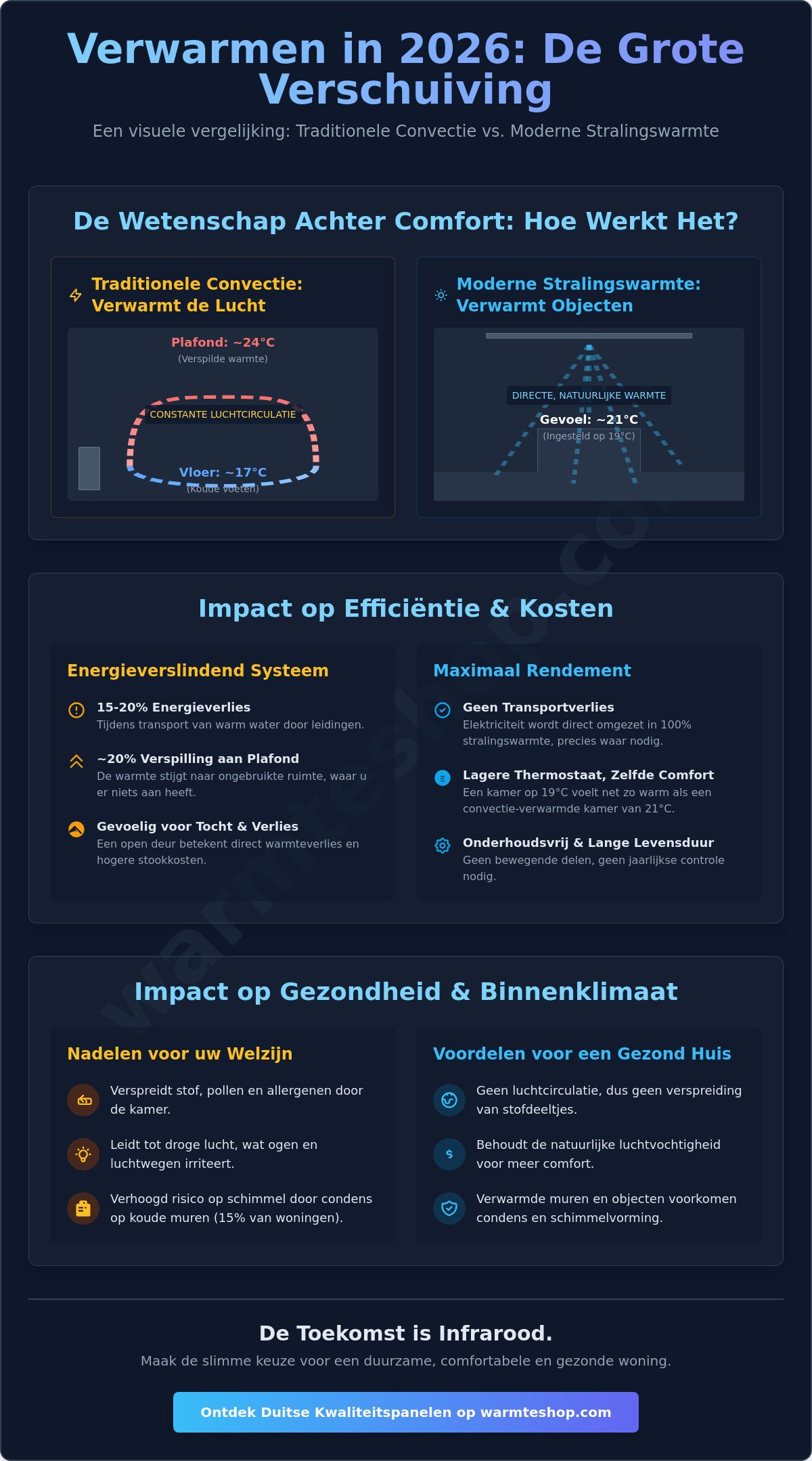
The impact of the stricter EPC standards is undeniable in this regard. Homes must not only be better insulated but also utilize technologies that leave a minimal ecological footprint. This directly affects your thermal comfort. A crucial insight for 2026 is that radiant heat works more efficiently than traditional convection. A room heated to 19 degrees with infrared heating feels warmer and more pleasant to the human body than a room at 21 degrees where only the air has been heated. This is because objects and bodies absorb the heat directly, just like the beneficial rays of the sun on a winter day.
Our journey began with the open fire, which later gave way to the coal stove and eventually the gas boiler in the 20th century. While the gas boiler revolutionized convenience, it also brought drawbacks. Fossil fuels result in significant CO2 emissions and an average energy loss of 15 to 20 percent during the transport of hot water through pipes. In 2026, we leave this inefficient model behind. Heating in 2026 is the technological translation of natural solar radiation into a smart, emission-free indoor climate.
New regulations in the Benelux, such as the obligation for hybrid heat pumps or electric alternatives when replacing old boilers, are putting the market under pressure. The rise of smart grids makes controllable systems necessary. Infrared technology addresses this by responding directly to energy demand, allowing you to make optimal use of self-generated solar energy. Moreover, this technology fits perfectly into the circular economy; the systems are maintenance-free, have a long lifespan, and contain no moving parts that wear out quickly. This makes the switch in 2026 not only an ecological necessity, but above all a smart investment in your living comfort.
Home comfort begins with the fundamental choice of how you want to heat. Most homes currently still rely on convection, a process in which the air serves as a transport medium for energy. This creates a constant airflow that inevitably disperses dust particles, pollen, and allergens throughout the room. For people with sensitive airways or dry eyes, this places a daily strain on the indoor climate. Scientific research into various renewable sources, including biomass heating, underscores that the efficiency of any system is closely linked to the way energy is transferred to the human user.
Traditional radiators operate on a simple but inefficient principle: cold air is drawn in across the floor, heated by the radiator, and then rises directly to the ceiling. This results in a stratified temperature difference where it can be 24 degrees at your head, while your feet remain cold at just 17 degrees. Measurements show that traditional systems often waste 20% of their generated energy on the unused space at the ceiling.
An open door or ventilation grille is disastrous for the energy bill with forced air heating. The heated air escapes immediately outside or into the hallway, causing the thermostat to constantly demand extra energy to compensate for the loss. Additionally, the cooling of warm, humid air against cold exterior walls promotes condensation. In 15% of homes, this phenomenon is the direct cause of mold formation in areas where air circulation stagnates.
Infrared technology takes a radically different route by utilizing the physical mass of the room. Instead of heating the volatile air, walls, floors, and furniture are activated directly. As a result, the room acts as a thermal battery that releases heat slowly and evenly back into the environment. Radiant heat is heat that feeds the mass, not the air.
This method is identical to the physical workings of the sun. Even on a cold winter day, you feel the direct warmth of the sun's rays on your skin, regardless of the air temperature. Because the air remains virtually still under radiant heat, the room maintains a healthy humidity level and dust settles on the floor. For those striving for a sustainable interior upgrade, infrared heating a solution that minimizes energy loss due to drafts and guarantees a constant comfort temperature in every corner of the room.
The choice of a new system determines your living comfort for the next twenty years. In 2026, the focus will definitively shift to smart, electric solutions that guarantee independence from gas. An objective comparison between heat pumps, electric convectors, and infrared panels shows that the ideal choice depends on your specific living situation and level of insulation.
Infrared panels distinguish themselves by their maintenance-free nature. Because these systems contain no moving parts, pumps, or filters, mechanical failures virtually never occur. This results in a lifespan that often exceeds 25 years without the need for a technician. With a heat pump, you must account for periodic inspections and moving components that wear out over time. The installation costs of infrared solutions are often 50% lower than those of a hybrid or full heat pump. Extensive pipework is simply not necessary.
Connecting to solar panels makes electric heating truly cost-effective. By converting the generated energy directly into radiant heat, you increase your own consumption of solar power. This is a smart strategy to offset the impact of changing energy tariffs. Radiant heat works exactly like the sun; it does not heat the air, but the objects and people in the room. This provides an immediate and comfortable feeling, even if the air temperature is slightly lower.
A heat pump is cost-effective as a basic heating solution in homes with very high insulation values, such as the A+++ label. However, for many renovation projects or specific rooms like the home office or bathroom, infrared panels are a smarter choice. They offer a fast response time and do not require thick pipes running throughout the house. A ceiling panel is often installed and ready for use within 45 minutes. The combination of both systems often delivers the best results: the heat pump for a constant base temperature and infrared for targeted comfort.
A smart thermostat is essential to keep your energy consumption under control. By using zone heating, you only heat the rooms where you are actually present at that moment. This prevents unnecessary consumption in bedrooms or the hallway during the day. Modern control systems learn from your daily routine and adjust the heat output accordingly. For an overview of the most efficient control systems, please visit our collection of thermostats. With these, you take the step towards an intelligent and future-proof home.
Efficient heating in 2026 revolves around customization per room. Every room in the house places different demands on temperature, speed, and aesthetics. While the bathroom requires a short but powerful heat peak, the living room craves a constant, healthy atmosphere that invites relaxation. By intelligently tailoring technology to a room's function, you increase living comfort while minimizing energy waste.
The bathroom is the place where you immediately need direct warmth in the morning. Traditional systems often react too slowly to your morning routine. An infrared mirror offers the ideal solution here; it warms your body instantly while simultaneously preventing annoying condensation on the glass. For a complete wellness experience, choose a towel radiator that ensures dry, warm towels after every shower. Additionally, Sunshowers your physical well-being by combining infrared heat and controlled UV light. This stimulates blood circulation and vitamin D production, which makes a measurable difference to your energy levels, especially during the dark winter months.
In the living room, everything revolves around the balance between design and a healthy living environment. Infrared photo panels transform your heating into a personal work of art on the wall, allowing technology to blend seamlessly into your interior. For those who prefer a minimalist look, ceiling mounting offers an invisible solution that heats the floor and furniture evenly. You can perfectly combine this modern comfort with added atmosphere by installing an electric fireplace . This creates the visual pleasure of a burning fire without the emission of particulate matter, significantly improving the air quality in your home compared to a wood stove.
Bedrooms and home offices require a specific approach using low-temperature radiation. This technique keeps the air fresh and prevents you from becoming drowsy due to excessive air temperature. The human brain performs optimally at an ambient temperature of 18 degrees Celsius, provided that the radiant heat effectively blocks cold drafts near windows. This ensures stable concentration during long workdays at home without causing dry eyes or a groggy feeling.
The transition of living space does not stop at the back door. Outdoor spaces are increasingly being integrated into the living area through the use of patio heating. These systems make it possible to sit comfortably outside even at outdoor temperatures of 10 degrees Celsius. This extends the outdoor season by an average of three months per year, directly translating the investment in sustainable outdoor heating into greater living enjoyment.
Discover how you can optimally heat every specific room in your home with infrared solutions from Warmteshop.
With the approaching energy targets of 2026, choosing a reliable partner is essential for your living comfort. Since 2008, Warmteshop has positioned itself as the undisputed market leader in the Benelux in the field of radiant heating. Over the past 15 years, we have completed more than 50,000 installations, ranging from compact bathrooms to entire office buildings. This experience forms the basis of our advice. Our German quality panels are designed to last for decades, and we underscore this with a unique warranty that extends up to 10 years across various product lines.
Effective heating starts with precision. No two homes are identical, which means that a standard solution is rarely the most efficient. That is why our experts always perform a detailed, customized heat calculation. In doing so, we take into account the insulation value of your walls, the type of glazing, and the specific volume of each room. This prevents you from installing too many panels or, conversely, dealing with cold corners. In our more than 30 showrooms spread across Belgium and the Netherlands, you have the opportunity to experience the unique solar heat for yourself before making an investment.
Warmteshop acts as your guide in the transition to a CO2-neutral future. By switching to our infrared solutions, you take a major step towards gas-free living. Our own professional installation service operates nationwide, ensuring you can always count on professionals from your own region. High customer satisfaction, with an average score of 9.2, proves that our approach works. Thousands of families are now enjoying a healthier indoor climate without air movement or dust circulation, simply by heating smartly with the power of radiation.
Switching to sustainable energy is not an obligation, but an opportunity to take your living comfort to a higher level. You can immediately request a free consultation during which one of our specialists will analyze your living situation. During this consultation, you will discover how to achieve maximum results on your energy bill with minimal adjustments.
Are you curious about the aesthetic possibilities for your interior? Then take a look at our complete collection of infrared heating, where design and functionality come together in panels of glass, metal, or even mirrored surfaces. It is time to bring the sun into your home. Choose the expertise of Warmteshop and ensure yourself a warm and sustainable home for decades to come.
The transition to sustainable energy requires a fundamental overhaul of how we heat. The shift from inefficient convection heating to advanced infrared radiation offers a tangible improvement in both your energy consumption and your personal well-being. By focusing on directly heating the building envelope and the people inside, you prevent unnecessary heat loss and enjoy a constant, pleasant temperature comparable to the natural warmth of the sun.
Warmteshop acts as your expert guide, with over 30 physical showrooms in the Benelux where you can experience the technology firsthand. Our advisors use specialized software for energy-efficient heat calculations, ensuring that every system is perfectly tailored to the insulation value of your specific spaces. Combined with the assurance of top German quality and an extensive warranty period, you choose a worry-free and stylish solution ready for decades to come. A green future begins with a smart choice for today.
Discover the ideal infrared solution for your home at Warmteshop
Infrared panels are often more economical to use than gas heating when deployed smartly as zone heating. While a central heating boiler suffers an average heat loss of 15% to 20% through pipes and air circulation, infrared panels convert 100% of the electricity into direct radiant heat. By heating where you actually spend time, you significantly reduce energy consumption. If you combine this with solar panels, monthly costs decrease even further.
Yes, you can heat, provided the property's insulation value meets modern standards. In homes with energy label A or B, infrared functions as a fully-fledged primary heating system that regulates each room independently via digital thermostats. This system eliminates the need for a gas connection and maintenance-intensive water pipes. For optimal results, an advisor calculates the exact power required per room to guarantee comfort.
For a 20m² room, you need an average of between 1,200 and 2,000 Watts of power. The exact requirement depends heavily on the degree of insulation: for a well-insulated new-build home, 60 Watts per m² is often sufficient, while an older home from 1970 would require closer to 100 Watts per m². By distributing the total power over two panels of, for example, 750 Watts, you create an even heat distribution without cold corners in the room.
Infrared panels are completely safe for both children and pets because they contain no open flames or glowing elements. The surface temperature of a wall panel reaches a maximum of 90 to 110 degrees Celsius, which, due to the low thermal mass, does not cause immediate burns upon brief contact. For extra safety, we often recommend ceiling mounting. This keeps the panels out of reach and allows them to distribute the heat evenly across the floor and furniture, just like the sun.
Additional insulation is not strictly mandatory, but it significantly increases the efficiency of your heating system. For homes built before 1990, we recommend installing at least double glazing and cavity wall insulation to limit heat loss. A well-insulated building envelope ensures that radiant heat remains stored in the walls and floors for longer. As a result, the panels need to switch on less frequently, which directly leads to lower power consumption and a more consistent indoor climate.
A high-quality infrared panel has an average lifespan of 25 to 30 years. Because the system contains no moving parts, pumps, or fluids, there is virtually no mechanical wear. This makes the technology much more sustainable than a traditional heat pump or central heating boiler, which often require replacement after 15 years. You enjoy maintenance-free heat for decades without needing a technician to visit annually for inspections.
You can easily install basic plug-based models yourself using the included brackets and screws. For an aesthetic finish where cables are concealed within the wall or ceiling, we recommend hiring a certified installer. Furthermore, a professional will ensure proper connection to a separate circuit if you are installing multiple panels simultaneously. This prevents overloading your electrical network and guarantees optimal communication between the thermostats and the heating elements.
Infrared panels are ideally suited for the bathroom because they heat the walls and tiles directly, preventing condensation and mold. In damp rooms, always choose panels with an IP44 certification or higher, which indicates they are splash-proof. An infrared mirror is a smart choice in this regard; it provides you with pleasant radiant heat and never fogs up after a hot shower. This way, you combine functional design with healthy, dry air quality in your smallest room.


