

Heating for new-build homes in 2026: The complete guide to smart and gas-free living
, by Warmteshop, 18 min read
, by Warmteshop, 18 min read
Installing a large-scale heat pump seems like the only path to a gas-free future, but for many builders in 2026, this is actually the most expensive detour to a comfortable home. You probably recognize this. You want a sustainable…
Installing a large-scale heat pump seems like the only path to a gas-free future, but for many builders in 2026, this is actually the most expensive detour to a comfortable home. You probably recognize this. You want a sustainable home, but you dread that initial investment of often more than 20,000 euros. That is a substantial amount for a system that, moreover, requires annual maintenance and complex technology. The ideal heating system for a new-build home must not only meet the strictest environmental requirements but also enrich your interior without bulky radiators or visible pipes disrupting the aesthetics of your new living room.
At Warmteshop, we believe that the energy transition is an opportunity for greater living comfort, not a technical burden. In this comprehensive guide, you will discover how to create a maintenance-free system using modern infrared technology that reduces your installation costs by up to 50 percent. We explain how the smart combination with solar panels minimizes your energy bill. You will learn exactly how this healthy radiant heat, comparable to the natural power of the sun, transforms your home into an oasis of tranquility and design.
The time when a roaring gas boiler was the standard is definitely behind us. In 2026, gas-free heating for new-build homes the only logical and legally permitted path. Since the tightening of Flemish energy legislation on January 1, 2025, connection to the natural gas grid has been prohibited for new subdivisions and large construction projects. This transition forces builders to take a fundamentally different view of heat. In a home that meets the BEN (Nearly Energy Neutral) standards, the actual heat demand has dropped drastically. Whereas an inadequately insulated home from 1990 still required 200 Watts per square meter, a modern construction in 2026 often requires less than 30 to 35 Watts per square meter.
This high level of insulation means that heavy, central systems simply can no longer dissipate the heat they produce. The focus is therefore shifting to smart, renewable sources that work seamlessly with the home's envelope. The role of PV panels is crucial in this regard; according to current building regulations, new construction must generate a significant portion of its energy needs itself. This paves the way for systems that convert this self-generated green electricity directly into comfort, without the intervention of fossil fuels.
The E-level of your home, which by 2026 often needs to reach the E20 mark or lower, is largely determined by the chosen technologies. The choice of your heating system directly influences this score. We are seeing a clear shift from bulky central units to decentralized concepts. By using infrared heating in specific zones, you can fine-tune the heat demand per room. This significantly reduces the energy load on the home, as you only consume energy where and when it is needed.
In a hermetically sealed new build, excessive power output leads to so-called 'cycling'. The system then switches on and off constantly because the target temperature is reached too quickly. This is not only inefficient but also shortens the lifespan of the equipment. Modern heating for new-build homes therefore utilizes radiant heat. Instead of heating the air, which causes dust displacement and dryness, radiation directly heats the mass of the home. This principle feels like the natural warmth of the sun on a windless spring day. The result is a stable indoor climate with a lower air temperature but a higher sense of comfort.
In the search for the ideal heating system for new-build homes in 2026, infrared technology is increasingly emerging as the winner. While traditional systems heat the air, infrared works on the principle of direct radiant heat. This means that the panels directly heat objects, walls, and people in the room. In a modern, airtight house, this is a crucial advantage. Because the air itself is not the carrier of heat, no energy is lost through inevitable air circulation or ventilation losses.
Choosing infrared also means choosing a carefree future. The system is completely maintenance-free; there are no pumps to seize up, no filters to clog, and no mandatory annual inspections costing an average of 150 euros per visit. With a technical lifespan of more than 25 years, this infrared heating a reliability that mechanical systems simply cannot match. Moreover, the indoor climate remains healthier because there is hardly any dust circulation, which is a direct benefit for the 20 percent of the population sensitive to allergies.
New-build homes in 2026 will be virtually hermetically sealed. In this context, infrared performs optimally because the panels reach their full power within 5 to 10 minutes. There is no slow warm-up time as with traditional underfloor heating. The synergy with a type D ventilation system is striking; while the ventilation provides fresh air, the infrared radiation keeps the walls dry and warm. This effectively prevents thermal bridges and condensation, ensuring that the insulation value of the structure continues to perform at 100 percent of its potential.
The experience of infrared heat is best compared to a windless spring day where the sun warms your skin, even when the ambient temperature is still low. This psychological comfort means the thermostat can often be set 1 or 2 degrees lower without sacrificing comfort. Infrared is the only technology that heats matter directly. This direct transfer ensures a stable heat sensation that penetrates deep into the room. The result is a constant temperature without the familiar "cold feet" that often occur with systems that rely solely on air movement.
Are you curious how this technology fits into your specific building plan? Discover the possibilities of energy-efficient heating for new-build homes and experience the comfort in one of our showrooms.
Choosing the right heating system for a new-build home in 2026 revolves around the balance between comfort, ease of installation, and efficiency. Although the heat pump is often presented as the standard option, it is essential to compare the technology with a modern infrared system. The differences in both the initial investment and long-term operation are greater than many people realize. While a heat pump relies on complex mechanics and fluids, infrared works with direct radiant heat, comparable to the beneficial rays of the sun.
The initial investment costs, the CAPEX, often constitute the biggest obstacle in new construction. For an average home of 140 square meters, an air-to-water heat pump, including underfloor heating and installation, often costs between €14,000 and €21,000. A complete infrared heating for the same home usually ranges between €6,500 and €9,500. This represents a direct saving of more than 50% on construction costs.
The design of a modern heating system for a new-build home must blend seamlessly into the interior. With infrared heating, the need for a large technical room disappears. After all, you do not need 200 or 300-liter buffer tanks for your heating water. This immediately yields 2 to 3 square meters of extra living space, which represents a huge hidden gain at current square meter prices.
The exterior of the home is also spared. There is no need to place a noisy outdoor unit on the roof or in the garden, which enhances the aesthetics of the facade and prevents noise nuisance for the neighbors. The panels themselves are only 2 centimeters thick and can be designed as a mirror, a painting, or an unobtrusive white ceiling panel. This gives you complete freedom when furnishing your living room; not a single radiator blocks your view or the placement of your designer furniture.
Moreover, when combined with solar panels, infrared becomes an extremely smart choice. In the highly insulated homes of 2026, the total energy demand for heating will be so low that the simplicity of infrared technology often renders the complex installation of a heat pump unnecessary. It is a no-nonsense approach to luxury: less technology that can break down, more comfort that is immediately felt.
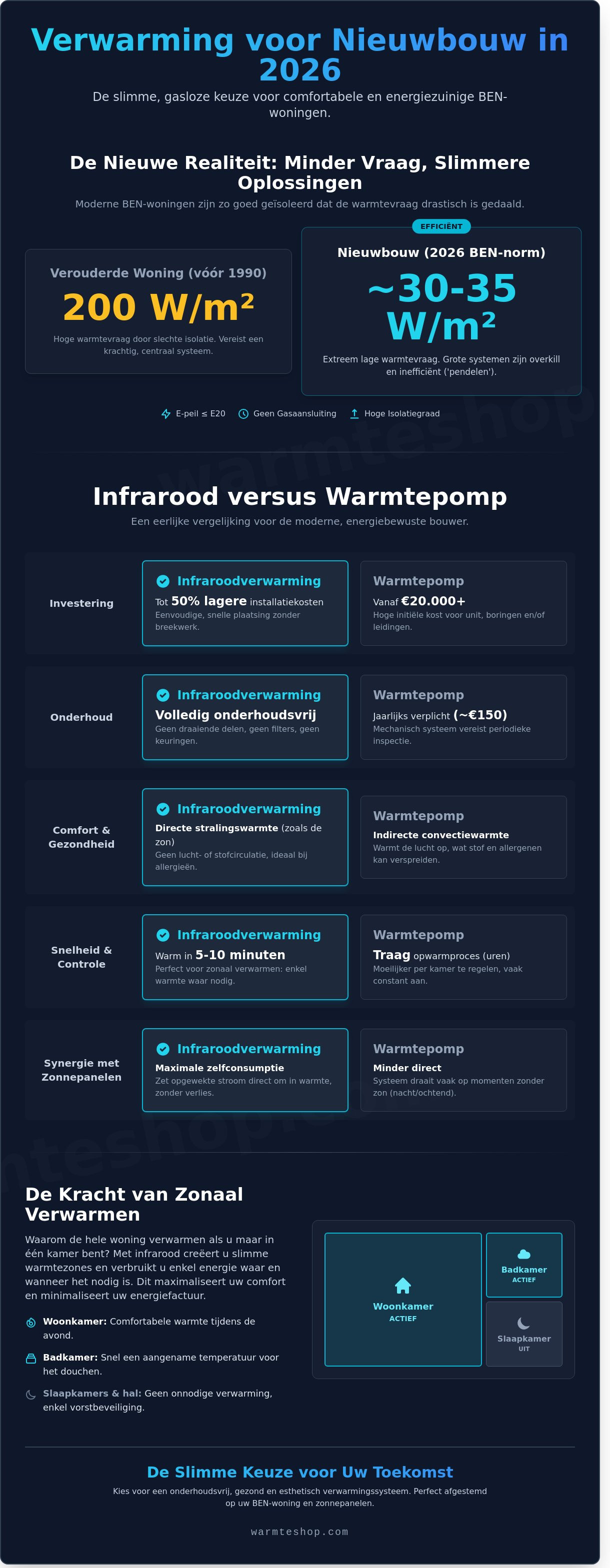
An efficient heating design for your new-build home begins with the principle of zonal heating. Instead of keeping the entire house at a constant temperature, you heat only the rooms where you actually spend time. This prevents unnecessary energy waste in unused rooms. In the living room, often the largest zone, ceiling panels offer the most effective solution. By mounting infrared panels on the ceiling, radiant heat reaches every corner of the seating area without obstruction. It feels like the natural warmth of the sun shining on your skin, providing an immediate sense of comfort at a lower air temperature.
The bedroom requires a completely different approach. For a healthy night's sleep, a baseline temperature of 16 to 18 degrees Celsius is ideal. However, you don't want to shiver while getting dressed. Infrared technology excels here thanks to its short warm-up time of less than 10 minutes. You switch the panels on briefly for a quick heat boost and turn them off again as soon as you leave the room. This integration with smart home systems allows you to easily set schedules that align with your daily rhythm.
In the bathroom, infrared transforms the space into a personal spa. An infrared mirror is indispensable here; it prevents condensation after showering, allowing you to style your hair immediately. For extra luxury, a towel radiator a warm towel is ready to use right away. Safety is paramount; we only install equipment with the correct IP zones (minimum IPX4) to guarantee complete water resistance in damp areas.
The intelligence of your system lies in its control. Modern thermostats ensure an average saving of 30% on your energy costs compared to central controls. You can preheat your home via your smartphone while you are still on your way home from work. Furthermore, we connect your heating to the digital meter. As a result, your system primarily consumes power when your solar panels are operating at peak production, making your heating for a new-build home virtually cost-free.
For the seamless operation of such smart thermostats and apps, a stable home network is indispensable. Especially in a new-build home, this is the ideal time to lay a solid foundation for all your digital applications, from heating to entertainment. A reliable wired network forms the backbone of your smart home. For more information, you can learn more about Network Cables and Network Products – Netwerkkabelshop.
Would you like to know how zonal heating increases your living comfort? Discover our infrared solutions for every room.
Choosing the right heating system for a new-build home is a decision for the next thirty years. At Warmteshop, we understand that this transition to gas-free living raises questions about comfort and efficiency. That is why our service does not start with the product, but with a thorough analysis of your project. Our experts perform detailed heat loss calculations based on your building plans. In doing so, we consider insulation values, glass surface area, and the specific layout of each room. This prevents overcapacity and guarantees that you never pay a euro too much for energy.
We combine high-quality technology with aesthetic design. Whether you choose sleek ceiling panels or an elegant infrared mirror in the bathroom, the technology serves your interior. The entire process, from the initial calculation to professional installation, is carried out by our own certified technicians. They ensure seamless integration with your smart thermostats, so you enjoy a perfectly regulated indoor climate from day one.
As part of the Infrared Heating Group, you benefit from over 15 years of experience at the forefront of the energy transition. Our focus remains unchanged on sustainable quality and certified safety. Where traditional systems heat the air, our panels mimic the natural radiant heat of the sun. This creates a healthy living environment without dust circulation or dry air. Many homeowners who have made the switch report a significant improvement in their living comfort. They particularly praise the speed with which rooms reach the desired temperature and the complete control over energy consumption per room.
Figures and technical specifications tell only half the story. Heat is a sensory experience that you must feel. With more than 30 physical showrooms in the Benelux, we offer you the opportunity to experience the unique radiation of infrared for yourself. Here you can compare various surfaces and designs, from glass to ceramic. Our advisors are ready for a free consultation, using your building plans as a starting point. A well-thought-out heating plan for a new-build home not only saves you on installation costs but also increases the future value of your house.
Are you ready to take the step towards a sustainable future? Our experts are happy to help you realize a gas-free home that is ready for 2026 and beyond.
The transition to a gas-free future will be the standard for every modern construction project by 2026. With infrared technology, you choose a system that perfectly complements the high insulation values of current Nearly Zero Energy (NZEB) homes. This innovative technique does not heat the air, but rather the mass of the home and the people themselves, just as the natural radiation of the sun does. The result is energy savings of up to 30% compared to conventional electric systems. The ideal heating system for a new-build home combines a sleek design with a healthy indoor climate and, moreover, eliminates annual maintenance costs.
With over 15 years of experience in the Benelux, Warmteshop offers the certainty you seek with such an important investment. Our advisors are ready in 30 physical showrooms to create a detailed, tailor-made heating plan, while our certified installation service guarantees worry-free integration. This ensures you have a sustainable solution ready for the stricter energy standards of tomorrow. Take control of your own energy consumption and experience the pleasant warmth you deserve.
Discover our infrared solutions for new construction
Infrared heating is ideally suited as the primary heating source for a new-build home that meets current BENG standards. Thanks to the superior insulation of homes built after 2021, radiant heat is optimally retained within the walls and floors. This results in a stable indoor climate without unnecessary air movement.
In an average home of 120 square meters, this system ensures an even temperature distribution comparable to the natural warmth of the sun. It offers a reliable and comfortable solution for anyone who wants to live completely gas-free without compromising on coziness.
For a modern, insulated new-build, you can expect an average output of 20 to 30 Watts per cubic meter. In a 40-square-meter living room with a standard height of 2.6 meters, this amounts to approximately 2,600 Watts of total power. You distribute this over three to four strategically placed panels for optimal radiation coverage.
This precise dimensioning prevents unnecessary energy consumption and guarantees that every corner of the room feels comfortable. Our advisors calculate this exactly based on your specific building plans for the best result.
The combination of infrared panels and solar panels forms the perfect basis for a zero-energy home. While the ceiling panels provide direct heat, your PV panels generate the necessary electricity in a sustainable way. With an average yield of 3,500 kWh per year from an installation of 10 solar panels, you cover a significant portion of your consumption.
This is how you transform your heating for a new-build home into a virtually free and carbon-neutral energy source. It is a smart investment that quickly pays for itself due to low operating costs.
In a well-insulated home with an A+++ energy label, consumption costs range between 15 and 20 kWh per square meter per year. For a terraced house, this means an annual consumption of approximately 2,100 kWh for total heating. Because you heat each room individually with smart thermostats, accurate to within 0.5 degrees, you do not waste energy on unused spaces.
This saves up to 30 percent on the energy bill compared to traditional electric systems that heat the air. The efficiency of radiant heat means the thermostat can safely be set a degree lower.
In most cases, a standard 3x25 amp connection is more than sufficient for a complete infrared system in a new-build home. Because the panels rarely all operate at full power simultaneously, the peak load remains within the safe margins of your grid connection. However, we do recommend distributing the panels across different circuits in the fuse box.
A single 16-amp circuit can safely power up to 3600 Watts of heating output. A certified Warmteshop installer always checks this during installation to guarantee trouble-free operation.
High-quality infrared panels have an expected lifespan of 20 to 30 years thanks to the absence of moving parts. There is no wear and tear on pumps, pipes, or filters, making the system virtually maintenance-free. Manufacturers often offer extensive warranties of up to 10 years on the panel's technical components.
This makes it a highly sustainable investment for your new-build home heating, as you incur no costs for annual inspections throughout its entire lifespan. It is a worry-free solution that ensures a healthy indoor climate for decades.
Infrared heating is completely safe for both children and pets because it involves no open flames or glowing hot elements. When mounted on the ceiling, the panels hang out of reach of small children or curious pets. Furthermore, the technology ensures a healthier indoor climate because no dust or pollen circulates through the room.
This improves air quality by approximately 40 percent for people with allergies or respiratory problems. The panels are equipped with built-in sensors that automatically switch off the system in the event of overheating.
The crucial difference is that infrared heats objects and people directly, whereas a convector heats the ambient air. With convection, warm air rises to the ceiling, which in a room with a height of 2.6 meters often leads to energy loss and cold feet. Infrared radiation works more directly and is much more efficient for your living comfort.
With radiant heat, you experience the same comfort at an air temperature that is 2 degrees lower than with air heating. This results in a direct energy saving of 20 to 50 percent compared to traditional electric heaters.


