

Heater for your industrial hall in 2026: choose efficient infrared heating
, by Warmteshop, 17 min read
, by Warmteshop, 17 min read
Why would you still pay to heat the air against the ceiling while your staff are standing in the cold on the work floor? With the rising energy tax on gas to approximately €0.7265 per m³ in 2026, the tradit…
Why would you still pay to heat the air against the ceiling while your staff on the factory floor are standing in the cold? With the rising energy tax on gas reaching approximately €0.7265 per m³ in 2026, the traditional industrial hall heater that only moves air is no longer a cost-effective choice. You are likely noticing that the need to move away from gas is becoming increasingly urgent, especially now that building automation legislation is tightening for large installations. It is frustrating to see how precious energy literally dissipates within the immense height of your hall.
Discover how to turn this transition into a strategic advantage by choosing Warmteshop's direct radiant heat, which feels just as natural and comfortable as the sun on a clear day. In this article, you will learn how to heat your industrial hall sustainably and cost-effectively with our advanced infrared technology. We discuss the switch to a low-maintenance system, the financial benefits of the energy investment deduction, and how to create a healthy working environment that is fully prepared for the future of 2026.
Heating an industrial space is a complex undertaking that goes beyond simply installing a powerful heat source. Most business owners still use a traditional warehouse heater that operates on the basis of convection. This means that the installation heats large volumes of air and then blows it into the space. Although this seems effective, this method conflicts with the laws of physics. In an average hall eight to ten meters high, a huge thermal imbalance is created that unnecessarily drives up your energy bill.
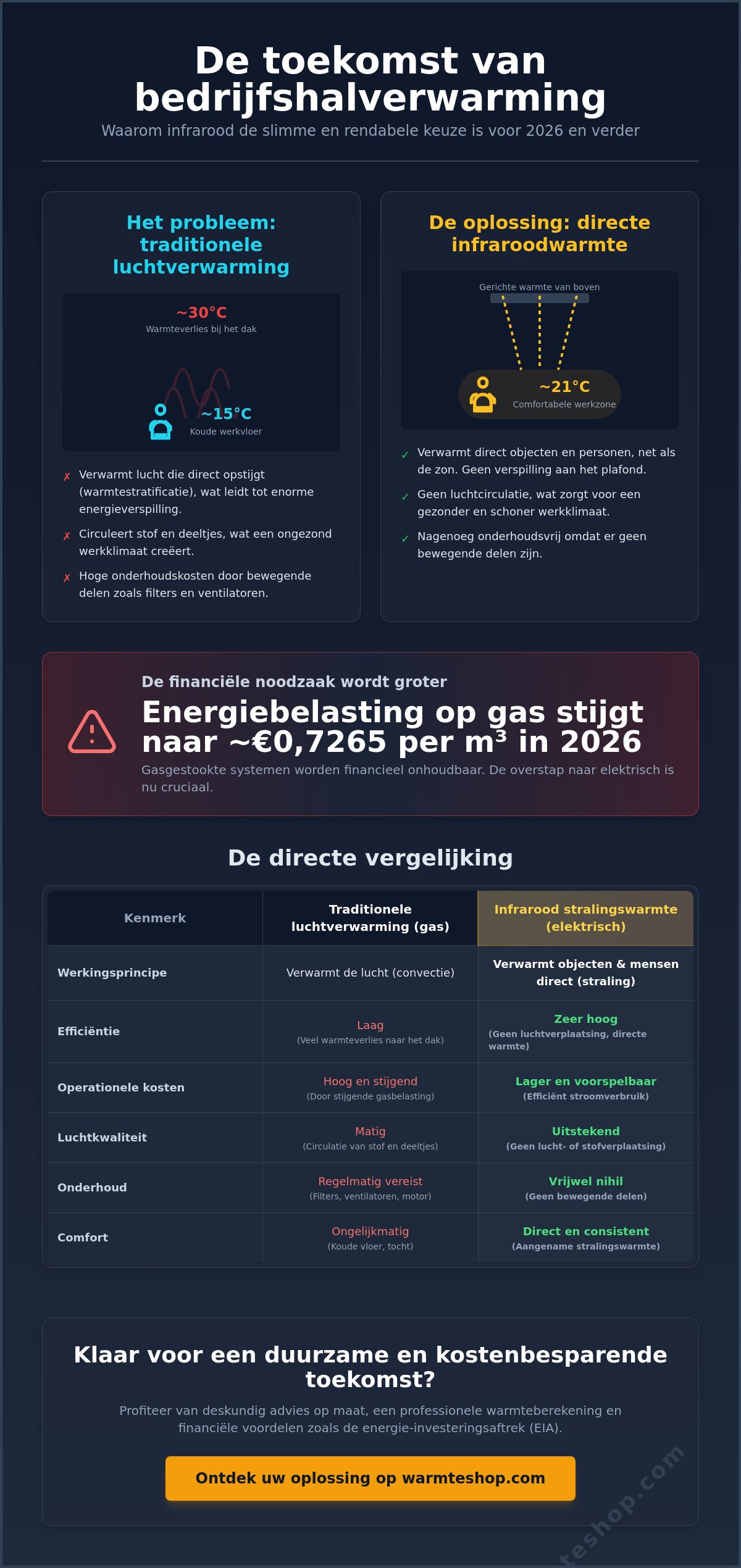
The biggest enemy of an efficient indoor climate is thermal stratification. Because warm air is lighter than cold air, the heated air rises directly to the ceiling. This results in a situation where it can be thirty degrees at the top of the hall, while your staff on the work floor are standing in the cold. It is a pure waste of energy to heat cubic meters of air in places where no one is present. Moreover, drafts and open overhead doors only exacerbate the problem. As soon as a door opens, the warm air escapes immediately, after which the system has to run at full power again to restore the temperature.
With the impending changes in 2026, the need for an alternative is only increasing. The energy tax on natural gas is rising to approximately €0.7265 per m³, making gas-fired systems financially unsustainable. Entrepreneurs are being forced to take a critical look at their energy consumption and take the switch to electricity seriously.
Air is a poor carrier of heat. In an industrial setting, convection creates a constant airflow that carries away dust and particles but fails to retain heat effectively. The temperature difference between the floor and the ceiling can reach up to two degrees per meter of height. For a high-ceilinged industrial hall, this means you have to saturate a massive volume of air before the workspace feels comfortable. This process is slow and inefficient. To understand how to bypass this process, it is helpful to look at how infrared heaters work based on radiation rather than air displacement.
In addition to high energy consumption, traditional industrial air heaters often entail significant maintenance costs. Filters must be replaced regularly, and the moving parts in fans are prone to wear and tear. Furthermore, the constant air movement creates an unhealthy working environment. Dust particles circulate continuously through the room, which can lead to respiratory irritation among your employees. In a time when health and sustainability are central, these are factors you can no longer ignore.
The operation of a modern industrial hall heater is fundamentally different from the traditional systems you may be accustomed to. Instead of using air as a means of transport, infrared heating opts for a direct approach. You can best compare this to the natural warmth of the sun on a clear winter day. Although the ambient air may be cold, you feel the direct radiation on your skin as soon as you step into the sun. Our infrared systems apply exactly this principle. The energy is only converted into heat the moment the rays strike an object, a machine, or a person. This means that you no longer have to wait for the entire cubic volume of the hall to heat up before your staff can work comfortably.
This method of direct heat transfer ensures unprecedented efficiency in large spaces. Because objects and floors absorb heat and slowly release it back into the environment, the entire structure of your hall acts as a thermal battery. This prevents the rapid cooling that occurs with systems that only heat the air. Moreover, an infrared industrial hall heater from Warmteshop is virtually maintenance-free. Since there are no moving parts such as fans or motors, there is no mechanical wear. You are investing in a sustainable solution that delivers reliable heat year after year without the need for costly service contracts.
When choosing industrial infrared heaters, the wavelength of the radiation is crucial for the result. Short-wave radiation, also known as bright heaters, has a high intensity and penetrates deeper into the space. These are extremely suitable for very high halls or places where there is a lot of draft, such as loading docks. Long-wave radiation, the so-called dark heaters, emits a softer heat without light emission. These are ideal for workshops of average height that are well insulated. At Warmteshop, we are happy to advise you on which specific industrial infrared heaters best suit the architecture of your building.
Your staff's sense of comfort improves immediately after switching on the heaters. No warm-up time is required, which means productivity remains high right from the start of the workday. Another major advantage is the prevention of condensation. Because the machines and stocks themselves are heated rather than the air, moisture and rust have less chance to form. Furthermore, our systems operate completely silently. The absence of whirring fans creates a quiet working environment where communication between employees flows more smoothly. If you would like to experience how this healthy warmth feels, we invite you to discover our collection of infrared heating in one of our showrooms
The decision between a traditional gas-fired installation and an electric industrial heater will be simpler than ever before in 2026. While gas systems involve complex infrastructure, heavy piping, and strict annual inspections, infrared heating excels in ease of installation. Mounting requires no extensive demolition work; a stable electrical network and sturdy mounting points are sufficient. This significantly reduces the initial investment, as you do not need to install costly gas infrastructure throughout the entire building. Moreover, this electric setup offers enormous flexibility. Should the layout of your hall change due to a new production line or a modified warehouse layout, you can simply move the heaters along to the new workflow.
In addition to ease of installation, sustainability plays a decisive role. The transition to CO2-neutral operations is no longer a distant prospect, but a current requirement. By choosing infrared, you immediately move away from fossil fuels. This not only reduces your ecological footprint but also protects your company against volatile price increases on the gas market. Combined with smart management via modern thermostats , you ensure a system that only consumes energy when strictly necessary.
With the reduction of the energy tax on electricity to approximately €0.1105 per kWh in 2026, the financial threshold for electric heating is historically low. Many industrial buildings now feature a substantial surface area of solar panels. By using your own generated electricity directly for your industrial air heaters, you maximize your return. Moreover, a gas-free building significantly increases the value of your commercial real estate. Complying with the GACS legislation, which comes into effect on January 1, 2026, becomes a simple task rather than a bureaucratic hurdle with our smart control modules.
The biggest advantage of an infrared industrial hall heater is the possibility of zone heating. In a large warehouse, large parts of the day are often unoccupied. Instead of keeping the entire hall at temperature, you create comfort zones in specific locations:
By using motion sensors and smart thermostats, the system automatically switches back in unused zones. This prevents unnecessary waste and ensures that your energy bill is linked solely to actual productivity. For companies looking to further streamline their logistics processes, a specialized partner like Jagelo Haulage also provide the necessary efficiency in the areas of transport and port logistics.
A successful implementation of a warehouse heater begins long before the first screw goes into the wall. It requires a well-thought-out strategy that takes your employees' workflow as its starting point. Instead of haphazardly equipping the entire space with heaters, we look at the areas where the impact is greatest. This prevents you from investing in capacity that you ultimately do not use. We analyze walking routes, fixed workstations, and areas where cold drafts occur to develop a watertight heating plan.
Safety is paramount. Industrial heaters generate intense heat. This means that we must maintain strict distances from flammable goods, wooden shelving, and packaging materials. Additionally, your electrical installation must be designed to handle the peak load. We often use three-phase power connections to ensure network stability, especially when switching on multiple powerful units simultaneously. Proper integration with your existing power supply prevents overloading and guarantees constant heat output during the coldest days.
The effectiveness of infrared heating depends on the correct angle. Each heater has a specific dispersion angle that determines the size of the heat footprint on the floor. If you hang the heaters too high, the radiation loses power before reaching the work floor. If you hang them too low, the heat becomes too intense for your staff. We ensure a strategic overlap in coverage to eliminate cold shadow spots behind shelving or machinery. Furthermore, mounting on rafters or ceilings requires robust mounting hardware that can withstand the thermal expansion of the system.
Professionals in the sector often use a guideline of approximately 100 to 150 watts per square meter for specific work zones in a warehouse heater located in a moderately insulated environment. However, this figure depends heavily on the ceiling height and the level of ventilation in the building. A hall with a large glass surface area or frequent openings at loading docks requires a higher intensity to maintain comfort. For detailed specifications and technical data on our systems, please consult the collection of industrial air heaters on our website.
Do you want to know exactly how many heaters you need for optimal results in your specific situation? Request a professional heat calculation from Warmteshop for tailored advice from our experts.
Warmteshop positions itself as a reliable guide in the world of the energy transition. We understand that switching to a gas-free industrial hall heater can be a major step for your company. That is why we offer not only high-quality products but also the expertise needed to efficiently heat a complex industrial space. With more than 30 showrooms in the Benelux, we are always close by for personal advice. You can experience the beneficial radiant heat there for yourself and discover how our technology brings the natural warmth of the sun to your workplace. This local presence, combined with our years of experience in the industrial sector, makes us the ideal partner for your sustainability project.
Our approach is always pragmatic and solution-oriented. We view the transition to green energy not as an obligation, but as a smart upgrade for your business operations. Our specialists guide you from the initial calculation to the final professional installation. This ensures you have a system that seamlessly aligns with your specific business needs and the applicable legislation of 2026. Healthy heat that warms people and space—that is the unmistakable signature of Warmteshop.
No two industrial halls are the same. The insulation value, ceiling height, and specific workflow within your premises determine the ideal configuration of your heating system. Therefore, our technical specialists always conduct a detailed on-site analysis. The goal is to create a tailor-made plan that prevents overcapacity. After all, nothing is more of a waste than paying for power you never use. During a no-obligation consultation, we will assess your situation and provide you with a clear quotation. This way, you know exactly where you stand and how to optimally utilize your industrial hall heater for maximum efficiency.
Investing in infrared technology is a long-term decision. The energy savings and virtually non-existent maintenance costs are immediately visible in your operating figures. Because our heaters contain no moving parts, their lifespan is significantly longer than that of traditional air heaters. This makes the switch financially very attractive, especially when you take advantage of tax benefits such as the energy investment deduction. Do you want to take immediate steps towards a carbon-neutral workplace? Then contact our experts for a infrared panel solution or visit one of our showrooms for a demonstration of our industrial systems.
The transition to gas-free operations by 2026 need not be a cause for concern. By choosing a modern industrial hall heater based on infrared technology, you invest in a system that not only complies with the latest legislation but also directly contributes to a more comfortable working environment. You prevent unnecessary energy waste through targeted zone heating and enjoy a low-maintenance installation that provides reliable heat for decades. Moreover, with current tax benefits and falling tax rates, the switch to electricity is a financially smart move for every entrepreneur.
As part of the Infrared Heating Group, Warmteshop specializes in energy-efficient industrial solutions that deliver tangible results. With more than 30 showrooms in the Benelux, we offer you the assurance of local advice and tailored technical expertise. Our specialists are ready to guide you through every step of this smart upgrade, from the initial calculation to the final implementation on the work floor.
Are you ready to structurally reduce your energy costs and offer your staff the best working conditions? Request a no-obligation heat calculation for your industrial hall from Warmteshop now and experience the benefits of our innovative systems for yourself.
In 2026, electric heating is often financially more attractive than gas due to changes in energy taxes. While the tax on natural gas rises to approximately €0.7265 per m³, the tax on electricity decreases to around €0.1105 per kWh. Furthermore, an infrared heater in a warehouse saves significantly on operating costs because you do not waste energy heating the air near the ceiling, but instead direct the heat directly to the work floor.
The number of heaters required depends on the size of the zones to be heated and the specific insulation value of your building. For effective heating of workspaces in a hall, we often calculate with a capacity between 100 and 150 watts per square meter. A professional heat calculation by our specialists is essential to determine exactly how many units your situation requires without overcapacity.
Infrared heating is extremely flexible and can heat either an entire hall or specific zones. However, in large, high halls, zone heating is the most cost-effective choice for your company. You then heat only the areas where employees are actually working, such as packing stations or assembly lines, so you do not pay unnecessarily for heating unused storage space.
The installation height usually varies between 3 and 10 meters, depending on the type of heater and the chosen power. Powerful short-wave heaters are often suspended at greater heights to cover a wide area without losing intensity. For lower workspaces, we often recommend dark heaters that emit a gentler heat and can be mounted at a lower height for optimal comfort.
Infrared heat has a very positive effect on the indoor climate and the health of your staff. Because there is no active air movement, significantly less dust and pollen swirl through the hall, preventing respiratory irritation. The radiant heat feels natural and stimulates blood circulation, contributing to a healthy and vital work environment during the cold winter months.
Our industrial heaters feature a high IP rating, making them highly resistant to moisture and dust. This makes a Warmteshop industrial hall heater suitable for the most challenging industrial environments, including halls where liquids are handled or where high humidity prevails. Our advisors are happy to assist you in selecting the right heater with the appropriate protection rating for your specific sector.
You control the temperature easily and efficiently via wireless thermostats or smart home Wi-Fi modules. This allows you to group various heaters into zones and control them completely independently of each other via a central system. For instance, you can set the heating in the warehouse to a lower setting than at the active workstations, ensuring optimal energy consumption management and maximum comfort for your staff.


