

Energy-efficient supplementary heating: how to heat smartly and comfortably
, by Warmteshop, 15 min read
, by Warmteshop, 15 min read
Energy-efficient supplementary heating does not start with the heater with the lowest output or the latest technology, but with the question of where and when you need heat. Do you want to make a workspace comfortable, shorten the bathroom…
Energy-efficient supplementary heating does not start with the heater with the lowest output or the latest technology, but with the question of where and when you need heat. Do you want to make a workspace comfortable, briefly heat the bathroom, or maintain a temperature for an entire room? That choice determines which type of heating is suitable and how much electricity you consume.
Are you hesitating between infrared heating and an electric convector? Infrared provides targeted radiant heat to people and objects, while a convector heats the air in the room. Neither is automatically more economical in every situation. The heat demand, operating time, and controls make the difference.
In this article, you will learn how to tailor supplementary heating to the room, the duration of use, and the desired comfort. We discuss when infrared heating can be practical, when another electric heater is a better fit, and how to limit unnecessary power consumption with thermostat control and conscious use. This allows you to make more targeted choices regarding heat where you need it.
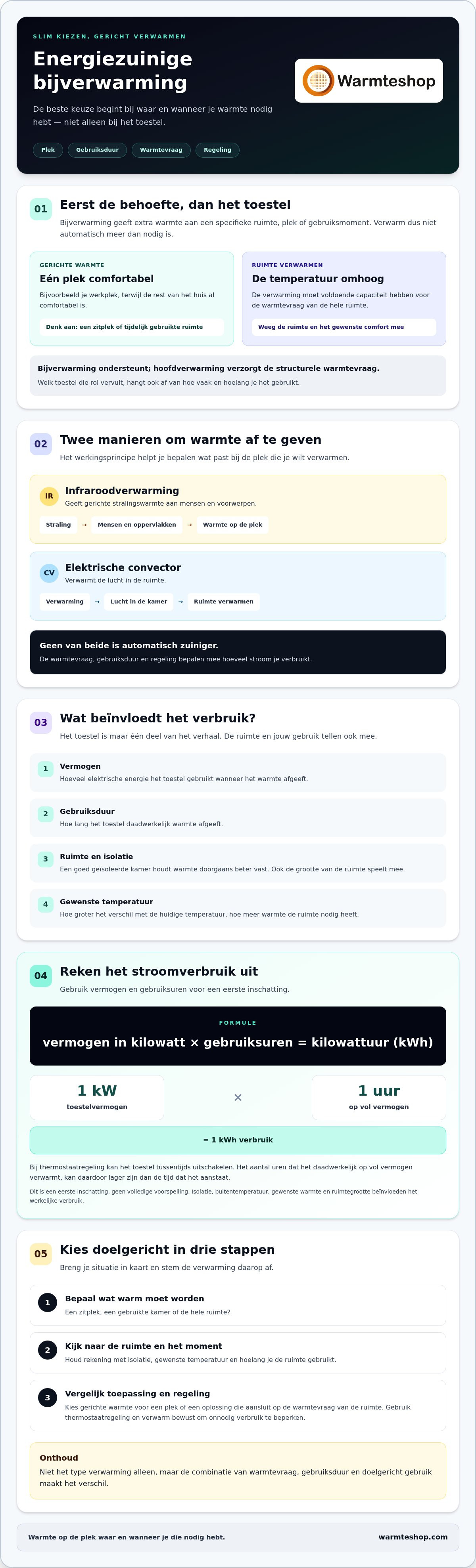
Supplemental heating is extra heat for a specific room, location, or moment of use. You use it alongside the heating that usually keeps your home at temperature, for example, when you are sitting at your desk and want more comfort there. Energy-efficient supplemental heating means tailoring the heat to where and when you need it, so that you do not heat rooms or moments that do not require it.
Energy-efficient heating does not depend solely on the appliance. First, determine what you want to heat: do you want to sit comfortably in one spot, or do you need to raise the temperature of an entire room? For the former, targeted heat may be appropriate. For the latter, the heater must have sufficient capacity for the space. An appliance that does not suit the situation may continue heating for a long time or, conversely, provide insufficient comfort.
Supplementary heating can be useful if you use a workspace while the rest of the house is already comfortable, or when you only heat a hobby room occasionally. Extra heat can also be beneficial in a temporarily used room. The comfort needs in that spot are not necessarily the same as the heat demand of the entire house. Therefore, determine which room or seating area you are using and do not automatically heat more than necessary.
Supplementary heating supports the heating at times or places where extra comfort is desired. Primary heating is intended to meet the structural heat demand of a home or room. This distinction depends not only on the appliance, but also on how often and for how long you use it. If you heat a room daily and for extended periods, take the total heat demand and expected consumption into account. One heating type is not automatically the most economical choice in every home.
Electric heating can emit heat via various principles, including convection and radiation. Read more about how electric heating works to understand the difference between heat for the air in a room and heat for a specific spot. This keeps the function of supplementary heating clear: providing extra comfort where and when you need it.
Electricity consumption depends, among other things, on the power output of the appliance and the time it emits heat. Heat demand also plays a role: it determines how long a heater must operate to achieve the desired comfort. A well-insulated room generally retains heat better than a room where heat is lost quickly.
The desired temperature and the size of the room also play a role. The greater the difference between the current temperature and the temperature you want to achieve, the more heat the room requires. Moreover, there is a difference between feeling warmth quickly at your location and heating the air and surfaces of an entire room. A device may feel comfortable immediately, but that does not automatically mean that less energy is needed to heat an entire room for an extended period.
Power, expressed in kilowatts (kW), indicates how much electrical energy an appliance uses per unit of time when emitting heat. Calculate the consumption using this formula: power in kilowatts × operating hours = kilowatt-hours (kWh). A 1 kW appliance that heats at full power for one hour consumes 1 kWh. With thermostat control, the appliance may switch off intermittently. Consequently, the number of hours it actually heats at full power may be lower than the time the appliance is switched on.
Use the formula as a first estimate, not as a complete prediction of your consumption. Insulation, outside temperature, desired heat, and room size influence how much and for how long you need to heat. As a result, the same heater can result in different consumption in two different rooms.
Infrared radiation heats people and surfaces directly. As a result, you can feel warmth at the point where the radiation strikes. A convector heats the air in the room. That difference can determine which device is suitable for your application, but it does not in itself indicate how much electricity is required to deliver the desired heat.
An electric heater is not automatically economical simply because of the type; consumption depends on the heat demand, the duration of use, and how targeted your heating is. Infrared can be suitable for targeted heating, while another solution is better suited if you want to heat an entire room. For orientation, view infrared heating for various applications. Compare the solutions based on your situation rather than designating one technology as the most economical in advance.
Do not choose based solely on the type of appliance. First, determine whether you want to feel warmth in one fixed spot, heat the air in a room, or need temporary extra heat. The insulation, layout, and size of the room also influence which capacity is appropriate. Therefore, there is no universal capacity that is sufficient for every room.
| Heating type | Suitable application | Point of attention |
|---|---|---|
| Infrared panel | Targeted heat at a workspace or seating area | Placement and distance partly determine where you feel the heat. |
| Convector | Heating the air in a used room | Take into account the heat demand and how long you use the room. |
| Compact electric heater | Temporary extra heat at a specific location or in a room | For prolonged use, the total usage time counts towards consumption. |
If you want to feel warmth in a fixed spot, for example at your desk or favorite chair, infrared heating can be a suitable option. Wall and ceiling panels emit radiant heat to people and surfaces, similar to how the sun directly warms your skin. The perception of warmth depends partly on the placement, the distance to the panel, and the layout of the room. For example, if there is a piece of furniture between you and the radiant heat, the warmth may feel different. Explore the possibilities for infrared heating if you want to compare different applications.
A convector heats the ambient air. This can be pleasant when you want to experience the warmth in a larger part of a room, rather than primarily in one spot. A compact electric heater can be handy if you need extra heat temporarily. How well it suits you depends, among other things, on the room and the duration of use. View the electric convectors for space heating and compare them with your situation.
The appropriate choice for energy-efficient supplementary heating therefore depends on the desired comfort: direct heat in one spot requires a different solution than heating the air in an entire room. Also check whether the unit has sufficient capacity for the space. If you are unsure about the required capacity, expert advice or a heat calculation can help tailor the choice to the room.
A suitable appliance only works effectively if you also determine where, when, and for how long you use it. By thinking about this in advance, you prevent a heater from running unnecessarily or emitting heat in a room where no one is present.
Targeted supplementary heating starts with choosing the location and times of use, followed by an appropriate temperature and control. Then check whether the settings are comfortable in practice. This way, you make energy-efficient supplementary heating part of a conscious heating routine.
First, determine when you actually use the room. If you heat a home office primarily during fixed working hours, a schedule can help adjust the heat accordingly, if the appliance or control system has this function. A thermostat monitors the set temperature and helps prevent the room from becoming warmer than you want. View the thermostats for heating control to explore the possibilities.
Limit heat loss where possible. Close doors and address gaps or poor insulation so that heat does not escape the room as quickly. Then check your settings: is it comfortable, and are you only heating when you are using the room? Adjust the temperature or times if necessary. Do not leave an electric heater on unattended unless expressly permitted by the manufacturer. Always follow the safety regulations and operating instructions of the appliance.
Do you want to tailor the temperature control to your usage? See which thermostat control suits your heating and daily routine.
The right choice starts with your heating needs, not with the assumption that one technology is always the most economical. Warmteshop offers infrared heating, infrared panels, electric convectors, and thermostats. Expert advice helps you tailor the options to your situation. Not sure which capacity fits? A heat calculation can help you get a clearer picture of the required heat for the room.
The clearer you describe the space and its use, the more targeted your discussion of the possibilities will be. Therefore, gather information in advance about:
This information can support a heat calculation, but does not lead to a single fixed outcome in advance. The best solution also depends on the desired heat distribution and how often you use the room. Do you have questions about placement, connection, or mounting? Discuss technical installation questions with an expert. If mounting requires specific knowledge, professional installation is available.
An expert provider looks beyond just the appliance type. An infrared panel may suit the desire for heat in a specific spot, while a convector heats the air in the room. A thermostat can help adjust the temperature to suit usage. Which solution fits depends on the room, usage times, and comfort preferences. This prevents a general claim about energy efficiency from determining the choice without taking the actual heat demand into account.
Warmteshop combines a webshop with physical stores and showrooms. There, you can view various heating solutions and discuss your situation. With information regarding space usage, insulation, and desired heat output, you can ask for more targeted advice and carefully weigh your options.
Do you want to compare infrared heating with your needs? View the options and discover which solution suits you.
A smart choice starts with your heating needs. Do you want to make a fixed spot comfortable or heat the air in an entire room? Match the type of supplementary heating to the room, duration of use, and desired heat. The device alone does not determine whether you have energy-efficient supplementary heating. Appropriate settings and heating only when you use the room also help prevent unnecessary power consumption.
Unsure about the required capacity or the correct operation? Warmteshop offers infrared heating, convectors, and thermostats, along with expert advice and heat calculations to tailor the options to your situation. If installation requires specific knowledge, professional installation is available. You can also explore the options in the webshop or visit one of the physical stores and showrooms.
This way, choosing becomes not a matter of gambling, but of tailoring comfort to how you use the space. Discover infrared heating and find a suitable solution. Choose a solution that provides heat where and when you need it.
Infrared heating can be suitable if you primarily want to provide extra warmth to a specific spot or person. The radiant heat is directly felt on people and surfaces, but this does not automatically mean that the device uses less electricity in every room. Consumption depends on factors such as heat demand, duration of use, settings, and insulation. Therefore, choose energy-efficient supplementary heating based on the application, not just on the heating type.
That cannot be said without further ado. The costs depend on energy consumption, your energy price, the efficiency of your main heating system, and how long you use the supplementary heating. Electric heating can be practical for a limited space or for short periods of use, but that does not automatically prove that it is cheaper. Compare your own rates and usage situation before estimating potential savings.
Power consumption depends on the capacity of the appliance and how long it heats. Multiply the capacity in kilowatts by the number of operating hours to calculate the consumption in kilowatt-hours. This result does not accurately predict your bill: your electricity tariff and heat demand also play a role. Use the product specifications and your own usage time for a realistic estimate of energy-efficient supplementary heating.
Neither is automatically more economical in every situation. Infrared provides radiant heat that can be directed directly at people and surfaces. A convector heats the air in the room. Which option suits you depends on where you want heat, how long you heat, and whether you primarily want to make yourself or the entire room comfortable. Therefore, compare the application and heat demand, not just the appliance types.
That does not depend solely on the floor area. Also consider the insulation, ceiling height, usage time, desired temperature, and the location where you need heat. For targeted heating, infrared may be worth considering; a convector might be suitable if you want to heat the ambient air. If the required capacity is unclear, have the heat demand assessed. A general power rule does not automatically take your space into account.
Yes, provided the appliance and the thermostat are compatible. Thermostat control helps adjust the heating to the desired temperature and time of use. Check compatibility beforehand and follow the manufacturer's instructions. If the control system has a schedule, you can align heating times with your routine. This may prevent heating for unnecessarily long periods, but it does not yield a fixed savings percentage: the result depends on your usage.
At the same power output, electricity consumption increases the longer the heater emits heat. A thermostat can interrupt or adjust operation as soon as the set temperature is reached, depending on the appliance and the circumstances. How often heating is needed also depends on heat loss, insulation, and outside temperature. Set an appropriate temperature and heat only when the room requires extra warmth.


