

Electric supplementary living room heating: Smart saving and maximum comfort in 2026
, by Warmteshop, 21 min read
, by Warmteshop, 21 min read
Is your thermostat set to 21 degrees while you are still sitting on the couch with a blanket? It is a frustrating reality for many households; the air is warm and dry, but the walls and your feet remain unpleasantly c…
Is your thermostat set to 21 degrees while you are still sitting on the sofa with a blanket? It is a frustrating reality for many households; the air is warm and dry, but the walls and your feet remain unpleasantly cold. With energy prices set to remain stably high toward 2026, every extra degree feels like a drain on your monthly budget. Fortunately, there is a smarter way to comfort. By choosing electric supplementary living room heating, specifically via advanced infrared technology, you heat not the volatile air, but directly the objects and people in the room.
You probably recognize the desire to heat only the seating area without unnecessarily heating the entire ground floor. In this article, you will discover how the right electric supplementary heating can lower your gas bill by up to 30 percent while simultaneously creating a healthier indoor climate without that annoying dry air from central heating. We dive into the world of aesthetic heating panels and smart control systems that transform your living room into an oasis of natural radiant heat, just like the beneficial effect of the sun on a clear day.
By 2026, the way we view our indoor climate will have fundamentally changed. The days of heating the entire mass of air in a home to 21 degrees are behind us. We are making the switch en masse from central air heating to local object heating. This transition is driven by the necessity to live gas-free and the rising demand for energy efficiency. Central to this is zonal heating: a smart strategy whereby you only heat the space where you are actually staying, precisely at the times you are there.
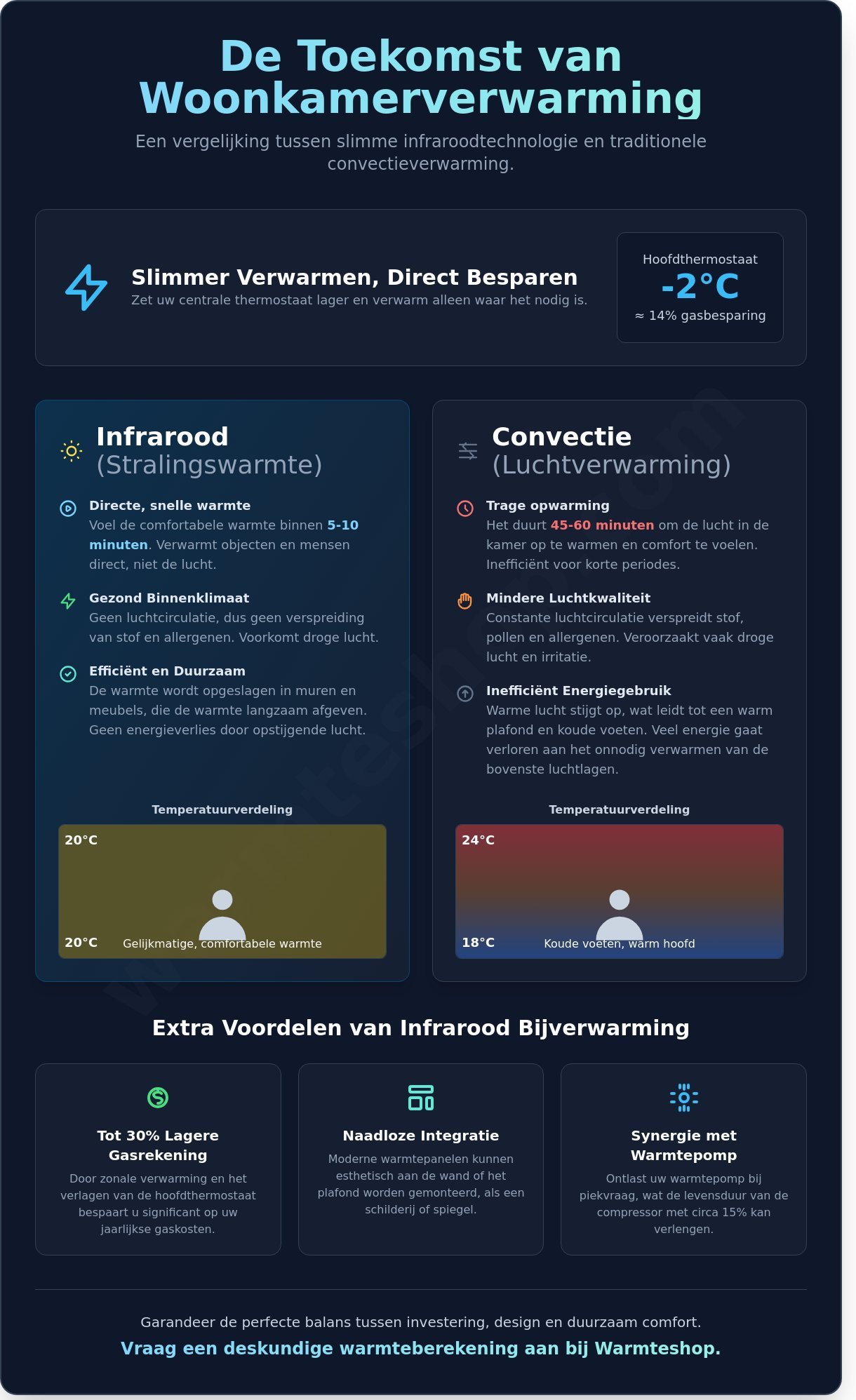
The technical operation of electric heating makes it possible to convert energy directly into comfort without transport losses. By using electric supplementary heating in the living room, the standard central heating thermostat can be lowered by 2 degrees. Practical figures show that every degree less on the main thermostat results in a saving of approximately 7 percent on annual gas consumption. With a reduction of 2 degrees, you therefore immediately reduce the energy bill by 14 percent, while the electric supplementary heating maintains the local temperature around your seating area at the perfect level.
Classic radiators work on the basis of convection, a process in which air is heated and begins to circulate. This entails three major disadvantages. First, the airflow causes a constant movement of particulate matter and allergens, creating an unhealthy indoor climate for the 25 percent of the population with allergies or sensitive airways. Second, warm air rises. This creates an inefficient temperature difference where it is 24 degrees at the ceiling, while your feet rest on the floor in a layer of air at 18 degrees. Finally, the slowness is a problem; heating an average 40-square-meter living room via the central heating system often takes 45 to 60 minutes before a comfortable level is reached.
Modern electric supplementary living room heating, such as infrared panels, acts as a direct heat boost. Instead of heating the air, objects and people are irradiated directly. You will feel the warmth within 5 to 10 minutes of switching it on. This is the ideal solution for the early morning hours or late evening on the sofa, when it is unnecessary to keep the entire house at a comfortable temperature.
An often underestimated benefit is the synergy with the heat pump. A heat pump operates most efficiently at a constant, low temperature. When you force the heat pump to quickly raise the temperature by a few degrees, it often switches on an inefficient electric resistance element. By using an electric panel for this peak demand, you relieve the load on the heat pump. This can extend the lifespan of the compressor by an estimated 15 percent, as the number of 'starts and stops' of the pump decreases drastically. In this way, the supplementary heating acts not only as a source of comfort but also as a protector of your sustainable installation.
The choice of the right electric supplementary heating for the living room depends entirely on how you want to experience the heat in your living space. There are two fundamentally different techniques: radiant heat and air heating. While traditional central heating primarily moves the air, modern electric systems often work with direct radiation, which has a very different impact on your living comfort.
Infrared panels mimic the natural warmth of the sun. Instead of heating the air, these panels emit long-wave infrared rays that strike objects, walls, and people in the room directly. This creates an immediate feeling of comfort, even when the air temperature in the room itself is still relatively low. Because the walls and furniture absorb this energy and slowly release it back into the space, the living room stays warm longer without the thermostat having to run constantly at a high level.
Convector heating works on the opposite principle. These devices draw in cold air from the bottom, heat it via an internal element, and blow the warm air out again at the top. This creates a constant circulation of air. Although this can heat a room quickly, it also stirs up dust particles and causes an uneven temperature distribution. In many cases, you will notice that it is stiflingly hot near the ceiling, while your feet on the floor still feel cold.
When critically comparing the costs and consumption of electric supplementary heating, it is striking that both techniques are 100% electrically efficient in terms of consumption. However, the major difference lies in the efficiency of heat transfer. With infrared radiation, you can typically set the thermostat 2 to 3 degrees lower than with convection, while experiencing exactly the same level of comfort. Every degree the thermostat is set lower directly results in a saving of approximately 6% on your energy consumption for that specific room.
Infrared is the ideal solution for those striving for a healthy indoor climate in the living room. There is no active air movement, which is a blessing for residents with allergies or sensitive airways. The heat penetrates deep into the structure of the home, keeping walls dry and preventing mold formation. Discover our full range of infrared heating for the living room and experience the comforting deep heat that instantly transforms your interior.
A convector can be useful in situations where you want to dispel a cold draft very occasionally and within a few minutes. Fan heaters go a step further by forcibly pushing air into the room. However, this is accompanied by a constant noise level averaging 45 to 55 decibels and rapid drying of the air. In a living space where you want to relax or watch television, it is better not to choose a fan heater due to the acoustic disturbance and the dry eyes it can cause.
Would you like to know exactly what power is needed to optimally heat your seating area? Receive no-obligation advice from an expert at the Warmteshop for a sustainable solution that suits your specific living situation.
Many homeowners hesitate to switch to electric heating for fear of a high energy bill. However, the reality is that electric supplementary living room heating is actually a powerful tool for reducing total energy costs. A calculation example makes this immediately clear. An average 600-watt infrared panel consumes only €0.18 per hour at an electricity price of €0.30 per kWh. If you use this to heat your seating area specifically, the central heating for the rest of the house can be set two degrees lower. Every degree lower on the thermostat of your gas-fired central heating saves an average of 7% on your annual gas consumption. For an average household, this means a saving of approximately 140 m³ of gas per year, which at current rates amounts to savings of over €180 compared to only a few tens of euros in extra electricity costs.
The efficiency lies in the technology. Whereas a traditional 2000-watt electric heater heats the air which then escapes, a low-wattage panel works much more effectively by heating objects directly. In the discussion regarding infrared versus convection, it is striking that radiant heat requires much less energy to achieve the same level of comfort. The presence of solar panels significantly accelerates the payback period. Certainly as long as the net metering scheme remains in effect, you use your own generated solar energy to heat your living room, reducing operating costs to zero.
The concept of zone heating is based on simple mathematical logic: why heat a 40-square-meter living room if you are just sitting on the sofa? By setting the central heating to 18 degrees as standard and only heating the active zones, you prevent heat from being lost in unused corners or hallways. In modern, well-insulated homes, the synergy between infrared and insulation is optimal. Heat is retained by the walls and floors, meaning the panel needs to switch on less and less frequently to maintain the desired temperature. This reduces effective consumption by a further 15% to 20% compared to less well-insulated spaces.
The greatest savings are achieved through precision. The use of high-quality thermostats is essential for any electric living room supplementary heating installation. Smart control can reduce consumption by up to 30% simply by never heating more than necessary. Modern Wi-Fi modules and apps make it possible to fully adapt your heating schedule to your lifestyle. You can switch on the heating via your smartphone as soon as you drive up the driveway, ensuring the room is comfortable the moment you step inside.
These innovative control methods ensure that electric supplementary heating is no longer a luxury, but a smart investment that pays for itself over the years in both comfort and money.
Choosing the right electric supplementary heating for the living room doesn't stop at selecting the right wattage; the physical position in the room determines the final comfort level 100%. While a traditional radiator is often an obstacle under a window, modern infrared panels offer complete freedom to place the heat source exactly where you spend the most time. Ceiling mounting is the absolute leader in terms of efficiency. By attaching a panel to the ceiling, the infrared radiation is not hindered in any way by furniture such as sofas, armchairs, or coffee tables. This results in heat distribution that is up to 22% more effective than with wall mounting, because the floor is heated directly and acts as a secondary heat source.
Would you prefer to mount the panels on the wall? If so, please ensure a strict unobstructed radiation space of at least 50 centimeters in front of the panel. For an optimal seating experience, our advisors recommend positioning the panel diagonally above or opposite the sofa. This ensures you are directly hit by the radiation without the air becoming bone dry. At a dining table, a panel directly above the table works best; this creates a targeted heat zone that responds immediately as soon as you sit down. Installation is often completed within 30 minutes using the included mounting kits.
Modern heating technology makes it possible for your heat source to blend seamlessly into your interior style. Nowadays, infrared panels are often designed as personalized works of art or functional infrared mirrors. These mirrors are a smart choice for living rooms directly connected to an open kitchen or hallway. They never fog up and offer a dual function that saves wall space. The technology behind these panels converts 95% of the energy directly into radiant heat. This process mimics the natural warmth of the sun by heating objects and people directly, rather than the air mass. When ceiling-mounted, this ensures an extremely even distribution, limiting temperature differences between the floor and the ceiling to less than 1 degree Celsius.
For those seeking visual coziness in addition to physical warmth, the electric fireplace the ideal solution. These systems combine realistic LED flame technology with a powerful heat output, often ranging from 1,000 to 2,000 watts. It is a smart way to apply electric supplementary heating in larger rooms where you want to create a 'warm cocoon'. Research shows that the visual presence of moving flames increases the subjective perception of warmth by an average of 2 degrees. This psychological effect allows you to set the thermostat lower without sacrificing comfort. Nowadays, cables and connections can be easily concealed in a custom-made cornice or via subtle, paintable cable ducts mounted directly against the skirting board.
Creating a healthy and stylish living environment starts with the right technology in the right place. Do you want to find the perfect balance between design and efficiency? Request a free consultation at Warmteshop for a customized heating plan.
The switch to a sustainably heated home starts with a well-thought-out plan. For optimal electric supplementary heating in the living room, it is essential that you do not simply hang up a panel, but consider the specific needs of your living space. At Warmteshop, we act as your reliable guide in this energy transition. We translate complex technology into a comfortable indoor climate that perfectly suits your lifestyle and home. Our approach is based on facts and technical precision, ensuring that your investment contributes directly to a lower energy bill and increased living comfort.
An accurate heat calculation forms the absolute foundation of every successful project. We base our advice on hard data such as the insulation value of your walls, the type of glazing, and the exact cubic meters of the living room. Without this calculation, you risk a system that either delivers insufficient power, resulting in a lack of comfort on cold days, or consumes unnecessarily high amounts of electricity due to overcapacity. Our experts calculate exactly how many watts per square meter are required to efficiently reach the desired temperature. This prevents disappointment and ensures a system that functions trouble-free for years.
Infrared heat is a sensory experience that you simply have to feel to understand its added value. In our more than 30 physical showrooms spread across the Benelux, including locations in Antwerp, Roeselare, and Oud-Gastel, you literally step into the heat of the future. During a free consultation, we demonstrate how the radiation directly heats objects and people, exactly as the natural rays of the sun do. You gain immediate insight into the power required for your specific situation and can admire the various designs of our panels in real life.
We do not leave the installation of your new heating system to chance. Our own professional installation service guarantees a safe, neat, and technically correct finish. Our installers have experience with hundreds of installations per year and know exactly how to position the panels for the most efficient heat distribution. This not only ensures a perfectly functioning system but also preserves the full manufacturer's warranty on your equipment. Safety and peace of mind are paramount, so that you can enjoy healthy, radiant warmth immediately after installation.
Whether you want to equip a compact 25-square-meter studio with electric supplementary living room heating or an industrial loft with 4-meter-high ceilings, we offer scalable systems that grow with your ambitions. As a proud partner of the Infrarood Verwarming Groep, we adhere to the strictest quality standards for all our products. Every panel undergoes rigorous testing before it hangs on your wall. Request a no-obligation quote today for a solution that structurally improves your living comfort and prepares your home for a gas-free future.
Choosing Warmteshop means choosing a partner who looks beyond just selling a product. We support you in the entire transition to sustainable living. Our systems are designed to work seamlessly with smart thermostats and green energy sources such as solar panels. This allows you not only to transform your living room into an oasis of peace and warmth, but also to actively contribute to a carbon-neutral future. The combination of local expertise, physical accessibility, and technical innovation makes us the authority in the field of modern electric heating.
The transition to a sustainable and energy-efficient home is in full swing, and the standard for 2026 is already within reach. By investing in electric supplementary living room heating, you opt for healthy radiant heat that directly warms objects and people, comparable to the natural warmth of the sun. This system significantly increases your living comfort while you turn down the central heating thermostat by a few degrees. Warmteshop offers you the assurance of more than 15 years of experience in innovative infrared technology. In our 30+ showrooms spread across the region, you receive personal advice that perfectly matches your interior and consumption needs. Our certified installers then ensure a worry-free and technically perfect installation in your home. This allows you to combine a lower carbon footprint with a stylish design that elevates your living room. The road to a smart, electric future begins with expert advice and a high-quality installation.
Discover the perfect electric supplementary heating for your living room at Warmteshop
Prepare your home for the next generation and enjoy a wonderfully warm and healthy indoor climate every day.
In many situations, electric supplementary living room heating is cheaper than gas when you heat only the areas where you actually spend time. An average household saves up to 15 percent on the annual energy bill by setting the central thermostat two degrees lower and heating only the seating area with infrared. Electricity converts 100 percent of the energy into heat without loss through pipes. With solar panels, you reduce these operating costs to almost zero euros per kilowatt-hour.
For effective supplementary heating in an average insulated living room, calculate 25 to 30 watts per cubic meter of space. In a seating area of 50 cubic meters, you therefore need a capacity of 1,250 to 1,500 watts to sit comfortably. This calculation ensures that you quickly reach the desired comfort temperature of 21 degrees Celsius without unnecessary energy waste. Our advisors in the 30 showrooms spread across the Benelux would be happy to make an exact calculation for your specific living situation.
The infrared panel is currently the most energy-efficient option for supplementary heating because it heats objects and people directly, rather than the air mass. This system consumes up to 40 percent less energy than traditional electric convectors, which have to move the entire air. Thanks to the targeted radiant heat, you experience the same comfort at an air temperature of 19 degrees Celsius as you would at 21 degrees with an air heating system. This translates directly into a lower monthly energy bill and higher efficiency.
You can easily install an infrared panel yourself using the included mounting kit and a standard 230V socket. Most panels weigh between 5 and 15 kilograms and are securely mounted to the wall or ceiling within 20 minutes. For a completely invisible finish where the cables are routed into the wall, we recommend hiring a certified electrician. This ensures your installation immediately complies with NEN 1010 safety standards and allows you to enjoy a sleek design without visible wires.
Long-wave infrared radiation is completely safe and even healthy for humans and animals because it mimics the natural warmth of the sun without harmful UV radiation. Since there is no active air circulation, 80 percent less dust and pollen swirl through the living room. This offers immediate relief for children with allergies or sensitive airways. Furthermore, the mucous membranes do not dry out and the humidity remains at a stable level of approximately 50 percent, which benefits overall resistance.
The fundamental difference is that a convector heats the air, whereas an infrared panel directly heats objects and bodies in the room. With convection, warm air rises to the ceiling, which leads to 30 percent heat loss at floor level in a high-ceilinged living room. Infrared radiation stores heat in the walls and furniture, which then slowly release this energy back into the surroundings. This ensures a constant temperature without annoying drafts or cold feet along the floor.
Electric supplementary heating can replace the entire central heating system, provided the home meets modern insulation standards such as energy label A or B. In homes built after 2015, we see a 25 percent increase in the number of households switching entirely to infrared heating as the primary source. The system has a modular design, allowing you to control the temperature very precisely per room via an app. In combination with a heat pump boiler, you create a completely gas-free and future-proof home that is ready for the energy transition.
A modern infrared panel reaches its full operating temperature within 8 to 12 minutes after switching on the thermostat. However, you will feel the direct radiant heat on your skin after just 30 seconds when you are within the panel's range. To bring the entire living room and the surrounding mass to the desired temperature, we recommend activating the heating 30 minutes before using the room. Smart thermostats fully automate this process based on your daily routine.


