

Electric garage heating: The complete guide to an energy-efficient workshop in 2026
, by Warmteshop, 21 min read
, by Warmteshop, 21 min read
Why would you waste precious energy heating the air in a drafty room when you actually only want to keep yourself warm at the workbench? Many hobbyists and professionals notice that their traditional…
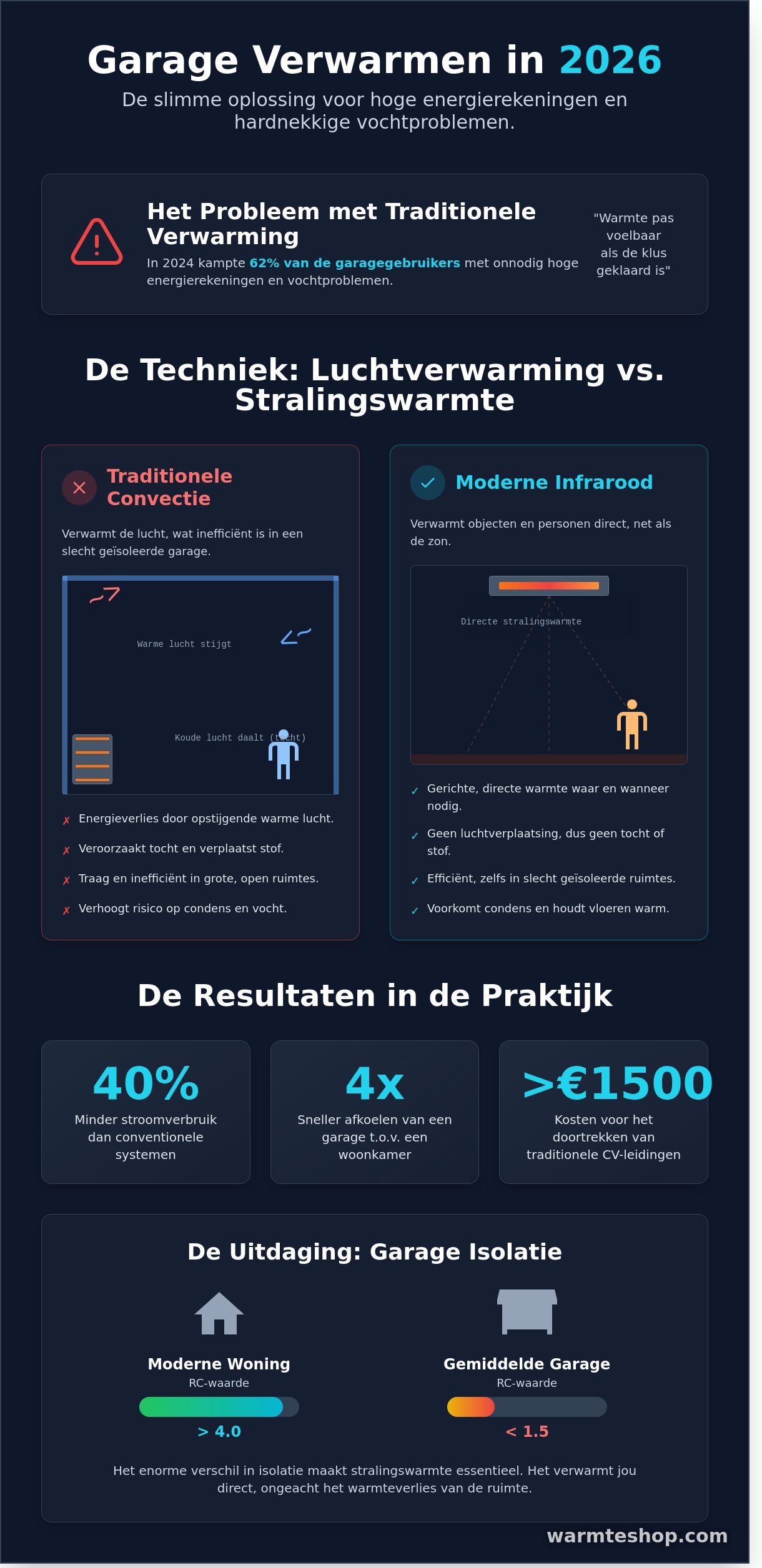
Why waste precious energy heating the air in a drafty space when you actually only want to keep yourself warm at the workbench? Many hobbyists and professionals find that their traditional heater only really gives off heat once the job is already finished, which in 2024 led to unnecessarily high energy bills and persistent moisture problems for over 62% of garage users. Nowadays, heating your garage electrically is no longer an expensive emergency solution, but a conscious choice for immediate comfort and smart savings on your fixed costs.
You probably want nothing more than a workspace that feels instantly comfortable the moment you flip the switch. In this complete guide for 2026, you will discover how to use advanced infrared technology to transform your workspace into an energy-efficient environment that consumes up to 40% less power than conventional systems. We explain step-by-step how to benefit from maintenance-free radiant heat that, just like the natural warmth of the sun, heats objects and people rather than the air, making condensation and cold feet a thing of the past for good.
The days when the garage served merely as a cold storage space for the car or a dusty storage place for tools are definitely behind us. By 2026, we will see the garage transformed into a fully-fledged part of the home. Whether it concerns a high-quality home office, a private gym, or an air-conditioned hobby room, the need for a stable climate is greater than ever. The transition from gas to electricity plays a major role in this. Extending central heating pipes to a garage is technically complex and costly, with installation costs often rising to over €1,500. Heating your garage electrically has therefore become the most logical and financially attractive solution.
This trend is not limited to the garage alone; more and more people are investing in separate garden houses or wellness spaces, with specialists such as HOLZHEIM Garten & Wellness demonstrating how high-quality timber structures form the perfect foundation for an additional living space.
Electric systems offer unprecedented flexibility. You do not need to do any demolition work for heavy pipes and are not dependent on the capacity of your current central heating boiler, which in many cases is already running at its maximum power. The technology behind electric heating makes it possible to make a room comfortable immediately with a simple power connection. Whereas traditional radiators heat up slowly and often fail in a poorly insulated garage environment, modern electric systems respond instantly to the demand for heat. This prevents unnecessary energy consumption when you are not using the space.
In the current energy market, where self-generated solar power is the norm, the garage serves as the ideal place to put this green energy to good use. It is a smart upgrade that not only increases living comfort but also directly and positively influences the property value by improving its multifunctional usability.
An average garage cools down up to four times faster than a living room. This is because the insulation values (RC value) of garage doors and exterior walls often remain below 1.5, whereas a modern home scores above 4.0. The biggest problem with conventional heating is air circulation. Warm air rises, cools against the uninsulated roof, and causes drafts across the floor. Heating your garage electrically with systems that heat objects rather than air effectively solves this problem. This way, the heat stays where you work or exercise, regardless of any existing drafts.
In 2026, we distinguish between three main technologies for the garage. Convectors are ideal for basic heating, while fan heaters provide a lightning-fast boost. However, the most sustainable choice remains infrared heating. This technology mimics the natural heat of the sun. Instead of heating the air, these panels radiate heat directly to your body and the floor. This ensures a level of comfort that occurs even at lower air temperatures, resulting in average energy savings of 20% to 30%. With stricter CO2 standards, this efficient use of energy is essential for a future-proof home.
In 2026, choosing electric is no longer a compromise, but a conscious step towards a healthier and more comfortable indoor climate. Due to rapid installation and the elimination of pipe maintenance costs, a modern electric system pays for itself faster than any fossil fuel alternative.
Heating a garage requires a fundamentally different approach than a living room. Most garages are moderately insulated and often feature high ceilings or an uninsulated sectional door. Anyone opting for electric garage heatingmust understand that there is a crucial difference between heating air and heating mass. Traditional systems rely on convection. In this process, air is passed along a heating element, after which the heated air expands and rises. In a three-meter-high garage, precious heat collects directly against the roof surface, while the floor where you work remains freezing cold.
Infrared radiation works on a completely different principle. Instead of using air as a means of transport, a panel emits electromagnetic waves that are only converted into heat once they strike an object. Think of the walls, your workbench, the toolbox, or your own body. These objects absorb the energy and store it. A solid wall retains heat up to 400% longer than air. This creates a thermal buffer in the room. When you briefly open the garage door, the heat remains stored in the objects, ensuring the room returns to the desired temperature within a few minutes after closing the door.
The impact of ventilation on the efficiency of electric systems should not be underestimated. Figures on the costs and consumption of electric heaters show that systems that heat only air lose up to 35% of their efficiency in drafty environments. In an active garage that is frequently ventilated due to fumes or dust, radiant heat is the only method that guarantees constant comfort without unnecessary energy waste.
Infrared panels use long-wave infrared radiation, technically designated as IR-C. This is exactly the same safe frequency emitted by the sun on a clear winter day. Although the thermometer indicates a low air temperature, you feel the direct warmth of the sun's rays on your skin. This effect ensures that the perceived temperature when heating a garage electrically via infrared. You can therefore set the thermostat lower while the comfort level remains the same as a conventionally heated room at 21 degrees. This results in direct savings on your monthly energy costs.
Moreover, this technique is beneficial for health in a work environment. Because air circulation is not required to dissipate heat, dust particles and allergens remain on the ground. In a workshop where sawing or sanding takes place, this is a significant advantage for air quality.
An electric convector can be a suitable solution if you only want to keep the garage frost-free during the winter months. These units react quickly and can raise a room from 5 to 10 degrees in a short time. However, for an active hobby room, the disadvantages are significant. The constant airflow creates an unstable climate and moves fine dust throughout the entire space. As soon as the garage door opens to drive a vehicle in, the accumulated warm air escapes within 20 seconds, after which the unit has to reheat at full power.
For a heavily used garage, a hybrid setup or a full focus on radiant heat is often the most cost-effective long-term investment. Would you like to discover which technology best suits your specific situation? You can always visit a showroom for a demonstration of the various systems and a customized calculation.
Heating your garage electrically doesn't have to cost a fortune, provided you make the right choices regarding power and technology. For a standard 20-square-meter garage with average insulation, we generally calculate with a required power of 100 watts per square meter. This means you need a 2,000-watt system to quickly bring the space to a comfortable working temperature. When considering the expected energy prices for 2026, which hover around €0.35 per kWh, an hour of intensive heating will cost you approximately €0.70.
The major advantage of modern systems is that they rarely run at full power constantly. According to the US Department of Energy, the efficiency of electric heating at the point of use is 100 percent because every unit of electricity is directly converted into heat. With infrared technology, you also benefit from zone heating. Instead of heating the entire 50 cubic meters of air in the garage, you direct the radiant heat specifically at your workbench or hobby corner. This reduces effective energy consumption by an average of 30 to 40 percent compared to traditional air heaters.
Let's look at two realistic scenarios for a 20-square-meter garage during the winter months of 2026. In the first scenario, you are working on your project for eight hours on a full Saturday. Due to thermostat control, a 2000-watt smart infrared panel will only be truly on for about 50 percent of the time. This results in a consumption of 8 kWh, which amounts to €2.80 for a full day of comfort.
In the second scenario, you only want to keep the garage frost-free to protect your car or stored paint stock. The thermostat is then set to 5 degrees Celsius. In this case, the system often consumes less than 2 kWh per day, costing you only €0.70 per day. The payback period for infrared panels compared to cheap electric fan heaters is typically less than three winters, purely due to the higher efficiency of radiant heat, which does not immediately blow away when the garage door is opened.
The key to a low energy bill lies in the accuracy of the control. The use of wireless thermostats is essential in this regard. These sensors measure the temperature at the place where you are working, and not directly next to the heat source. As a result, the system stops heating exactly on time, preventing an unnecessary temperature rise of even just one degree. Every degree lower saves you an immediate 6 percent on heating costs.
By combining these techniques, you transform the garage from a cold concrete box into a comfortable, sustainable workspace. The investment in a smart control system pays for itself by preventing unnecessary operating hours. This ensures that heating your garage electrically remains a smart and manageable choice for the future.
Transforming a garage into a comfortable space requires more than just plugging something in. To make heating your garage electrically cost-effective, a strategic approach is essential. After all, you don't want to waste energy heating the outside air. This step-by-step plan helps you make optimal use of every square meter.
Step 1: Determine the intended use. A garage used solely for storing the car and bicycles requires sufficient frost protection at around 7 degrees Celsius. Are you setting up the space as a home gym or workshop? Then aim for a comfort temperature of 18 to 20 degrees. This difference determines whether you choose a low-wattage panel or a powerful heater.
Step 2: Analyze the weak points in the insulation. A standard steel up-and-over door loses up to 30% of the generated heat. Also check the roof and windows. Replacing single glazing with HR++ glass (with a U-value of 1.1) significantly increases the efficiency of your heating system. Seal gaps at the threshold with brushes to eliminate drafts.
Step 3: Choose the right position for your panels. The location where you install the heat source determines its effectiveness. In a garage, space is often limited due to cabinet walls and tools. By mounting your infrared panels on the ceiling, you prevent furniture from blocking the radiation.
Step 4: Install zone heating. Why heat the entire 30-square-meter garage if you are only standing at your workbench? Place a panel directly above your main workspace. This way, you can enjoy a comfortable temperature within 5 to 10 minutes in the spot where you actually are, while the rest of the garage remains at a lower base temperature.
Step 5: Check safety and IP ratings. Garages are often dustier or more humid than a living room. Always check the IP rating of the equipment. For a dry garage, IP20 is sufficient, but in a humid environment or where there is a risk of splashing water, IP44 is the minimum requirement for safe operation.
Ceiling mounting is the superior choice in most garages. Infrared radiation works just like the sun; it heats objects and bodies directly. When panels are suspended from the ceiling, the floor becomes the largest heat buffer. The concrete floor absorbs the radiation and gradually releases it back into the room. This prevents "shadow spots" behind workbenches or vehicles where the heat would otherwise not reach. Do you want to combine aesthetics with power? Then opt for slim wall panels in areas where the ceiling is too high, such as in garages with a pitched roof of more than 3 meters.
In an active workshop, fire safety is a top priority. During work activities that generate a lot of sawdust or fine dust, traditional convectors with open filaments are dangerous. In such cases, robust industrial heaters a better option. These devices are designed to withstand harsh conditions and often have a higher IP rating, such as IP65, making them completely dustproof and spray-proof. This is crucial for the lifespan of your system when you regularly sand or work with liquids. Heating your garage electrically thus becomes not only a comfortable but also a safe choice for the long term.
Do you want to know exactly what power your garage needs for an optimal climate? Request a free heat loss calculation from our experts.
Choosing to heat your garage electrically is a smart step towards a gas-free future and a more functional home. Warmteshop acts as your expert partner in this, with a network of 32 specialized showrooms spread across the Benelux. Our advisors base their recommendations not on assumptions, but on hard data. We perform a precise heat calculation for every customer, taking into account the exact cubic meters and the specific insulation level of the space. This process prevents you from incurring unnecessarily high energy bills due to overcapacity or experiencing an uncomfortable cold due to insufficient power.
Our infrared panels are manufactured from high-quality materials such as tempered safety glass or robust powder-coated aluminium. These components are highly resistant to the challenging climate in a garage, where moisture and rapid temperature fluctuations often play a role. Unlike traditional convection heaters, which heat the air and thereby stir up dust and allergens, infrared offers healthy radiant heat. You can directly compare this experience to the natural warmth of the sun on your skin on a clear spring day. Because airflow is minimal, the walls remain dry and mold has up to 85% less chance of settling in the corners of your garage.
For spaces that are not completely enclosed, such as a semi-open garage or a workshop with a roller door that opens regularly, our powerful patio heaters the ideal solution. These units use short-wave infrared radiation that is unaffected by wind gusts, meaning approximately 92% of the generated energy is directly converted into palpable warmth on the person. For compact sheds of less than 12 square meters, we have slim wall panels that take up hardly any valuable workspace. You can choose simple DIY assembly using the included templates and brackets, or leave the full installation to our certified technicians, who will conceal the wiring within a few hours.
A targeted investment in infrared technology immediately increases your living comfort while reducing your ecological footprint. By heating your garage electrically in combination with our smart Wi-Fi thermostats, you save up to an additional 18% on your monthly running costs. The system only switches on when sensors detect activity or when you give the command via your smartphone. Switching to this green technology is a valuable upgrade for your home that pays for itself in the long run through lower maintenance costs and a longer equipment lifespan. We invite you to request a no-obligation quote specifically tailored to the technical specifications of your project. For those who wish to experience the unique radiant heat for themselves first, our showrooms offer the opportunity for a live demonstration. There, our specialists will show you how aesthetic design and technical efficiency come together in a sustainable heating solution.
Choosing to heat your garage electrically using infrared technology means you immediately say goodbye to unnecessary heat loss and high energy bills. While old systems heat the air slowly, our panels deliver instant radiant heat that warms objects and walls. This significantly increases thermal comfort and prevents moisture problems with your valuable tools. Thanks to this targeted approach, you save an average of 30 percent on your operating costs compared to traditional electric heaters.
As the market leader in the Benelux since 2008, Warmteshop understands the transition to CO2-neutral living and working like no other. Our certified installation service guarantees safe and efficient installation in any hobby room. With more than 30 physical showrooms spread across the region, an expert is always ready to provide you with a customized calculation. You benefit from healthy heat comparable to the natural power of the sun, without dust or allergens circulating through the room.
Discover our energy-efficient infrared panels for your garage
Turn your garage into the most comfortable place in the house and enjoy an optimal working environment all year round.
Infrared panels are the most cost-effective solution for electrically heating a garage because they heat objects and people directly, rather than the entire air mass. At an electricity price of €0.35 per kWh, a 600-watt panel consumes only €0.21 per hour, resulting in a 30% saving compared to traditional electric heaters. This technology prevents unnecessary energy loss in high or drafty spaces.
You require an average of 40 to 100 watts per square meter, with the exact requirement depending on the insulation value of your exterior walls. For a standard 18-square-meter garage with moderate insulation, this amounts to a total power output of 1,440 watts. The advisors in Warmteshop's 30 showrooms would be happy to perform an exact calculation to optimally balance your living comfort and energy consumption.
Yes, infrared panels are very safe because they contain no open flames or glowing elements that can ignite vapors. The surface of a panel reaches a controlled temperature of up to 95 degrees Celsius, which is well below the flash point of most workshop fluids. This makes the transition to this modern technology a safe upgrade for your workshop or hobby room.
You can effectively heat a non-insulated garage by using direct radiant heat that won't blow away at the first gust of wind. Infrared radiation works exactly like the natural heat of the sun; it heats your body and the workbench directly without the intervention of air. Even in a space with single-brick walls, you will experience pleasant and healthy warmth at your workspace within 5 to 10 minutes.
A convector heats the air, which then rises to the ceiling, whereas infrared panels heat the floor and walls directly. In a garage with a ceiling height of 2.5 meters or more, a convector is inefficient because the heat lingers at the top, where it is of no use to you. Infrared ensures that objects in the room become 2 to 3 degrees warmer than the ambient air, creating a stable and pleasant climate.
You prevent condensation by directly heating the garage walls with infrared, preventing moisture in the air from settling on cold surfaces. When the wall temperature remains 1 or 2 degrees above the dew point, mold stands no chance and your tools remain rust-free. This method contributes directly to a healthy indoor climate and the sustainable preservation of your building and assets.
You can easily mount most infrared panels yourself using the included brackets and four standard screws. The system plugs directly into a standard 230V socket, so no complicated technical modifications are required in your fuse box. For seamless integration or mounting on a high ceiling, Warmteshop's certified installers can often complete the full installation for you within 2 hours.
You must check whether the relevant circuit can handle the extra power, as a powerful electric heater often consumes between 2,000 and 3,000 watts. A standard circuit in the Netherlands or Belgium is fused at 16 amperes, which allows a maximum load of 3,680 watts. If you use heavy stationary machines simultaneously, it is advisable to install a separate circuit to prevent overloading.


