

Electric fireplace with heating: how to choose the right fireplace in 2026
, by Warmteshop, 16 min read
, by Warmteshop, 16 min read
The most beautiful fireplace is not automatically the best choice for your living room. If you choose an electric fireplace with heating, start with the location where it will be placed and the heat you expect. Does a freestanding model, insert fireplace… fit?
The most beautiful fireplace is not automatically the best choice for your living room. If you choose an electric fireplace with heating, start with the location where it will be placed and the heat you expect. Does a freestanding model, insert, or built-in version suit your space? And are you primarily looking for extra comfort in a seating area, or do you expect the fireplace to noticeably heat a larger room?
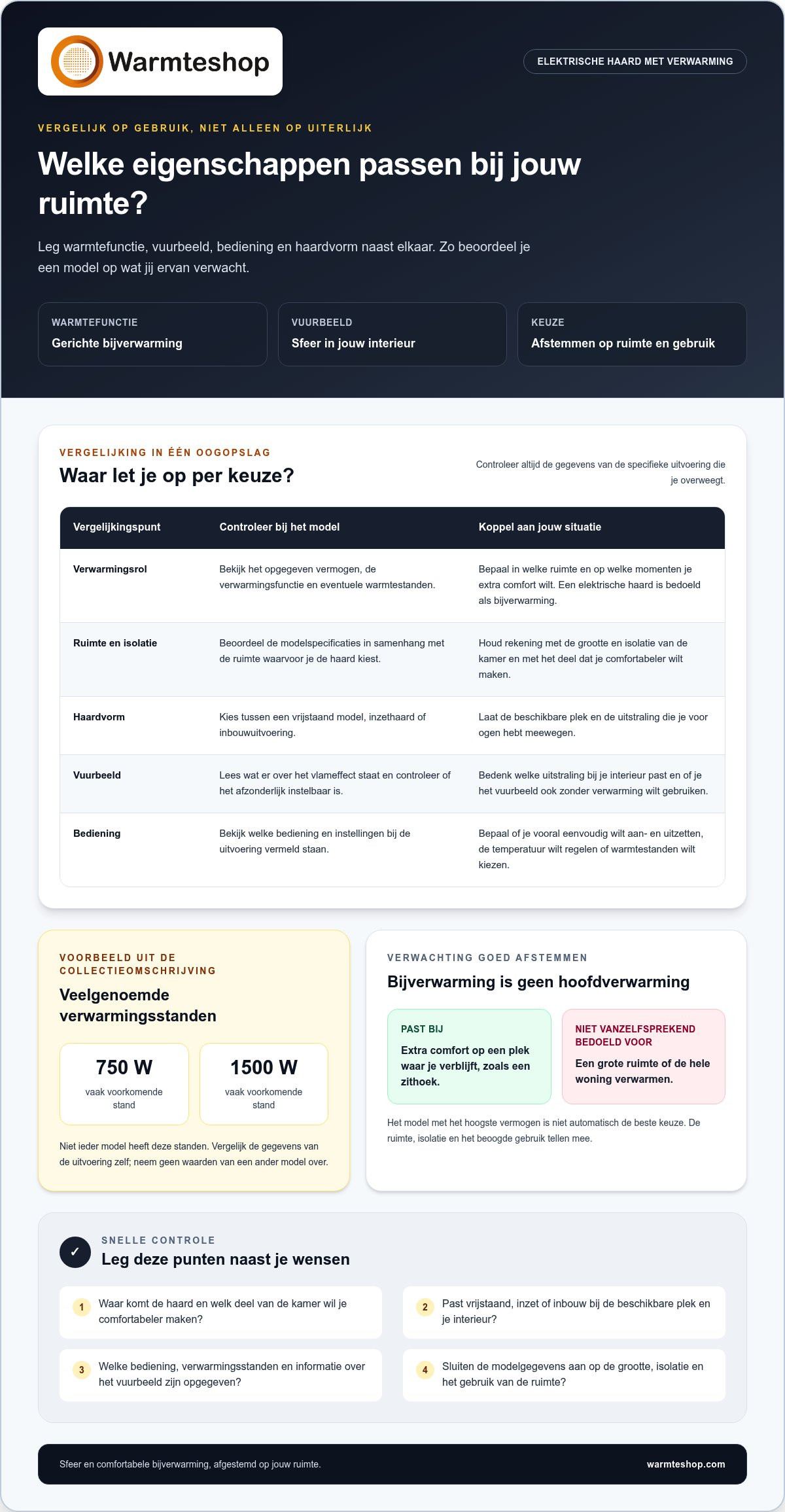
This consideration is important, because an electric fireplace is typically intended as supplementary heating and not as primary heating for a large room. Moreover, models differ in heating settings, controls, and flame effect. By comparing these features with the available space and your interior, you avoid choosing based solely on appearance.
In this article, you will read which fireplace shape suits your space, what to expect from the heating function, and what to look out for regarding operation, placement, and safe use. This allows you to compare electric decorative fireplaces effectively and find a model that combines ambiance with comfortable supplementary heating.
An electric fireplace with heating combines a visible flame effect with a function for additional heat. You add atmosphere and comfort without a wood fire or chimney. As a result, an electric fireplace can also fit in places where a traditional fireplace is not practical. The heating function is intended to make a room more comfortable, not necessarily to keep the entire house at a comfortable temperature.
The heat is particularly useful if you are seeking targeted comfort in the room where you are staying. This is zone heating: you use heat where you need it at that moment, rather than expecting a single appliance to heat all rooms. Whether a model contributes sufficiently depends, among other things, on the size and insulation of the room and the specifications of the fireplace. Therefore, you should always assess the output in relation to the room and the intended use.
An electric fireplace with heating combines the ambiance of a flame with additional warmth. The most important question is whether the model suits the space and the use you have in mind.
Consider a seating area where you often relax, or another room you want to make warmer and more atmospheric at certain times. The fireplace is then a targeted addition to your existing heating system. Assess the room, the insulation, and the product specifications together. The model with the highest output is not automatically the best choice; what is more important is whether the design aligns with where and how you want to use the heat.
The flame effect is primarily visual; the heating function adds warmth. Whether you can use both functions separately varies by model. Therefore, base your choice on the product specifications. Electric fireplaces are intended as supplementary heating: they can provide extra comfort, but are not automatically suitable as primary heating for a large room or the entire home. More background on how electric heating works helps put that function in perspective.
If you are looking for another way to add heat in a targeted manner, consider infrared heating as a separate heating solution. Keep this choice separate from the features of an electric fireplace: infrared heating is not a function that can be attributed to a fireplace. First, determine your heating goal. Then you can compare solutions based on what they can mean for your home.
Do not compare models based solely on their appearance. First determine what the fireplace needs to do in your home, and then look at the practical features. This prevents an attractive flame display or high power output from determining the choice, while the fireplace shape, controls, or available space are a less suitable fit.
Use this checklist when comparing models:
First, note the size of the room, how well it is insulated, and how often you intend to use the fireplace. The collection description mentions 750 W and 1500 W as common heating settings, but not every model has these settings. Therefore, compare the specifications of the model you are considering. A higher power output does not in itself prove that a fireplace is suitable; the room and usage also determine what fits.
Next, check whether the available settings match your expectations. Do you want extra heat occasionally during a quiet moment, or do you expect to use the function for longer periods? Make that distinction before evaluating the specifications. If the product page mentions power output, thermostat control, or separate heat settings, include that information in your comparison. If a value is missing, compare models based on the features that are listed and do not copy data from another version.
The flame effect contributes to the appearance of the fireplace. The controls determine how easily you adjust the settings. Therefore, look at the product information regarding the flame effect and controls. A separately adjustable flame effect can be useful if you primarily want atmosphere, but not every fireplace offers this. Also check per model whether the flame effect can operate without heating.
Evaluate features based solely on what is described for the specific version. A remote control, thermostat control, or a choice of multiple heat settings is a meaningful comparison factor if it is listed for the model. Compare the features with your preferences: do you want to simply switch the appliance on and off, regulate the temperature, or primarily have a flame effect that matches your interior? This way, you compare ease of use without making assumptions about features between models.
With your checklist at hand, you can take a targeted look at the electric fireplaces in the collection . Compare the listed features with your space and preferences.
The shape of the fireplace determines how you can integrate the fireplace into your room and interior. A freestanding model is suitable if you are looking for a standalone fireplace setup. An insert fireplace is placed in an existing opening. A built-in model can be part of a planned wall or interior layout. Which shape fits therefore depends on the situation at home. First, choose the fireplace shape that suits the location and your decor. Then, compare the models and their specifications.
| Hearth shape | Suitable placement situation | Example models |
|---|---|---|
| Detached | You are looking for a freestanding fireplace unit and have a suitable spot in the room. | Termofol 1327-10 |
| Stake | You want to integrate a fireplace into an existing niche or opening. | Termofol 1300, Termofol 1400 |
| Built-in | You incorporate the fireplace into an interior or wall design. | Termofol 1326, Termofol 1324, Termofol 3S, Termofol 1S |
A freestanding model such as the Termofol 1327-10 suits a design where you do not use a built-in fireplace opening as a starting point. An insert fireplace, such as the Termofol 1300 or 1400, is intended for a plan where you utilize an existing niche or opening. Therefore, first consider what is already present in the room and how much space you have. The model shape does not indicate which dimensions or additional features apply to a specific version.
Measure the intended location and compare the dimensions with the product specifications. For an insert model, the opening where you want to place the fireplace is particularly important. A model name or shape category does not replace this measurement check. Also consider how the design relates to furniture, sightlines, and the style of the room. This prevents you from choosing a model that looks attractive but does not logically fit into your existing decor.
For recessed models, the size variant is a practical starting point for your comparison. The Termofol 1326 is specified in variants of 91.4, 127, and 152.4 cm. For the Termofol 1324, variants of 91.4, 121.8, and 182.6 cm are listed. Use these specifications to compare versions side by side, but check the product page to see exactly what the size indicates and what installation space is required.
Termofol 3S and Termofol 1S are also examples of built-in models with multiple specified variants. Compare the available versions based on the product data. Do not transfer dimensions or features from one variant to another without verification. This way, you make fireplace shape and size part of a single practical choice: first determine where the fireplace will be installed, and then see which version fits.
A fireplace design is only a good fit if the model can be practically placed or built into the intended location. Therefore, check not only the appearance but also the space, connections, and usage information. An electric fireplace does not require a wood fire or flue, but it does require careful consideration of its placement. Always use the appliance according to the instructions for the specific model.
First, determine where you want to place or install the fireplace and from which spot you want to view the fire. Measure the available space and compare it with the product specifications. Also check where a power outlet is located and whether the specified connection suits the situation. Do not rely on general distance measurements. Follow the product information regarding clearance, ventilation, and placement.
Review these points before choosing a model:
For safe use, always follow the product-specific instructions for your fireplace.
Do not automatically expect a single fireplace to heat your entire home. Electric fireplaces are intended as supplementary heating. How much comfort they add depends partly on the room, the insulation, and the model specifications. Determine in advance which room you want to heat and compare that expectation with the appliance's specifications. This way, you won't confuse a cozy addition with a solution for heating the entire house.
Also take maintenance into account when making your choice and using the product. Keep the air intake dust-free to prevent dust from accumulating, and follow the manufacturer's instructions for cleaning and maintenance. Consult the model instructions before cleaning the appliance or adjusting settings. This is especially important if you use the fireplace with heating regularly. The correct routine and operation vary by model; do not let general assumptions replace the model-specific information.
Have you checked the location, connection, and usage requirements? View electric fireplaces with heating and compare the model details with your situation.
Have you determined the desired fireplace shape and key requirements? Then you can compare models more specifically. The examples below show which versions you can find in the Warmteshop collection. A model name is a starting point, not a complete product specification. Check the dimensions, heating details, and features of the version you are viewing on the product page.
This way, you get an overview of different fireplace shapes without attributing features to a model that you have not checked:
If you want to compare versions within a model range, look at the specified dimensions for Termofol 1326 and Termofol 1324, for example. The Termofol 1326 is available in variants of 91.4, 127, and 152.4 cm. For the Termofol 1324, variants of 91.4, 121.8, and 182.6 cm are specified. Use these dimensions to create a shortlist and compare them with the available space. Check the product page to see exactly what the size indicates and how much installation space the chosen version requires.
A short list of possible models makes the differences clearer. List the same points for each model: fireplace shape, size, desired role of the heating function, and the features described for that specific version. This way, you are not just comparing names or appearance, but testing each option against your living space and usage. Do not copy missing information from another variant.
Still undecided between a freestanding fireplace, an insert model, or a built-in version? Start with the location where the fireplace will be installed. An existing opening might be a reason to choose an insert model; conversely, a planned wall layout might be a reason to compare built-in models. For a broader overview of shape and appearance, also view the collection of electric ambient fireplaces.
Compare the product details of your shortlist and choose the electric fireplace with heating that suits your space and preferences. View electric fireplaces with heating and compare the models.
Translate your preferences into a short, practical shortlist. First, determine where the fireplace will be placed and which model suits that location. The collection includes freestanding, insert, and built-in models. Furthermore, several Termofol models are available in various specified size variants. This allows for targeted comparison, without basing your choice solely on aesthetics or the model name.
Check the product specifications of your favorites and compare the dimensions with the space you have available. Also consider when you want to use the heating function and which controls you find convenient. This way, you make choosing an electric fireplace with heating a well-considered step towards extra atmosphere and comfort in your home.
View the electric fireplaces with heating and discover which model suits your living space and preferences. Choose a fireplace that fits the location, usage, and your interior.
No, an electric fireplace does not burn wood and therefore does not require a chimney or flue. However, you do need a suitable electrical connection. For a built-in model, for example, consider how you will keep the cord and socket accessible without losing sight of the installation instructions. Check the product information for your specific model and determine in advance whether the chosen location is practical for connection and daily use.
This is possible with some models, but you cannot assume it for every fireplace. It is useful if you want the ambiance of a fireplace on a mild day but do not need extra heat. Check the product page to see if you can control the flame effect separately. Also, check how to adjust the settings, as the controls vary by model.
An electric flame effect is not a real wood fire, but parts can become hot during use. Therefore, keep children and pets at a distance and do not let them play with the fireplace or controls. Position the appliance according to the manufacturer's instructions and allow for the indicated clearance. Read the safety instructions before switching on the fireplace for the first time.
That depends on the model and the operation of the heating function. Some fireplaces use a fan to circulate warm air. This can be audible during use. The collection description lists a silent fan as standard, but this does not automatically apply to every model. If silence is important, for example in a study or bedroom, please check the model-specific information regarding noise and settings.
You do not need to remove ash or add wood. Keep the air intake dust-free according to the collection description and switch off the appliance before performing maintenance. Follow the manual when cleaning to avoid damaging parts or surfaces. The exact maintenance steps may vary by model. Therefore, use the manufacturer's instructions and do not choose cleaning agents or methods yourself.
Yes, electricity from solar panels can power an electric fireplace when self-generated electricity is available at that moment. How this affects your consumption depends on when you generate power and when you use the fireplace. A fireplace remains intended as supplementary electric heating. Therefore, do not automatically count on specific savings; these depend on your energy contract, consumption, and generation pattern.


