

Electric additional heating in the living room: The complete guide for 2026
, by Warmteshop, 20 min read
, by Warmteshop, 20 min read
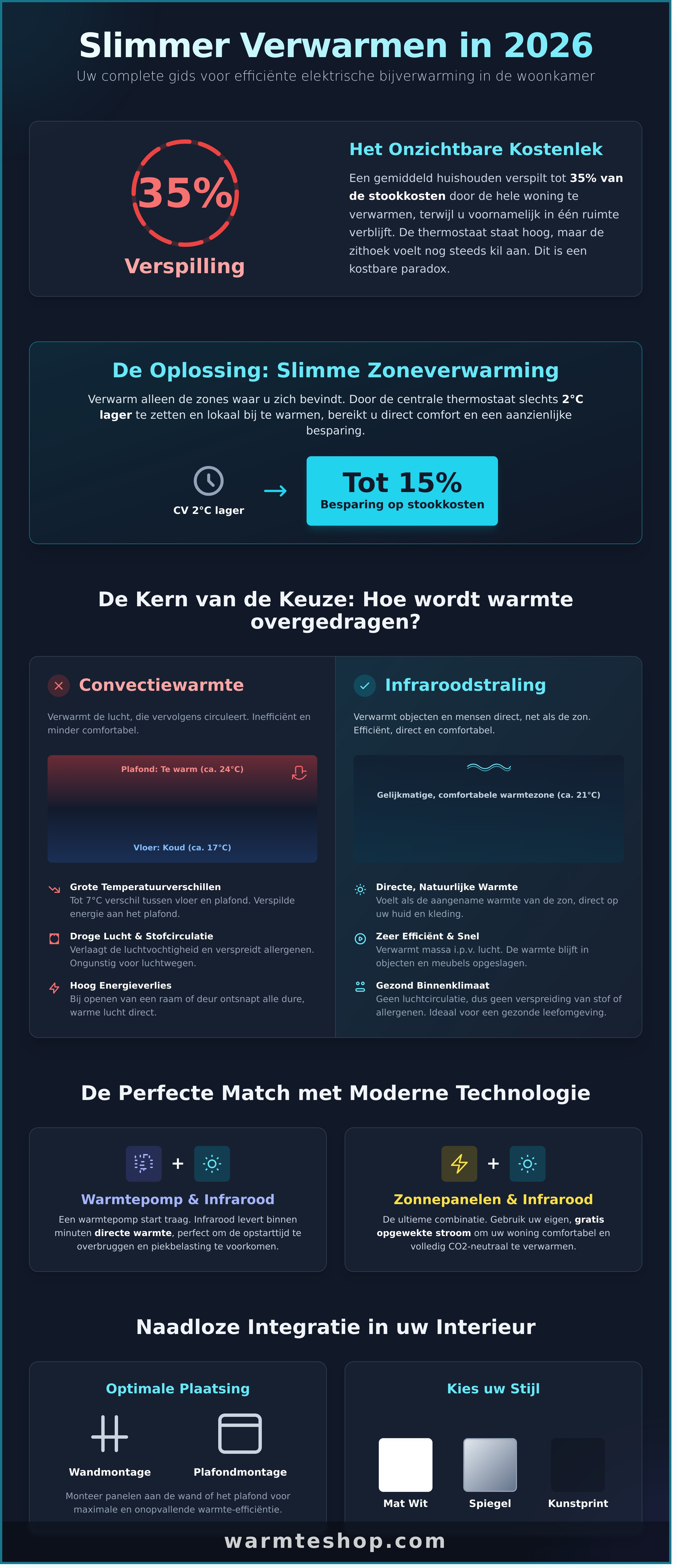
Did you know that the average household wastes up to 35% of its heating costs unnecessarily heating the entire home, even though people spend most of their time in the living room? The central heating system is running at full tilt..
Did you know that the average household wastes up to 35% of its heating costs unnecessarily heating the entire home, even though they spend most of their time in the living room? The central heating is running at full blast, yet that one sitting area still feels chilly, and the thought of the next gas bill continues to nag. It's a costly and frustrating paradox that plagues many homes.
This complete guide for 2026 is your answer to this waste. We show you how a smartly chosen electric supplementary living room heater solves this problem permanently. Discover how modern technology allows you to create targeted heat exactly where you need it, significantly increase your living comfort, and simultaneously structurally lower your energy bill. We discuss the most efficient technologies, from stylish infrared panels that heat like the sun to smart thermostats, and provide a concrete step-by-step plan to find the perfect, aesthetic solution for your interior.
Electric supplementary heating is a targeted and efficient way to create extra heat in specific areas of the home, supplementing your central heating system. Instead of heating the entire home, you direct the heat exactly where you need it. This principle, also known as zone heating, is based on converting electricity into heat, a process technically known as Joule heating. For a detailed technical background on what electric heating is, Wikipedia offers an excellent overview of the fundamental principles.
The relevance of this technology has grown exponentially in recent years. From 2026, the hybrid heat pump will become the standard for replacing the central heating boiler. This marks a definitive shift in how we think about heating. Constantly maintaining a high temperature throughout the entire house with a central system is becoming less efficient and expensive. The future is focused, smart, and electric. The living room, as the heart of the home where you spend the most time, is the most logical place to start this smart upgrade. Electric supplementary living room heating is no longer a luxury, but a strategic investment in comfort and sustainability.
This transition offers a unique opportunity to drastically reduce our dependence on gas. By turning down your main heating and supplementing it locally with electricity, ideally generated by your own solar panels, you immediately take control of your energy consumption and your ecological footprint. You'll no longer be heating unused spaces and simultaneously increase your personal comfort.
Zone heating in your living area provides immediate and tangible benefits. By lowering your central thermostat by just 2 degrees and applying local heat, you can save up to 15% on your heating costs. You'll enjoy pleasant, direct warmth right where you relax, read, or watch TV. Unlike traditional convection heating, which circulates and dries out the air, modern infrared heating provides healthy radiant heat that warms objects and people, similar to the warmth of the sun.
The synergy between a heat pump and electric auxiliary heating is perfect. A heat pump is extremely efficient, but often has a longer start-up time to bring a room up to temperature. Electric infrared panels, on the other hand, provide instant heat within minutes. This perfectly compensates for the heat pump's "slow" start-up and prevents peak loads on your main system during cold evenings. Do you have solar panels? Then the combination becomes even more powerful. You use your own, freely generated electricity to create a comfortable and carbon-neutral indoor climate. This is the smartest way to a gas-free future.
This integrated approach, combining a main system with smart auxiliary heating, is becoming increasingly popular worldwide. To see how an experienced HVAC specialist handles this, you can check out RMI Heating and Air Conditioning.
Choosing an electric heater for your living room is about more than just power and design. The underlying technology largely determines comfort, energy consumption, and the impact on your indoor climate. Fundamentally, there are two systems: convection heat, which warms the air, and radiant heat, which directly warms objects and people. Understanding this difference is the first step toward a smart and sustainable heating solution.
For larger or open spaces like the living room, the method of heat transfer is crucial. Air heating (convection) tends to concentrate heat near the ceiling, far from where you need it. Radiant heat, on the other hand, works like the sun: it delivers direct, tangible heat exactly where you are. This makes it a fundamentally more efficient approach to comfort.
A convector, often a fan or a traditional electric heater, works by drawing in cold air, passing it over a heated element, and then blowing the heated air back into the room. This creates constant air circulation. While this can quickly heat a small corner, it has significant drawbacks for a living room:
Infrared heating works on a completely different, more natural principle. Instead of using air as a transport medium, infrared panels emit safe, long-wave radiant heat. These heat waves don't heat the air itself, but are directly absorbed by all objects and people in the room, such as your furniture, the floor, and yourself. These objects store the heat and gradually release it back into the environment.
This process provides a superior feeling of comfort and a healthier indoor climate:
For a modern and effective electric addition to your living room heating system, choosing infrared is a logical step towards sustainability and comfort. It's an investment in a healthy living environment and lower energy bills. The right choice depends on your specific space and needs. Discover which infrared panel best suits your interior and experience the difference in warmth for yourself.
When searching for the most advanced and efficient form of electric supplementary heating for the living room, infrared panels emerge as the undisputed leader. The reason is fundamentally different from traditional heating. Instead of heating the air, which is a slow and energy-intensive process, infrared panels utilize long-wave infrared radiation. This radiation directly heats the objects, walls, and people in the room. It is a principle that nature has been perfecting with the sun for millions of years. An in-depth analysis of infrared heating versus convection heating demonstrates why heating mass rather than air is superior in efficiency and comfort.
This technological advantage translates into three concrete advantages:
The heat from an infrared panel is directly comparable to the pleasant warmth of the sun on a spring day. It's not a dry, stuffy air heat, but a deep, radiant heat that is absorbed by your skin. This radiation stimulates blood circulation and creates a relaxed feeling in your muscles. It creates a personal "comfort zone" exactly where you need it, for example, in your living room. You no longer need to heat the entire living room to 21°C to feel comfortable; a pleasant 19°C temperature, supplemented by the direct radiation from the panel, is more than enough.
One of the most frequently asked questions is the power required for effective supplementary heating. As a rule of thumb, for a reasonably insulated living room, you can expect approximately 35 watts per cubic meter (m³) for a noticeable increase in comfort. For a seating area in a 50 m³ room, a 700 to 800 watt panel is often sufficient.
Let's take a calculation example. You want to comfortably heat your living room for three hours on a chilly evening with an 800-watt panel. At an average electricity price of €0.35 per kWh, the costs are as follows:
0.8 kW x 3 hours x €0.35/kWh = €0.84
For less than one euro, you can enjoy targeted, comfortable warmth for an entire evening. Moreover, the efficiency of your electric living room supplementary heating is exponentially increased by good insulation. Walls and objects that have absorbed the heat slowly radiate it back out, meaning the panel needs to switch on less often to maintain the temperature. This makes infrared heating a smart partner in a sustainable and energy-conscious household.
An infrared panel is more than a heat source; it is a precision instrument for comfort. The full potential of your electric supplementary living room heating is only realized when the installation and operation are perfectly tailored to your lifestyle. Thoughtful placement and a smart thermostat are not an afterthought, but the key to maximum efficiency and significant energy savings.
The effectiveness of infrared heat depends entirely on the unobstructed spread of its rays. Just like the sun, a panel can't heat an object if there's something in the way. Therefore, it's crucial never to place an infrared panel behind a sofa, a large piece of furniture, or thick curtains. The object will then absorb all the heat, leaving the rest of the room cold and completely wasting the energy.
The right location determines success. Each infrared panel has a specific beam angle, typically between 100 and 120 degrees. This allows you to direct the heat very precisely. For a 12 m² seating area, it's essential that the panel is positioned so that the rays cover the entire area without leaving any "cold spots." There are two excellent options:
Efficient heating means consuming energy only when necessary. A simple on/off switch is insufficient for this. A smart thermostat control system can reduce your consumption by as much as 30% to 40%. A wireless thermostat is therefore not a luxury, but an essential component for accurate control and maximum savings. It measures the temperature exactly where you are staying, not directly next to the heating panel.
The modern electric living room heater integrates seamlessly into your digital life. A Wi-Fi module connects the heater to a smartphone app. This allows you to turn the heating on before you leave, or turn it off if you forget. For even more control, you can opt for zone control. This allows you to set separate temperatures and schedules for different areas of the living room, such as the lounge and dining area. This way, you only heat where and when it's truly needed, resulting in an unprecedented level of comfort and control.
Every living room is unique. For a perfectly coordinated system, accurately calculating the required heat output and ideal placement is crucial. Ask our experts for a free, no-obligation heat calculation to discover the perfect configuration for your home.
The days when heating was a purely functional and often unsightly element in the living room are long gone. Today, modern electric supplementary living room heating is a full-fledged part of your interior design. It is a conscious choice that combines aesthetics and efficiency. At Warmteshop, we understand that a heat source must seamlessly match your personal style. That is why we offer an extensive range of designs, finishes, and customization options that make your heating a focal point, or allow it to blend completely into its surroundings.
The finishing options are designed to complement any interior style. Do you prefer a sleek, minimalist interior? Then a panel in matte white or a subtle textured coating is the perfect choice. These panels are barely noticeable against a light-colored wall. For a luxurious and modern look, our glass panels in white or black offer an elegant solution. They subtly reflect light and add a design element to the space. A mirrored panel is not only a source of warmth but also a clever way to visually expand and brighten a room.
Take it one step further and transform your heating into a personalized work of art. Our customization options allow you to have an infrared panel printed with your own photo, favorite painting, or unique design. This way, your heat source becomes a cherished memory or a statement piece that no one else has. Comfort and personality come together in a unique way.
In addition to these modern electric solutions, some opt for a more traditional, artisanal approach to combining warmth and design. Although it involves a different technology, it can serve as inspiration for how a heat source becomes the focal point of a room. An example of this is the stavba kachlových kamen na míru, where a stove is built entirely to measure as a unique piece of furniture.
Our collection is specifically curated to provide functional warmth that simultaneously offers aesthetic added value. Consider, for example, an infrared photo panel above the sofa that looks like a framed work of art. Or choose the infrared mirror in the hallway or next to the seating area; a practical and stylish solution that prevents condensation and spreads pleasant warmth. Even a chalkboard panel in the kitchen or a workspace in the living room can serve as an efficient heat source where you can write down groceries or notes.
Warmteshop is part of the Infrarood Verwarming Groep, the largest player in the Benelux with over 15 years of experience. This in-depth expertise translates into advice you can rely on. Our specialists perform a professional heat calculation for your specific living situation, ensuring you optimal efficiency and comfort. Correctly sized electric supplementary heating in the living room is crucial for efficient operation and a low energy bill.
We believe in the power of a personal experience. That's why we're delighted to invite you to one of our 30+ showrooms in the Benelux. Here, you can see the various models for yourself, experience the pleasant radiant heat, and ask our advisors your questions directly. They'll help you find the perfect match for your needs, budget, and interior. Discover our complete collection of infrared heating online or visit us for personalized advice.
Switching to a sustainable heat source is no longer a distant prospect; it's a concrete step you can take today. As we've seen, infrared panels offer the most efficient and comfortable solution. They provide direct radiant heat, similar to the sun, and thanks to modern designs, they integrate seamlessly into any interior. This is the smart upgrade for those looking for lower energy costs and greater living comfort.
the right electric additional heating for your living room is an investment in your well-being and home value. Trust the expertise of Warmteshop. As the market leader in the Benelux since 2008, with our own certified installation service and more than 30 physical stores, we offer personalized advice. Our specialists will help you find the perfect match for your specific situation.
Put theory into practice. Request a free heat calculation from Warmteshop now and discover exactly what power your space needs. Switch with confidence to the healthy, efficient heat of the future.
The required power depends on the insulation level and the size of your living room. For a well-insulated room, you can expect 70-85 watts per square meter. A 20 m² living room therefore requires a panel of approximately 1500 watts. For moderately insulated rooms, this increases to 100-120 watts per m². Our experts are happy to provide a precise heat calculation for your specific situation, ensuring optimal comfort and efficiency at all times.
Yes, infrared is often significantly cheaper than gas for zone heating. An infrared panel converts up to 93% of the energy into direct radiant heat that warms people and objects, not the air. This allows you to heat your seating area quickly and efficiently, while the central thermostat can be set 2 to 3 degrees lower. This targeted approach leads to immediate and noticeable savings on your gas consumption, especially during the shoulder seasons.
In most cases, you can easily install an infrared panel yourself. Wall installation is similar to hanging a picture; with the included bracket and manual, it can be completed in 30 minutes. However, for ceiling mounting or a permanent connection to the electrical grid, we recommend the expertise of a certified electrician to ensure absolute safety and perfect operation.
An infrared panel reaches a surface temperature between 85 and 110 degrees Celsius, but is safe for brief contact. Unlike a scorching radiator, a quick, accidental touch doesn't immediately cause burns. However, for families with young children, we always recommend ceiling mounting. This places the panel completely out of reach and ensures the most efficient heat distribution, offering a double benefit.
The fundamental difference is heat transfer: convection versus radiation. A convector heats the air, which then circulates and can stir up dust. An infrared panel, the most advanced form of electric supplementary heating for living rooms, emits direct heat rays. These feel like the natural warmth of the sun and directly warm the people and objects in the room, resulting in a healthier and more pleasant indoor climate.
You'll feel the direct radiant heat of an infrared panel within 5 to 10 minutes. Because the heat radiates directly onto your body, you'll experience a comfortable feeling almost immediately. Fully heating all the objects in the room will, of course, take longer, depending on the insulation. The big advantage is that you don't have to wait for the entire room to reach the desired temperature before you feel comfortably warm.
Yes, combining your infrared panels with a smart thermostat is the most efficient method. This allows you to control the temperature per room or zone via a smartphone app. Easily set weekly programs and heat only where and when needed. This not only maximizes your comfort but also provides energy savings of up to 30% compared to manual operation.
No, the long-wave infrared radiation (IR-C) from our panels is 100% safe and even beneficial to health. This radiation is identical to the sun's heat rays and should not be confused with harmful UV radiation. Infrared heat stimulates blood circulation, can relieve muscle tension, and does not release dust or allergens. This contributes to a healthy and comfortable indoor climate, ideal for allergy sufferers.


