

Cozy warmth at home: The complete guide to optimal living comfort in 2026
, by Warmteshop, 17 min read
, by Warmteshop, 17 min read
What if the numbers on your thermostat actually say nothing about how warm you really are? You probably recognize this: the heating hits 21 degrees, but you still experience cold feet and an uncomfortable…
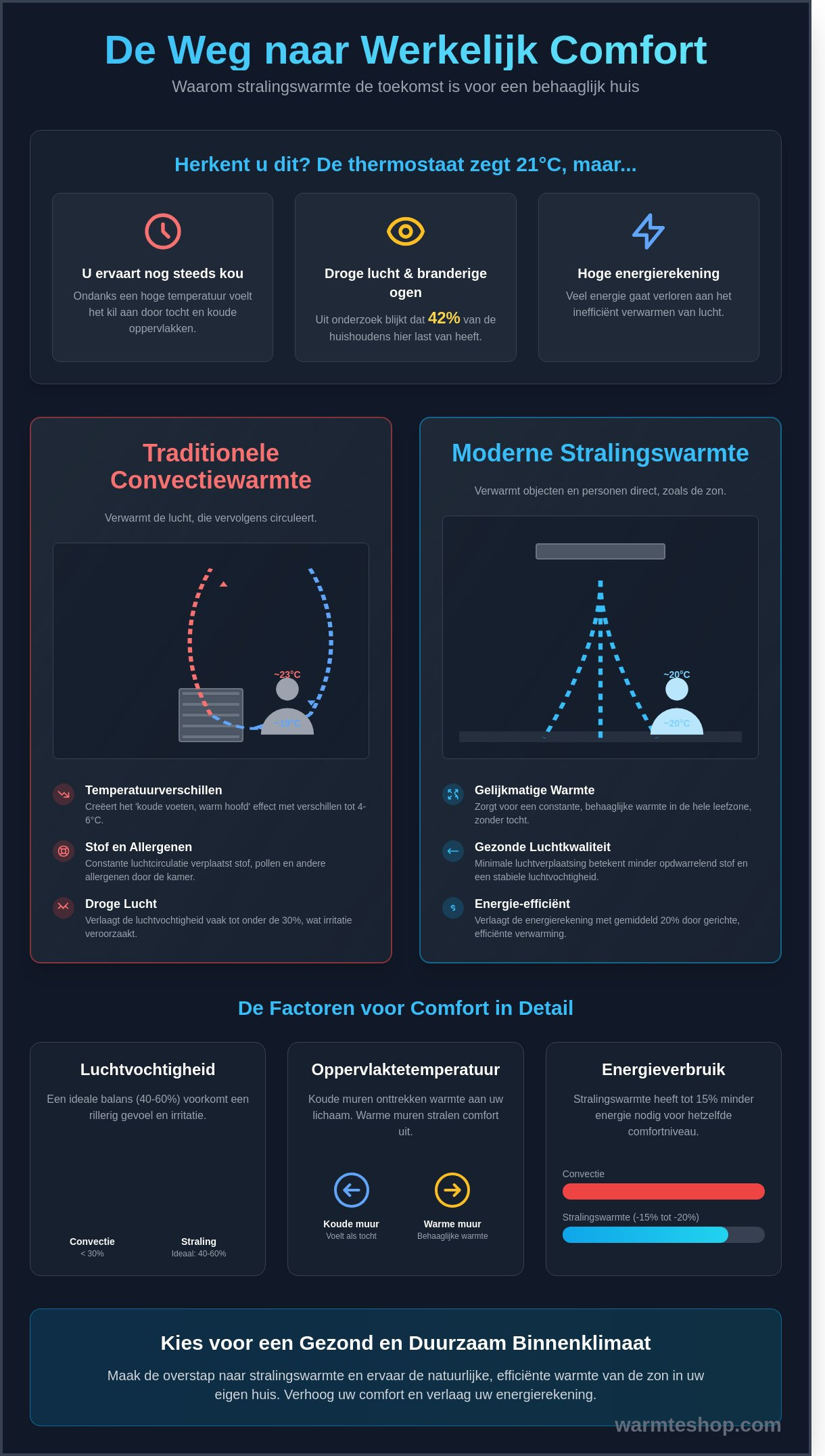
What if the numbers on your thermostat actually say nothing about how warm you really are? You probably recognize this: the heating hits 21 degrees, but you still experience cold feet and an unpleasant draft along your legs. In 2024, consumer research showed that 42% of households suffer from dry air and burning eyes during the heating season. It is a clear sign that the traditional focus on air temperature falls short of truly comfortable warmth in the home.
In this guide, you will discover how to create a truly comfortable indoor climate by switching to radiant heating. We promise you a method that allows you to experience the natural, healthy warmth of the sun directly in your living room, without bothersome dust circulation or energy loss. You will get a clear overview of how smart zone heating lowers your energy bill by an average of 20%, while you enjoy the technological standards for optimal living comfort in 2026.
Comfortable warmth in the home is more than a simple reading on a digital thermostat. By 2026, we will understand that true living comfort stems from a precise physiological balance between three key factors: air temperature, radiant temperature of surrounding surfaces, and relative humidity. It is a common misconception that 21 degrees always feels warm. In a home with cold walls and frequent drafts, this temperature can still feel uncomfortable, whereas a room at 19 degrees with the right radiant temperature balance feels like a warm blanket.
This phenomenon is described in detail in *The Science Behind Comfort*, which focuses on the interaction between humans and their environment. Our skin acts as an extremely sensitive receiver for infrared radiation energy. When the average radiant temperature of the walls, floor, and ceiling is uniform, our body needs to exert less effort to maintain its own core temperature of 37 degrees. This ensures immediate relaxation of the nervous system and a deep sense of well-being.
Traditional radiators work primarily on the basis of convection. They heat the air, which then rises to the ceiling and cools down again near the floor. This process creates a constant airflow and temperature differences that can reach up to 4 degrees Celsius between your head and your feet. Infrared heating works fundamentally differently by heating objects and people directly, similar to the natural warmth of the sun on a clear winter day. Because the mass of the home absorbs the heat and releases it slowly, up to 15% less energy consumption is required to achieve the same level of comfortable warmth in the house.
A healthy indoor climate depends on the humidity level of the air. Traditional heating systems tend to dry out the air extremely, sometimes to below 30%. Dry air promotes the evaporation of moisture from your skin, a process that draws heat away from your body and leaves you feeling shivery. By choosing systems that do not unnecessarily move or heat the air, the natural humidity remains stable between the ideal 40% and 60%. This not only prevents respiratory irritation but also ensures that the warmth in the room feels much more constant and "fuller" without the need to turn up the thermostat.
Do you recognize the feeling when the thermostat shows a neat 21 degrees, but you still have to put on a cardigan? This phenomenon often arises from an imbalance in the factors for thermal comfort within your home. Traditional radiators primarily heat the air via convection. This warm air rises directly to the ceiling, creating a temperature difference of as much as 4 to 6 degrees between your head and your feet. This "cold feet, warm head" syndrome is one of the biggest barriers to truly comfortable warmth in the house.
Moreover, air currents cause a constant draft in the room. As warm air rises, cold air is drawn across the floor towards the radiator. This circulation forcibly cools your body, even if the average room temperature is theoretically high enough. In the homes of 2026, we aim for a system that minimizes this air movement and delivers energy directly where it is needed.
Cold walls and floors act like magnets that draw heat from your body. Even in a well-insulated home, a wall that is only 15 degrees can cause radiant asymmetry. You then feel a cold draft on one side of your body, which immediately destroys the sense of comfort. By choosing infrared heating, objects and walls are heated directly instead of the air.
A wall that is 2 to 3 degrees warmer than the ambient air significantly increases the comfortable warmth in the home . Thermal mass plays a crucial role in this. When your interior and walls store heat, the entire room acts as a buffer. This prevents the rapid temperature fluctuations you experience with traditional systems as soon as the thermostat switches off.
The constant air circulation from radiators moves not only heat but also dust, pollen, and allergens. For the more than 1.2 million Dutch people with respiratory conditions, this dust circulation constitutes a daily burden on their health. Radiant heat creates a static layer of air. Because the air is not forced to circulate, the air quality remains noticeably fresher and cleaner.
In addition, warm walls offer a preventive solution against mold formation. Mold thrives in cold, damp places where condensation occurs. By directly heating walls and keeping them dry, you lower the local humidity at the surface to below the critical limit of 70 percent. This results in a healthier indoor climate and the sustainable preservation of your home's structure. Would you like to experience for yourself how this technique improves your living comfort? Then visit one of our local showrooms for a customized demonstration.
Every room in a home has a unique dynamic and requires a specific approach to achieve comfortable warmth. Instead of heating the entire volume of air in the home, in 2026 we will focus on the places where you actually spend time. This zonal approach increases comfort and reduces the waste of precious energy.
In the bedroom, a healthy night's sleep benefits from cooler air of approximately 16 to 18 degrees Celsius. By opting for a warm core under the covers and only minimal base heat in the room, the air remains fresh and oxygen-rich. For the home office, we apply a different strategy. Here, everything revolves around focus. Local infrared radiation at the workspace prevents you from getting cold hands or feet, which can increase productivity by an average of 15% without having to turn up the thermostat in the rest of the house. This is how you apply smart strategies for comfort without high energy costs.
In addition, a towel radiator an indispensable addition to the luxurious hotel feel. These systems not only dry your towels but also ensure a constant, pleasant temperature for the fabrics. Safety is paramount in this regard. All electric heating elements in damp rooms must comply with the IP44 standard, which guarantees protection against splashing water.
The interior design plays a crucial role in retaining this radiant heat. Rugs on a hard floor and heavy curtains act as thermal buffers. They absorb the radiation and slowly release it back into the room, keeping the temperature stable. This ensures a constant sense of comfort, even when the active heating switches off briefly.
Good window coverings and the right flooring choice are essential in this regard; they function as an extra layer of insulation that minimizes heat loss. Interior specialist MadeBySarina, for example, offers a wide range of custom solutions that combine atmosphere and insulation.
Comfortable warmth at home does not have to cost a fortune in 2026. The transition to a sustainable home is not just about new equipment, but above all about the intelligence with which you use it. We see that households switching to targeted heating strategies reduce their energy consumption by an average of 25% to 30%. The key to this success lies in stopping the unnecessary heating of unused spaces and minimizing heat loss through small, smart interventions.
Modern thermostats nowadays act as the conductors of your home comfort. While old systems often showed fluctuations of 1.5 to 2 degrees, smart controllers keep the temperature constant within a margin of 0.2 degrees. This prevents the notorious temperature spikes that consume unnecessary energy. By simply programming your living pattern in the app, the Wi-Fi module ensures that the home reaches the desired temperature at exactly the right moment. You have real-time insight into your consumption via your smartphone, which often leads directly to more conscious and economical heating behavior.
The idea of keeping the entire house at a single central temperature all day long will be definitively outdated by 2026. Zone heating allows you to treat each room as a separate island of comfort. Infrared panels play a crucial role in this. They work exactly like the sun; they do not heat the air, but directly the people and objects present in the room. This is the most efficient way to comfortable warmth in the home in the spaces where you actually spend time, such as the home office or the sitting area. Unused rooms remain at a lower base temperature of, for example, 15 degrees, resulting in enormous savings on the annual bill.
The synergy between technology and insulation makes the difference:
Would you like to discover how to combine these techniques for a lower energy bill? View our range of high-quality infrared heating and start saving today.
A home ready for 2026 requires a well-thought-out approach. The days of simply turning up a central thermostat and waiting for the air to warm up are behind us. For truly comfortable warmth in the home, a tailored heating plan is essential. After all, every room has a different dynamic; the bathroom requires a quick, intense heat peak in the morning, while the living room benefits from constant, even radiation that warms the walls and objects.
Our advisors base their advice on facts and data. We look at the insulation value of your walls, the type of glass, and your personal lifestyle. Figures show that a correctly sized system operates up to 20% more efficiently than a standard solution. To truly understand this technology, we invite you to visit one of our showrooms. Here, you can experience for yourself the difference between convection heating and direct radiant heat comparable to the sun. This personal experience is the only way to determine which intensity suits your comfort preferences.
The transition to a sustainable home is an investment in the future. Professional installation by our own teams guarantees that every panel is positioned with millimeter precision for optimal efficiency. A deviation of just 10 degrees in the installation angle can already affect the effectiveness of the radiation.
Integrating infrared heating into your interior is nowadays an aesthetic choice. You can choose from invisible ceiling panels that blend seamlessly with the plasterwork or striking design elements on the wall, such as frosted glass or natural stone panels. Our experts perform an exact capacity calculation, averaging 20 to 35 Watts per cubic meter, depending on your insulation level. This prevents under-capacity and ensures that you enjoy comfortable warmth in your home.
The road to a gas-free home doesn't have to be complex. Warmteshop offers you the assurance of certified technicians and more than 15 years of expertise in the Benelux. We supply not only products, but a complete heating plan including no-obligation quotes that provide transparent insight into your future energy consumption.
Would you like to know exactly what the possibilities are for your specific living situation? Make an appointment for an in-home consultation today. Our specialists will analyze your home on-site and lay the foundation for a sustainable, comfortable, and healthy indoor climate that you can rely on for decades to come.
True comfort in 2026 revolves around the perfect balance between innovative technology and a healthy indoor climate. The science behind radiant heating proves that we no longer need to heat the air to achieve a comfortable temperature; it is about directly heating the objects and people in the room. This method eliminates those annoying cold drafts and ensures a constant, cozy warmth in the home that feels just as natural as the sun's rays, while simultaneously significantly lowering your energy bill.
As the market leader in the Benelux with over 15 years of experience, Warmteshop offers you the absolute assurance of top German quality. Our systems combine sleek aesthetics with maximum thermal efficiency and come with extensive warranties for your long-lasting peace of mind. With more than 30 physical stores spread across the region, there is always an expert advisor nearby to guide you through the switch to smart, green energy. Turn your home into a sustainable oasis where you feel welcome every single day.
Discover our extensive collection of infrared heating for a comfortable home
The ideal room temperature for a living room is between 19 and 21 degrees Celsius. However, with infrared heating, you already experience a comfortable feeling at an air temperature that is 2 degrees lower. This is because the radiant heat warms your body directly, just like the natural warmth of the sun on a clear winter day. In the bedroom, a cooler 16 to 18 degrees is sufficient for a healthy and deep night's sleep.
You create comfortable warmth in your home without turning up the thermostat by switching from forced-air heating to radiant heat. Infrared panels heat the walls and furniture, which then slowly release the heat back into the room. This prevents cold drafts along the floor and walls. Maintaining stable humidity around 50 percent also helps, as humid air retains heat more effectively than extremely dry air.
Infrared heat differs from traditional radiators because it heats objects directly rather than the surrounding air. Whereas a radiator uses 90 percent of its energy to move air, an infrared panel directs 100 percent of the radiation to the people and mass present. You feel the heat immediately on your skin without experiencing a stuffy feeling. This technology mimics the effect of sunbeams, resulting in a deep and relaxing heat experience.
Healthy air quality is inextricably linked to the chosen heating method in your home. Traditional convection radiators create constant air circulation that spreads dust, pollen, and bacteria throughout the room. Infrared panels operate with 0 percent air displacement, keeping the air clean and preventing your mucous membranes from drying out. Research shows that humidity remains stable between the optimal 45 and 55 percent with radiant heat.
You prevent cold feet on a hard floor by mounting infrared panels on the ceiling that radiate directly onto the floor. The radiation reaches the floor and heats the tiles or laminate to a comfortable temperature of approximately 22 degrees Celsius. The floor thus acts as an indirect heat source that tackles the cold at the source. In our showrooms, we would be happy to show you how this technology completely eliminates cold zones in your home.
Infrared panels are ideally suited as primary heating, provided your home's insulation values meet current standards. For a modern house, we calculate an average output of 25 to 35 Watts per cubic meter to heat the space efficiently. By equipping each panel with its own thermostat control, you create a completely CO2-neutral system. This system will be the standard for gas-free living in 2026 and offers maximum control over your energy consumption.
A towel radiator in the bathroom offers the dual function of a towel dryer and a highly efficient room heater. Our infrared towel dryers reach their full operating temperature within 8 minutes to quickly warm up the room. This prevents mold formation by drying towels faster and keeps the bathroom dry and fresh. It is an aesthetic upgrade that immediately contributes to the comfortable warmth in your home during your daily grooming routine.
You save an average of 20 to 30 percent on your annual energy bill by switching to smart zone heating. Instead of heating the entire house to a fixed temperature, you only heat the rooms where you actually spend time. In an average family home, this significantly reduces total energy consumption without compromising on comfort. Based on your living area and insulation level, our experts calculate exactly how many euros you save per year with this modern approach.


