

Convection vs. radiant heat: Which heating method suits your home in 2026?
, by Warmteshop, 21 min read
, by Warmteshop, 21 min read
What if your thermostat is invariably set to 21 degrees in the winter, while you still suffer from cold feet and an uncomfortable feeling? For over 65 percent of homeowners, this is the daily reality due to …
What if your thermostat is invariably set to 21 degrees in the winter, while you still suffer from cold feet and an uncomfortable feeling? For over 65 percent of homeowners, this is the daily reality due to inefficient systems that simply stick the heat to the ceiling. You likely recognize the dry air and burning eyes associated with traditional radiators that unnecessarily stir up dust throughout the room. The fundamental choice between convection vs. radiant heat determines not only your daily comfort but also the size of your monthly energy bill in 2026.
At Warmteshop, we believe that heating should feel just as natural as the first rays of sunshine on your skin on an early spring day. In this article, you will learn why directly heating objects and walls is much more effective than moving large, dry masses of air. We promise you a clear insight into how radiant heat is the key to a healthier indoor climate without bothersome drafts. We compare both techniques based on efficiency and modern technology, so you know exactly which method transforms your home into a sustainable and comfortable home for the future.
To make the right choice for your home, it is essential to understand exactly how heat moves through a room. At its core, the discussion about convection versus radiant heat around the medium that transports the energy. With convection, the air acts as the transport medium, whereas radiation directly heats matter such as walls, furniture, and the human body. This distinction determines not only your comfort but also the amount of your monthly energy bill.
Air is naturally an excellent insulator but a remarkably poor heat conductor. The thermal conductivity of still air is only about 0.026 W/m·K at room temperature. This explains why traditional heating systems must move the air with great force to heat a room. What is the difference between convection and radiant heat? The science of heat transfer teaches us that energy always flows from a warm to a cold object, but the path this energy travels differs fundamentally between these two methods.
Most traditional radiators found in 80% of Belgian and Dutch homes are actually misnamed. Although the name suggests otherwise, they release approximately 90% of their heat via convection. Infrared panels, on the other hand, represent the purest form of radiant heat. They skip the intermediate step of heating the air and direct the energy directly to the solid objects in the room.
The process of convection relies on a physical cycle of rising and falling air. The radiator heats the surrounding air, causing it to expand, become lighter, and rise to the ceiling. As soon as this air cools, it descends back to the floor to be heated again. This creates a constant airflow that inevitably disperses dust and allergens throughout the room.
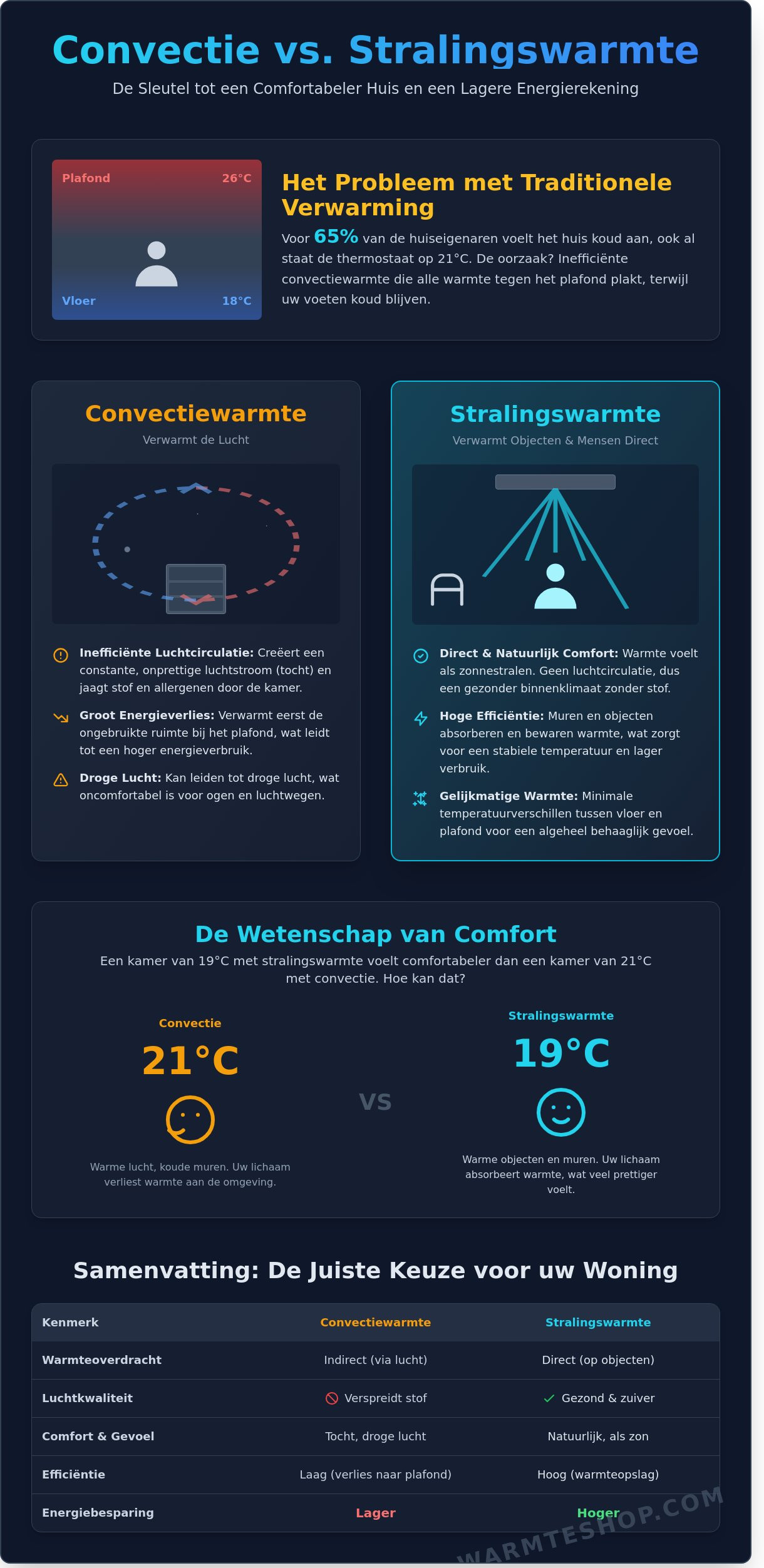
A major disadvantage of this system is temperature stratification. It is not uncommon for it to be 26 degrees Celsius at the ceiling, while your feet rest on the floor at a temperature of only 18 degrees. Especially with convectors in large rooms or homes with a ceiling height of more than 2.8 meters, this leads to an enormous loss of efficiency, because you are effectively heating the unused space above your head first.
Radiant heat works via invisible electromagnetic waves, similar to the way the sun heats the earth. When these waves strike an object or person, the energy is converted into heat. After all, you also feel the sun on your face during a cold winter day, even when the air temperature is around freezing point. This proves that radiation does not need air to provide comfort.
Objects in the room, such as an oak table or a brick wall, have a much greater thermal mass than air. As a result, they retain heat considerably longer. Whereas a room with convection heat cools down within 10 minutes as soon as the door is opened, a room with radiant heat remains stable. This is because the walls slowly radiate the stored energy back into the room, ensuring a constant and healthy indoor climate without a feeling of drafts.
Home comfort is much more than a simple number on a digital display. The fundamental choice between convection and radiant heat revolves around the way our bodies absorb and retain energy. Traditional convection systems work by heating the air in a room. This warm air rises, cools down at the ceiling, and sinks back down. This creates a constant airflow that is often perceived as restless or drafty. Infrared radiation works differently. It emits electromagnetic waves that directly heat objects and people in the room, without using the air as a means of transport.
A room at 19 degrees Celsius heated with infrared panels often feels more comfortable than a room at 21 degrees with central heating running. This phenomenon is explained by the operative temperature, which is the average of the air temperature and the radiant temperature of the surrounding surfaces. When walls and furniture are warm, your body loses less of its own heat to the environment. In this process, the walls act as a thermal battery. They store energy and gradually release it back into the room. This significantly increases the thermal mass of your home, keeping the temperature stable even if a door is briefly opened.
The US Department of Energy confirms that this direct transfer ensures superior efficiency and consumption because no energy is lost to unnecessary air circulation. In an average home, this can reduce energy loss due to ventilation by 12 to 15 percent.
Infrared radiation mimics the natural warmth of the sun. As soon as the invisible waves touch your skin, an immediate biological reaction occurs that stimulates blood circulation. This creates a deep, soothing warmth that penetrates deep into the muscles. Because objects retain heat rather than the air, cold spots in the corners of the room disappear completely. You experience an even heat distribution where the temperature difference between the floor and the ceiling is often less than 1 degree Celsius. This creates a soothing environment that promotes mental relaxation.
One of the greatest benefits of radiation is the tranquility it brings to the indoor climate. Convection creates a constant airflow that disperses dust, pollen, and allergens throughout the home. For the 25 percent of the population suffering from allergies or asthma, this is a crucial factor. Moreover, natural humidity is maintained. You will not suffer from dry eyes, a sore throat, or static electricity. Because the walls are warmer than the air, condensation is prevented. This eliminates the risk of mold formation, which structurally improves the air quality in the home.
Would you like to experience for yourself how this technology can transform your living comfort? You can always schedule a no-obligation consultation at one of our local showrooms to personally test the heat.
The energy transition forces us to take a critical look at how we heat our homes. In 2026, the traditional gas-fired central heating boiler will no longer be the standard. The discussion about convection versus radiant heat therefore increasingly revolves around pure efficiency and smart energy management. With convection, you heat the air mass in a room. Warm air rises, cools down at the ceiling, and sinks back down. This process is slow and fragile. As soon as you open a window for ventilation, the heated air escapes immediately outside. You are literally throwing your precious energy out the window.
Radiant heat takes a fundamentally different approach. Instead of heating volatile air, infrared panels focus on the mass of the home, such as walls, furniture, and human skin. These objects retain heat much longer than air. The US Department of Energy confirms that radiation is one of the most direct forms of heat transfer, minimizing energy loss due to air movement. This results in a more stable indoor climate where the perceived temperature remains high, even when the actual air temperature is lower.
The financial gain lies in the thermostat setting. Because the direct radiation acts directly on your body, you can set the thermostat an average of 2 degrees lower without sacrificing comfort. Every degree you lower the heating results in a saving of approximately 6 percent on your energy bill. In an average household, this translates into a significant reduction in annual expenses. The synergy with your own solar panels completes the picture. By converting the generated electricity directly into heat, you create a virtually closed and CO2-neutral energy system.
Radiant heat is significantly less sensitive to drafts and ventilation than traditional systems. In modern, airtight homes, infrared heating optimally because the walls act as a thermal battery. Whereas convection relies on a constant airflow that disperses dust and allergens, radiation keeps the air calm and healthy. Good insulation remains essential for both methods, but radiant heat prevents cold walls from dragging down your sense of comfort by actively warming the walls themselves and keeping them dry.
A central heating boiler is often inefficient because the entire system has to start up to heat just one room. With zone heating, you heat only the place where you are. Smart thermostats play a crucial role in this. They ensure that panels in the bathroom are only active during your morning routine, while the living room is only activated later in the day. This precision prevents unnecessary consumption in unused spaces. You do not consume a single kilowatt-hour too much. Switching to this targeted method of heating is a logical step for anyone striving for a lower ecological footprint and a healthy bank account.
Choosing between convection and radiant heat is a decision that directly impacts your monthly energy bill and your daily well-being. Every room in the house places different demands on the indoor climate. While a living room benefits from a constant base temperature, a bathroom requires a quick, powerful heat boost that has an immediate effect on the perceived temperature.
The bathroom is the place where radiant heat proves its superiority. In a humid environment, an infrared mirror a dual solution. Within 5 to 8 minutes, the glass surface is warm enough to completely eliminate condensation. You step out of the shower and immediately enjoy a clear view without having to wipe. Combine this with a towel radiator that dries the towels and simultaneously heats the walls. Because radiation penetrates materials such as ceramic and stone, the floor feels up to 3 degrees Celsius warmer than in a room heated solely by air heating.
In bedrooms and home offices, everything revolves around peace and a healthy climate. Convection creates a constant airflow that disperses dust and allergens throughout the room. This can cause irritation in 15% of people with sensitive airways. Radiant heat is completely silent and keeps humidity stable at around 45 to 55 percent. This prevents dry eyes and a sore throat while working or sleeping.
Large spaces with ceilings above 2.60 meters expose the weakness of convection. Warm air immediately rises to the highest point, leaving you sitting in the cold downstairs while the unused space upstairs remains unnecessarily warm. Infrared panels on the ceiling direct heat waves vertically downwards to where the occupants are located. This increases efficiency by approximately 22% in homes with an atrium or an open stairwell.
Outdoors and in large industrial halls, the effectiveness of a patio heater undisputed. While warm air dissipates immediately in the slightest breeze, infrared radiation remains effective at wind speeds of up to 15 kilometers per hour. The technology works like the sun: the heat is immediately felt on the skin, regardless of the ambient temperature. For large-scale applications in warehouses, heating the entire air mass is often financially unfeasible. By irradiating only the active work zones, companies save up to 50% on their operational energy costs.
This focus on direct, palpable heat is not only practical; it can also be a source of entertainment. For events where heat and light play a spectacular role, you can check out StageHeat.
The aesthetic possibilities of modern radiant panels make the system suitable for any interior. You have a choice of various design options:
We see this personalization trend not only in heating, but throughout the entire interior design industry. For instance, specialized companies such as Textieltransferhuis now also offer advanced printing techniques for the textile industry, enabling unique designs on fabric.
In many modern homes, we are seeing the rise of hybrid systems. The existing heating remains at a low base temperature of 18 degrees, while the infrared panels provide a local comfort level of 21 degrees. This smart balance between convection and radiant heat reduces the CO2 emissions of an average household by 10 to 15 percent per year.
Do you want to know exactly which solution is most cost-effective for your home? Request a free heating plan from the experts at Warmteshop for tailored advice.
The final choice in the battle between convection and radiant heat determines how you experience your home for the next thirty years. At Warmteshop, we understand that this transition involves more than just replacing a radiator. It is an investment in a healthier indoor climate and a lower energy bill. We guide you through the entire process, from the initial technical analysis to the expert installation of panels that are just 22 millimeters thick. These slim panels integrate seamlessly into your interior, whether you choose an unobtrusive white ceiling panel or a stylish mirror in the bathroom.
Our approach is based on facts and precision. While traditional systems often lose 15 to 20 percent of heat due to air circulation against the ceiling, infrared converts 100 percent of the electrical energy into direct heat. This results in an average saving of 22 percent on your operating costs compared to electric convectors. You can experience this unique warmth for yourself in our showrooms throughout the Benelux. The sensation is comparable to the natural warmth of the sun on a windless day, where it is your body, rather than the air, that is heated directly.
No two homes are identical, which is why we start every project with a detailed heat calculation. We consider the insulation value of your walls and the total volume of the room. For a well-insulated living room, we often use a standard of 25 to 30 Watts per cubic meter, while a bathroom requires a higher intensity of approximately 60 Watts per cubic meter for optimal comfort. This data forms the basis for your personal plan, ensuring you never pay too much for unnecessary power.
The integration of modern technology makes your heating smarter and more efficient. We easily connect our systems to your smart home network via 2.4 GHz WiFi thermostats. This allows you to control the temperature in each room with an accuracy of up to 0.5 degrees via your smartphone. Installation is carried out by our own certified installers. They ensure a secure connection and an aesthetic finish, concealing cables invisibly. You immediately benefit from a system that requires no maintenance and does not spread dust throughout the room.
The switch to infrared is a crucial step towards a gas-free home. With the 2050 climate targets in mind, electric heating with radiant heat is the most logical choice. Infrared panels have no moving parts, such as pumps or fans, which means that the lifespan extends to up to 25 years without any wear and tear. You no longer require annual maintenance costs or inspections, resulting in long-term savings of hundreds of euros per year.
By choosing Warmteshop technology, you invest in a sustainable future without compromising on luxury. In a modern, sustainable home, the comparison between convection and radiant heat almost always favors radiation. It prevents dry eyes, reduces dust circulation, and keeps the walls dry, effectively preventing mold formation. We invite you to schedule an appointment today for a no-obligation consultation. Our advisors would be happy to show you how to transform your home into an oasis of healthy, green warmth.
Do you want to make the switch? Visit one of our showrooms and experience for yourself why more than 15,000 households have already chosen Warmteshop's expertise.
The decision between convection and radiant heat directly determines the quality of your living environment and the amount of your energy bill. While traditional convection unnecessarily circulates the air and disperses dust particles, radiant heat warms the walls and objects in your room. This creates an even temperature without energy loss. Since 2008, Warmteshop has served as the reliable guide in this energy transition. With more than 30 showrooms in the Benelux, we bring technical innovation closer to the consumer. With us, you do not get a standard solution, but a result based on a free, customized heat calculation.
The year 2026 calls for heating systems that combine efficiency with an aesthetic design. Infrared panels offer that unique balance by exactly mimicking the natural warmth of the sun in your interior. Our experts are ready to show you how this technology transforms your home into an oasis of tranquility and sustainability. It is time to say goodbye to outdated methods and choose the certainty of an expert. Your comfort is our priority, and you will notice this in every detail of our service.
Discover our energy-efficient infrared panels and experience the sun in your home
No, radiant heat is completely safe and even promotes a healthier indoor climate compared to traditional systems. The technology mimics the natural heat of the sun without the harmful UV radiation. Because no air movement occurs, the amount of airborne dust and dust mites in the room decreases by 20 percent. This offers direct relief for the 1.5 million Dutch people who suffer from respiratory allergies or asthma.
You can heat your entire home perfectly using radiant heat as your primary heating source. Infrared panels provide sufficient power to maintain a constant 21 degrees in every room, provided the wattage is calculated correctly based on the insulation value. Nowadays, 25 percent of homeowners opt for this gas-free solution during a major renovation. The system has a modular design, allowing you to control the temperature in every room independently and with extreme precision.
The switch when weighing up convection versus radiant heating yields an average energy saving of 10 to 30 percent per year. You save immediately because the thermostat can be set 2 degrees lower while the comfort level remains the same as with a warmer air heating system. For an average family, this means a reduction in energy costs of approximately 280 euros per heating season. Targeted heating prevents you from wasting energy heating empty air spaces.
Radiant heat feels warmer because the infrared waves heat your skin and the objects in the room directly, rather than the air. With air heating, the ambient temperature must be at least 22 degrees for a comfortable feeling, whereas radiation offers the same comfort at just 19 degrees. The effect is comparable to the sun on a cold winter day; you feel the intense heat directly on your body. This direct transfer is 40 percent more efficient than heating the entire air mass.
You do not need complex wiring or three-phase power for the installation of infrared panels. A standard 230-volt socket is sufficient to put a panel into immediate use. For larger installations of more than 3600 watts, we recommend a separate circuit in the fuse box to distribute the load optimally. This saves you 100 percent on the drilling and breaking work normally involved in the installation of central heating.
The heat largely remains in the room because it is stored in the walls, the floor, and the furniture. Whereas with air heating 80 percent of the heat escapes within 2 minutes, the solid mass of radiant heating retains the energy. As soon as you close the window, the room is back to the desired temperature within 5 minutes. This makes ventilating in the winter much less expensive for your energy bill.
Infrared panels are the most efficient solution for rooms with ceilings of 3 meters or higher. In the battle between convection and radiant heat, convection loses a lot of ground here, because warm air rises directly to the ceiling where no one benefits from it. Radiant panels direct the heat waves vertically downwards to the living zone. As a result, you experience a constant temperature on the floor without having to unnecessarily heat the upper meters of air.
An infrared panel reaches its optimal operating temperature within 5 to 15 minutes after being switched on. However, the first heat radiation is already felt on your skin within 60 seconds if you are standing within the radiation range. This fast response time is ideal for rooms you only use occasionally, such as a bathroom or a home office. By using smart thermostats, you reduce energy consumption in these rooms by a further 15 percent.


