

Comfortable feeling of warmth: The science behind true home comfort
, by Warmteshop, 17 min read
, by Warmteshop, 17 min read
Did you know that over 60% of your personal indoor comfort is determined by radiation and not by air temperature alone? It is a frustrating phenomenon that many households recognize: the thermostat ticks the 21 g…
Did you know that over 60% of your personal indoor comfort is determined by radiation and not by air temperature alone? It is a frustrating phenomenon that many households recognize: the thermostat hits 21 degrees, but you still experience cold feet or an unpleasant draft. This lack of a truly comfortable feeling of warmth stems from an imbalance between the heated air and the cold surfaces in your home. You will surely recognize the downsides of traditional systems, such as dry eyes caused by dust circulation or temperature differences of up to 5 degrees between the floor and the ceiling.
At Warmteshop, we view the switch to green energy as a smart upgrade for your living comfort. In this article, you will discover how the interaction between radiant heat and objects in your room creates a stable and healthy indoor climate. We explain how to heat like the sun. This increases comfort and lowers energy costs by an average of 20%. You will gain a clear insight into the science behind thermal comfort, so you can say goodbye to an inefficient heating experience for good and enjoy healthy, constant warmth in every corner of the room.
A comfortable sense of warmth is more than a number on a display. It is the state of thermal comfort in which the human body is in perfect balance. You do not need to release excess heat into the environment, nor do you need to waste energy absorbing it. In this neutral state, we experience the highest degree of well-being.
The scientific formula for this feeling is simple. The comfort temperature is the average of the air temperature and the radiant temperature of objects in the room. This immediately explains why 21 degrees on the thermostat in an old house with cold walls feels chilly, whereas that same temperature is actually comfortable in a room with infrared heating
In addition to temperature, humidity and air speed play a crucial role. A humidity level between 40% and 60% is ideal for human health. As soon as the air becomes too dry, moisture evaporates from your skin faster, which has an unwanted cooling effect. Drafts also disrupt the experience; an air movement of just 0.2 meters per second can lower the perceived temperature by as much as 2 degrees.
Scientifically speaking, heat is much more than a number on a digital thermostat. It revolves around the way our body exchanges energy with its immediate surroundings. Traditional heating systems focus primarily on heating the air, a process we call convection. Infrared technology takes a fundamentally different path by focusing on matter. This difference in approach forms the core of a truly comfortable sense of warmth. While heated air quickly escapes through cracks or vents, radiant heat remains anchored in the physical structure of your home.
Imagine a clear winter day with an air temperature of just 3 degrees Celsius. As soon as you step out of the shade into the sun, you immediately feel an intense, pleasant warmth on your face. This natural phenomenon is caused by infrared radiation that bypasses the cold air and directly heats objects and people. Infrared panels simulate this process in your interior. The invisible light waves penetrate approximately 0.1 millimeter deep into the skin. This direct transfer stimulates blood circulation and ensures an immediate sense of well-being, without the entire air mass in the room having to be set in motion first.
This desire for natural warmth and comfort does not stop at the front door. For outdoor enthusiasts who want to enjoy comfort even while camping or at festivals, the right equipment is crucial. For an extensive range, you can visit BeCamp.dk.
Convection heating inevitably creates an unnatural stratification in the room. Warm air rises to the ceiling, while your feet remain in the cold. This results in a temperature difference between the floor and the ceiling that can reach up to 6 degrees Celsius. Infrared radiation eliminates this problem by directly activating objects such as the floor, furniture, and walls. These objects absorb the energy and act as a thermal battery that gradually releases the heat back into the environment.
The efficiency of this method is unprecedented; nearly 100% of the electricity consumed is directly converted into heat where you need it. The result is a stable indoor climate that is less susceptible to drafts or temperature fluctuations. Are you ready for a more modern way of heating? Discover the possibilities of our infrared heating and experience the soothing power of radiant heat for yourself.
Many people automatically associate a high thermostat setting with comfort. However, a room at 21 degrees with traditional radiators often feels less pleasant than a room heated by radiant heat. This is due to the action of convection. In this process, the air is heated, after which it immediately rises to the ceiling. This creates vertical temperature stratification. In an average living room, the temperature difference between the floor and the ceiling can reach as much as 4 degrees Celsius. Therefore, while you sit on the sofa, the heat is located above your head, while your feet remain in a layer of cold air. This hinders achieving a truly comfortable feeling of warmth.
In addition, the constant movement of air creates an invisible draft. Even if this air is warm, human skin perceives the airflow as a cooling effect. The body reacts to this by closing the pores, which removes the feeling of comfort. Air heating focuses on heating the emptiness in a room, rather than the people and objects inside it.
Convection heating creates a constant air circulation that is detrimental to health. This airflow carries fine dust particles, pollen, and dust mites throughout the entire home. For the 25 percent of the population suffering from allergies or sensitive airways, this often leads to irritation. Moreover, heating the air causes a drop in relative humidity, often to below the critical threshold of 40 percent. This results in dry eyes, a sore throat, and an interior that feels static. Infrared heating, on the other hand, leaves the air undisturbed and maintains stable humidity, which is essential for a healthy indoor climate.
Air is an extremely volatile medium that retains hardly any energy. When you open a door or leave a window slightly ajar for ventilation, the heated air escapes the room within 60 seconds. The system then has to start heating the new mass of cold air all over again. This process is slow; traditional systems often take 20 to 30 minutes to make a noticeable difference. Although convectors prove their worth in specific situations such as a hallway or stairwell, they are less efficient for prolonged use. Radiant heat penetrates the mass of the home, such as the walls and floor, retaining the heat and allowing you to enjoy a comfortable feeling of warmth.
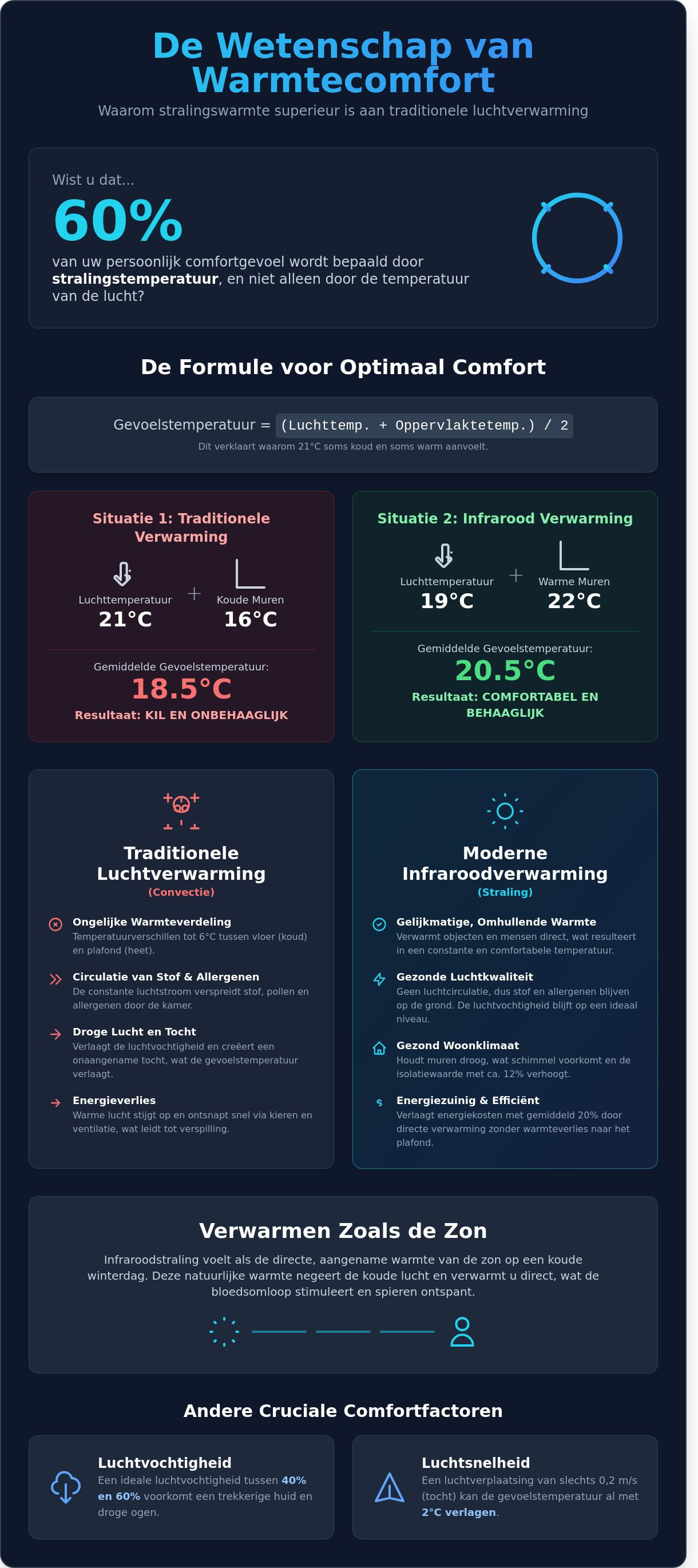
A constant and comfortable feeling of warmth is not achieved by simply turning up the thermostat. It is about the right balance between the radiant temperature and the temperature of the objects in the room. When walls and floors remain cold, a room still feels chilly even at an air temperature of 21 degrees. Infrared panels solve this by directly heating the mass in the home, rather than the air.
In 2026, heating an entire home with a single central thermostat will be an outdated concept. Why waste precious energy on an unused guest room or the hallway? With infrared technology, you create specific heat islands in places where you actually spend time, such as the seating area or your home office. This targeted heating significantly increases the immediate comfort experienced. Practical figures show that you can save up to 30% on your energy costs simply by tailoring the heat demand per zone to your daily rhythm.
A stable indoor climate requires precision. Temperature fluctuations disrupt the comfortable feeling of warmth and often lead to unnecessary energy consumption. Our wireless thermostats measure the temperature exactly where you are, rather than against a cold exterior wall. Automation prevents peak consumption by controlling the panels gradually. As a result, the surfaces in the room remain at a constant temperature; this is comparable to how the sun warms a stone wall, which then continues to radiate natural heat for hours.
For optimal results, the strategic placement of panels is crucial. Keep the following tips in mind for your installation:
Warm surfaces ensure that the air needs to circulate less. This results in less dust displacement and more stable humidity, which is essential for a healthy indoor climate. By investing in this targeted approach, you transform your home into a future-proof environment where efficiency and luxury go hand in hand.
When furnishing a home, heating is often viewed as a necessary evil. Warmteshop breaks this dogma by seamlessly combining advanced technology and aesthetics. A comfortable sense of warmth is only achieved when the technology blends invisibly into the space, while performance remains at its maximum. We shift the focus from purely functional heat to an integral part of your interior design, where sustainability and comfort form the basis for every renovation or new build.
Modern heating no longer needs to take up valuable space. Our collection ranges from stylish infrared mirrors that never fog up to completely invisible ceiling solutions. These panels are manufactured from high-quality materials and have an average lifespan of 20 to 30 years. Because there are no moving parts in the systems, technical maintenance is virtually unnecessary. This makes infrared technology a smart, future-proof investment for any type of home.
Radiant heat works fundamentally differently from traditional air heating. Instead of circulating the air, objects and people are heated directly. This principle mimics the natural warmth of the sun. The result is an indoor climate free of swirling dust, which is an immediate relief for people with allergies or respiratory issues. Furthermore, the infrared radiation penetrates deep into the skin, which has a beneficial effect on stiff joints and muscles. This is a major advantage, especially in the bathroom. View our towel radiators for a warm start to the day and experience how a dry, healthy space promotes your well-being.
The synergy between technology and sustainability truly comes to fruition with correct installation. With our intelligent thermostats, you control the temperature per room, leading to energy savings of up to 25 percent compared to traditional central systems. Because every building and every occupant is unique, personal advice remains the most important step. With more than 30 physical showrooms in the Benelux, Warmteshop offers the local expertise needed for a tailored heating plan. Our advisors calculate exactly what power your space requires to achieve that desired comfortable feeling of warmth in every corner of your home.
True home comfort begins with understanding the science behind radiant heat. Instead of merely moving the air, infrared heats the objects and people in the room directly. This process mimics the natural warmth of the sun. Since 2008, Warmteshop has been the specialist in this energy-efficient technology. Our top-quality German systems guarantee even temperature distribution without drafts or cold corners. This results in that coveted and truly comfortable feeling of warmth that instantly elevates your living enjoyment.
With more than 30 showrooms in the Benelux, we always offer you personalized, tailored advice. Switching to green radiant heating is not mandatory, but a smart upgrade for your interior and your wallet. Our extensive warranties give you the security you seek in a modern home improvement. You deserve a home that not only feels warm, but is also healthy and future-proof.
Discover our extensive collection of infrared heating and experience the comfort for yourself
Make the switch to an innovative way of heating and enjoy a perfectly balanced indoor climate every day.
Air temperature only measures how warm the air in a room is, whereas a comfortable feeling of warmth is created by the balance between the air and the radiant temperature of objects. In traditional systems, the air is often 21 degrees while the walls remain cold, causing an unpleasant draft. Infrared radiation directly heats the mass in the room. This ensures a stable experience that is not dependent on air movement.
You prevent dry air by choosing radiant heat instead of the usual convection heat. Traditional radiators heat the air constantly, often causing humidity to drop below the healthy limit of 40 percent. Infrared panels heat objects and people directly without forcing air circulation. As a result, the natural moisture balance in the home is maintained, and you will no longer suffer from dry eyes or an itchy cough.
Infrared heat feels different because it mimics the natural effect of the sun through direct radiation. A radiator heats the air, which then rises to the ceiling, often resulting in warm heads and cold feet. Infrared rays penetrate deep into the skin and objects, providing direct and even heat. This creates a deep relaxation that can be compared to the benefits of sunlight on a cold winter day. For those seeking deeper connection and personal growth in addition to physical comfort, practices such as Shibari-Tantra an interesting exploration.
Yes, even heat is possible by strategically directing infrared panels at cold walls and floors. In homes with insulation values dating from before 1990, uninsulated walls often draw all the heat out of your body. By directing panels at these surfaces, the walls themselves become an active heat source. This eliminates cold drafts at the window and ensures a stable indoor climate, even if the insulation does not meet the latest standards.
The thermostat can be set an average of 2 to 3 degrees lower without compromising your well-being. Because the radiant heat acts directly on your body, you experience the same comfort at an air temperature of 18 degrees as at 21 degrees with convection. This reduction leads directly to energy savings of approximately 6 percent per degree. It is a smart way to lower your energy bill while keeping the indoor temperature just as comfortable.
Cold walls draw radiant heat away from your body, leading to an uncomfortable feeling despite a high air temperature. When a wall is more than 3 degrees colder than the air, an unpleasant draft is created that runs down the wall. Infrared panels solve this by directly raising the wall temperature. A warm wall reflects the heat back into the room, which is essential for achieving a truly comfortable feeling of warmth.
Infrared heating is ideally suited as primary heating, provided the power output is precisely tailored to the specific room. In an average living room, you need approximately 25 to 30 Watts per cubic meter for optimal results. Warmteshop's systems offer a complete replacement for gas-fired central heating boilers. With this, you enjoy a maintenance-free solution that operates completely CO2-neutral when using green electricity from your own solar panels.
You feel the first radiant heat within just 2 to 5 minutes of switching on the panel. While a traditional radiator often takes 30 minutes to heat the entire room air, infrared works on your skin almost immediately. The maximum surface temperature of 85 to 95 degrees is reached quickly. This makes the panels ideal for rooms where you are not present all day, such as the bathroom or a home office.


