

Carbon-neutral living in 2026: The complete guide to a sustainable home
, by Warmteshop, 18 min read
, by Warmteshop, 18 min read
What if the switch to a gas-free home didn't feel like a major renovation, but like an aesthetic upgrade that immediately increases your daily comfort? Many homeowners are currently rightly concerned that…
What if the switch to a gas-free home didn't feel like a major renovation, but rather an aesthetic upgrade that immediately increases your daily comfort? Many homeowners are currently rightly concerned about ever-rising energy costs and the technical complexity of making their homes more sustainable. You probably want to do your bit for the climate, but preferably without your living room turning into a dusty construction site or a cold, unwelcoming space. The concept of carbon-neutral living often conjures images of complex installations, while the reality can be much more elegant.
In this guide, you will discover how to transform your home into a carbon-neutral oasis of comfort without compromising on coziness or design. We show that a sustainable future begins with smart choices that pay for themselves. You will learn everything about the transition to a gas-free home by 2026, focusing on innovative solutions such as infrared technology that mimics the natural warmth of the sun. From lowering your monthly expenses to increasing your home value by an average of 10 percent, we guide you step by step toward a healthier and future-proof indoor climate.
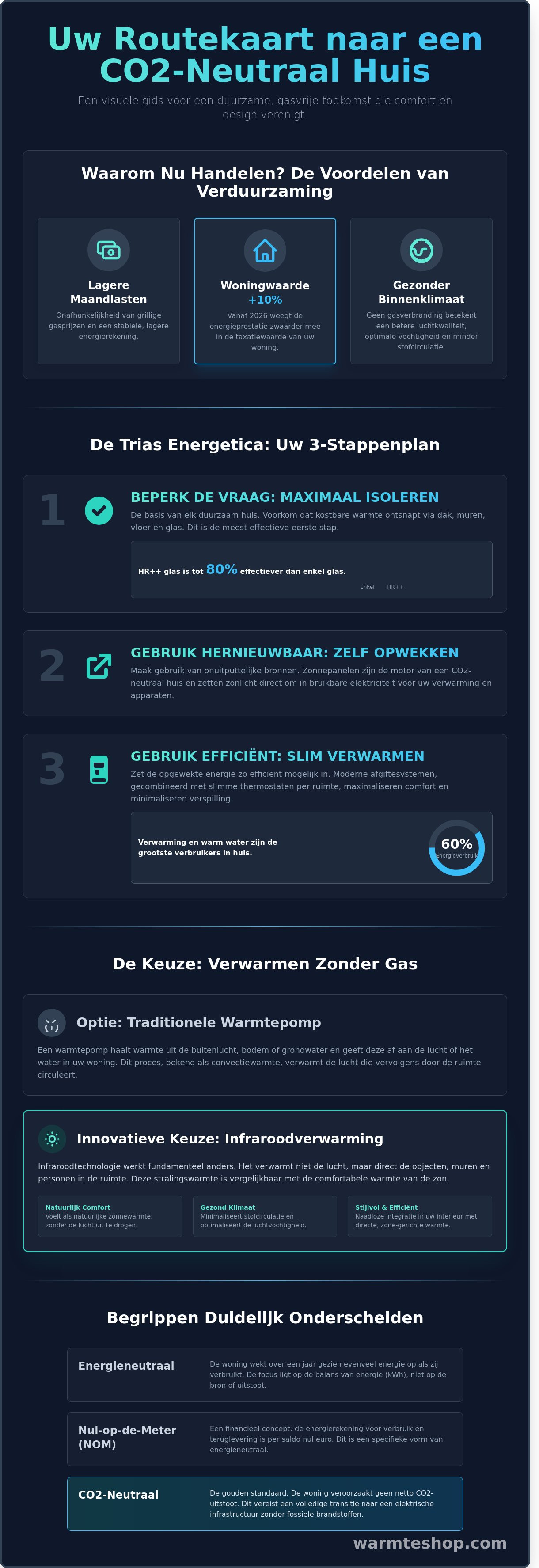
CO2-neutral living is the new standard for a future-proof home. It means that, viewed over an entire calendar year, your home causes no net emissions of greenhouse gases. Whereas a traditional house relies on fossil fuels that emit harmful gases when burned, a CO2-neutral house runs on renewable sources. The European Union has set strict climate targets for 2050, but the impact on your personal situation will be felt much sooner. From 2026 onwards, banks and appraisers will weigh the energy performance of homes even more heavily in market value, making sustainability a direct investment in your assets.
Many homeowners become confused by the various terms in the market. To make the right choices, it is essential to understand what a zero-energy home is and how it differs from other concepts. An energy-neutral home generates as much energy as it consumes, while a zero-energy home (NOM) specifically focuses on an energy bill of zero euros. CO2-neutral living, however, goes a step further by making the complete transition to an electric infrastructure, eliminating every form of fossil fuel emissions.
Living gas-free is no longer a choice in the Benelux, but the norm. The volatile prices of fossil fuels create uncertainty, whereas self-generation via solar panels offers stability and independence. In addition to the financial aspect, health plays a major role. A home without gas combustion has a healthier indoor climate. Switching to infrared heating offers a unique advantage in this regard; it simulates the natural radiant heat of the sun, which is not only efficient but also optimizes humidity and dust circulation.
Making a home sustainable does not start with the purchase of complex installations, but with a smart strategy. The Trias Energetica serves as the gold standard in this regard. This three-step plan helps you work systematically towards lower emissions. The first step is limiting energy demand by maximizing insulation. Step two focuses on the use of renewable sources such as solar and wind. The final step concerns utilizing the remaining energy needs as efficiently as possible. For those striving for truly CO2-neutral living , this often means, in practice, completely eliminating fossil fuels.
Heating is the biggest culprit in the CO2 footprint of an average household. Figures show that approximately 60% of total energy consumption is used to keep the home warm and heat water. This is an enormous share. By taking a critical look at how you heat, you achieve the greatest gains for the environment and your wallet. Switching to modern systems such as infrared heating can be a smart move in this regard, as this technology heats objects directly rather than the air, just like the sun does.
Insulation is the foundation of every sustainable home. Roof, wall, and floor insulation ensure a constant indoor temperature and prevent precious heat from escaping. High-efficiency (HR++) glass is essential in this regard; it provides a barrier that is up to 80% more effective than single glazing. To maintain a healthy indoor climate without heat loss, ventilation with heat recovery (HRV) is indispensable. This system reuses the heat from extracted air to preheat fresh outside air, ensuring you no longer experience cold drafts.
Technology never stands still. By 2026, solar panels with an efficiency of over 22% will be the standard, allowing you to generate sufficient power even on smaller roof surfaces. Aesthetics also play a greater role; panels are increasingly being seamlessly integrated into the roof design. This year, a home battery will be the linchpin of your energy network. It stores the power generated during the day for use in the evening hours. For those moments when your own production falls short, green power contracts offer the necessary security for a fully carbon-neutral living experience.
For the realization of a modern solar energy system, the expertise of a specialist is essential. Companies such as EEHD Erneuerbare Energien Handel und Distribution GmbH are an example of an experienced partner in the market for photovoltaic installations and renewable energy that can help navigate the technological possibilities.
The switch to a gas-free home is a crucial step in the process of CO2-neutral living. The Dutch government explains why it is now essential to accelerate this transition towards the goal of a climate-neutral Netherlands in 2050. While the heat pump is often seen as the standard solution, infrared heating offers a technically simpler and often more sustainable alternative. A heat pump installation costs on average between €6,500 and €15,000. Infrared panels require an investment that is often 60% lower, depending on the number of rooms. Moreover, a panel easily lasts 25 to 30 years without any maintenance, whereas a heat pump requires a costly technical overhaul or replacement after an average of 15 years.
The embodied carbon footprint of infrared is remarkably low. Whereas a heat pump contains complex compressors and environmentally harmful refrigerants, a high-quality infrared panel consists primarily of recyclable aluminium, glass, and a carbon element. This significantly reduces the total ecological impact during production and at the end of its lifespan. In renovation projects, infrared excels in flexibility. You install the panels on the ceiling or wall without extensive demolition work on floors or pipes, which lowers the barrier to sustainability.
Infrared heating works fundamentally differently from traditional systems. It does not heat the air, but directly the objects and people in the room. This is exactly the same principle as the sun warming your skin on a cold winter day. Because no air circulation is required, dust settles on the floor and the air does not dry out. This results in a healthier indoor climate with fewer allergens. You experience the same thermal comfort at an air temperature that is 2 degrees Celsius lower than with convection heating, which immediately reduces your energy consumption by approximately 12%.
In homes with an insulation value of RC 4.5 or higher, infrared functions excellently as primary heating. For homes that are still making improvements to their insulation, the hybrid solution is ideal: a heat pump for the base load and infrared for targeted heat in the bathroom or home office. A traditional convector is less suitable for a plan for CO2-neutral living. These systems waste energy by collecting warm air against the ceiling, whereas you need the heat at living level. Infrared delivers the heat exactly where you are, without unnecessary energy loss.
The transition to carbon-neutral living does not begin with a major renovation, but with insight. A professional energy scan is your starting point. This scan reveals exactly where heat is escaping your home and what insulation values your walls and windows currently have. Based on this data, you draw up a multi-year plan. This plan serves as your roadmap for the next 5 to 10 years, allowing you to work step-by-step towards a completely gas-free situation. It is a strategic investment that immediately increases your living comfort.
Financial support makes this transition more accessible. Governments encourage sustainability with substantial amounts. In the Netherlands, you can recover up to 30% of your investment costs for insulation and heat pumps through the ISDE subsidy. In Flanders, the Mijn VerbouwPremie offers comparable benefits. Combine this with tax benefits, such as a reduced VAT rate on labor costs, to shorten the payback period of your systems. Smart control via central management systems then ensures that your energy consumption remains limited to the absolute minimum.
Traditional central heating systems often heat the entire house, resulting in enormous energy waste. With a wireless thermostat per room, you create an efficient zone heating system. You control the temperature in the living room independently of the bedrooms or the home office. By heating unused rooms little to not at all, you immediately save up to 20% on your annual energy costs. Smart schedules learn from your daily rhythm. The heating automatically switches down a notch when you leave for work and ensures a comfortable climate just before you arrive home. This is modern efficiency without compromising on luxury.
Big steps are important, but do not underestimate the power of small interventions. Replacing an old refrigerator with an A+++ alternative reduces the appliance's power consumption by an average of 50%. LED lighting combined with smart plugs eliminates standby power consumption, saving tens of euros annually. For targeted heat in the bathroom, an infrared mirror an excellent choice. This technology does not heat the air, but directly your body and the objects in the room, similar to the healthy radiation from the sun. It offers immediate comfort and also prevents condensation from forming on the glass.
A comprehensive vision for carbon-neutral living also includes the outdoor space. An ecologically designed garden contributes to biodiversity and a better local climate. Examples from specialized companies, such as EcoShine Kft., can offer inspiration on how a sustainable garden completes the overall picture of a climate-neutral home.
Do you want to know exactly which steps have the greatest impact on your specific home? Discover the possibilities of infrared heating for your home and start saving today.
Warmteshop envisions a future where sustainability and comfort go hand in hand. Our mission is clear: we make sustainable heating accessible and stylish for every household. The switch to carbon-neutral living does not have to mean compromising on your interior. With more than 30 physical showrooms in the Benelux and an extensive webshop, we offer a unique combination of tangible experience and digital convenience. Our infrared technology mimics the natural radiation of the sun. This is the most direct path to a green home, because you heat the objects and people, not the air. This prevents unnecessary energy loss and creates a healthy indoor climate free from the circulation of dust or pollen. We provide custom solutions that blend seamlessly into your current interior design, allowing the technology to do its work almost invisibly.
Optimal efficiency begins with absolute precision. Our experts perform detailed heat calculations so you know exactly how many watts each specific room requires for maximum efficiency. A calculation error of just 10% in the required power can lead to unnecessarily high energy consumption or a chilly room. Our in-house installation service guides you through the complete, worry-free transition to a fully gas-free home. Thanks to our years of experience in the Benelux since 2008, we guarantee systems that last for decades without losing power. You choose the certainty of a proven track record and a partner who knows the local market inside out.
With us, sustainability takes on a face that matches your personal taste. Choices range from unobtrusive ceiling panels that blend seamlessly with the plasterwork to aesthetic photo panels that serve as personalized artwork on the wall. For the bathroom, we offer an innovative experience with Sunshowers. This system combines healthy heat and controlled UV light while showering, giving your vitamin D levels a much-needed boost during the dark winter months.
We invite you to come and experience the benefits of infrared radiation for yourself. It is the smartest step you can take today for comfortable and carbon-neutral living tomorrow. Our advisors are ready to draw up a plan that perfectly matches your living situation and budget.
The transition to a gas-free future requires a well-thought-out approach in which the Trias Energetica forms your foundation. By first focusing on high-quality insulation and then switching to smart systems such as infrared panels, you achieve a significant reduction in energy consumption. CO2-neutral living is no longer a distant dream in 2026; it is an achievable reality that directly contributes to your daily living comfort. Warmteshop guides you step by step through this process. With more than 30 physical stores in the Benelux, we always offer an expert point of contact near you. As a proud partner of the market-leading Infrarood Verwarming Groep, we guarantee technology that flawlessly mimics the natural heat of the sun. Our experts perform specialized, customized heat calculations for your specific spaces. This way, you know exactly what savings to expect. The switch to green energy is a smart investment in a healthy indoor climate and a lower energy bill.
Discover our infrared solutions for a CO2-neutral future
Together, we are building a home that is ready for the generations after us.
No, these two terms differ in their core focus on the impact the home has on the climate. With energy-neutral living, you generate exactly as much energy over an entire year as you consume, often measured via the electricity meter. CO2-neutral living goes a step further by reducing net greenhouse gas emissions to zero over the entire lifecycle of the energy supply. This means that you completely stop burning fossil fuels such as natural gas and use only 100% green electricity or renewable sources.
Yes, any home from, for example, 1930 or 1970 can be made completely carbon neutral through a smart combination of insulation and modern technology. The process begins with addressing the building envelope, aiming for an Rc value of at least 4.0 for walls and roofs. Once heat demand has dropped by 60%, you replace the old gas boiler with an electric system such as infrared panels. This transforms even a monumental building into a sustainable, future-proof home ready for the world of tomorrow.
On average, a well-insulated terraced house of 120 m² requires approximately 15 to 22 solar panels to fully cover the consumption of infrared heating. This number is based on an annual consumption of approximately 3,500 kWh for heating and 2,500 kWh for domestic use. With 400 Wp panels, you generate around 6,800 kWh per year. This allows you to achieve a net-zero energy situation where your home no longer emits CO2 into the electricity grid, which is essential for a sustainable lifestyle.
Infrared panels consume more electricity per kWh than a heat pump, but the total cost of ownership is often lower over a 15-year period. A heat pump has a high COP of 4, while infrared converts energy directly into heat on a 1-to-1 basis. However, the purchase price of infrared is 70% lower and there are zero maintenance costs associated with the system. For homes with solar panels, infrared is a smart choice because you direct the radiant heat where you are, preventing unnecessary heating in empty rooms.
In 2026, you can make use of the ISDE subsidy, which is expected to cover 30% of insulation costs when implementing two or more measures. For electrical solutions such as heat pump boilers, the grant will continue to average between 500 and 900 euros. In addition, the Energy Saving Loan from the National Heat Fund offers an interest rate of 0% for households with a total income below 60,000 euros. It is advisable to check the current amounts on the RVO website for your specific situation.
You begin the process by first reducing your home's heat losses by 40% through high-quality insulation and HR++ glass. A logical first step is sealing gaps and insulating the attic floor, which has an immediate effect on your daily comfort. Next, install a smart meter to accurately analyze your consumption per room. Once the foundation is in place, switch to a fossil-free heating system such as infrared panels, which act like the sun's natural heat and heat the room directly.
Yes, infrared heating is completely safe because the panels comply with strict European CE safety standards and are always equipped with overheating protection. The surface temperature of a wall panel reaches a maximum of 95 degrees Celsius, which does not cause burns upon brief contact. Furthermore, because there is no air circulation, 80% less dust and pollen swirls through the room. This ensures a healthy indoor climate that is ideal for children with allergies or sensitive airways, without you having to worry about safety.
The average payback period for a complete transition to carbon-neutral living is currently between 7 and 12 years. Thanks to savings on the gas bill, which quickly amount to 1,500 euros per year for an average family, the investment in solar panels and infrared panels pays for itself rapidly. Moreover, the property value increases by an average of 5% to 10% due to an improved energy label. It is therefore not only an investment in the environment, but also a direct boost to your equity and daily living comfort.


