

Buying infrared heating in 2026: The complete guide to smart and sustainable heating
, by Warmteshop, 21 min read
, by Warmteshop, 21 min read
What if your heating doesn't move the air, but directly warms your body and interior, just like the sun does on a clear winter day? When you are considering buying infrared heating, you choose uv…
What if your heating doesn't move the air, but directly warms your body and interior, just like the sun does on a clear winter day? When you consider purchasing infrared heating, you are choosing a technology that will set the standard for smart, gas-free living by 2026. It is a logical step for anyone striving for a lower energy bill without compromising on daily comfort.
You have probably also noticed that traditional energy costs are becoming more unpredictable every year and that the search for the right wattage per square meter often causes unnecessary confusion. The fear of a cold or technical-looking interior holds many people back, while the need for a sustainable alternative is greater than ever. We understand these doubts and offer you the necessary expert clarity during this transition.
In this comprehensive guide, you will discover how to choose the right infrared panels for your home or office, focusing on concrete savings averaging 22 percent on your annual consumption. We provide an overview of the latest installation tips for 2026 and show how modern aesthetics and healthy radiant heat come together perfectly. This way, you transform any space into an oasis of natural warmth and timeless design.
The transition from fossil fuels to electricity is no longer a distant prospect. From 2026, the energy landscape in the Benelux will change permanently due to stricter regulations regarding natural gas connections for new construction and major renovations. Anyone deciding to purchase infrared heatingis choosing a technology that heats the mass within a home, rather than the air. This is the essence of decentralized object heating. Instead of a central boiler circulating liters of water to heat the air, infrared panels utilize direct radiant heat.
It is crucial to understand the distinction between short-wave radiation, which we know from patio heaters, and long-wave radiation (C-radiation), which has been specifically developed for indoor use. For an in-depth understanding of how infrared heating works and the different wavelengths, scientific documentation provides a solid foundation. Indoors, long-wave radiation ensures even absorption by walls, furniture, and human skin, resulting in a deep, comfortable warmth experience comparable to the natural rays of the sun.
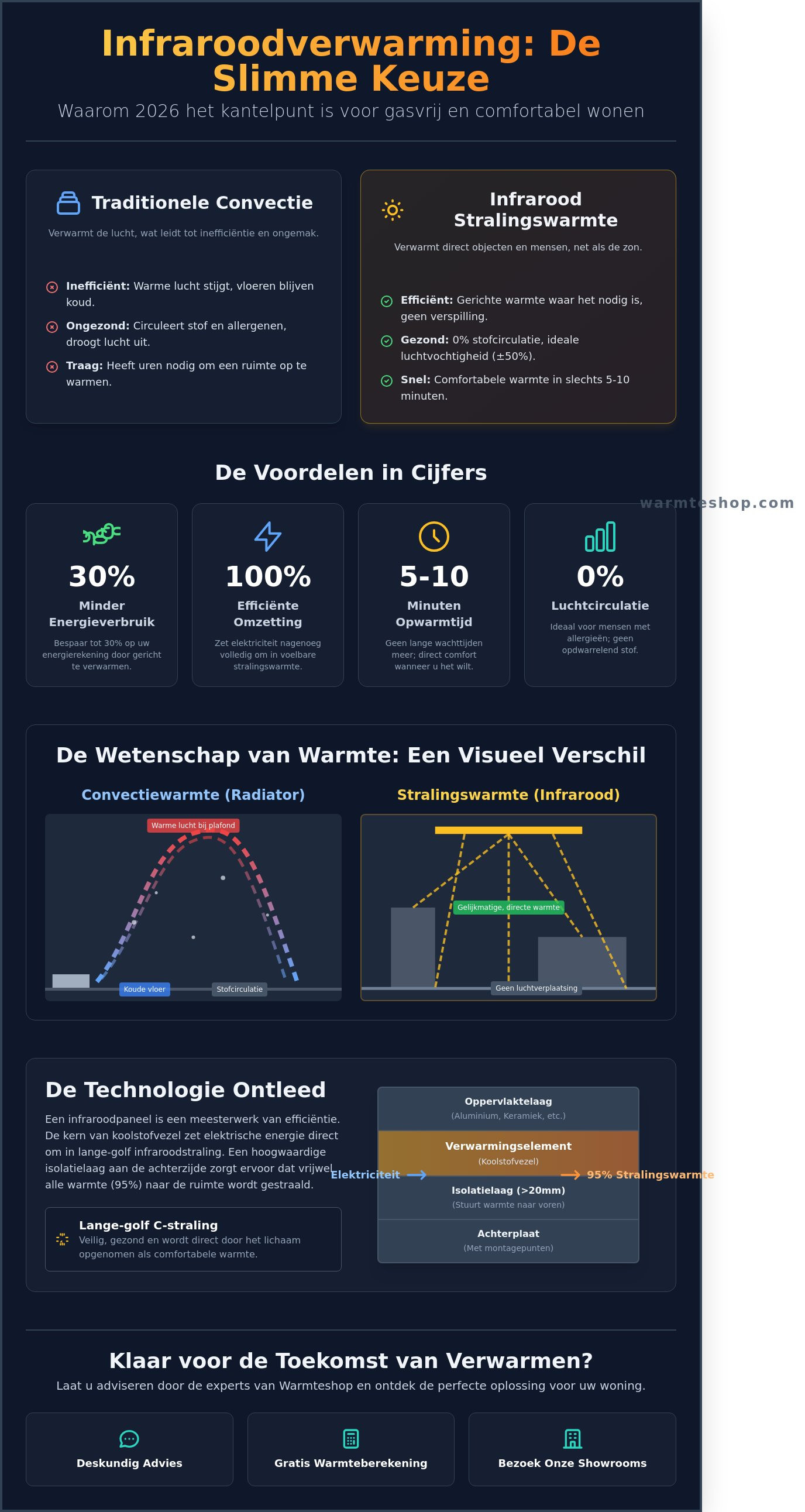
The transition to a carbon-neutral home requires smart solutions that go beyond just a heat pump. Infrared heating plays a key role in this because it allows for highly targeted heating. In an average household, savings on the energy bill can amount to as much as 30 percent by activating only those rooms where someone is actually present. This makes the system extremely efficient for the home office or the bathroom. Furthermore, health benefits directly from this choice. Because no air movement occurs, dust circulation remains limited to 0 percent, which is a huge relief for people with allergies or respiratory problems. Moreover, humidity remains stable at around the ideal 50 percent, making dry eyes and a sore throat a thing of the past.
Classic radiators work on the principle of convection: they heat the air, which then rises and cools down again. In modern, well-insulated homes with high ceilings, this process is extremely inefficient. After all, warm air remains trapped against the ceiling while the floor stays cold. The sun serves as our greatest source of inspiration in this regard. Just as you feel the warmth of the sun directly on your skin, even on a cold winter day, our panels work in the same way. The radiation converts objects in the room into heat reservoirs. These objects slowly release the heat back into the surroundings. Another major advantage is the response speed. While underfloor heating takes hours to reach the desired temperature, an infrared panel reaches its maximum radiant power within just 5 to 10 minutes. You transform a chilly room into an oasis of comfort in no time. Anyone wishing to invest wisely in the future of their home would do well to purchase infrared heating as a sustainable alternative to outdated systems.
The core of a modern infrared panel consists of a wafer-thin mat of carbon fiber or graphite. These materials have the unique property of converting electrical energy into long-wave infrared radiation with an efficiency of nearly 100%. Unlike traditional radiators, which heat and circulate the air, these panels focus directly on the mass in a room. The science of radiant heat confirms that this process is much more effective for human comfort, as the walls, floors, and furniture absorb the heat and gradually release it again. This creates an even temperature without the familiar dust displacement of convection heat.
A high-grade insulation layer is located on the back of every high-quality panel. Without this barrier, a large portion of the energy would simply disappear into the wall. By using a minimum of 20 millimeters of thermal insulation, up to 95% of the generated heat is directed to the front. The choice of surface material then determines the speed and the experience. Aluminum panels often reach their ideal operating temperature within just 6 minutes. If you choose a natural stone or ceramic version, heating up takes approximately 20 minutes, but you will enjoy the stored residual heat for a long time after switching off.
The surface structure plays a crucial role in heat distribution. A panel with a slightly granular texture increases the effective surface area, directing the radiation into the room at an angle of nearly 170 degrees. This ensures even heat distribution without cold spots. Anyone considering purchasing infrared heatingwould do well to pay attention to these technical details, which make the difference between a basic panel and a high-efficiency system that provides years of comfort.
Determining the correct capacity is essential for a comfortable indoor climate. A standard formula for homes built after 2012 is 30 to 35 Watts per square meter. For older homes from the 1980s, this requirement often rises to 45 to 55 Watts per square meter. Also take ceiling height into account; for ceilings higher than 2.7 meters, you must increase the total capacity by 10%. It is a misconception that a lower wattage saves energy. In practice, 15% overcapacity is actually more efficient. The panel heats the room faster, causing the thermostat to cut off the power supply sooner and reducing total consumption over the entire day.
Safety is paramount in electric heating systems. When purchasing infrared heating, always pay attention to the IP rating, especially for installation in the bathroom or damp areas. An IP44 certification is the standard here, meaning the panel is protected against splashing water from all directions. In addition to the mandatory CE marking, certifications such as TÜV or GS offer extra assurance regarding build quality and durability. Furthermore, every modern panel must be equipped with at least two integrated overheat protection devices. These sensors immediately switch off the power as soon as the internal temperature exceeds 110 degrees Celsius, guaranteeing safe use in any household situation.
Making a well-considered choice starts with determining the exact purpose of your home. Do you want to heat the entire home gas-free, or are you looking for a specific solution for the seating area? For primary heating in a home built after 2010, you can expect an average output of 25 to 30 Watts per cubic meter. In older homes, this requirement is often higher. Purchasing infrared heating is a long-term investment. Because the panels contain no moving parts, such as pumps or filters, the expected lifespan is often more than 20 years without the need for annual maintenance.
The installation location largely determines your comfort. Ceiling mounting offers the most efficient heat distribution because the radiation reaches the floor and furniture unimpeded, which then release the heat back into the room. This results in an efficiency that is up to 15% higher than with wall mounting. Is infrared heating a smart choice? Independent experts confirm that the direct radiant heat warms objects rather than the air, minimizing energy loss due to drafts. When purchasing, also pay attention to the material; ceramic panels retain heat longer than metal variants, which is beneficial for thermal inertia in larger rooms.
Heating no longer needs to be a disruptive factor in your interior. Modern panels are slim, often only 2 centimeters thick, and blend effortlessly into their surroundings. A white panel on a white ceiling is virtually invisible. For those who want to make a statement, an infrared photo panel a solution. This allows you to combine art with a high-quality heat source. In the bathroom or hallway, an infrared mirror its worth. It never fogs up after showering and ensures a pleasant start to the day without the need to install a bulky radiator.
You can only achieve maximum efficiency with the right control. A digital thermostat per room is essential to keep your energy consumption low. Unlike central heating, infrared allows you to control each room individually. Modern Wi-Fi modules make it possible to adjust the temperature via your smartphone, even when you are not at home. The latest systems use algorithms that take local weather forecasts into account. If the sun is going to shine in two hours, the system switches off the panels in advance to prevent overheating and unnecessary power consumption. This type of zone control can reduce your energy bill by up to 20% compared to traditional thermostats.
check the warranty conditions when purchasing infrared heating . A quality brand often offers a 5 to 10-year warranty on the technical components. In our showroom in Antwerp, we would be happy to explain how to integrate these systems into your specific living situation. This makes the transition to green energy a tangible upgrade to your daily living comfort.
Every room in the house has a unique heating requirement that calls for a specific approach. While a bedroom needs to remain cool for deep sleep, the bathroom, on the other hand, requires a rapid, powerful temperature increase when you are there. Anyone considering purchasing infrared heatingwill soon discover that this technology works like the sun: objects and people are heated directly, not the air. This results in an efficiency that conventional radiators simply cannot achieve, because no energy is lost to circulating air currents.
The bathroom is often the first place homeowners make the switch. It is a room that is used only briefly but intensively. Instead of letting a radiator blast all day, an infrared panel provides the desired comfort temperature within 6 to 9 minutes. The radiant heat penetrates the walls, giving moisture and mold no chance.
In the living room, everything revolves around zone heating. It is illogical to heat 60 cubic meters of air when you are sitting alone on the sofa. By strategically placing a panel above the seating area, you create a heat island. This can lower the central heating thermostat by as much as 2 degrees, resulting in an immediate saving of 12% on annual heating costs.
For those seeking the coziness of an open fireplace without the ash and particulate matter, a decorative fireplace with infrared technology is the ideal match. In the home office, we see that desk panels are becoming the standard for remote workers. These compact panels under the desk keep the legs warm, ensuring that concentration remains measurably higher throughout the workday because the body expends less energy maintaining core temperature.
In the bedroom, infrared offers a crucial advantage: there is no air circulation. This means that dust particles and pollen do not float through the room, improving air quality by 40% for people with allergies. A panel on the ceiling heats the bed and the floor, allowing you to step into a comfortable room without the air feeling dry and stuffy.
Outdoor spaces and industrial halls require a different approach. Here, we distinguish between short-wave and long-wave radiation. A high-quality patio heater with short-wave radiation is insensitive to wind, allowing you to sit comfortably outside even in a breeze of 3 Beaufort. It extends the gardening season by an average of 3 to 4 months per year.
For larger volumes such as warehouses or workshops, industrial heaters essential. These systems heat the floor and the machines, which then release the heat into the surroundings. In the garden, 'dark heaters' are often chosen when disturbing red light is not desired, ideal for covered verandas where aesthetics and atmosphere are paramount.
The process of purchasing infrared heating at Warmteshop does not stop at the checkout. Over the past 15 years, we have developed a process that guarantees complete peace of mind. With 32 physical showrooms spread across the Benelux, we offer a local point of contact where you can experience the technology firsthand. This network enables us to always be with our customers within 45 minutes for a personal consultation or technical support. The core of our success lies in the combination of high-quality German technology and in-depth knowledge of the local housing market.
A crucial part of your process is the free heat calculation we perform for every customer. We leave nothing to chance. Our advisors analyze the insulation values of your walls, the type of glazing, and the exact cubic meters of the space. Whether you want to heat a 1920 townhouse in the center of Antwerp or an energy-neutral new build from 2024, the calculation is accurate to the watt. This prevents you from investing unnecessarily in overcapacity or facing excessive power consumption due to undercapacity.
The installation is carried out by our own team of 14 certified technicians. They possess the necessary credentials and years of experience with complex installations on both ceilings and walls. We work with invisible mounting systems, allowing the panels to blend seamlessly into your interior. After installation, a comprehensive explanation of the thermostat control follows. We won't leave until you know exactly how to get the maximum return from your system. Our aftercare is lifelong; we remain your partner for questions regarding energy saving and system expansion.
Since its founding in 2008, Warmteshop has grown into the undisputed market leader in the Benelux. We now have more than 25,000 successful installations to our name. This experience translates into a product range that includes only the most efficient technologies, such as our panels with a conversion rate of 98% to radiant heat. Our customers rate us with an average score of 9.4 based on independent reviews. We would be happy to show you practical examples of similar projects in your region in the showroom, so that you know exactly what results to expect.
Infrared heat is difficult to describe, but is instantly recognizable as soon as you feel it. It is the unique sensation of the sun on a cold winter day, but in your own living room. In our showrooms in Antwerp, Brussels, Roeselare, and Oud-Gastel, all models are set up and working. Here you can see the differences between glass panels, limestone finishes, and mirror heating in various sizes. A visit to the showroom is the best way to assess the aesthetic quality and the intensity of the radiation. Make an appointment today for a no-obligation, personalized consultation, during which we will create your ideal heating plan together.
The switch to a gas-free home is no longer a distant prospect, but a smart investment in your daily living comfort. Infrared panels offer an efficient solution by directly heating the mass in a room, just as the sun heats the earth. This prevents unnecessary energy loss and creates a healthy climate without dry air or dust circulation. If you want to purchase smart infrared heating for your home, precise matching to your specific needs is crucial for an optimal return of nearly 100 percent.
At Warmteshop, you benefit from expertise spread across more than 30 physical stores in the Benelux. We leave nothing to chance and offer you a free professional heat calculation to prove your future savings in black and white. Our certified installation service then ensures a safe and aesthetic finish in every room of your home. The path to a CO2-neutral future is open and begins with the right technology on your ceiling or wall.
Discover our full range of infrared heating and request a free quote
Choose sustainable quality today and enjoy an unprecedented level of comfort for years to come.
Infrared heating costs an average of between 150 and 250 euros per year in electricity for a standard 600-watt living room panel with 1,000 operating hours. This amount is based on an average electricity price of 0.25 euros per kilowatt-hour. Thanks to precise thermostat control, the system switches 20 to 30 percent more efficiently than traditional electric heaters. Furthermore, you save even more by heating only the specific zones you are actually using at that moment.
Yes, infrared panels can replace your entire gas-fired central heating system, provided the capacity is correctly calculated for each individual room. In an average insulated home, you need approximately 30 to 40 watts per cubic meter to guarantee a constant base temperature. By choosing a fully electric system, you immediately reduce your home's CO2 emissions to zero when combined with green electricity or your own solar panels.
Infrared radiation is completely safe and even beneficial to health because the system uses long C waves. These waves do not penetrate deep into the skin but stimulate blood circulation by 15 percent through direct heat transfer, comparable to the natural warmth of the sun. Unlike convection heat, no dust displacement occurs. This ensures a healthier indoor climate with stable humidity between 45 and 55 percent.
For optimal efficiency, mount an infrared panel on the ceiling at a height between 2.50 and 3.00 meters. With this mounting, the rays reach a spread angle of approximately 170 degrees, ensuring the floor and furniture are heated evenly. If you mount a panel lower than 2.30 meters, the radiant heat on the head may be perceived as too intense. Ceiling mounting provides 15 percent higher efficiency compared to a wall installation.
A professional panel has an efficiency of 95 percent or higher, while cheap DIY store models often only reach an efficiency of 60 to 70 percent. Professional systems use high-quality carbon fiber elements and a back shielded with 2 centimeters of insulation material. As a result, heat is projected forward and no energy is lost through the wall. Furthermore, with a specialist, you benefit from an extended warranty period of 5 to 10 years.
When installing two or three panels, modification to the meter box is usually not necessary because they fit on existing 16-amp circuits. However, if you wish to purchase infrared heating for an entire home, we recommend having the simultaneity factor calculated by an expert. For a total power exceeding 3,600 watts on a single circuit, it is necessary to install an additional circuit. This prevents overloading and guarantees the safe operation of your heating system.
The payback period for infrared panels averages between 5 and 8 years, which is significantly shorter than the 12 to 15 years required for an air-to-water heat pump. Although a heat pump has a high technical efficiency, the initial installation costs of infrared are up to 70 percent lower. You save immediately on annual maintenance costs because the panels contain no moving parts. This makes it a financially sound choice for both renovation projects and modern new builds.
Infrared panels are ideally suited for older homes with less insulation because they heat objects and bodies directly rather than the air. While warm air quickly escapes through cracks or ventilation grilles, radiant heat remains stored in the walls and furniture. You increase the comfort level in the room by 2 to 3 degrees without having to turn up the thermostat. For a home built in 1970, we recommend a capacity of 45 watts per cubic meter to effectively compensate for heat loss.


