

Looking to buy a portable air conditioner? The complete guide to smart cooling in 2026
, by Warmteshop, 18 min read
, by Warmteshop, 18 min read
What if the heatwave of 2026 is no longer an assault on your sleep, but an opportunity to prove the efficiency of your home? We all recognize the image of a bedroom that feels like an oven, while e…
What if the heatwave of 2026 is no longer an assault on your sleep, but an opportunity to prove the efficiency of your home? We all recognize the image of a bedroom that feels like an oven, while a noisy fan only moves warm air around. It is understandable that you hesitate to purchase a portable air conditioner when you think of the awkward exhaust hoses and the rising energy bill. At Warmteshop, we believe that cooling should not be a compromise for your comfort or the planet.
In this guide, you will discover how to choose the right portable air conditioner that suits your specific space, without the noise level exceeding 50 decibels. We show you how to save up to 15 percent on your cooling costs through smart positioning and modern technology. You will gain insight into the latest installation methods for every type of window and learn how a mobile system seamlessly contributes to a sustainable and healthy indoor climate. We dive into the technical specifications, compare the most efficient models, and provide practical advice for a worry-free summer.
A portable air conditioner is an advanced, portable cooling system that uses active heat pump technology to precisely control the indoor temperature. Unlike simple fans, this device does not merely move air but actually extracts thermal energy from the room. The heart of the machine contains a compressor and a closed circuit with refrigerant. By 2026, the use of R290 propane gas will be the standard for sustainable cooling. This natural refrigerant has a Global Warming Potential (GWP) of only 3, making it an environmentally friendly alternative to older synthetic refrigerants that place a heavier burden on the ozone layer.
The operation is based on a physical principle whereby the refrigerant absorbs heat and transports it outside via a drain hose. This hose is an essential part of the system. Without proper external venting, the heat generated by the compressor would return directly into the room, completely negating the cooling effect. The great strength of a portable air conditioner lies in its mobility. You create a productive working environment in the study during the day and simply roll the unit to the bedroom in the evening to bring the temperature to a comfortable 18 degrees Celsius for an optimal night's sleep.
Many consumers confuse a portable air conditioner with an air cooler, but the underlying technology differs fundamentally. An air cooler works on the basis of water evaporation, which results in only a slight drop in the perceived temperature. A real air conditioner easily lowers the actual room temperature by up to 10 degrees Celsius, even during a persistent heatwave. Additionally, humidity plays a crucial role in your daily comfort. While an air cooler actually increases humidity, a portable air conditioner as a powerful dehumidifier. It extracts liters of moisture from the air, which immediately eliminates the oppressive heat and ensures a healthier indoor climate.
The choice for a mobile system is often based on flexibility and speed. For tenants or residents of historic buildings, a fixed installation is often not an option due to strict building regulations or the prohibition on making holes in the facade. A portable unit does not require extensive renovation or a heavy outdoor unit mounted on the wall. Moreover, you save on high installation costs, which often exceed €1,500 for fixed split systems. In a climate where we experience extreme heat for an average of only 20 to 30 days a year, a portable system offers the most efficient balance between investment and living comfort.
selecting the right portable air conditioner is all about the perfect balance between pure power and sophisticated technology. A bad purchase often leads to unnecessarily high energy consumption or a device that simply fails to cool the room. You want a system that not only lowers the temperature but does so in a way that suits your lifestyle and home. The focus today is on devices that communicate intelligently with your surroundings and cause minimal disturbance.
The cooling capacity, expressed in British Thermal Units (BTU), forms the basis of your decision. For a standard, well-insulated room, we use a rule of thumb of 100 to 140 BTU per cubic meter (m³). A 20 m² bedroom with a ceiling height of 2.5 meters (50 m³) therefore requires a capacity between 5,000 and 7,000 BTU. Factors such as large south-facing glass surfaces or a flat roof increase this requirement by at least 15 to 20 percent.
Noise pollution is often the biggest frustration with mobile systems. In practice, you perceive a difference of 15 dB as a doubling of the sound volume. While 65 dB at full power is comparable to a loud conversation, a modern 'Silent Mode' reduces this to approximately 50 dB. This level is acceptable for an undisturbed night's sleep or a focused workday. The latest models in 2026 utilize improved compressor isolation, minimizing vibrations and low resonances.
Placement plays a crucial role here. Never place the unit directly against a hollow wall or on a wooden floor without a damping mat; this amplifies vibrations. For optimal management of your indoor climate throughout the year, you can combine the cooling with one of our advanced thermostats, so that you always maintain full control over the temperature settings.
A modern portable air conditioner is more than just a cooling block on wheels. When making your purchase, look for the presence of a HEPA air filter, which will be the standard in 2026 for removing fine dust and allergens. Wi-Fi app control allows you to activate the cooling while you are on your way home. Also check the physical characteristics: a weight of 30 kilos is not a problem, provided the device is equipped with high-quality 360-degree swivel casters that do not leave marks on your parquet floor.
When purchasing a portable air conditioner, look beyond the purchase price alone. After all, operating costs determine the long-term comfort in your home. In 2026, the energy label will be the most important indicator for your wallet. While a unit with an A+++ label represents a larger initial investment, it consumes up to 40% less power than a standard model with an A label. This difference translates directly to your monthly energy bill, especially now that dynamic energy contracts have become the standard in Dutch households.
Let's look at the actual figures. Assuming an average electricity rate of €0.35 per kWh, cooling with a 2.5 kW portable air conditioner costs approximately €0.30 to €0.45 per hour at full load. By comparison, an electric convector for heating often consumes more energy to achieve comparable thermal comfort, because cooling is technically a process of heat transfer rather than pure generation. The rise of inverter technology has revolutionized this. Where old models constantly switch on and off, an inverter compressor continuously adjusts its speed. This prevents costly peak loads and ensures a more stable indoor climate without unnecessary energy waste.
Efficiency starts with precise control. By using smart thermostats , you prevent the cooling from running unnecessarily when you are not present in the room. A 20% annual saving is a realistic goal in this regard. Additionally, an airtight window seal is crucial; without a proper seal, warm outside air flows straight back in, forcing the motor of your portable air conditioner to work harder. Combine this with strategic cooling by letting in cool air early in the morning and consistently keeping sun blinds closed during the day.
Neglecting basic maintenance leads to invisible costs that quickly add up. A clogged filter forces the fan to run harder, increasing energy consumption by an average of 15%. Quality brands typically last 8 to 10 years with proper maintenance. Cheap budget models often show a significant decline in cooling capacity after just 3 years. Also, take into account the costs of a biennial professional cleaning to prevent mold growth. Although modern closed systems rarely need topping up refrigerant, regular inspection can significantly extend the lifespan of your appliance and optimize performance.
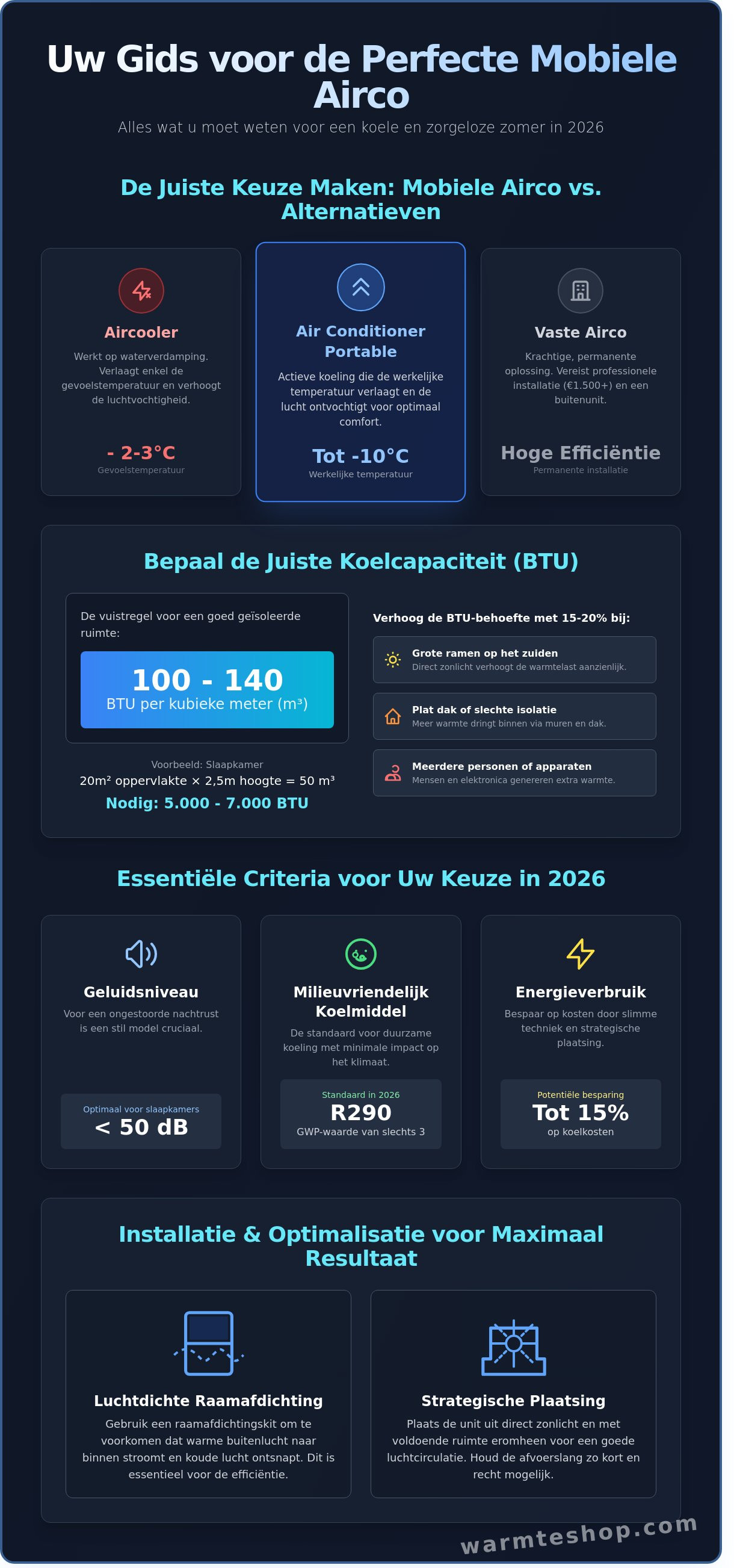
Correct installation determines whether your portable air conditioner is an efficient cooling source or an unnecessary expense on your energy bill. The ideal location is always within 1.5 meters of a window and directly near a grounded power outlet. Preferably do not use an extension cord; the high starting current of the compressor can lead to overheating with inferior cables. Additionally, maintain a clear zone of at least 50 centimeters around the intake grilles. This guarantees an unobstructed airflow and prevents the device from having to work unnecessarily hard to reach the desired temperature, which is essential for maintaining its technical lifespan.
Without a proper seal, warm air flows in just as fast as the unit can cool. For tilt-and-turn windows, universal textile sets will be the standard in 2026, while sliding windows work best with an adjustable plastic sliding plate. Eliminate gaps with self-adhesive draft strips to prevent insects and humid outside air from undermining cooling efficiency by up to 25%. Keep the exhaust hose as short and straight as possible. Any kink in the hose causes heat buildup in the tube, forcing the compressor to work harder and increasing power consumption unnecessarily.
A healthy indoor climate requires consistent maintenance. Strictly clean the dust filters every 14 days with a vacuum cleaner or lukewarm water to maintain optimal airflow. A dirty filter forces the portable air conditioner to run at a higher speed, which reduces cooling performance by an average of 15%. In addition to the filter, disinfecting the condenser is essential. Use an antibacterial spray once per season to prevent biofilm formation and unpleasant odors caused by stagnant condensate.
Remember to empty the condensate reservoir regularly, especially during periods of high humidity. Most modern units switch off automatically as soon as the reservoir is full, which can abruptly interrupt your cooling comfort during the hottest moments of the day. Are you preparing the appliance for winter? Then drain all residual water via the bottom drain plug and store the unit upright in a dry, dust-free area to protect the internal electronics from corrosion.
A portable air conditioner offers immediate relief during the hottest days of the year, but true living comfort requires a vision that extends beyond the summer months alone. Temporary cooling solves the problem of acute overheating; however, a healthy indoor climate requires a constant balance between temperature, humidity, and air quality. The switch from active air cooling in the summer to the healthy radiant heat of infrared heating in the winter forms the basis for a future-proof home in 2026. Infrared technology mimics the natural warmth of the sun. In this process, objects and people are heated directly rather than the air, avoiding the dry and stuffy atmosphere of traditional systems.
By choosing zone heating, you only consume energy in the rooms where you actually spend time. This targeted approach ensures that you are less dependent on fluctuating energy prices. Warmteshop acts as your expert guide in this energy transition. We help you take the step from a temporary solution, such as a portable air conditioner, to an integrated system that maximizes your living comfort all year round.
The transition between seasons does not have to mean giving up your outdoor space. With a powerful patio heater , you extend the outdoor season by an average of 12 weeks per year. Radiant heat offers a key advantage in this regard: the heat does not blow away in a light breeze, and there is no bothersome dust displacement. This results in a more constant perceived temperature and a healthier climate for your respiratory system. An integrated approach where cooling and heating are coordinated ultimately results in the lowest energy bill.
Every home has specific characteristics that determine ideal climate control. In our showrooms, you have the opportunity to experience the operation of infrared technology firsthand through a live demonstration. Warmteshop advisors assist you in creating a detailed heating and cooling calculation based on your floor area and insulation value. This way, we prevent overcapacity and unnecessary energy consumption. Together, we seek the perfect balance between modern design and sustainable performance. Our systems are designed to be an aesthetic addition to your interior without compromising on functionality. Visit one of our locations and discover how to transform your home into an oasis of peace and comfort, regardless of the weather conditions outside.
selecting the right portable air conditioner revolves around the ideal balance between immediate cooling performance and long-term energy efficiency. You have discovered that smart installation and precise maintenance form the basis for optimal results in any room. By choosing innovative climate technology now, you not only increase your comfort during extreme heat waves; you invest in a healthy indoor climate that pays off all year round.
Warmteshop has been the market leader in high-quality home solutions for over 15 years. Our experts are ready to assist you in more than 30 physical showrooms spread across the Benelux. Here, you receive expert advice specifically tailored to your living situation and wishes for sustainable cooling or heating. We translate complex technology into tangible benefits for your daily life, ensuring that the switch to green energy becomes a logical and comfortable upgrade.
Discover our energy-efficient solutions for a comfortable home at Warmteshop
Turn your home into a place where you always feel comfortable, regardless of the temperature outside.
For a 20-square-meter room with a standard ceiling height of 2.5 meters, you need a capacity of at least 7,000 to 9,000 BTU. This calculation is based on an average heat load, using approximately 350 to 450 BTU per square meter. In a moderately insulated room or a south-facing room, we recommend the higher limit of 9,000 BTU to ensure stable comfort during hot summer days.
Yes, an effective portable air conditioner must always vent the extracted heat outside via an exhaust hose to actually lower the indoor temperature. Without this hose, the warm air continues to circulate in the room; the device then functions merely as a fan and the temperature does not drop. For optimal efficiency, use a window sealing kit that prevents 30% of the cooled air from escaping directly back outside through the gap in your window.
The fundamental difference is that a portable air conditioner has an active cooling cycle with a compressor and refrigerant, whereas an air cooler merely evaporates water to create a light breeze. An air conditioner can easily lower the room temperature by 10 degrees Celsius, whereas an air cooler often does not manage more than a drop of 2 to 3 degrees. Furthermore, an air cooler significantly increases humidity, which is often perceived as stuffy and uncomfortable in warm weather.
A modern portable air conditioner with an A+ energy label will consume an average of between 0.8 and 1.1 kWh per hour during active cooling in 2026. With 8 hours of use per day, this results in a daily consumption of approximately 6.4 to 8.8 kWh. Thanks to innovative inverter technology, the latest devices consume up to 40% less power than models from five years ago, because they match their output more accurately to the desired thermostat setting.
Yes, many high-end models nowadays are equipped with a heat pump function, allowing them to also serve as energy-efficient supplementary heating. These devices extract heat from the outside air and blow it indoors, which is up to three times more efficient than a traditional electric heater with a filament. It is a smart way to increase your living comfort during the transitional months without having to turn on the central heating at full power.
In a humid climate, you must manually empty the condensate reservoir on average every 4 to 8 hours if the appliance does not have an automatic evaporation function. Many modern systems nowadays remove up to 90% of the moisture directly via the warm air hose, meaning you sometimes only need to check the reservoir after a full week. Always pay attention to the float safety switch; this automatically switches off the appliance when the water level reaches the limit to prevent leaks.
Most portable air conditioners produce a noise level between 50 and 65 decibels, which is comparable to the volume of a normal conversation. For an undisturbed night's sleep in a small bedroom, we recommend cooling the room intensively on the highest setting for two hours before going to sleep. Then switch to the special night mode, which often reduces the noise level to below 45 decibels by intelligently minimizing fan speed and compressor activity.
In 80% of cases, reduced cooling capacity is due to clogged air filters blocking the necessary airflow. Clean these filters every two weeks with a vacuum cleaner or lukewarm water to maintain efficiency and a healthy indoor climate. If the problem persists after thorough cleaning, there may be a refrigerant leak or a defective compressor, which necessitates an inspection by a qualified technician.


