
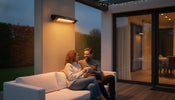
Buying infrared veranda heating: the complete guide to a warm outdoor space in 2026
, by Warmteshop, 19 min read
, by Warmteshop, 19 min read
What good is a beautifully designed outdoor space if you can only sit there in the autumn wearing a thick winter coat? It is a familiar problem: you want to enjoy the fresh air to the fullest, but as soon as the so…
What good is a beautifully designed outdoor space if you can only sit there in the autumn wearing a thick winter coat? It is a familiar problem: you want to enjoy the fresh air to the fullest, but as soon as the sun sets or the wind picks up, the cold drives you back inside. Many people struggle with heaters that heat the air more than the person, or whose clumsy design completely ruins the aesthetics of their home.
Finding the right infrared veranda heating is the key to a true extension of your living room. You surely recognize the longing for that natural warmth of the sun, even when it is freezing outside. In this complete guide, you will discover how to choose a system that perfectly suits your specific situation, so that you can comfortably enjoy a cozy seating area all year round. We look at the latest trends for 2026, explain the crucial difference between short and long wavelengths, and show how smart thermostats help you keep energy costs low without compromising on comfort.
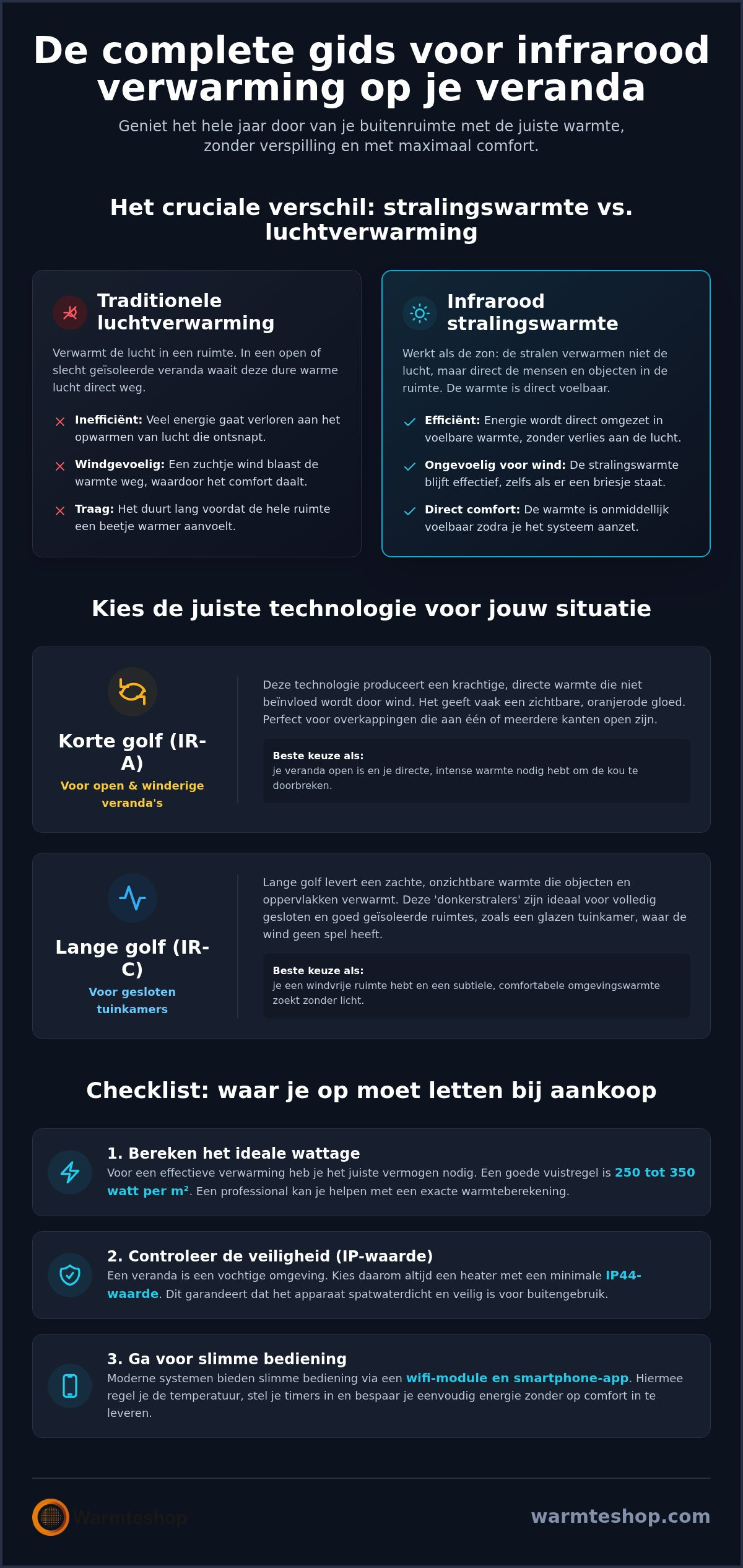
You have a beautiful veranda, but as soon as the temperature drops, it often feels more like a chilly transition zone than a cozy place. Traditional heating systems try to heat the air mass, which in a semi-open or glass space is often like trying to mop up water with the tap still running. Infrared takes a fundamentally different approach. The technology focuses not on the air, but on the matter and the people in the room.
Infrared radiation works in exactly the same way as the natural warmth of the sun. Even on a cold winter day, you feel the warmth on your face as soon as the sun breaks through. This is because the rays do not heat the air between you and the sun, but reach your skin and clothing directly. Exactly the same thing happens with an infrared veranda heater. This ensures an immediate feeling of comfort without having to wait for minutes for the entire room to finally reach the desired temperature.
Because the radiation strikes objects directly, wind has virtually no effect on heat transfer. Whereas a classic gas heater simply sees its heat blown away by the slightest breeze, an electric infrared heater remains highly effective. Additionally, the system is completely silent and odorless, which is essential for a relaxed atmosphere. There are no humming fans or burners, which also means that no dust or dry air is blown around. This creates a healthy heat experience that is pleasant for the eyes and respiratory system. Moreover, maintenance is virtually nil. Because there are no moving parts in the system, wear is rare, and periodic cleaning of the surface is sufficient to maintain high efficiency.
Convection heating relies on the circulation of warm air. In a veranda, where the level of insulation is often lower than in the rest of the home, that heated air escapes through cracks, ventilation grilles, or open sides within seconds. The technical operation of infrared radiation ensures that the energy is directly absorbed by the floor, furniture, and walls. These objects store the heat and then release it evenly into the surroundings. This creates a constant and stable temperature. Another major advantage is zone heating. You can set the systems to heat only the seating area where you are actually sitting, which prevents unnecessary energy consumption in the rest of the veranda.
With a high-quality patio heater based on infrared technology, you transform your veranda into a fully-fledged garden room that you can enjoy twelve months a year. It significantly increases your usable living space without the need for extensive renovation of the central heating system. Moreover, the direct radiant heat has a proven positive psychological impact. It simulates the comfortable feeling of sunlight, which reduces stress and promotes your overall well-being during the dark months. The boundary between indoors and outdoors blurs completely. This allows you to enjoy your garden even on those crisp autumn evenings or during an early spring morning, while sitting comfortably and warmly. It is a smart upgrade that not only improves your living comfort but also enhances the aesthetic value of your outdoor space.
Choosing the right technology is not a matter of taste, but of pure physics. The effectiveness of your infrared veranda heating is closely linked to the extent to which wind has free rein in your outdoor space. In the world of infrared, we distinguish between three wavelengths: short, medium, and long. Each variant has specific properties that determine whether you remain comfortable or if the energy is simply lost to the outside air.
The choice depends entirely on the 'openness' of your veranda. While a fully glazed garden room calls for a subtle, invisible heat source, an open canopy requires brute force to break the cold. Independent research into infrared heating confirms that the experience of comfort and energy efficiency stand or fall on this alignment between technology and environment.
Do you have a veranda that is open on one or more sides? Then short-wave (IR-A) is the only logical choice. Halogen and quartz heaters produce very powerful, direct radiation that is not sensitive to drafts. You can often recognize these models by their characteristic red glow. The major advantage is speed: as soon as you flip the switch, you feel the warmth. No warm-up time is required. Do you find the bright red light bothersome? Then choose a modern 'low glare' model. These devices use special filters to reduce light emission by up to 80 percent, while maintaining intense heat output. It is the perfect solution for those chilly evenings on an open terrace.
For a fully enclosed veranda or a well-insulated garden room, long wave (IR-C) is superior. These systems, also known as dark radiators, emit no light at all. They heat the space in a quiet, even manner. In an enclosed space, wind is not a factor, giving the panels time to warm up the walls and floors. An infrared ceiling panel is the ideal solution here. By integrating the heating into the ceiling, you save space and ensure a heat distribution comparable to a warm blanket. For spaces that fall between 'open' and 'fully enclosed', such as a veranda with glass sliding walls, medium wave (IR-B) often offers the perfect balance between power and comfort.
Still unsure which technology best suits your situation? Then take a look at our collection and find the ideal patio heater that matches your home's architecture.
A warm veranda starts with an accurate calculation of the required power. It is a common mistake to rely on the standard wattages applicable indoors. Because an outdoor space loses heat more quickly, you need significantly more power here. For effective infrared veranda heating, we generally use a standard of 250 to 350 watts per square meter. This high wattage is necessary to compensate for the influence of drafts and cold air currents.
The efficiency of this approach is supported by the UK government report on infrared heating, which demonstrates that targeted radiant heat is much more effective than traditional methods in less insulated environments. Instead of investing in a single unit with extremely high output, it is often smarter to opt for distribution. By strategically placing, for example, two or three 1000-watt units, you create an overlapping heat zone. This prevents you from sweating on one side of the table while still feeling cold on the other.
Safety is at least as important as comfort during installation. Infrared heaters can become very hot on the surface. Therefore, strict safety distances apply. Depending on the model, there must often be 30 to 50 centimeters of space between the heater and flammable materials such as a wooden structure or a sunshade. Expert installation ensures that the heat is utilized optimally without risks to your home.
In an outdoor environment, the IP rating of your equipment is crucial. For a sheltered veranda, IP44 is the absolute minimum. This rating indicates that the housing is splash-proof and protected against objects larger than one millimeter. However, do you have a semi-open veranda where rain can blow inside during strong winds? Then we often recommend an upgrade to IP55. These devices are resistant to water jets from any angle, which is essential for the lifespan and safety of your system in the changeable climate of the Benelux.
No two verandas are the same. Factors such as the amount of glass, the presence of insulation, and the specific wind conditions determine how much power you actually need. A glass sliding wall, for example, retains heat much better than an open side, which directly impacts your energy costs. To prevent mispurchases, Warmteshop offers a free heat calculation. Our experts assess your specific situation and recommend the best patio heater from our collection of 32 specific veranda solutions. This ensures you invest in a system that provides exactly the right amount of comfort, even on the coldest days of 2026.
An infrared veranda heater should not only be functional but also seamlessly complement the architecture of your home. In 2026, heating is no longer a bulky element that spoils the view. Nowadays, you choose models that blend completely into the surroundings. Do you have a modern aluminium canopy? Then a finish in anthracite or black is the standard. For classic wooden verandas with a light finish, white panels are ideal for maintaining a sense of calm in the design.
In addition to color, the installation plays a major role in the appearance. For a sleek and minimalist look, you can opt for built-in models. These blend seamlessly into the ceiling of your veranda, leaving only the subtle glass panel or grille visible. This creates a high-end finish typically found in luxury hotels. For those seeking maximum flexibility, freestanding models offer a solution. You can easily move the heat source to wherever you are sitting at that moment, whether that is the dining area or the lounge set at the back of the garden.
Moreover, modern systems are often dimmable. This is an essential feature, as the heating requirements on a mild spring evening differ from those on a chilly November day. You can adjust the intensity steplessly using a remote control or app. This prevents it from getting too hot and allows you to save directly on energy consumption.
The real revolution lies in the control. By using smart home Wi-Fi modules , you transform the veranda into an intelligent living space. You can easily control the infrared veranda heating via your smartphone, even when you are not yet at home. Set smart schedules so that the cushions of your lounge set feel comfortably warm as soon as you step outside after work. For maximum efficiency, you can connect the system to motion sensors. The heating then switches off automatically when no one is present in the room anymore, preventing unnecessary costs.
Luxury glass panels are a popular choice for modern conservatories and garden rooms. They look elegant and, thanks to their smooth surface, are very easy to clean. An important aspect of a professional installation is concealing the technical components. At Warmteshop, we always advise on how to invisibly integrate cables and connections into the veranda's supporting structure. This prevents a cluttered appearance and protects the wiring from the elements. The result is a heating system that feels like an integral part of your home, rather than a separate addition.
Curious how this technology fits your style? Discover our extensive collection and find the perfect patio heater for your unique outdoor space.
Finding the right infrared heating for your veranda requires more than just a quick purchase; it requires the expertise of a specialist who understands the finer nuances of outdoor heating. Since 2006, Warmteshop has been the leading expert in the Benelux in the field of infrared technology. With a huge stock of over 5,000 panels and 32 specific solutions for verandas, we offer a suitable system for every situation. Whether you have an open terrace that requires brute force or a luxury garden room that demands aesthetic perfection, we have the technology to transform your outdoor space.
A unique advantage of our approach is the opportunity to experience the heat for yourself first. With more than 30 showrooms spread across the Benelux, including locations in Antwerp and Culemborg, we invite you to feel the difference between various heaters. Our advisors will show you how the different wavelengths react to drafts and how the various designs suit your living style. This eliminates any uncertainty and ensures that you make the switch to this sustainable form of heating with peace of mind.
In our collection, you will find, among others, the robust powerhouses from the brand MO-EL. These heaters are specifically designed for intensive outdoor use and are known for their immense reliability and wind resistance. For those seeking a more refined look in an enclosed garden room, our infrared glass panels are the ultimate choice. These combine a sleek design with very even heat output. To maximize ease of use, we offer complete sets including wireless thermostats. With these, you can regulate the temperature down to the degree, which not only increases comfort but also prevents unnecessary energy consumption.
Choosing Warmteshop means choosing certainty and a personal approach. Our certified installation service takes all the work off your hands. We ensure a worry-free installation where all safety distances are strictly observed and the cabling is concealed. Our years of experience enable us to create a custom heat calculation that exactly matches your specific veranda construction. In addition to specific solutions for verandas, you can come to us for a wide range of patio heaters for various other outdoor applications. We view the transition to green energy as a smart upgrade for your living comfort and are happy to guide you step by step towards the perfect, warm outdoor space.
The right infrared veranda heating is more than a functional addition; it is a smart investment in your living comfort that permanently blurs the line between indoors and outdoors. You now have the knowledge to make an informed choice between short-wave and long-wave technology based on the wind sensitivity of your space. By focusing on the right wattage and an aesthetic design, you create a place where you will enjoy spending time, even on the coldest days of 2026.
At Warmteshop, we understand that every situation is unique. That is why our experts in more than 30 showrooms in the Benelux are ready to advise you. We are happy to help you with a free heat calculation to determine the ideal configuration for your veranda. Moreover, thanks to our large stock and fast delivery from our own warehouse, you will be enjoying that lovely, sun-drenched warmth in no time.
View our complete collection of infrared heating for the veranda and discover how easy it is to take your outdoor experience to the next level. We look forward to helping you with this comfortable upgrade to your home.
Infrared heating is actually a very efficient solution because you heat people directly, rather than the air. In a veranda, this prevents heat from blowing away immediately with a slight breeze. Operating costs depend on the desired temperature and the insulation of the space. By using smart thermostats and Wi-Fi modules, you can accurately control consumption and only heat when you are actually sitting outside, which prevents unnecessary costs.
For a 15-square-meter veranda, you typically need between 3,750 and 5,250 watts of power. This is because we calculate with 250 to 350 watts per square meter for outdoor spaces to compensate for the cold outside air. It is often more effective to distribute this power across three 1,500-watt units for even heat distribution. This creates an overlapping heating zone so that everyone at the table sits comfortably.
Yes, many systems come with a plug and can be easily mounted using the included brackets. However, for infrared veranda heating, we often recommend professional installation by our certified technicians. An expert ensures a safe connection to the power grid and conceals all cabling invisibly within the structure. Furthermore, a professional guarantees that the correct safety distances to flammable materials, such as a wooden canopy, are strictly adhered to.
No, certainly not all heaters emit that characteristic red light. You can opt for so-called dark radiators or long-wave infrared panels that operate completely light-free; these are ideal for sheltered garden rooms. For more open verandas, there are 'low glare' models that reduce light emission by as much as 80 percent. This allows you to enjoy powerful short-wave heat without the ambient lighting in your garden being disturbed by a bright glow.
Infrared heating is completely safe under a wooden canopy, provided you maintain the prescribed safety distances. Most units require a clearance of 30 to 50 centimeters from the wooden ceiling or side walls. Furthermore, modern heaters are equipped with heat shields at the rear to minimize heat emission upwards. By choosing a model with the correct IP rating and expert installation, you can enjoy a warm wooden veranda without any worries.
The main difference lies in the wavelength and intensity of the radiation. A patio heater typically uses short- or medium-wave radiation, which provides intense heat that reaches the skin directly and is wind-resistant. An infrared panel works with long-wave radiation and emits a gentler heat without light. Panels are therefore more suitable for fully enclosed conservatories, while the powerful patio heater is the best choice for open verandas.
That depends entirely on the total wattage you install for your infrared veranda heating. A standard circuit can handle a maximum of 3600 watts. If you install multiple heaters that exceed this capacity, a separate circuit in the fuse box is necessary to prevent overloading. We recommend consulting an electrician immediately during the planning phase; for example, you can check out High Demand Electrical for an impression of high-level specialized electrical services. This ensures that the wiring is thick enough for the power of the chosen units.
Yes, provided the device has the correct protection rating for an outdoor environment. For a veranda, an IP44 rating is the absolute minimum; this means the heater is splash-proof. In situations where wind can blow rain directly against the device, we recommend upgrading to IP55 or even IP65. These heaters are completely jet-proof and resistant to the most challenging weather conditions. Therefore, always check the IP specifications before installing a system in an exposed environment.


