

Infrared Heating Disadvantages: An Honest Guide for 2026
, by Warmteshop, 22 min read
, by Warmteshop, 22 min read
Infrared heating isn't the most suitable solution for every home or situation. That might sound strange coming from a specialist, but at Warmteshop, we believe in a lasting relationship based on trans..
Infrared heating isn't the most suitable solution for every home or situation. That might sound strange coming from a specialist, but at Warmteshop, we believe in a lasting relationship based on transparency and honest advice. You've probably landed on this page because you have doubts. You've heard stories about higher energy bills or heat that feels different than you're used to, and you want to be sure you're making the right choice for the future. These concerns are entirely valid and a crucial part of a well-informed decision.
That is why we have put together this honest guide for 2026. We dive deep into the real downsides of infrared heating, without sugarcoating anything. More importantly, we show you exactly how to circumvent these perceived disadvantages and even turn them into an advantage for your specific living situation. We discuss everything from initial costs and power consumption to installation and the type of insulation that ultimately determines your return, so that you can make the switch to gas-free living with confidence.
The fact that you're researching the disadvantages of infrared heating is a sign of a well-considered decision. At a time when the energy transition is forcing us to move away from natural gas, a critical look at alternatives is not only smart but also necessary. Infrared heating is fundamentally different from the systems we've known for decades. It's not air heating, but radiant heat. This type of heating uses long-wave infrared rays to send direct heat to objects, walls, and people in a room, similar to the heat of the sun. For a more in-depth technical explanation of what infrared heating entails, reference is often made to the direct transfer of energy. This direct approach creates a completely different heating experience, which is both the source of its strength and the source of many questions.
Doubts often stem from unfamiliarity with the principle and the growing, sometimes confusing market. While the government aims for a completely gas-free housing stock by 2050, solutions like infrared panels are becoming increasingly important. They offer an efficient, electric, and CO2-neutral heating method, provided they are installed correctly and are of high quality. Unfortunately, this is not always the case, leading to the criticism found online.
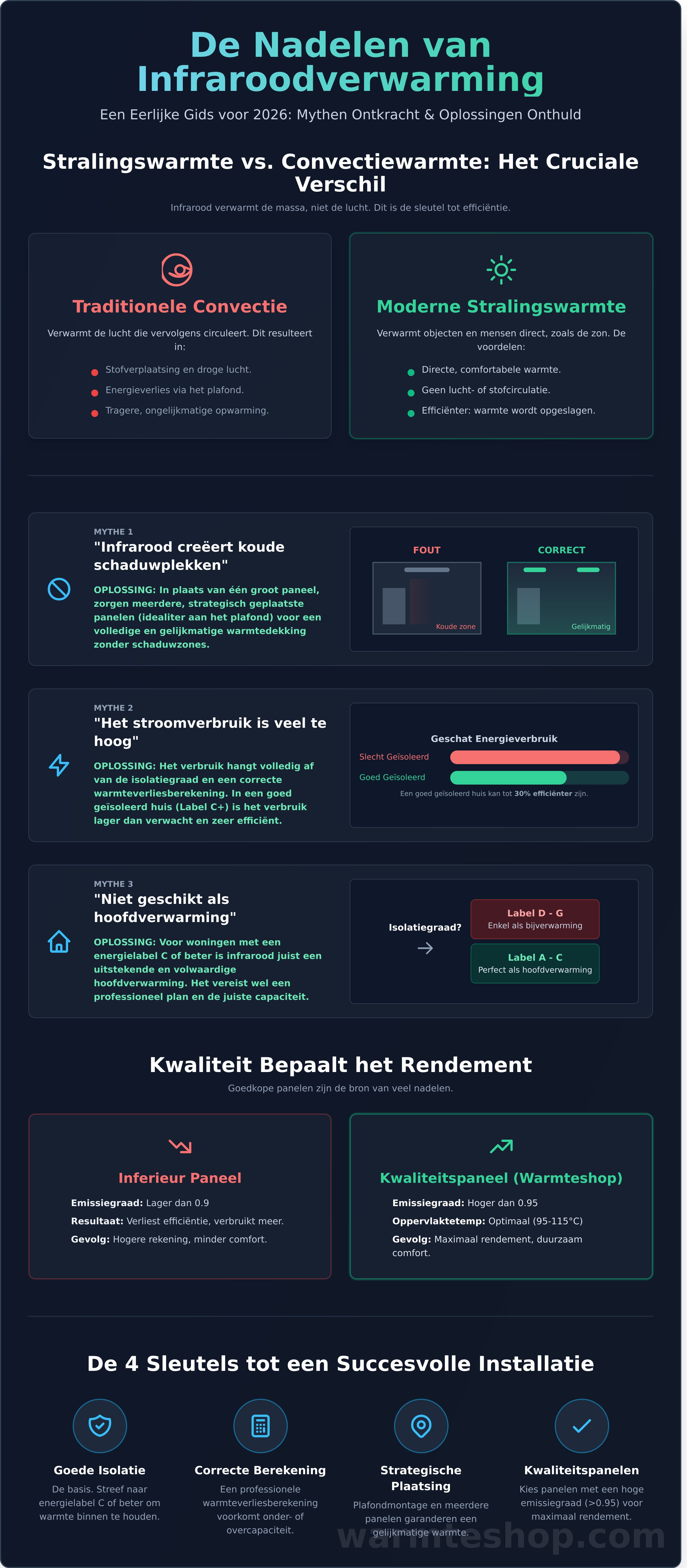
For decades, our homes have been heated by convection: radiators or underfloor heating that warm the air in a room. This warm air rises, cools, and then falls again, creating constant air circulation. Radiant heat doesn't do this. It heats the mass in the room, which in turn distributes the heat evenly. This requires a different approach. For example, the effectiveness is directly linked to the insulation level of your home. In a well-insulated house (energy label C or better), the efficiency can be up to 30% higher than in a poorly insulated building, because the stored heat doesn't escape through walls and windows.
A significant portion of the disadvantages of infrared heating discussed online can be directly traced back to the quality of the panels. Cheap panels from hardware stores or anonymous webshops often have a low emissivity rate (lower than 0.9), which means they convert radiation into sensible heat less efficiently. High-quality panels, such as those from Warmteshop, have an emissivity rate of more than 0.95 and a controlled surface temperature between 95°C and 115°C. This guarantees optimal heat output and a long lifespan. An inferior panel inevitably leads to a higher energy bill and discomfort, unfairly giving the technology a bad name.
The most common criticisms that we will address honestly and factually in this article are:
In the following sections, we'll debunk these myths with concrete data and practical examples, so you can make an informed choice for your future-proof home.
Infrared heating is rapidly gaining popularity as a sustainable and comfortable alternative to traditional systems. However, many questions and misconceptions persist online. To make a well-informed choice, it's essential to honestly analyze the frequently discussed disadvantages of infrared heating . We'll delve into the five most common criticisms and separate the facts from the myths, so you know exactly what to expect.
Unlike a radiator, which heats the air (convection), an infrared panel works like the sun. It emits direct radiant heat that warms objects and people in the room. This feels wonderful, but has a downside: the rays can be blocked. A large cabinet, a sofa, or even a large pillar can create a "heat shadow," making the area behind it feel noticeably cooler. This phenomenon requires careful consideration of placement.
Correct placement and power calculations are crucial. Therefore, always request personalized heating advice to avoid cold zones.
A common point is that the heat disappears immediately once you switch off the panel. This is partly true, because the direct radiation stops. What people forget, however, is that the energy isn't lost. The infrared rays have heated the walls, floor, and furniture. These objects act as a heat battery and slowly release their heat back into the room. The result is a much more stable and comfortable temperature than with convection heating, where the heated air quickly cools or escapes through cracks.
Cost is a decisive factor. At first glance, electricity seems more expensive per kWh than gas. However, this comparison is too simplistic. An infrared panel doesn't need to heat the entire air mass in a room; it heats the living area specifically. As a result, the panel is on for much less time per day than a central heating boiler. For a fair comparison , we must therefore consider total energy consumption, not just the price per kWh.
Starting in 2026, the calculation will become even more interesting due to the shifting energy tax, with the tax on gas increasing and the tax on electricity decreasing. If you combine infrared heating with solar panels, you'll generate your own free energy, and your operating costs will drop to almost zero. This is one of the main disadvantages of infrared heating, but with a smart approach, it can turn into a major advantage.
As mentioned with the shadow effect, you can't simply hang a panel anywhere. Its effectiveness depends entirely on the correct positioning. A panel hung directly above the seating area on the ceiling provides a much higher level of comfort than a panel mounted on the wall behind a curtain. The distance to the zone to be heated and the radiation angle determine the heat perception. A professional installation plan, based on the layout and use of the space, is therefore not a luxury but a necessity for optimal results.
A sleek, designer panel on the wall is beautiful, but what about the wiring? A visible cord to the outlet can be an aesthetic drawback for some. Fortunately, there are elegant solutions. During renovations or new construction, the cables can easily be concealed in the wall or ceiling. In existing situations, an electrician can often conceal the connection via a nearby light fixture. Furthermore, there are design solutions available, such as infrared panels disguised as a mirror or painting, which blend seamlessly into your interior.
Choosing a new heating system is an important decision that will impact your comfort and wallet for decades to come. To make a well-informed choice, it's essential to evaluate infrared heating not only on its own merits but also compare it to the most common alternatives: heat pumps and traditional convectors. This involves considering more than just the purchase price.
A fair comparison revolves around the balance between investment costs (CAPEX) and operational costs (OPEX), as well as maintenance, lifespan and ease of use.
The speed of heating is another crucial distinction. Infrared panels deliver sensible radiant heat within 5 to 10 minutes. You feel the heat directly on your skin, similar to the sun. A heat pump or convector must first heat the air in the room, a process that is much slower and more energy-intensive. This direct transfer of energy is a fundamental principle of radiant heat, a concept that is also substantiated in the broader scientific assessment of infrared technology, which confirms the efficiency of this heat transfer.
The bathroom is the perfect space to experience the unique benefits of infrared. You only need intense heat for short periods. Infrared delivers this instantly, without waiting. Moreover, the radiation warms the walls, floor, and objects directly. This prevents condensation and is a highly effective method for combating mold. An infrared mirror heater is a smart solution here, combining comfortable warmth with a permanently condensation-free mirror.
Although higher electricity costs are often cited as one of the disadvantages of infrared heating, this depends heavily on the situation. In modern, highly insulated homes (such as passive houses or BENG homes), the heat demand is so low that infrared can be an extremely cost-effective primary heating system. Also, in situations where a heat pump is technically impossible (e.g., apartments without the option for an outdoor unit) or the investment is too high, IR offers a fully-fledged, gas-free alternative. The key to success is precision. By connecting each panel to a smart thermostat, you create zones and heat only where and when needed, thereby minimizing consumption.
A pleasantly warm home doesn't start with the panel itself, but with a well-thought-out plan. Most perceived disadvantages of infrared heating aren't inherent in the technology itself, but rather the consequences of improper application. With the right knowledge and approach, you can turn every potential drawback into an advantage. The secret lies in perfectly adapting it to your unique living situation.
Follow these five steps to ensure an optimally performing, comfortable and energy-efficient infrared system.
The biggest drawback arises from insufficient wattage. An undersized panel must continuously operate at 100% capacity to heat the room, leading to unnecessarily high power consumption and a feeling of insufficient warmth. For a well-insulated room (built after 2000), expect approximately 25 watts per cubic meter (m³), while an older, less insulated home easily requires 40 watts per m³. Objects in the room, such as a stone floor or a solid wood table, act as heat buffers; they absorb the radiation and release it slowly, contributing to a constant and comfortable climate.
Modern thermostats transform your heating system. By installing presence sensors, the heating automatically switches off in rooms where no one is present for 30 minutes. Programming schedules per room ensures a perfect balance between comfort and savings. You achieve the ultimate efficiency boost by connecting your infrared panels to solar panels and a home battery. This allows you to use free solar power generated during the day to heat your home in the evening, reducing operating costs to near zero. This ensures that high electricity costs never become a disadvantage of infrared heating in your situation.
Accurate calculations are key to success. Avoid disappointment and discover exactly how much power your home needs. Request your free heating plan here and let our experts perform a detailed analysis for you.
Choosing a heating system is a crucial decision that strikes a balance between immediate comfort, long-term costs, and sustainability. In this article, we have discussed the disadvantages of infrared heating honestly and transparently. It has become clear that infrared heating is not a universal solution, but an extremely efficient technology when applied correctly. The question is not whether infrared is good, but whether it is good for your home and lifestyle.
A successful transition to infrared heating hinges on thorough preparation. Its effectiveness is directly linked to factors such as your home's insulation, ceiling height, and room layout. Correct sizing and strategically placing the panels are essential for creating a pleasant feeling of warmth without unnecessary energy consumption.
So, who might find the disadvantages a deal-breaker? In practice, we see that homes with very low insulation (an Rc value lower than 2.0) or large, drafty spaces with high airflow are less suitable. In such situations, heat can escape too quickly before the objects in the room can absorb and reradiate it. This can lead to higher energy consumption than expected, negating the benefits. It is precisely here that the disadvantages of infrared heating most apparent.
At Warmteshop, we believe in a fair approach. Our mission isn't simply to sell, but to offer the best, most sustainable heating solution for your specific situation. That's why our specialists will sometimes advise against installing infrared as your primary heating system if your home isn't suitable. Your long-term satisfaction is more important to us than a quick sale. This is the added value of our 30 physical stores in the Benelux: you'll receive personalized and reliable advice from an expert who understands your situation. Feel free to schedule a free, no-obligation heat simulation and discover the best option for you.
Are you convinced of the possibilities of infrared heating and is your home well insulated? Then you're ready to make the transition to a healthy, comfortable, and gas-free future. This technology offers unprecedented possibilities for both primary and secondary heating, with an elegant design that seamlessly blends into any interior.
Every home is unique. That's why personalized advice is the only guarantee for a perfectly functioning and energy-efficient system. Our team is ready to help you every step of the way.
Request your free, customized quote here!
Choosing a new heating system is an important decision. This guide has shown that the most frequently mentioned disadvantages of infrared heating, such as higher power consumption or uneven heat distribution, can be completely avoided with the right knowledge and planning. Correct sizing and strategic placement, tailored to a well-insulated room, are the key to maximum efficiency and a pleasant, healthy indoor climate.
The effectiveness of your heating depends entirely on the quality of the panels and the advice provided. With over 18 years of experience and 30+ showrooms in the Benelux, Warmteshop offers the assurance of premium German quality panels from Ecaros and Alkari. We help you debunk the myths and create a system that perfectly suits your home, so that the transition to gas-free heating is not only sustainable but also surprisingly comfortable.
Creating a healthy and stimulating environment is not just about warmth, but also about providing space for activity and development. For those with young children, it can be inspiring to discover Kigata, a specialist in designing active play spaces.
Are you ready to take the step towards future-proof heating? Discover the possibilities for your situation and how much you can save. Calculate your savings with infrared heating here and experience the cozy warmth of the future in your own home.
No, infrared heating is absolutely not harmful to health. Warmteshop's panels use long-wave infrared radiation (IR-C), which is comparable to the heat of the sun. This radiation directly heats objects and people, which can actually have a positive effect on blood circulation. Furthermore, because the air does not circulate, significantly less dust and allergens are dispersed, making it a healthy choice for any household. This is particularly important in situations where comfort and well-being are crucial, such as in long-term home care. For such support in Belgium, one can turn to Zuster in Huis, who specialize in live-in assistance.
An infrared panel primarily heats the objects, walls, and people within its radiant range. These heated masses then gradually release their heat to the rest of the room, causing a secondary increase in the air temperature. You'll feel the heat most quickly directly in the radiant zone, but with correct sizing and placement, the entire room will be comfortably and evenly warm. It's an efficient method of zoned heating, precisely where you need it.
The exact energy consumption depends on the insulation value and the size of the room. For example, a well-insulated 20 m² living room requires a panel of approximately 700 watts. If this panel is active an average of 4 hours per day for 180 heating days, the annual consumption will be approximately 504 kWh. A smart thermostat can further optimize this consumption by only heating when absolutely necessary, which offers significant savings compared to traditional electric heaters.
Yes, you can replace your radiators with infrared panels, but it's a different way of heating. You're no longer dependent on plumbing and a central heating boiler. The placement of the panels is crucial for optimal heat distribution. Correct positioning on the ceiling or high on the wall ensures the best results. Our team is happy to help you with a personalized installation plan to ensure a seamless and efficient transition.
Switching from gas central heating to an electric alternative is a project that often requires the expertise of a traditional plumber or heating engineer, for example, to safely disconnect the old boiler. Although this article focuses on the Benelux, it may be interesting for readers with a broader perspective to see how specialists operate in other markets. For an example of such an all-round installation company in the London region, you can discover Plumbing & Boilers London.
Briefly opening a window for ventilation results in significantly less heat loss than with conventional heating. Traditional systems heat the air, which escapes immediately. Infrared radiation warms the objects and walls in the room. These masses retain heat much longer. As soon as the window is closed again, the room quickly feels comfortable again because the stored heat is released. This is one of the advantages over convection heating.
No, most infrared panels don't require a special connection. A standard 230V socket is sufficient for panels up to approximately 2,500 watts per group. You can therefore easily install the panels yourself and use them immediately. Only for installations with a very high total power or for permanent connections in damp areas such as bathrooms, specific electrical modifications are required according to the NEN 1010 standard. We are happy to advise you on this.
Infrared panels can certainly serve as primary heating in an older house, provided the insulation is adequate. One of the known disadvantages of infrared heating is that efficiency decreases in poorly insulated or drafty buildings. The radiant heat can then be retained less effectively. We therefore always recommend optimizing the insulation first. A combination of insulation measures and infrared heating is the most sustainable and comfortable long-term solution.
Our high-quality infrared panels have an exceptionally long lifespan. They contain no moving parts, minimizing wear and tear. You can expect a lifespan of 25,000 to 30,000 hours, which equates to over 25 years with average use. The panels are completely maintenance-free. This makes the investment not only sustainable but also very financially attractive in the long run, with no unexpected maintenance or replacement costs.


