

How Many Watts of Infrared per m²: The Definitive Guide for 2026
, by Warmteshop, 21 min read
, by Warmteshop, 21 min read
What if the standard rule of thumb of 100 watts per square meter that you read everywhere online is actually the reason your energy bill is unnecessarily high? The question of how many watts of infrared per m² you really need…
What if the standard rule of thumb of 100 watts per square meter that you read everywhere online is actually the reason your energy bill is unnecessarily high? The question of how many watts of infrared per m² you actually need is often answered with vague estimates, while a deviation of just 15% in power can already lead to uncomfortable cold zones or wasted electricity. You want healthy warmth that feels like the natural radiation of the sun, without the uncertainty of whether your system can handle the cold days in 2026.
We recognize the confusion caused by the many conflicting pieces of advice currently circulating. You aim for a sustainable upgrade to your living comfort, but you want the guarantee that this investment results in a lower energy bill and a perfect indoor climate. In this guide, you will discover our scientifically based calculation method that determines, down to the watt, exactly what your specific space requires. We walk you through the technical factors of insulation and space utilization, so that you can make the switch to a carbon-neutral and comfortable home with complete confidence.
Infrared heating works fundamentally differently from the central heating we have been using in our homes for 50 years. Whereas a traditional radiator heats the air, an infrared panel focuses directly on the matter in a room. The wattage of a panel indicates how much electrical energy is converted into invisible heat rays. It is a technology that we can compare to the sun on a clear winter day. Despite an air temperature of only 2 degrees Celsius, the warmth on your skin feels instantly comfortable as soon as you step into the sun. This principle of radiation intensity is the core of your calculation.
When determining how many watts of infrared per m² you need, we do not look at the air volume, but at the surfaces to be heated. A panel with insufficient power will never bring the room to the desired temperature. This leads to an inefficient system where the thermostat constantly calls for heat, the so-called cycling behavior. Instead of an energy-efficient cycle where the panel is active for only 20 minutes per hour, an undersized panel continues to consume power for 60 minutes without providing the desired comfort.
Traditional systems rely on convection, where warm air rises and cold air moves across the floor. This is a slow process that wastes a lot of energy at the ceiling. What is infrared heating? In essence, it is a source that radiates direct energy to objects and people. These objects form the "thermal mass" of your home. Your walls, floor, and furniture absorb the radiation and gradually release it back into the room. As a result, the perceived temperature with infrared is on average 2 to 3 degrees higher than the actual air temperature. This effect ensures that you often achieve the same comfort with a lower wattage per square meter as with gas heating.
In the installation industry, a standard of 100 Watts per square meter is still often discussed. For modern homes, however, this figure is now outdated and often leads to unnecessary overdimensioning. Thanks to insulation standards becoming increasingly stricter towards 2026, the wattage requirement in new construction has dropped drastically. In an excellently insulated living room, 30 to 35 Watts per m² is often sufficient.
However, the actual requirement depends heavily on the ceiling height. A room with a ceiling of 3.2 meters has significantly more surface area of exterior walls that can lose heat than a standard room of 2.6 meters. Therefore, it is essential to always link the question of how many watts of infrared per m² is needed to the specific characteristics of your home. An accurate calculation prevents you from investing in unnecessarily heavy panels or, worse still, in a system that falls short during a cold winter night with temperatures below -5 degrees Celsius.
Choosing the right power output is therefore a balance between the insulation value, the function of the room, and the desired heating speed. A bathroom, for example, requires a higher intensity (often 100 Watts per m²) because we desire a peak in comfort there in a short time, whereas a bedroom is often more than adequately served with 30 Watts per m².
Determining the correct wattage is not guesswork, but a precise summation of building physics properties. The central question when making your home sustainable is always: how many watts of infrared per m² is specifically needed for this space to create a comfortable climate? Infrared panels work differently from traditional convection; they heat the mass in a room rather than the air. As a result, your home's thermal envelope plays the leading role in the calculation. A monumental building with single glazing simply loses energy faster than an energy-neutral apartment. The balance between heat loss and heat absorption ultimately determines your living comfort and the level of your energy bill.
The desired room temperature is a second crucial factor. In a hallway that you merely walk through, a basic temperature of 15 to 18 degrees Celsius suffices. In the bathroom, however, where you often stand with wet skin, a rapid temperature increase to 24 degrees is desirable. This difference in intended use translates directly into the required capacity. A British study on thermal comfort confirms that the perception of radiant heat directly influences how efficiently we experience a room. At Warmteshop, we therefore employ a step-by-step approach that takes these nuances into account, ensuring you are never under-capacitated during a cold winter week.
The insulation level of your walls and roof is the biggest variable in our calculation. In a modern new-build home with an A+++ energy label, the building envelope is so airtight that 40 to 60 Watts per m² is often more than sufficient to let the sun into the house. Do you live in an average family home with a B or C label? Then the need shifts to 60 to 90 Watts per m² to compensate for the natural cooling of the walls. In older homes with a D or E label, where insulation is sometimes lacking, you should think in terms of 120 Watts per m² or more. In such cases, strategic placement of the panels is essential to prevent cold drafts at the walls.
Standard calculations often assume a ceiling height of 2.60 meters. If your ceiling is higher, such as in a loft or a townhouse, the volume to be heated increases. In that case, we recommend a wattage compensation of 10 percent for every 50 centimeters of additional height. Glass surfaces are also a point of attention. Even HR++ glass is colder than an insulated wall. The more glass, the higher the required power to neutralize that cold radiation. If you already use underfloor heating as a base, you can actually set the wattage of the infrared panels lower. The panels then serve as a quick comfort heater above the seating area or dining table.
The "Warmteshop method" looks beyond just the surface area. We analyze the number of exterior walls, the quality of the window frames, and your personal heating needs. This prevents you from consuming unnecessary electricity or, conversely, being left in the cold. Would you like to know exactly which configuration best suits your living situation? You can always request a no-obligation calculation from our experts in the showroom, where we translate the theory into a tangible heating plan for your own home.
The choice between infrared as primary heating or as strategic supplementary heating is the most important factor in determining how many watts of infrared per m² you need. When using infrared as the sole heat source, the system must be capable of fully charging the thermal mass of the walls and floors. This requires a higher initial capacity to guarantee a stable indoor climate, even during cold periods of -10 degrees Celsius. According to scientific studies on heat transfer, this direct radiation ensures a faster increase in operating temperature than traditional convection heating, allowing you to experience the same level of comfort with a lower installed capacity.
With supplementary heating, the focus shifts to zone heating. Instead of heating the entire room, you create an island of warmth around a desk or seating area. This significantly reduces wattage requirements, as you only keep the people in the direct radiant beam comfortable. The smart management of this power depends entirely on proper control. Modern thermostats play a crucial role in this. They prevent panels from running unnecessarily and manage peak power, which is essential for keeping the load on your electrical installation within limits.
Do you want to heat a home completely gas-free? Then an even distribution of power is essential. Instead of installing one large 1000-watt panel, it is better to choose two 500-watt panels. This prevents cold corners and ensures faster heating of the objects in the room. When calculating the connection value, you must take into account the capacity of your meter box. A standard 16-amp circuit can handle a maximum of 3680 watts.
We always recommend redundancy of approximately 10% to 15% extra capacity on top of the base calculation. A panel that keeps a room warm at 80% of its capacity lasts up to 5 years longer than a panel that has to operate constantly at full power to reach the desired temperature. This surplus capacity also ensures that the heating time after a cold night is reduced by 20%.
With spot heating in the living room, it is all about targeted comfort. To place a 3-meter-wide sofa "in the sun," a panel of 600 to 800 watts directly above the seating area is usually sufficient. This is an extremely efficient method to save on the energy bill. When you set the central heating 2 degrees lower, you save an average of 12% on your gas consumption, while the infrared panel keeps the local temperature pleasant for the user.
Many of our customers combine this technology with an electric fireplace for an enhanced experience. While the fireplace provides visual warmth and gentle air heating, the infrared radiation penetrates deep into the body for a relaxing effect. In this scenario, the question of how many watts of infrared per m² less relevant than the question of how many watts are needed to cover the specific living zone. Often, a power output of 250 watts per linear meter of sofa is sufficient to create a comfortable feeling, regardless of the ambient temperature in the rest of the room.
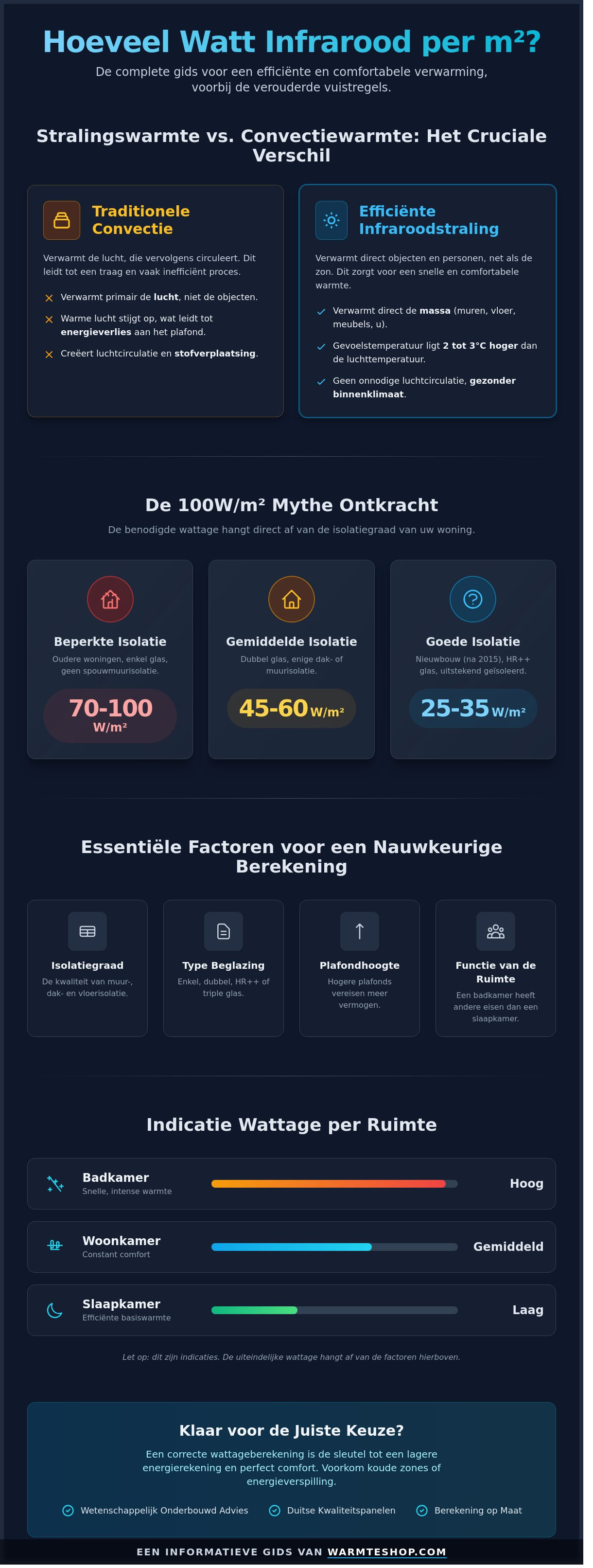
Every room in the house has its own character and specific heating needs. It is a misconception that you can apply the same power output to every square meter of the home. To determine how many watts of infrared per m² you actually need, we look at the use of the space and the desired heating speed. In the living room, where relaxation is central, we aim for a constant and even heat distribution. For an averagely insulated seating area, we generally calculate with 75 to 100 watts per m². By distributing the power across multiple ceiling panels, you create an enveloping warmth comparable to the natural radiation of the sun.
The bedroom requires a completely different approach. Here, a healthy night's sleep is the highest priority. Because a room that is too warm disrupts sleep quality, a lower output of 60 to 70 Watts per m² suffices. This is enough to remove the chill from the air without the room feeling stuffy. In a home office, the focus is precisely on productivity. Sitting still at a desk causes your body to cool down faster. A targeted panel of 80 to 90 Watts per m² above the workspace keeps your concentration sharp, while the rest of the room can remain at a lower base temperature. This saves energy and increases comfort where you need it most.
In the bathroom, different laws apply to comfort. You are often lightly dressed there, and the tiles naturally feel cold. That is why we use a significantly higher output of 150 to 200 Watts per m² here. This extra capacity is necessary to bring the room to a comfortable temperature within 5 to 10 minutes. A smart solution is the installation of an infrared mirror. This not only provides direct radiant heat to your face while shaving or applying makeup but also prevents the mirror from fogging up after a hot shower.
Homes with a void or ceilings higher than 3 meters pose a challenge for traditional systems. Although infrared radiation heats objects directly and not the air, a form of heat loss still occurs at extreme heights due to natural air circulation. In such situations, we recommend increasing the calculation of infrared wattage per m² by 15% to 20%. For very large volumes or commercial spaces , industrial air heaters based on powerful infrared technology are often the most efficient choice
When installing in large spaces, height is crucial. A panel hung too high loses intensity before the radiation reaches the floor. Wall mounting can offer a solution in an atrium to direct the radiation horizontally into the living zone, but ceiling mounting remains superior for heating the mass in the home. By strategically choosing more powerful elements in areas where you spend a lot of time, energy consumption remains manageable while living comfort is maximized.
Do you want to know exactly what capacity your specific situation requires? Request a free consultation at Warmteshop and let our experts make an accurate calculation for you.
You now have a clear picture of the theoretical basis and know approximately how many watts of infrared per m² are needed to comfortably heat your spaces. However, determining the correct power output is only the first step. The true power of an infrared system lies in translating those figures into a flawlessly functioning installation in practice. At Warmteshop, we combine German engineering with years of experience to convert that calculation into tangible warmth that feels like the natural radiation of the sun.
With more than 30 showrooms spread across the Benelux, we offer an accessible place where expert advice and technology come together. Our advisors look beyond a standard table. We analyze the specific thermal properties of your home, because a corner house from 1970 requires a fundamentally different approach than a modern apartment from 2022. Our high-quality German panels distinguish themselves by having the highest efficiency per watt on the market. This means that less energy is lost at the back of the panel and more active radiant heat is directed into the room. This not only increases comfort but also keeps the energy bill structurally low.
Our vision extends beyond the present day. With an eye on 2026, the year in which the transition to sustainable heating solutions accelerates due to changing legislation, we position infrared as the smart, all-electric standard. Our professional installation service ensures that every panel is mounted in the exact position to make optimal use of the room's thermal mass. Incorrect placement can reduce effective efficiency by as much as 15% to 20%. We avoid these pitfalls and guarantee a result that perfectly matches your living requirements, both aesthetically and functionally.
"Guessing" with wattages online carries risks that only become apparent when the first frost sets in. Insufficient power means the desired temperature is never reached, while excess power entails unnecessary investment costs. Our experts identify critical points such as thermal bridges in old window frames or the specific impact of mechanical ventilation on the perception of warmth. We calculate exactly how many watts of infrared per m² your specific situation requires. You will receive a free quote and a detailed consultation from us, so you know exactly where you stand without any surprises afterwards.
The switch to a healthier indoor climate and a lower carbon footprint starts with the right choice. View our full range of infrared heating and discover how design and sustainability go hand in hand. Whether you choose subtle glass panels or functional ceiling heating, the technology is ready to transform your home. Visit a showroom near you today for a live demonstration of our systems. Experience the deep, soothing warmth for yourself and learn about the savings opportunities for your unique living situation. Start saving today and invest in the comfort of tomorrow.
Determining how many watts of infrared per m² you need forms the crucial foundation for an energy-efficient home in 2026. You have discovered in this guide that floor area is not the only factor that counts. Factors such as the degree of insulation and ceiling height determine whether you achieve optimal comfort with 60 or 100 watts per square meter. A bathroom simply requires a higher intensity than a home office to immediately feel that characteristic, healthy radiant heat.
At Warmteshop, we translate these figures into a concrete plan for your interior. We have been the market leader in the Benelux since 2008, and our certified heating experts are ready to advise you in more than 30 showrooms. Thanks to our patented infrared technology, you benefit from the highest efficiency currently available. This results in a significant reduction in your CO2 emissions and an immediately noticeable saving on your monthly energy costs.
Make the switch to a sustainable and stylish heating system that feels like the first spring sunshine. Calculate your savings and view our infrared panels to see immediately what the possibilities are for your specific living situation. We look forward to working with you to prepare your home for the future.
For a 30 m² living room, you require an average of 2,250 Watts of power with a standard insulation value of 75 Watts per m². In an optimally insulated new-build home, this can drop to 1,800 Watts, whereas a home from 1970 often requires 3,000 Watts to remain comfortably warm. This calculation guarantees that the room maintains a constant indoor temperature of 21 degrees, even at an outside temperature of 5 degrees Celsius.
Two small panels offer superior heat distribution compared to one large panel of the same total wattage. By strategically placing the heat sources opposite each other, you prevent cold zones and create an even heat field that feels like the sun's natural radiation. In a room larger than 15 m², we always recommend installing multiple units to make optimal use of the 110-degree beam angle.
A panel with a higher wattage does not necessarily consume more power, because a powerful system reaches the target temperature faster and then switches off. A correctly sized 1000-watt panel operates more efficiently than a 500-watt model that must remain on continuously to dispel the cold. This results in a 15 percent saving on your energy consumption because the thermostat accurately limits the heating time to the bare minimum.
For effective supplementary heating in the bathroom, a power output of 100 to 120 Watts per m² is necessary to quickly warm up cold tiles and mirrors. In an average 6 m² bathroom, you should therefore choose an infrared panel of at least 650 Watts for an immediate sense of comfort. This higher intensity is essential to experience pleasant warmth within 10 minutes during your morning routine.
The material of the front panel influences the rate of heat release, with ceramic panels retaining heat longer than metal variants. When determining how many watts of infrared per m² you should install, the emissivity factor of the material plays a role; dark surfaces often radiate heat slightly more efficiently than glossy materials. Our experts calculate exactly which material provides the best return for your specific living situation and aesthetic preferences.
A standard 16-amp electrical circuit can support a maximum wattage of 3680 watts simultaneously without the fuse blowing. If you wish to heat an entire floor of 80 m², it is necessary to distribute the power over at least two or three different circuits. We recommend having a separate circuit installed by a certified installer for each room with a total power exceeding 2500 watts.
With an installed wattage that is too low, the room will never reach the desired comfort temperature, causing the panels to continue consuming power uninterruptedly without result. This leads to an unnecessarily high energy bill and an uncomfortable indoor climate because the walls and furniture do not build up sufficient thermal mass. A power deficit of just 15 percent can already cause the perceived temperature to be 3 degrees lower than planned.
Under a canopy, you need a significantly higher output of 250 to 300 Watts per m² to compensate for the influence of wind and cold air currents. For a seating area of 12 m², a short-wave infrared heater of 3000 to 3600 Watts is required for a noticeable result. These powerful heaters reach their full intensity within 1 second, allowing you to sit comfortably outside even at an outdoor temperature of 12 degrees.


