Heating a conservatory in winter: From an ice-cold glass cabinet to a warm winter garden

Heating a conservatory in winter: From an ice-cold glass cabinet to a warm winter garden

, by Warmteshop, 21 min read

What if your glass extension is no longer an unusable refrigerator in January, but the most comfortable spot in your home? Many owners of an extension find that heating their conservatory in the winter is a costly struggle …

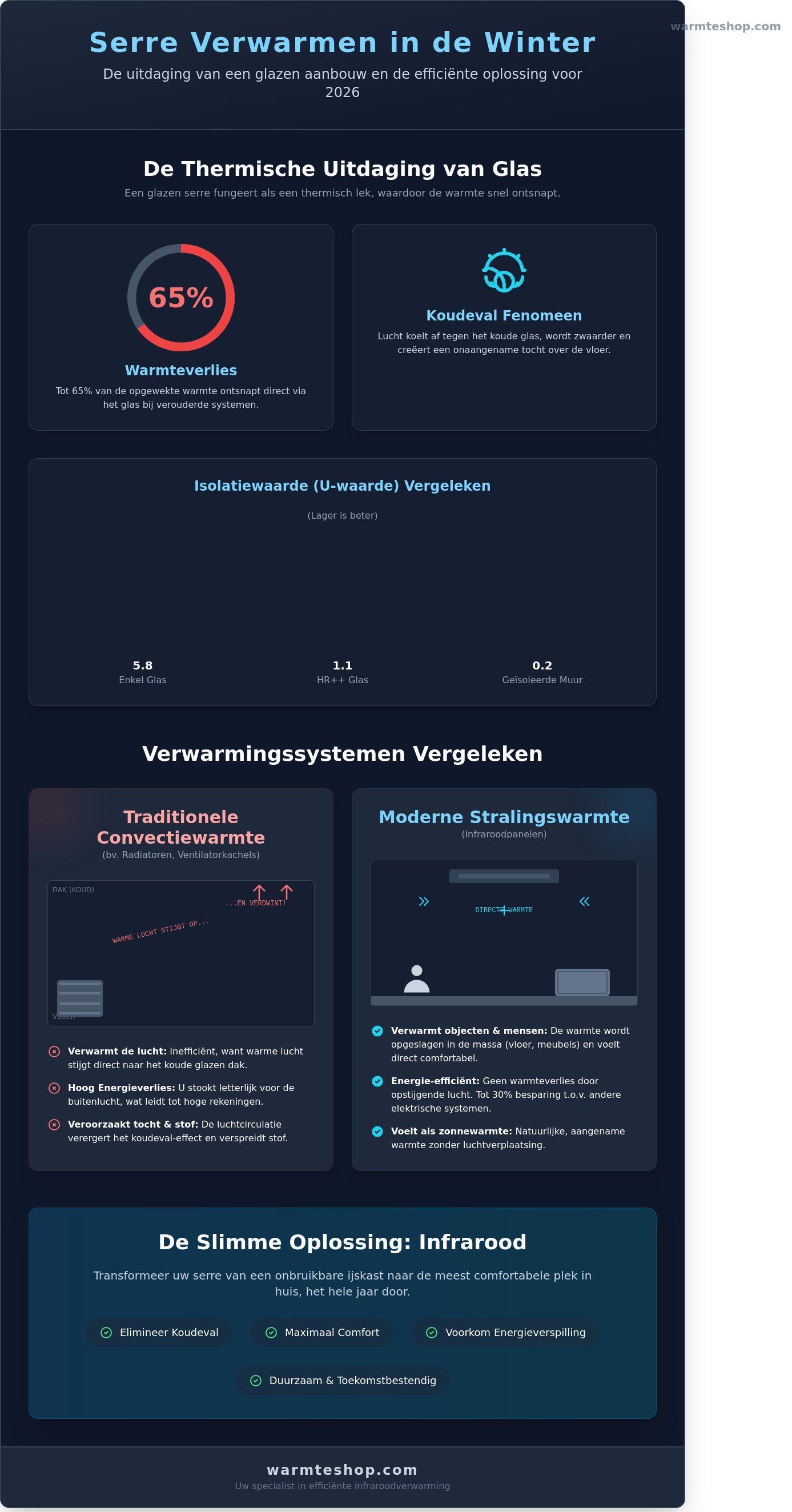
What if your glass extension were no longer an unusable refrigerator in January, but the most comfortable spot in your home? Many owners of an extension find that heating their conservatory in winter seems like a costly battle against the elements. You probably recognize the icy sensation of cold drafts near the windows and the frustrating condensation that obstructs your view of the garden. It is understandable that you hesitate to turn on the heating when up to 65% of the generated heat is lost directly through the glass in outdated systems.

In this article, you will discover how to heat your conservatory efficiently and comfortably in 2026, so that you can enjoy an atmospheric winter garden even at sub-zero temperatures. We are leaving the era of noisy, energy-guzzling fan heaters behind and making the switch to smart radiant heat that feels like the first spring sunshine. You will gain insight into how to create a comfortable climate without drafts or high bills. We discuss the most sustainable techniques that enhance your living comfort while simultaneously reducing your energy consumption by up to 30% compared to traditional electric heating.

Key Points

  • Understand the unique challenges of glass architecture and learn how to permanently eliminate the unpleasant phenomenon of cold drafts in your conservatory.
  • Discover the science behind infrared radiation which, just like the natural heat of the sun, directly heats objects and people without energy loss due to drafts.
  • Compare different systems and discover why heating a conservatory in winter with infrared panels is the most efficient and future-proof solution for 2026.
  • Get practical tips on smart insulation techniques and the strategic positioning of heating elements for maximum efficiency and optimal living comfort.
  • Learn how to transform your conservatory into a sustainable and stylish winter garden with aesthetic custom solutions, from infrared mirrors to design panels.

Why is heating a conservatory in the winter so challenging?

A conservatory offers a unique connection to the outdoors all year round, but as soon as the temperature drops below 5 degrees Celsius, this glass oasis often turns into an uncomfortable refrigerator. The fundamental cause of this lies in the physics of the material. Glass is an excellent conductor of temperature, which is a disadvantage in this case. While a standard insulated cavity wall has a U-value of approximately 0.2 to 0.3 W/m²K, even modern HR++ glass performs significantly worse with a value of 1.1 W/m²K. In the case of older conservatories with single glazing, we are even talking about a U-value of 5.8 W/m²K, allowing heat to escape almost unhindered.

The scientific basis behind the operation of a conservatory explains why sunlight heats the space quickly during the day, but this process works in the opposite direction during the winter months. As soon as the sun sets, the enormous glass surface acts as a thermal leak. The generated indoor heat is absorbed by the glass and immediately radiated into the cold outside air. As a result, heating a conservatory in winter a task that requires a specific approach, since standard methods simply cannot cope with this constant heat loss.

The thermal challenge of glass facades

In a glass room, the outside temperature plays a dominant role. When the wind blows against the glass at a speed of 15 kilometers per hour, the surface cools down even faster. This creates a phenomenon we call cold draft. The air that comes into direct contact with the cold glass cools down, becomes heavier, and flows downwards at a rapid pace. This causes an unpleasant, drafty airflow across the floor, even if the thermostat indicates that the air temperature in the center of the room is acceptable. As a result, comfort is completely negated.

The difference between a hobby greenhouse and a living greenhouse

The purpose of the space determines the strategy. For a hobby greenhouse where only frost-sensitive plants overwinter, a temperature of 5 to 7 degrees Celsius suffices. For a living greenhouse where you want to read or dine comfortably, a constant 20 degrees Celsius is required. This temperature difference of 13 degrees has a huge impact on energy consumption. Traditional radiators and convector heaters often fail here. They operate on the basis of air circulation, whereby the warmest air rises directly to the highest point of the greenhouse: the glass roof. This is the most unfavorable spot, as the heat is immediately lost to the outside air there.

Convection heat vs. Radiant heat

The mistake many people make when heating a conservatory in the winteris focusing on heating the air. Warm air is volatile and extremely difficult to retain in a glass environment. At Warmteshop, we therefore always advise heating the mass of the space rather than the air. Think of the way the sun can still warm your face on a cold winter day. This is radiant heat.

  • Convection: Heats air, rises to the cold roof, causes dust circulation and dry air.
  • Radiant heat: Directly heats the floor, furniture, and people. The objects retain the heat and gradually radiate it back out.

By choosing systems that heat objects, you minimize the impact of cold drafts and avoid literally heating the outside air. Transforming your conservatory into a sustainable, warm place begins with understanding that forced-air heating in a glass environment is like trying to mop up water with the tap still running.

The science behind infrared: The sun in your conservatory

Infrared radiation works fundamentally differently from the central heating we are used to. Where a classic radiator heats the air, an infrared panel emits invisible light waves that directly heat objects and people. You can best compare this to the natural warmth of the sun on a cold winter day; as soon as the sun disappears behind a cloud, you feel the cold, even though the air temperature has not changed. Your infrared heating works on exactly the same principle.

It is that direct, pleasant warmth that makes the difference between a chilly room and an atmospheric place, comparable to the sun on an Italian hill. For a beautiful example of such a luxurious and comfortable setting, you can check out Casa Balconi.

In a glass room, this is a crucial advantage. After all, warm air rises and escapes through the smallest cracks or cools down rapidly against the cold glass surface. With infrared technology, the energy remains stored in the mass of the room. This makes targeted conservatory heating in winter not only more comfortable but also much more logical. You heat the spot where you are sitting, instead of trying to keep the entire cubic meters of air in a poorly insulated room at temperature.

How infrared bypasses the glass problem

Glass is a notorious enemy of heat retention. Traditional convection heat is lost as soon as the air hits the glass. Infrared panels bypass this by activating the floor, furniture, and interior walls as heat batteries. These objects absorb the radiation and then release that heat very gradually back into the environment.

Another technical advantage is controlling the dew point. Because the walls and windows are directly irradiated, they remain warmer than the surrounding air. This prevents moisture from condensing on the glass, reducing condensation and mold growth by up to 85%. For optimal results, it is advisable to also consult this energy-saving checklist, which emphasizes how important sealing air leaks remains. Infrared radiation feels like the embrace of a sunny spring day, even when a snowstorm is raging outside.

Different wavelengths: Short vs. Long wave

Not every infrared source is the same. For a conservatory that serves as an extension of the living room, choose long-wave infrared panels. These panels do not emit light and provide a constant, mild heat that is ideal for prolonged use. They are safe for the skin and eyes, as the radiation intensity is specifically tuned for human comfort.

However, do you want to heat an unheated, drafty corner of the conservatory in winter for just an hour? Then a patio heater with short-wave radiation (recognizable by its orange glow) is more effective. This radiation is more powerful and insensitive to gusts of wind, but less suitable as permanent primary heating due to higher consumption and intense heat.

  • Long wave: Perfect as aesthetic main heating, no light emission, very energy-efficient with constant use.
  • Short wave: Ideal for immediate heating needs in open spaces, powerful radiation, immediately noticeable results.
  • Health: Because there is no air circulation, 90% less dust and pollen swirls around in your greenhouse.

Switching to this technology is a smart upgrade for your living comfort. It keeps humidity at a stable level of around 45% to 55%, which is pleasant for both your respiratory system and your houseplants. If you are wondering what capacity is needed for your specific glass surface, you can always seek no-obligation advice from an expert to have a custom calculation made.

Comparing heating systems: What really works in 2026?

The technology for heating a conservatory in winter will have matured by 2026. We are no longer looking at systems that simply heat the air; we are focusing on solutions that reach objects and people directly. Old-fashioned gas heating is losing ground due to the complex installation of pipes and the necessary ventilation that vents precious heat directly back outside. An average gas connection in an extension nowadays easily costs €1,500 in extra installation work, which unnecessarily prolongs the payback period.

Pellet stoves and wood stoves present a rustic image, but the reality in 2026 is different. Strict regulations regarding particulate matter emissions and constant maintenance make these systems less attractive for a glass-enclosed space. Moreover, temperature control is difficult. A conservatory reacts extremely quickly to the outside air; a heater that continues to glow for hours after the sun breaks through creates an unpleasant indoor climate. The "cheap" electric fan heater is the biggest pitfall. Although the purchase price is often under €40, such a device consumes 2,000 watts per hour to move air that immediately cools down against the glass. This results in a monthly energy bill that is 60% higher than with radiant heat.

For optimal results, we often combine active systems with passive heating strategies to retain base heat. This involves the use of thermal mass that absorbs heat during the day and releases it slowly in the evening, meaning the active heating does not have to work as hard.

Infrared vs. Underfloor Heating

In modern conservatories, electric underfloor heating often serves as the ideal foundation. It maintains the floor at a constant temperature of 18 degrees, preventing the cold from rising. The major drawback is its slowness; it often takes 3 to 5 hours for a cold floor to fully warm up. In a room with a lot of glass, where the temperature can plummet within 20 minutes at sunset, this response speed is insufficient.

Infrared panels fill this gap perfectly. This technology works exactly like the sun; the radiation does not heat the air, but directly your body and furniture. You will experience comfortable warmth within 5 to 10 minutes of switching it on. The installation costs of infrared are on average 40% lower than with traditional water-based systems, because no demolition work or piping is required.

Zone heating: The smart choice for the conservatory

Efficiently heating a conservatory in winter means stopping the heating of unused corners. By 2026, zone heating will be the standard. By strategically placing infrared panels above the seating area or dining table, you create an island of comfort without forcing the entire glass surface to 21 degrees. This immediately saves 25% on energy consumption.

Modern thermostats with Wi-Fi modules play a crucial role in this. These systems learn how quickly your conservatory cools down and only heat up when strictly necessary. You can activate the heating via an app while you are still in the kitchen, so that the conservatory is ready for use as soon as you are. A professional heat calculation by an expert is essential here; they calculate exactly how many watts per square meter are needed based on the insulation value of your glass, ensuring you never pay too much for your comfort.

Heating the conservatory in winter

Optimally furnishing your conservatory for winter use: Practical tips

A conservatory offers a unique view of the winter garden, but the large glass surfaces pose a challenge for your energy consumption. Heating your conservatory in winter therefore starts not with the thermostat, but with the design of the space itself. While standard bubble wrap is often a temporary and aesthetically less pleasing solution, thermal curtains with a metallized backing offer a more sustainable alternative. These curtains increase the insulation value of your glazing by as much as 40 percent, ensuring that the heat from your infrared panels stays inside instead of escaping.

Sun protection plays a surprising role during the cold months. While you utilize the sun's power during the day to passively warm the room, closed screens or roller shutters act as an extra barrier at night. This layer of still air between the glass and the sun protection reduces heat loss through the windows by an average of 15 to 20 percent. It is a simple action that has an immediate effect on your comfort and your energy bill.

Ventilation remains essential, even if you prefer to keep the cold out. A lack of fresh air leads to high humidity, which causes condensation on the profiles. Humid air requires significantly more energy to heat than dry air. By opening two windows opposite each other for 10 minutes daily, you refresh the air without the walls and furniture cooling down completely. This ensures a healthier indoor climate and more efficient operation of your heating system.

Where will you place the heating?

The position of your infrared panel determines the efficiency. Ceiling mounting is often more effective than wall mounting in a conservatory because it prevents cold drafts. The cold air sinking down along the glass walls is immediately neutralized by the radiant heat. Never place a panel directly opposite a window; the long-wave infrared radiation will then partially disappear through the glass. Aim the panels at the areas where you actually spend time to create a comfortable heat island, similar to the direct warmth of the sun on your skin.

Small interventions with a big impact

Details make the difference in a glass extension. A gap of just 2 millimeters in a sliding door can increase heat loss by 12 percent. Sealing seams with high-quality EPDM strips is an investment that pays for itself within a single winter. Additionally, plants play an active role; they regulate humidity naturally. Add a thick, low-pile rug to your seating area. Because infrared radiation heats objects, the rug will absorb the heat and slowly release it back to your feet, significantly improving the overall sense of comfort when heating the conservatory in winter .

Would you like to know exactly which setup is most cost-effective for your space? Discover our expertise and explore the possibilities for custom infrared heating for your conservatory.

The step towards a sustainable, warm conservatory with Warmteshop

Creating a pleasant climate in a glass extension requires a well-thought-out approach. At Warmteshop, we understand that a standard solution is often insufficient for the unique thermal dynamics of glass. Since the founding of the Infrared Heating Group, we have specialized in systems that heat not the air, but directly the objects and people in the room. This principle of radiant heat is comparable to the natural warmth of the sun, which is essential for heating a conservatory in winter keeping

Our custom solutions go beyond mere heat transfer. We offer a wide range of products, varying from functional infrared mirrors that prevent condensation on glass to artistic photo panels that reflect your personal style. The quality of our systems is ensured by strict European production standards, and we often offer a 10-year warranty on the heating elements. This underscores our focus on sustainability and long-term value for your home.

To truly understand the effectiveness of infrared radiation, a physical experience is often decisive. In our showrooms, we let you feel the difference between the dry air of a convector and the penetrating, healthy warmth of our panels. Because every conservatory differs in terms of insulation value and glass surface area, we always recommend requesting a free heat calculation. Our experts calculate exactly how many watts per square meter are needed, ensuring you never consume too much energy but always enjoy a comfortable temperature.

Aesthetics meets functionality

Heating no longer needs to be a disruptive element in your interior. Our panels are designed to blend seamlessly into the architecture of your conservatory. Whether you choose sleek, white ceiling panels that disappear against a light profile or personalized glass panels featuring your own image, the possibilities are endless. By 2026, the standard for a modern conservatory is that design and comfort go hand in hand, with technology invisibly contributing to a luxurious feel. Thanks to the low installation height of just 2 centimeters, you retain the spacious character of your glass extension while benefiting from a superior indoor climate.

Expert advice and installation

a conservatory in winter requires precision during placement. An incorrectly positioned panel can lead to heat loss through the glass or uneven heat distribution. Professional installation is therefore crucial for both safety and optimal efficiency. Our certified installers ensure a safe electrical connection and strategic positioning, which can reduce energy consumption by as much as 15% to 20% compared to DIY installation.

With our strong local presence in the Benelux, we are always close to our customers. You can visit the following locations for expert advice:

  • Roeselare: Our expertise hub for West Flanders.
  • Oud-Gastel: Centrally located for our Dutch customers.
  • Antwerp: Our flagship location for the Greater Antwerp region.

Are you ready to enjoy your conservatory to the fullest this winter without worrying about the energy bill? Contact Warmteshop today for a tailored solution that perfectly matches your living situation and aesthetic preferences.

Enjoy your glass winter garden all year round

You can easily transform a chilly glass extension into a fully-fledged living space by choosing the right technology. Infrared heating mimics the natural warmth of the sun, where the radiation directly heats objects and people instead of the volatile air. This prevents unnecessary energy loss through the glass surface. Heating your conservatory in winter thus becomes a sustainable choice that seamlessly aligns with the modern living standards of 2026. You enjoy a healthy indoor climate without bothersome air movement or dust circulation.

Warmteshop has been the undisputed market leader in the Benelux for this innovative form of heating since 2008. With a network of more than 30 physical stores, our experts always offer a tailored solution that fits your specific living situation. Our specialized infrared panels are designed for maximum energy efficiency and aesthetic integration into your interior. The transition to a green, warm conservatory is therefore a smart upgrade for your home value and your daily comfort.

Discover our infrared solutions for your conservatory and request a quote. We would be happy to welcome you to one of our showrooms for a personal demonstration of this healthy radiant heat.

Frequently asked questions about conservatory heating

What is the cheapest way to heat a conservatory in the winter?

The most cost-effective method to heat a conservatory in winter is the use of infrared panels in combination with high-quality insulation. Infrared panels consume up to 30 percent less energy than traditional convection heaters because they heat objects and people directly rather than the air. Thanks to this targeted radiant heat, you only need to set the thermostat an average of 2 degrees lower for the same level of comfort. This directly results in a lower energy bill at the end of the season.

How many watts per m² do I need for a glass conservatory?

For a standard glass conservatory, you need an average of 100 to 150 watts per square meter to maintain a comfortable temperature. In a room with a large glass surface area, heat loss is greater than in a well-insulated living room. Therefore, our experts often recommend a capacity of 120 watts per m² for single glazing and 100 watts per m² for double glazing. An accurate calculation prevents you from consuming unnecessary electricity or, conversely, being left in the cold.

Can I install infrared panels in my conservatory myself?

You can easily install infrared panels yourself using the included mounting kits and a standard 230V socket. Many of our customers choose DIY installation on the ceiling or wall to immediately enjoy the healthy solar heat. However, for a seamless finish and optimal zone layout, we recommend engaging a certified installer. This guarantees safe integration into your electrical circuit in accordance with the applicable NEN 1010 standards.

Does bubble wrap really help insulate a conservatory?

Bubble wrap reduces heat loss through single glazing by up to 50 percent during the cold winter months. It creates a layer of still air that acts as a thermal barrier between the cold outside air and your heated interior space. For best results, preferably use UV-resistant bubble wrap with 30-millimeter bubbles. This simple measure makes heating your conservatory in winter significantly more efficient and prevents precious radiant heat from escaping directly outside.

Is infrared heating safe for the plants in my greenhouse?

Infrared heating is extremely safe and even beneficial to the health of your plants because it mimics the natural warmth of the sun. The radiation heats the plant mass and potting soil directly, stimulating root growth without unnecessarily drying out the air. Because humidity remains stable and there is less dust circulation, you reduce the risk of mold formation by 25 percent. As a result, your plants remain noticeably more vital during the winter dormancy period.

How do I prevent condensation on my conservatory roof in the winter?

You prevent condensation by keeping the surface temperature of the glass above the dew point using targeted infrared radiation. Unlike warm air condensing against cold glass, infrared panels heat the glass surface itself. As a result, the pane remains dry and you maintain a clear view to the outside. Good ventilation combined with a constant base temperature of 7 degrees Celsius is often sufficient to completely eliminate moisture problems and condensation.

Can I use my conservatory all year round with infrared?

With the right infrared solution, you transform the conservatory into a fully-fledged living space that you can use comfortably 365 days a year. Even when the outside temperature drops below freezing, the panels create a cozy climate within 10 minutes. You don't have to heat all day; the fast warm-up time makes the system ideal for flexible use. This way, you can enjoy a sunny breakfast in your own glass garden even in January.

What are the disadvantages of infrared heating in a conservatory?

The main disadvantage is that infrared radiation requires a direct line of sight to effectively heat objects and people. If you sit behind a large object, you feel the direct heat less effectively, which we call the shadow effect. Additionally, the initial purchase price of a high-quality panel is often 40 percent higher than that of a cheap electric fan heater. However, you will recoup this investment within 3 years due to lower running costs and a long lifespan.

Tags


Blog posts

  • Smart Home Wi-Fi Modules: The Key to Intelligent Infrared Heating in 2026

    , by Warmteshop Smart Home Wi-Fi Modules: The Key to Intelligent Infrared Heating in 2026

    Read more 

  • Ceramic hob heating: The ultimate guide to stylish and economical heating

    , by Warmteshop Infrared heating Ceramic plate heating: The ultimate guide to stylish and economical heating

    Read more 

  • 4-star comfort at home: Why infrared heating is the new standard in 2026

    , by Warmteshop Infrared heating 4-star comfort in the home: Why infrared heating is the new standard in 2026

    Read more 

  • Buying infrared heating for 10m²: The ultimate buying guide for 2026

    , by Warmteshop Buying infrared heating 10m2: The ultimate buying guide for 2026

    Read more 

© 2026 Warmteshop, Website is managed by Eugene Verbraak

  • American Express
  • Apple Pay
  • Bancontact
  • Google Pay
  • iDEAL Wero
  • Maestro
  • Mastercard
  • PayPal
  • Shop Pay
  • Union Pay
  • Visa

Login

Forgot password?

Don't have an account yet?
Create a free account and enjoy many benefits.