

Heating the attic room in 2026: The complete guide to optimal comfort
, by Warmteshop, 20 min read
, by Warmteshop, 20 min read
Why would you still invest over 3,500 euros in 2026 in the laborious process of running central heating pipes to the top floor? Many homeowners leave their attics unused because the space simply feels too cold and drafty…
Why would you still invest over 3,500 euros in 2026 in the laborious process of running central heating pipes to the top floor? Many homeowners leave their attics unused because the space simply feels too cold and drafty. You are certainly not the only one who dreads the high installation costs and the mess of a major renovation. Heating your attic room sustainably often seems like a technical challenge, especially when the current insulation is not yet optimal.
We agree that every square meter in your home should be comfortable, regardless of the season. In this comprehensive guide, you will discover how to transform your attic into a cozy living space using the most efficient heating solutions available today. You will learn how to enjoy healthy radiant heat in just 10 minutes that feels instantly like the natural warmth of the sun. We dive into the world of aesthetic infrared panels that take up no valuable space and can reduce your energy costs by up to 20 percent compared to traditional systems. From quick installation to a carbon-neutral indoor climate, you will find all the answers here for a future-proof and warm home.
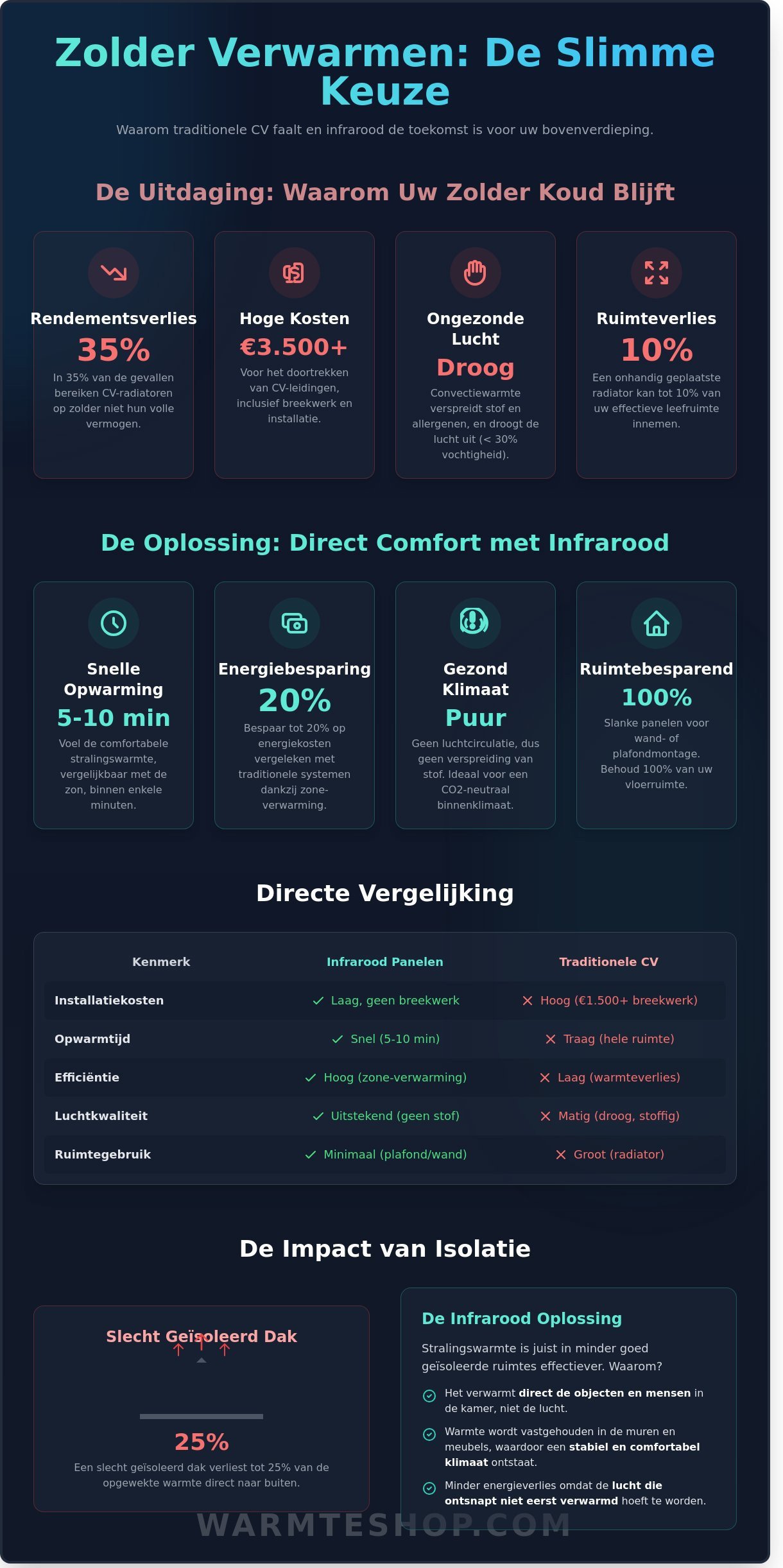
Heating an attic room requires a fundamentally different approach than the rest of your home. In most Dutch houses, the attic is located at the furthest point of the central heating circuit. The circulation pump of an average central heating boiler often has to force the hot water up two or three floors against gravity. This results in a loss of efficiency, whereby radiators on the top floor do not reach their full thermal output in 35% of cases. You turn the thermostat up high downstairs, but upstairs it remains chilly and uncomfortable.
Moreover, the thermal dynamics on the top floor are paradoxical. While warm air rises from the lower floors, the attic cools down the fastest due to the enormous roof surface area. Without the right heat source, an unpleasant indoor climate develops. Traditional convection radiators work by heating the air in the room. This process causes a constant airflow that disperses dust particles and allergens throughout the room. Especially in an attic, where ventilation is often more limited than in the living room, this leads to dry air with a humidity level that regularly drops below the critical threshold of 30%.
Extending existing gas lines to the top floor often entails unforeseen complications. Breaking open walls and floors for new pipes costs the average household between €1,500 and €2,500 for demolition and installation. These hidden costs often make choosing a traditional installation financially illogical. We therefore view the transition to smart, electric solutions not as a last resort, but as a strategic upgrade for your living comfort and the value of your home.
The effectiveness of your heating system stands or falls with the condition of your roof. The difference in heat demand between an uninsulated attic and a modern insulated roof is enormous; a poorly insulated roof loses up to 25% of the generated heat directly to the outside. When making a choice, it is essential to understand the principles of thermal insulation . Dormers, in particular, are notorious for thermal bridges. These weak points in the building envelope completely undermine the effectiveness of forced-air heating, because the heated air escapes immediately or cools down upon contact with the cold wall. Radiant heat offers a solution here, as this technology heats not the volatile air, but the solid objects and people in the room directly, comparable to the healthy rays of the sun.
Attics are characterized by their unique architecture, but the sloping walls present a logistical puzzle for traditional heating appliances. A standard radiator often has a height of 60 centimeters, while a knee wall in an attic is frequently no higher than 40 to 50 centimeters. Placing a bulky unit in the middle of the room consumes valuable square footage and disrupts the aesthetics of the space. For a 15-square-meter attic room, an awkwardly placed radiator can reduce the effective floor space by as much as 10%. A slim, space-saving solution that can be mounted on the wall or even the ceiling is therefore not a luxury, but a necessity to make optimal use of the attic as a fully functional bedroom or home office.
Attic rooms are often the most challenging spaces in the house to get comfortably warm. Traditional radiators rely on air circulation, where warm air rises directly to the highest points of the sloping roof. Infrared panels work fundamentally differently. This technology uses radiant heat, a principle you can compare to the natural warmth of the sun on a clear winter day. Instead of heating the air mass, the infrared rays focus directly on the objects, the floor, and the people in the room. These objects store the heat and gradually release it back into the surroundings.
The speed of this system is one of the greatest assets for a multifunctional attic. Within just 5 to 10 minutes of switching it on, you will already experience noticeable warmth at your workspace or by the bed. In the energy landscape of 2026, where the focus lies entirely on the transition to gas-free living, this is a crucial feature. Heating an attic room with infrared allows you to heat very precisely. You heat only the zone where you are located, which is significantly cheaper than trying to keep the entire volume of the attic at temperature with a central heating boiler.
The maintenance-free nature of these systems offers extra peace of mind. Infrared panels contain no moving parts or liquids. In concrete terms, this means:
The required capacity for your panel depends heavily on your home's thermal envelope. For an attic with modern insulation, we calculate an average of 25 to 30 Watts per cubic meter. With a moderately insulated roof, this requirement quickly rises to 35 to 40 Watts per m³. A well-insulated envelope is essential for low consumption; therefore, consult this guide to attic insulation to determine whether your roof already meets current standards. Also, take the ceiling height into account. The higher the ridge, the more power is needed to effectively direct the radiation to the floor. We often recommend a slight overcapacity. A panel with higher power reaches the desired temperature faster, causing the thermostat to switch off sooner. This results in approximately 15% lower energy consumption compared to an undersized system that has to operate at full power constantly.
Heating a healthy attic room means more than just setting the right temperature. Because infrared panels do not move air, dust particles, pollen, and allergens settle on the floor instead of floating around. This is a huge relief for people with sensitive airways or asthma who use the attic as a bedroom. Furthermore, the radiation has a positive effect on the structural integrity of your attic. The rays penetrate the walls and dry them from the inside out. This effectively prevents the formation of mold, a problem that often arises in attics due to condensation on cold walls. You maintain a stable humidity level of around 45%, which improves your concentration in a home office. Discover how you can furnish your attic energy-efficiently with our latest generation of design panels that effortlessly combine style and health.
The choice of the right method for heating an attic room is closely linked to the intended use of the space. While a classic radiator often seems to be the standard solution, modern electric systems often offer greater efficiency and immediate comfort. Installation costs for a high-quality electric convector often start at around €150, whereas a high-quality infrared panel costs between €350 and €850 on average. Although the purchase price of infrared is higher, this investment pays for itself through 20% to 30% lower energy consumption compared to traditional electric heaters.
Flexibility is the biggest advantage of electric systems. A socket solution outperforms a water-based system in every respect. You immediately save €1,200 to €2,100 in plumbing costs because no pipes need to be run through walls and floors. You plug in the panel and the heat is available instantly. This makes it an ideal solution for attics transforming from storage space into a fully functional home office or bedroom.
The comfort experience between these systems differs fundamentally. With central heating and convectors, warm air rises. This often results in a stuffy feeling near the ceiling and cold feet on the floor. Infrared radiation works differently. It mimics the natural warmth of the sun by directly heating objects and people. The floor and walls store this heat, ensuring an even temperature distribution without dust circulation. This creates a healthy indoor climate that is essential for a good night's sleep or utmost concentration at work.
Sustainability plays a decisive role in the modern home. The synergy between infrared panels and the solar panels on the roof directly above the attic is optimal. Because the distance between energy generation and the point of consumption is minimal, there is hardly any transport loss. You use your own green electricity to heat the space, paving the way for a completely gas-free upper floor.
A convector is a practical choice for rooms that need to maintain a constant, stable base temperature, such as a guest room that is rarely used but must not freeze. However, a convector is less suitable for poorly insulated attics. This is because the heated air escapes rapidly through cracks or a poorly insulated roof. When choosing inexpensive models, be aware of the drawbacks; these often produce a ticking sound when expanding and can emit a burning odor due to dust burning on the heating elements.
Extending the central heating system to the roof ridge presents technical challenges. Often, the standard circulation pump of the ground-floor boiler is not powerful enough to pump the water up three floors. This requires an additional support pump costing approximately €300. Additionally, you lose an average of 15% of heat in the pipes running through unheated knee walls. In many cases, the existing boiler is simply not designed for the extra capacity required for a full-fledged zone when heating an attic room.
An attic is often a puzzle of sloping lines and limited headroom. Infrared panels offer an elegant solution here by rewriting the laws of traditional heating. Instead of sacrificing valuable floor space to bulky radiators, you choose a strategic position on the ceiling. This keeps the knee walls and walls under the sloping roofs, which are often no higher than 120 centimeters, completely free for built-in wardrobes or a bed. The heat radiates from above downwards, just as the sun warms the earth. This ensures an even heat distribution without dust particles circulating through the room, promoting a healthier indoor climate.
The concept of zone heating is essential for a space that serves multiple functions. Perhaps you use only 4 square meters of the total 20 square meters as a workspace. With a targeted infrared panel above your desk, you create a comfortable microclimate of 21 degrees Celsius, while the rest of the room remains at a refreshing 16 degrees. This prevents unnecessary energy consumption in corners you rarely visit. Efficiently heating your attic room therefore begins with mapping out your daily movements within the space.
The integration of modern thermostats takes this comfort to a higher level. By using self-learning algorithms and weekly schedules, you reduce energy costs by an average of 22 percent. You can easily set the heating to switch on at 8:30 AM, ensuring the attic is at the exact temperature as soon as your workday begins. Safety remains the highest priority. When installing, always maintain a minimum distance of 20 centimeters from curtains or furniture. The panels themselves are designed so that the back remains cool, ensuring that mounting on wooden structures poses no risk whatsoever.
When mounting to a sloping plasterboard ceiling, the use of the correct hollow wall plugs is crucial to safely support the weight of approximately 5 to 10 kilograms. For an optimal beam angle, preferably position the panel parallel to the floor or at an angle of no more than 45 degrees. This ensures that the radiation hits the floor and furniture directly. Cables can be neatly concealed behind the plasterboards or in slim cable ducts running along the roof beams, creating a sleek and modern finish for your attic space.
When choosing a smart approach to heating an attic room, presence sensors play a key role. These sensors switch off the heat immediately as soon as you leave the room, preventing waste if you forget to turn down the thermostat. With Wi-Fi control via an app on your smartphone, you can preheat the attic while you are still having breakfast downstairs. Do you have a dynamic energy contract? Then program the system to provide extra heating during the cheapest hours of the day, so that the thermal mass of the walls retains the heat.
Do you want to know exactly which thermostat best suits your attic layout? Request a free consultation with Warmteshop now for a tailored solution.
Heating an attic room doesn't have to mean compromising on the aesthetics of your interior. Warmteshop proves that technology and design go hand in hand. While traditional radiators are often unsightly elements under a sloping roof, our panels offer a sleek solution just 22 millimeters thick. You can choose from a wide range of finishes, from timeless white (RAL 9016) to personalized photo panels made of tempered safety glass. These panels act as a functional work of art on the wall, giving attic room heating a visual upgrade rather than a necessary evil.
In an attic bathroom, the infrared mirror an indispensable addition. Thanks to the constant surface temperature, condensation stands no chance. You enjoy a clear view immediately after showering without having to wipe. For the children's room on the top floor, our chalkboard panels are a creative solution. Children let their imagination run wild on a surface that is safe to touch, while the room remains at an efficient temperature. This type of heating is dust-free, which is essential for health in smaller, often dusty attic spaces.
Choosing infrared heating is a strategic investment in your property. Homes fully prepared for a gas-free future increase in market value by an average of 5 to 8 percent. You not only improve immediate living comfort but also the home's energy label. Thanks to its long lifespan of more than 25 years and the absence of maintenance costs, this technology is the smartest way to a sustainable attic floor.
Safety comes first in damp spaces. Warmteshop panels have an IP44 rating or higher, making them resistant to splashing water. For extra luxury, integrate a towel radiator that dries your towels while the room is being heated. Infrared radiation tackles moisture problems at the source by directly heating the walls. This prevents mold growth in the corners of your attic bathroom, a common problem with traditional air heating.
Effectively heating an attic room starts with an exact heat loss calculation. Our experts look not only at the number of square meters but also analyze the insulation values of your roof and the specific volume of the space in cubic meters. This prevents overcapacity and unnecessary energy consumption. With more than 30 showrooms in the Benelux, we offer you the opportunity to experience the unique radiant heat for yourself. It is the only way to truly understand the difference between dry air and the natural warmth of infrared.
Are you ready to transform your attic into the most comfortable place in the house? Our advisors are ready to draw up a custom plan for you, including a detailed calculation of the required power.
Request a no-obligation quote for your attic project and discover the possibilities of modern heating.
The transformation of a cold storage space into a fully functional workspace or bedroom requires a well-considered choice. Heating your attic room with infrared technology is the most future-proof step you can take in 2026. Unlike slow convection systems, radiant heat provides immediate comfort without unnecessary energy loss through the roof. Since 2008, Warmteshop has been the specialist in this green transition. We supply systems that operate up to 30 percent more efficiently than traditional radiators by heating the mass of the room in a targeted manner.
You benefit from healthy warmth that reaches objects and people directly, just like the natural power of the sun. With more than 30 physical showrooms in the Benelux, we offer you the assurance of tangible advice and a design that perfectly matches your personal attic style. Our own certified installers take care of the complete installation. This means you don't have to worry about technical pipework or complex renovations. A sustainable and stylish upgrade to your home starts with the right expertise and high-quality materials.
Discover our infrared solutions for your attic room
Take the step today towards a healthier indoor climate and a lower energy bill in the long term.
On average, you need 30 to 40 Watts per cubic meter to effectively heat a well-insulated attic. For a standard 15-square-meter room with a pitched roof, this usually amounts to one powerful 750-Watt panel or two smaller 400-Watt panels. This distribution ensures an even spread of healthy radiant heat throughout the entire space.
Infrared panels are completely safe for wooden roof structures because they reach a controlled surface temperature of up to 95 to 110 degrees Celsius. Built-in heat sensors constantly monitor the temperature and immediately switch off the power in the event of deviations. This TUV-certified technology prevents wooden beams from reaching their critical temperature, thereby eliminating the risk of fire when correctly installed 2 centimeters from the surface.
You can easily install infrared panels yourself using the included mounting brackets and a standard 230V socket. Most DIYers complete the full installation within 30 minutes per panel. For seamless integration with smart thermostats or concealed wiring, you can use our own installation service, which installs more than 5,000 panels annually for homeowners and businesses.
You save an average of 10% to 15% on your total energy bill by specifically using infrared to heat an attic room. Traditional central heating systems often lose 20% of their heat during transport through long pipes to the upper floor. With electric radiant panels, you prevent this transport loss and heat only the room where you are actually present, which has a direct impact on your monthly costs.
The ideal position for an infrared panel is on the flat ceiling section or high on a straight wall, directed towards the area where you spend the most time. From this position, the radiation reaches the floor and furniture within a radius of 4 meters unobstructed. Never place panels directly behind a cupboard or curtain, as this reduces the effective heat output by more than 60%.
High-quality infrared panels are 100% silent because they contain no moving parts such as fans or pumps. Unlike old radiators that can tick or whistle due to air bubbles, these systems work with a solid heating element that expands silently. This makes the technology perfect for a quiet home office or a bedroom where silence is essential for a good night's sleep.
You feel the direct heat radiation on your skin within 5 to 10 minutes of switching on the system. Although the air temperature rises more slowly, the heated objects in the room ensure a stable indoor climate after approximately 20 minutes. Efficiently heating an attic room with infrared mimics the effect of the sun, causing the perceived temperature to be 2 to 3 degrees higher immediately.
Infrared heating is ideally suited as primary heating, provided the attic features modern insulation with a minimum Rc value of 3.5. By using zone control, you set the temperature per room with an accuracy of 0.5 degrees. This smart approach reduces energy consumption by as much as 25% compared to electric convectors, while you enjoy a carbon-neutral living environment.


