

Discussion with the Homeowners' Association about replacing central heating: A guide for 2026
, by Warmteshop, 18 min read
, by Warmteshop, 18 min read
What if the approaching 2026 deadline for stricter flue gas discharge regulations does not lead to sky-high collective costs, but instead offers the chance for complete independence? You are certainly not the only one dreading …
What if the approaching 2026 deadline for stricter flue gas discharge regulations does not lead to sky-high collective costs, but instead offers the opportunity for complete independence? You are certainly not the only one dreading the next meeting. Discussions with the Owners' Association regarding the replacement of the central heating often stall due to the enormous investments in shared infrastructure and residents' justified fear of condemned systems. It is a frustrating situation in which legal obligations and individual interests often stand in sharp opposition to each other.
In this guide, you will discover how to turn this complex impasse into a future-proof solution with infrared heating. This technology brings the healthy radiant heat of the sun directly into your living room, without the need for a jackhammer. We offer you a concrete plan for the HOA meeting that focuses on lower monthly costs and individual control for every resident. You will learn exactly how to make the transition to a carbon-neutral building while keeping installation costs and disruption to a minimum.
The year 2026 marks a crucial turning point for the Dutch housing market and the energy transition. For many Homeowners' Associations (VvE), replacing central heating is no longer a distant concern, but an urgent reality that directly impacts housing costs and comfort. Discussions with the VvE regarding central heating replacement usually begin when the Multi-Year Maintenance Plan (MJOP) indicates that the technical lifespan of the current installations, often between 12 and 15 years, has been reached. At this stage, technical necessity and individual preferences often clash.
There is a fundamental difference between fully collective systems, where a single central boiler heats the entire block, and individual boilers connected to a shared flue (CLV system). With collective systems, the decision rests entirely with the general meeting, whereas with individual boilers with a shared flue, the legal boundary between private property and common responsibility often blurs. In practice, this lack of clarity leads to delays of many years. While the board strives for uniformity and safety, individual owners worry about the investment costs and the extensive work required in their own apartments.
The deed of division forms the foundation of all decision-making. To understand how these processes are legally anchored, it is essential to know what a Homeowners' Association (VvE) is and what obligations it has under Dutch law. Since the introduction of the Gas Boiler Act on April 1, 2023, the collective liability of the board has been significantly increased. Only certified companies are permitted to work on gas combustion installations. This means that a VvE can no longer turn a blind eye to faulty individual installations discharging into a shared channel. Decisions regarding major changes to the heat supply often require a qualified majority of two-thirds of the vote, which discussions with the VvE regarding the replacement of central heating particularly complex when there is a lack of consensus.
The financial impact of retaining gas-fired systems will continue to increase by 2026. Costs for mandatory certified maintenance of flue gas ducts have risen by an average of 20% to 30% over the past two years due to stricter safety requirements. Setting aside funds for new gas infrastructure is risky; it is an investment in a technology that is being slowly phased out. Moreover, banks and mortgage lenders are increasingly requiring a favorable energy label for the financing of apartments. An outdated central system depresses the value of the property. The transition to modern solutions, such as infrared heating, offers a solution here. This technology works not by moving air, but by directly heating objects and people, similar to the healthy radiation of the sun. By opting for decentralized electric systems in combination with smart thermostats, a Homeowners' Association can definitively leave behind complex discussions regarding shared piping and collective boiler maintenance.
Discussions with the Homeowners' Association regarding the replacement of central heating often founder on the complexity of collective systems. A shared heat pump or connection to a district heating network requires extensive renovations to the building envelope and new pipe routing through all homes. Infrared panels offer a no-nonsense alternative. Installation is simply a matter of mounting and connecting to the existing power grid. No demolition work is required, which reduces disruption for residents by 80% compared to installing a collective water-based system.
With infrared, the cost structure shifts entirely towards individual management. With collective systems, HOA boards often struggle with opaque allocation keys and high fixed costs for grid management. With infrared heating, each resident settles their own consumption via a personal energy meter. This directly encourages energy-conscious behavior. Additionally, the maintenance burden for infrared is virtually zero. Whereas gas-fired systems or heat pumps involve annual technical inspections and moving parts that wear out, infrared panels have a lifespan of 25 to 30 years without the need for a technician.
The difference in comfort is immediately noticeable. Traditional radiators work on the principle of convection, where the air is heated and circulates. This causes dust displacement and temperature differences between the floor and ceiling. Infrared emits radiant heat, similar to the sun. This radiation heats the objects and people in the room directly, providing a constant and healthy warmth without dry air.
In the context of 2026, when insulation standards for apartments have become stricter, infrared heating often more efficient than a central system. In a well-insulated room, the heat demand is low. Zone heating allows you to heat only the room you are in. You no longer need to maintain the entire water circuit for a single warm room. This saves energy and significantly improves the indoor climate through stable humidity.
The idea that electric heating is unaffordable dates back to the era of inefficient radiant heaters. The current generation of panels converts 100% of the electricity into heat. In combination with the solar panels on the shared HOA roof, consumption figures will remain perfectly manageable in 2026. This technology also offers aesthetic solutions for specific spaces. Consider the bathroom, where an infrared mirror not only ensures a pleasant temperature but also immediately prevents condensation. In this way, the transition to gas-free living becomes an upgrade in luxury and convenience.
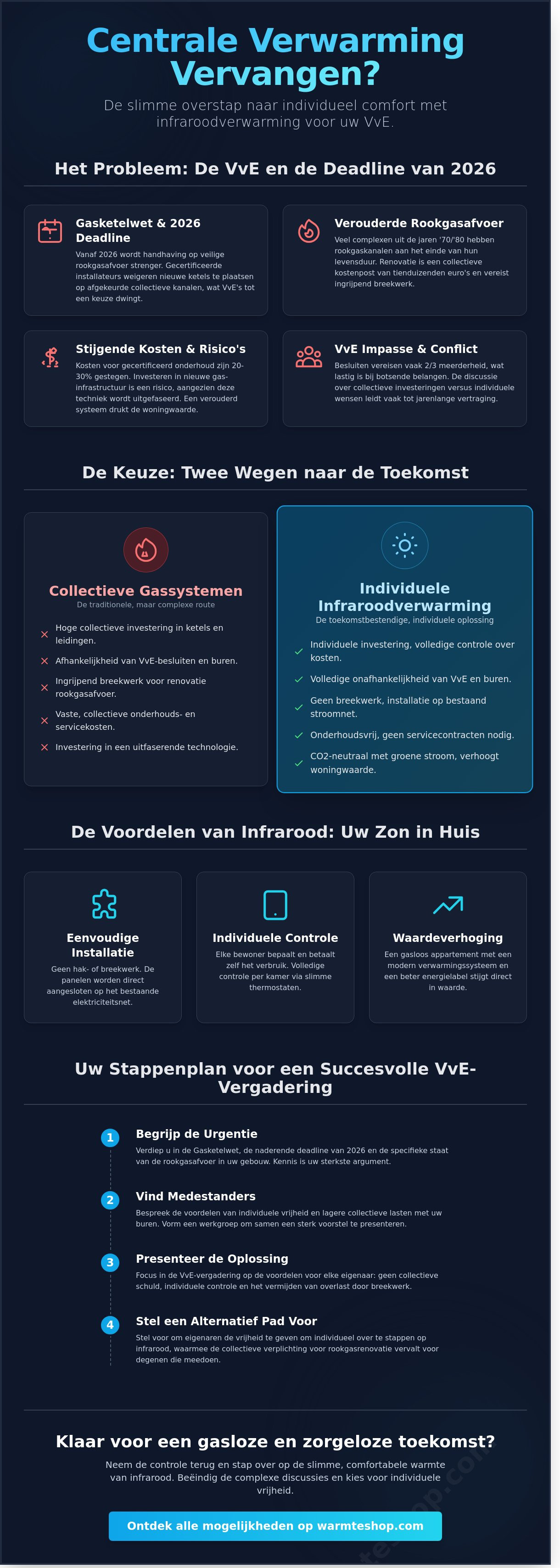
A constructive discussion with the Homeowners' Association about replacing central heating requires a strategic approach. You are not just changing a device; you are altering the energy infrastructure of the entire building. Follow these five steps to get your infrared heating plans approved.
The strongest argument is often the enormous savings on collective maintenance. In a gas-free building, the need for periodic inspection and replacement of common flue gas ducts is eliminated. This saves a Homeowners' Association thousands of euros on average per renovation cycle. In addition, you significantly increase fire safety by completely removing the gas connections from the building. For individual living comfort, infrared offers unprecedented precision. With modern wireless thermostats, every resident controls the temperature per room, preventing waste in unused spaces.
Concerns about the capacity of the meter cupboard are a frequently heard point. In practice, a standard 3x25A connection suffices for most apartments built after 1990, especially when the panels are smartly switched. To alleviate any apprehension, a test setup in a common area or a joint visit to a Warmteshop showroom is enlightening. People need to experience the natural solar heat of infrared to trust the technology. For financing, point out the energy saving loan from the Nationaal Warmtefonds, which offers favorable interest rates specifically for Owners' Associations (VvEs) for this transition.
After all, the goal of the discussion with the Owners' Association regarding the replacement of the central heating system is to create support by linking technical facts to tangible living comfort. Would you like to know how we can support your Owners' Association with tailored technical advice?
The approaching 2026 deadline is forcing many associations to make drastic choices. Infrared heating offers a solution that is superior both technically and financially. By choosing infrared panels, you bypass the technical complexity of a shared boiler room. This makes discussions with the Owners' Association regarding the replacement of central heating much more straightforward. After all, you are investing in a system that immediately increases the value of your apartment through an improved energy label and a modern, gas-free character.
Aesthetics play a decisive role in acceptance within a Homeowners' Association. Nowadays, infrared panels can be integrated into the interior almost invisibly. Think of matte ceiling panels that blend into the plasterwork or elegant mirrors in the hallway that simultaneously function as a powerful heat source. Because pipes or radiators are no longer required, you gain valuable square meters of living space. Moreover, the installation can be carried out individually; you are no longer dependent on the decision-making or the technical condition of your neighbors' installations for your own living comfort.
Warmteshop acts as your technical partner in this process. We support HOA boards with detailed heat loss calculations based on the specific insulation values of the building. Drawing on our expertise from over 15 years of experience in the sector, we translate complex data into an understandable installation plan. This gives all residents the assurance that the system performs optimally, even during a harsh winter.
Each room in an apartment has different heating requirements. In the living room, you choose wide radiant panels, while in the bathroom, you benefit from a multifunctional towel radiator that both heats the room and dries your towels. Thanks to smart thermostats with Wi-Fi control, you manage energy consumption per room down to the degree. This results in savings that are immediately visible on your monthly bill. Moreover, the system is completely maintenance-free, guaranteeing you carefree comfort for the next 20 years.
When multiple owners within the same Owners' Association switch, you benefit from significant economies of scale. Requesting a collective quote often leads to an attractive volume discount on both hardware and installation. We invite you and your fellow residents to visit one of our 30 showrooms in the Benelux for a live demonstration of the sun-like warmth. This way, you can experience the difference between forced-air heating and radiant heat for yourself before the discussion with the Owners' Association regarding replacing the central heating system is definitively decided.
The impending legislation of 2026 makes the discussion with the Homeowners' Association regarding replacing central heating more urgent than ever. You now have the opportunity to choose a future-proof solution that combines individual freedom with healthy radiant heat. Infrared panels bypass the technical hurdles of collective systems and offer an immediate return on your daily living comfort. It is a smart investment that increases the value of your apartment without the need for extensive, collective renovations.
Warmteshop has been the market leader in the Benelux since 2008, and we specialize in guiding these complex HOA transitions. With more than 30 physical showrooms, we offer the local expertise needed to convince every member of the association with facts and tangible results. Our advisors translate technology into understandable comfort that feels like the natural warmth of the sun. In this way, a difficult discussion is transformed into a joint improvement of the indoor climate.
Discover Warmteshop's infrared solutions for your Owners' Association
Your home deserves a heating system that is ready for the future and gives you back full control over your own comfort.
No, you may not modify your heating system without permission if this affects the building's common installations. The deed of division and the internal regulations of the Owners' Association determine which parts are private and which are common. In 80% of the apartment units, the piping and the central boiler fall under joint management. Therefore, any discussion with the Owners' Association regarding replacing central heating always begins with a formal request to the board.
Yes, infrared panels are perfectly capable of serving as the primary heating source for an entire apartment, provided the calculations are correct. Due to the direct radiant heat, comparable to the sun, the walls and objects heat up instead of the air. For an average, well-insulated apartment from 1990, a capacity of approximately 25 to 30 Watts per cubic meter is often sufficient. This ensures a constant temperature and a healthier indoor climate without bothersome air circulation.
Since April 1, 2023, the Gas Boiler Act mandates that only certified companies work on gas installations to prevent carbon monoxide poisoning. A standard is planned for 2026 whereby a sustainable alternative becomes the norm when replacing a central heating boiler. This forces Homeowners' Associations (VvEs) to make strategic choices regarding the energy transition now. Switching to electric infrared systems is a smart way to comply with these stricter regulations without complex renovations.
Older complexes often feature a standard 1x25 Ampere connection, which can be insufficient for a complete switch to electric heating. An upgrade to 3x25 Ampere is often necessary in buildings constructed before 1980 to enable the simultaneous use of panels and other equipment. The grid operator can usually carry out this upgrade within 12 weeks. It is advisable to have the total load calculated by an expert in advance.
The costs for removing radiators and pipes are usually borne by the individual owner if the modification is carried out on their own initiative. When the Owners' Association collectively decides to renovate the entire system, the costs are divided according to the fractional shares specified in the deed of division. In approximately 95% of cases, the owner remains personally responsible for the finishing of the home after the dismantling of the old hardware. Make clear agreements regarding this in advance.
It is entirely possible to use infrared panels as supplementary heating in specific rooms alongside the existing central heating system. You can lower the central heating thermostat to 18 degrees and heat the bathroom or study specifically with radiant heat. This immediately reduces gas consumption and increases comfort in the areas where you actually spend time. It is a safe intermediate step towards a completely gas-free home in the near future.
Success at the General Meeting begins with thorough preparation, including facts regarding energy savings and maintenance-free operation. Present a comparison demonstrating that infrared panels do not require annual inspection, which reduces HOA service costs in the long run. The discussion with the HOA regarding the replacement of central heating will proceed more smoothly if you focus on individual controllability and the elimination of shared heating costs. Transparency regarding the benefits for the entire building is crucial in this regard.
The payback period for infrared panels is favorable because installation costs are lower and maintenance costs are completely absent. According to manufacturer specifications, a high-quality panel lasts up to 30 years, whereas a central heating boiler typically needs replacing after 12 to 15 years. Due to the absence of moving parts and water-related risks, an owner saves significantly on repairs over the entire lifespan. Moreover, the investment translates directly into a higher home value and a better energy label.


